English
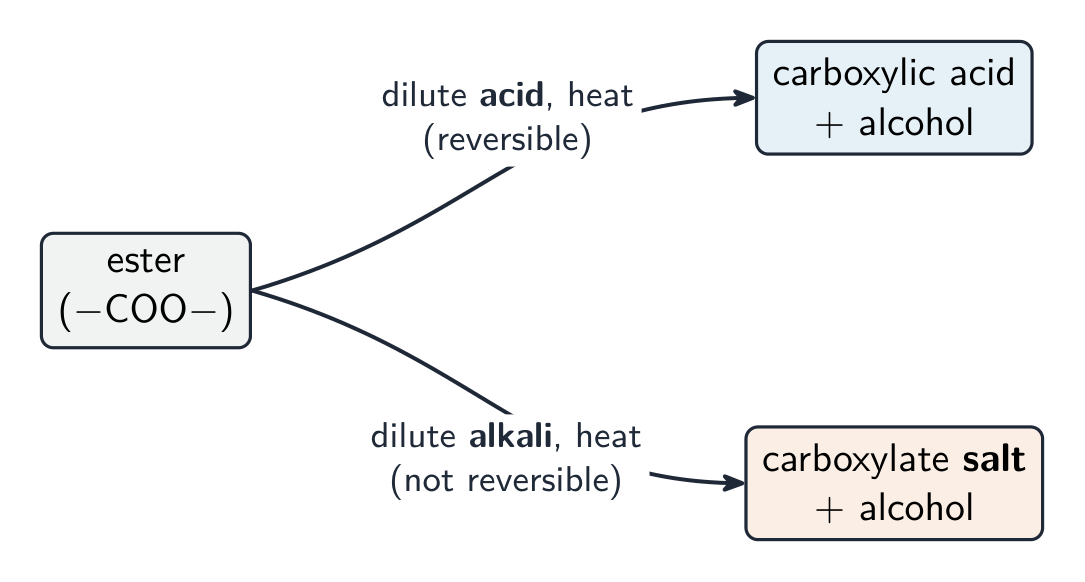
- recall the reactions by which carboxylic acids can be produced: (a) oxidation of primary alcohols and aldehydes with acidified $\text{K}_2\text{Cr}_2\text{O}_7$ or acidified $\text{KMnO}_4$ and refluxing (b) hydrolysis of nitriles with dilute acid or dilute alkali followed by acidification (c) hydrolysis of esters with dilute acid or dilute alkali and heat followed by acidification
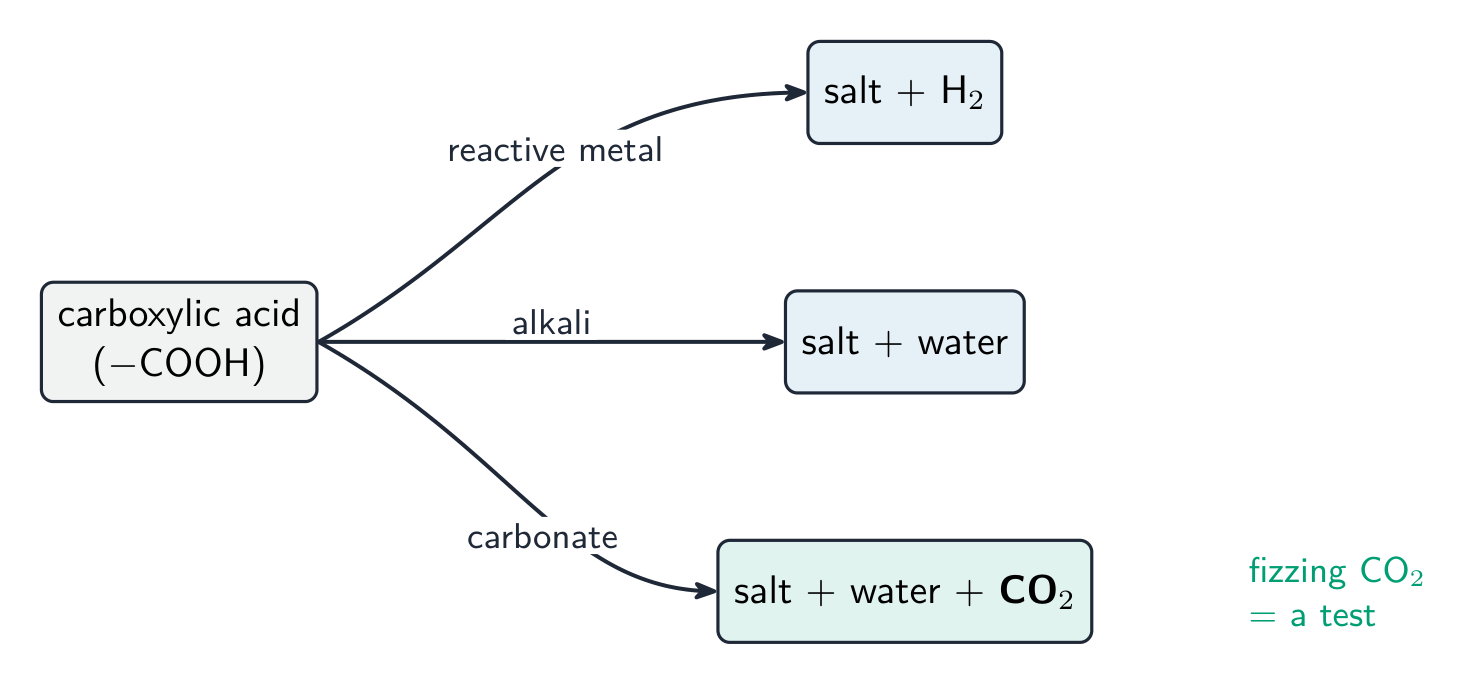
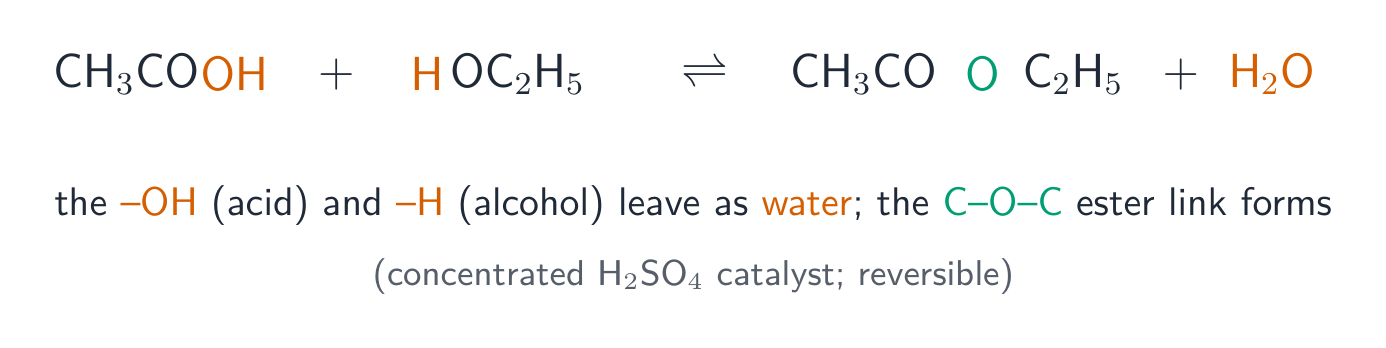
- describe: (a) the redox reaction with reactive metals to produce a salt and $\text{H}_2(\text{g})$ (b) the neutralisation reaction with alkalis to produce a salt and $\text{H}_2\text{O}(\text{l})$ (c) the acid–base reaction with carbonates to produce a salt and $\text{H}_2\text{O}(\text{l})$ and $\text{CO}_2(\text{g})$ (d) esterification with alcohols with concentrated $\text{H}_2\text{SO}_4$ as catalyst (e) reduction by $\text{LiAlH}_4$ to form a primary alcohol
עברית
- זכור את התגובות שבהן חומצות קרבוקסיליות יכולות להיות מופקות: (א) חמצון של אלכוהולים ראשוניים ואלדהידים עם $\text{K}_2\text{Cr}_2\text{O}_7$ מחומצת או $\text{KMnO}_4$ מחומצת ומחזיק (b) הידרוליזה של ניטרילים עם חומצה דלולה או בסיס דלול ולאחר מכן החמצה (c) הידרוליזה של אסטרים עם חומצה דלולה או בסיס דלול וחום ולאחר מכן החמצה
- תאר: (a) את תגובת האוקסידציה והחיזור עם מתכות רגישות כדי לייצר מלח ו$\text{H}_2(\text{g})$ (b) את תגובת הניטרול עם בסיסים כדי לייצר מלח ו$\text{H}_2\text{O}(\text{l})$ (ג) את תגובת החומצה-בסיס עם קربונטים כדי לייצר מלח ו$\text{H}_2\text{O}(\text{l})$ ו$\text{CO}_2(\text{g})$ (d) אסטריפיקציה עם אלכוהולים כאשר $\text{H}_2\text{SO}_4$ מרוכז משמש כקטליזטור (e) חיזור על ידי $\text{LiAlH}_4$ כדי ליצור אלכוהול ראשוני