| English | Français |
|---|---|
| rise/raɪz/ | monter |
| run/rʌn/ | run |
| gradient/ˈɡreɪdɪənt/ | pente |
The steepest street on Earth
- Baldwin Street in Dunedin, New Zealand, climbs 35 m for every 100 m along the ground.
- That ratio — rise 上升量 ÷ run 水平量 — is what mathematicians call the gradient 斜率.
- A single number tells you exactly how steep something is, whether it's a street, a roof, or a line on a graph.
La rue la plus pentue de la Terre
- Baldwin Street à Dunedin, en Nouvelle-Zélande, monte de 35 m pour chaque 100 m parcourus sur le sol.
- Ce rapport — montée ÷ course — est ce que les mathématiciens appellent la pente.
- Un seul nombre vous indique exactement à quel point quelque chose est pentu, que ce soit une rue, un toit ou une ligne sur un graphe.
What gradient measures
- The gradient $m$ tells you two things about a straight line:
- How steep it is (larger absolute gradient = steeper).
- Which direction it goes (positive = up to the right, negative = down to the right).
- A gradient of $0$ means the line is perfectly horizontal — no rise at all.
A steep alpine pass: gradient measures steepness as rise over run
Ce que mesure la pente
- La pente $m$ vous dit deux choses sur une droite :
- Sa pente (plus grande valeur absolue de pente = plus raide).
- Dans quelle direction elle va (positif = vers le haut à droite, négatif = vers le bas à droite).
- Une pente de $0$ signifie que la droite est parfaitement horizontale — aucune montée du tout.

Un col alpin pentu : la pente mesure la raideur par rapport à la course
Gradient
y = ax + b
The · Le gradient a measures steepness — rise over run. · Le gradient a mesure la raideur — élévation sur course.
A line that goes down as you move to the right has a gradient that is: · Une ligne qui descend quand on se déplace vers la droite a un gradient qui est :
Falling to the right means the change in y is negative for a positive change in x, so the gradient is negative. · Descendre vers la droite signifie que le changement en y est négatif pour un changement positif en x, donc le gradient est négatif.
The gradient of a horizontal line is 0. · Le gradient d'une ligne horizontale est 0.
A horizontal line has no vertical change (rise = 0), so m = 0/run = 0. · Une ligne horizontale n'a aucun changement vertical (élévation = 0), donc m = 0/course = 0.
Gradient from a grid; coordinates in Extended
- Pick any two points on the line, $(x_1, y_1)$ and $(x_2, y_2)$:
- The rise is the vertical gap between the points; the run is the horizontal gap.
The gradient triangle: count the squares up (rise) and across (run), then divide.
Pente sur grille ; coordonnées dans l'étendu
- Choisissez deux points quelconques sur la droite, $(x_1, y_1)$ et $(x_2, y_2)$ :
- La montée est l'écart vertical entre les points ; la course est l'écart horizontal.
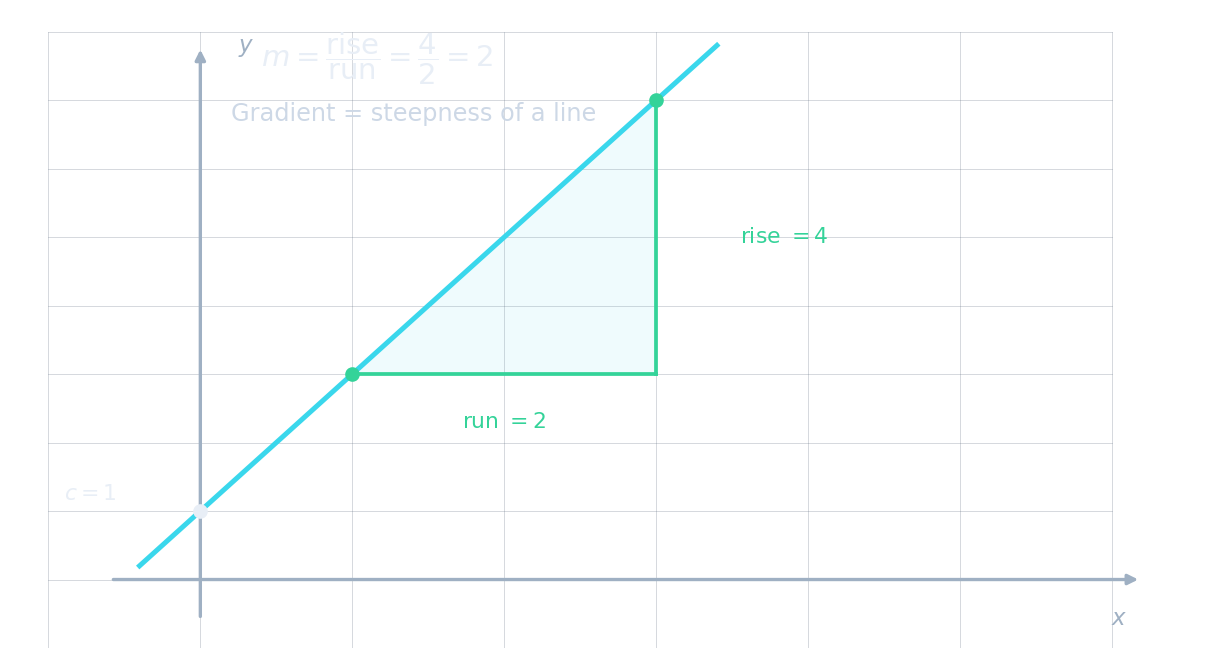
Le triangle de pente : comptez les carrés vers le haut (élévation) et vers la droite (progression), puis divisez.
Complete the formula: m = (y₂ − y₁) / (? − x₁). · Complétez la formule : m = (y₂ − y₁) / (? − x₁).
The full formula is m = (y₂ − y₁) / (x₂ − x₁). The denominator is the change in x, which is x₂ − x₁. · La formule complète est m = (y₂ − y₁) / (x₂ − x₁). Le dénominateur est le changement en x, soit x₂ − x₁.
Worked example
- Find the gradient of the line through $(1, 2)$ and $(4, 11)$.
- Rise $= 11 - 2 = 9$; run $= 4 - 1 = 3$.
- $m = \dfrac{9}{3} = 3$.
- The line climbs $3$ units up for every $1$ unit across — quite steep.
Quick check. Through $(0, 1)$ and $(2, 7)$: rise $= 7 - 1 = 6$, run $= 2 - 0 = 2$, so $m = \dfrac{6}{2} = 3$. Same gradient, same steepness — different line.
Exemple résolu
- Trouvez la pente de la droite passant par $(1, 2)$ et $(4, 11)$.
- Élévation $= 11 - 2 = 9$ ; progression $= 4 - 1 = 3$.
- $m = \dfrac{9}{3} = 3$.
- La droite monte $3$ unités pour chaque $1$ unité vers la droite — assez raide.
Vérification rapide. Par $(0, 1)$ et $(2, 7)$ : élévation $= 7 - 1 = 6$, progression $= 2 - 0 = 2$, donc $m = \dfrac{6}{2} = 3$. Même pente, même inclinaison — droite différente.
Find the gradient of the line through (1, 2) and (4, 11). · Trouvez le gradient de la droite passant par (1, 2) et (4, 11).
(11 − 2)/(4 − 1) = 9/3 = 3.
Find the gradient of the line through (0, 1) and (2, 7). · Trouvez le gradient de la droite passant par (0, 1) et (2, 7).
(7 − 1)/(2 − 0) = 6/2 = 3.
The subtraction trap
- You must subtract in the same order for both coordinates:
- $(y_2 - y_1)$ paired with $(x_2 - x_1)$, or $(y_1 - y_2)$ paired with $(x_1 - x_2)$.
- Mixing the order flips the sign and gives the wrong gradient.
Common mistake. Through $(1, 2)$ and $(4, 11)$: if you write $\dfrac{11 - 2}{1 - 4} = \dfrac{9}{-3} = -3$ you mixed the order — you took $y_2 - y_1$ on top but $x_1 - x_2$ on the bottom. Pick one point to be "first" and stick with it.
Le piège de la soustraction
- Vous devez soustraire dans le même ordre pour les deux coordonnées :
- $(y_2 - y_1)$ apparié avec $(x_2 - x_1)$, ou $(y_1 - y_2)$ apparié avec $(x_1 - x_2)$.
- Mélanger l'ordre inverse le signe et donne la mauvaise pente.
Erreur fréquente. Par $(1, 2)$ et $(4, 11)$ : si vous écrivez $\dfrac{11 - 2}{1 - 4} = \dfrac{9}{-3} = -3$, vous avez mélangé l'ordre — vous avez pris $y_2 - y_1$ au numérateur mais $x_1 - x_2$ au dénominateur. Choisissez un point comme étant "premier" et restez-y.
Gradient in the real world
- Road signs show gradient as a percentage: a 10% hill rises 10 m for every 100 m along.
- Wheelchair ramps must have a gradient of at most $\dfrac{1}{12}$ (about 8%) — that's building code in many countries.
- Roof pitch is a gradient too — steeper roofs shed rain faster.
La pente dans la vie réelle
- Les panneaux routiers affichent la pente en pourcentage : une colline à 10 % s'élève de 10 m pour chaque 100 m parcourus horizontalement.
- Les pentes d'accès pour fauteuils roulants doivent avoir une pente d'au plus $\dfrac{1}{12}$ (environ 8 %) — c'est la norme de construction dans de nombreux pays.
- L'inclinaison du toit est aussi une pente — les toits plus raides évacuent mieux la pluie.
Match each description to the correct gradient property. · Reliez chaque description à la propriété de gradient correcte.
Positive = rising rightward; zero = flat; negative = falling rightward; a larger magnitude means a steeper slope. · Positif = montant vers la droite ; nul = plat ; négatif = descendant vers la droite ; une plus grande magnitude signifie une pente plus raide.
You've got it
- gradient $m = \dfrac{\text{rise}}{\text{run}} = \dfrac{y_2 - y_1}{x_2 - x_1}$
- positive gradient → line goes up to the right; negative → down to the right; zero → horizontal
- subtract in the same order for both coordinates — mixing up the order flips the sign
- through $(1,2)$ and $(4,11)$: $m = \dfrac{9}{3} = 3$
Vous avez compris
- pente $m = \dfrac{\text{rise}}{\text{run}} = \dfrac{y_2 - y_1}{x_2 - x_1}$
- pente positive → la droite monte vers la droite ; négative → descend vers la droite ; nulle → horizontale
- soustraire dans le même ordre pour les deux coordonnées — mélanger l'ordre inverse le signe
- par $(1,2)$ et $(4,11)$ : $m = \dfrac{9}{3} = 3$