Gametes, fertilisation and pregnancy · Gamètes, fécondation et grossesse
| English | Français |
|---|---|
| embryo/ˈembrɪəʊ/ | embryon |
| implants/ˈɪmplænts/ | implants |
| placenta/pləˈsentə/ | placenta |
From gametes to a baby
- A new human life begins when two tiny cells meet, and then grows protected inside the mother.
- The journey runs from gametes to fertilisation to pregnancy.
Des gamètes à un bébé
- Une nouvelle vie humaine commence lorsque deux petites cellules se rencontrent, puis elle grandit protégée à l'intérieur de la mère.
- Le parcours va des gamètes à la fécondation puis à la grossesse.
Fertilisation to pregnancy · De la fécondation à la grossesse
Follow the route from gametes to implantation. · Suivez le trajet des gamètes jusqu'à l'implantation.
Compared with the egg, the sperm cell is: · Par rapport à l'ovocyte, la cellule spermatique est :
Sperm are small and motile; eggs are large with food. · Les spermatozoïdes sont petits et mobiles ; les ovocytes sont grands avec des réserves.
Sperm and egg
- The sperm is small, has a tail to swim, and carries little food.
- The egg is much larger and contains a food store for the early embryo 胚胎.
The uterus lining thickens, an egg is released at day 14, and a period follows if there is no pregnancy
Spermatozoïde et ovocyte
- Le spermatozoïde est petit, possède une queue pour nager et contient peu de réserves alimentaires.
- L'ovocyte est beaucoup plus grand et contient une réserve alimentaire pour l'embryon précoce 胚胎.
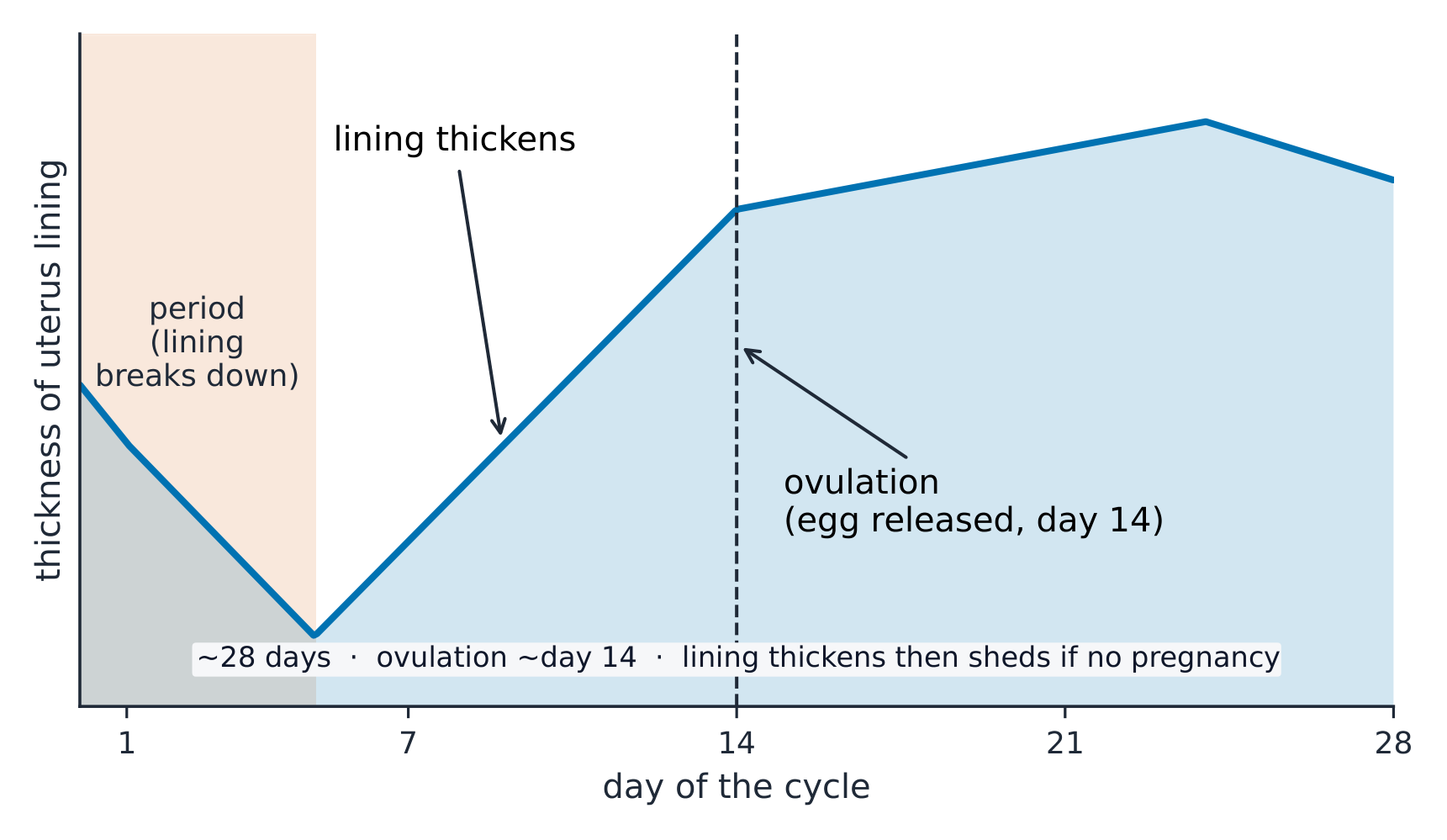
L'endomètre s'épaissit, un ovule est libéré au jour 14, et les règles suivent si aucune grossesse n'a lieu
Put these stages of early development in order. · Mettez ces étapes du développement précoce dans l'ordre.
Gametes fuse → zygote → embryo → implantation. · Gamètes fusionnent → zygote → embryon → implantation.
The embryo settles into the lining of the uterus in a process called ______. · L'embryon s'installe dans la paroi utérine dans un processus appelé ______.
Implantation begins pregnancy. · L'implantation commence la grossesse.
Fertilisation and implantation
- A sperm fuses with the egg → a zygote, which divides to form an embryo.
- The embryo implants 植入 in the lining of the uterus and continues to grow.
Fécondation et implantation
- Un spermatozoïde fusionne avec l'ovule → un zygote, qui se divise pour former un embryon.
- L'embryon s'implante 植入 dans la muqueuse utérine et continue de croître.
The placenta allows the baby to receive: · Le placenta permet au bébé de recevoir :
Oxygen and nutrients diffuse across; waste passes back. · L'oxygène et les nutriments diffusent à travers ; les déchets repassent.
In the placenta, the mother's and baby's blood flow close but do not mix. · Dans le placenta, le sang de la mère et celui du bébé circulent près mais ne se mélangent pas.
Substances pass by diffusion across a barrier. · Les substances passent par diffusion à travers une barrière.
The placenta 胎盘
- The placenta exchanges substances between the mother's blood and the baby's.
- Oxygen and nutrients pass to the baby; carbon dioxide and waste pass back — by diffusion.
The fetus develops in the uterus, joined to the placenta by the umbilical cord
The mother's and baby's blood don't mix. They flow close together in the placenta, but substances pass by diffusion across a barrier. Mixing would be dangerous because their blood types may differ.
Le placenta 胎盘
- Le placenta échange des substances entre le sang de la mère et celui du bébé.
- L'oxygène et les nutriments passent au bébé ; le dioxyde de carbone et les déchets repassent — par diffusion.
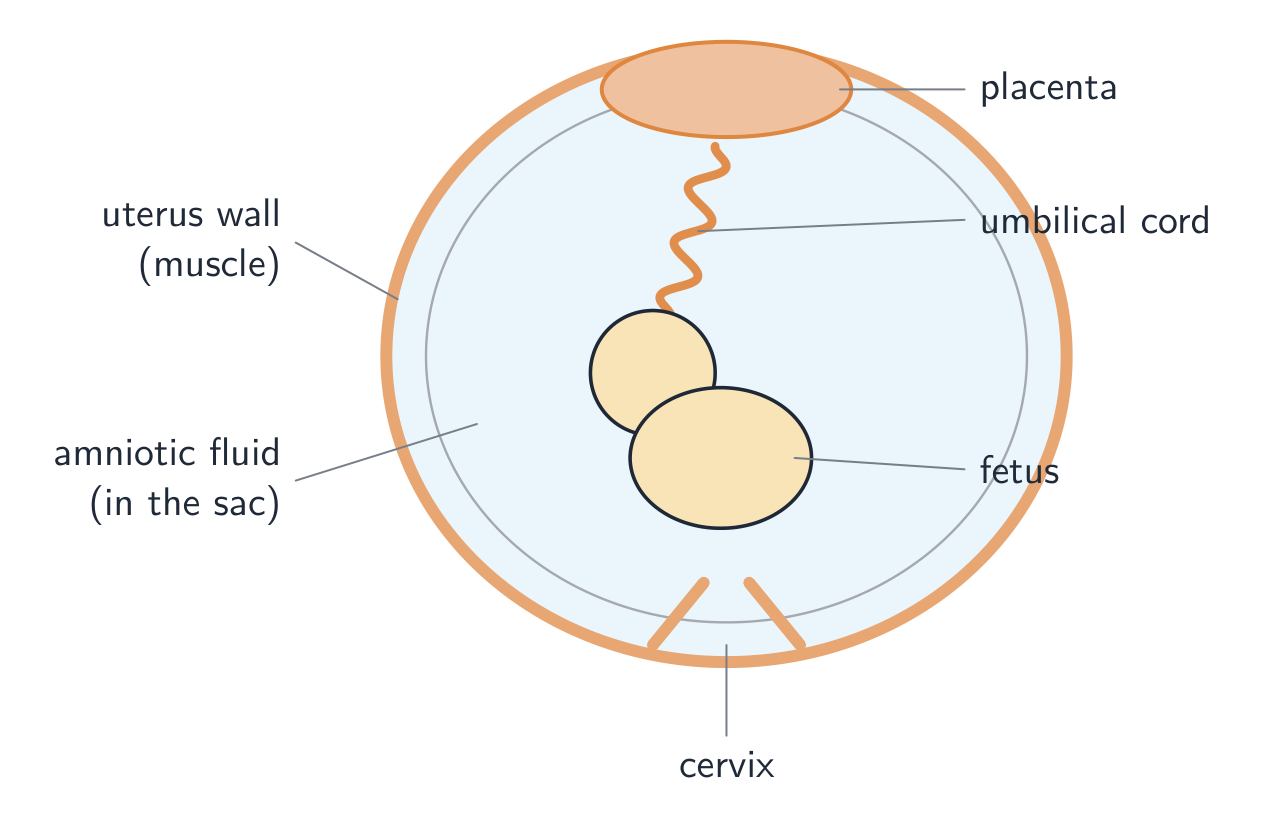
Le fœtus se développe dans l'utérus, relié au placenta par le cordon ombilical
Le sang de la mère et celui du bébé ne se mélangent pas. Ils circulent à proximité dans le placenta, mais les substances passent par diffusion à travers une barrière. Un mélange serait dangereux car leurs groupes sanguins peuvent différer.
You've got it
- the sperm is small with a tail; the egg is large with a food store
- fertilisation → zygote → embryo, which implants in the uterus
- the placenta exchanges oxygen/nutrients and waste by diffusion (blood doesn't mix)
Vous avez compris
- le spermatozoïde est petit avec une queue ; l'ovocyte est grand avec une réserve alimentaire
- fécondation → zygote → embryon, qui s'implante dans l'utérus
- le placenta échange oxygène/nutriments et déchets par diffusion (le sang ne se mélange pas)