Resistor-Capacitor (RC) Circuits · Circuits Résistance-Condensateur (RC)
| English | Français |
|---|---|
| time constant/taɪm ˈkɒnstənt/ | constante de temps |
| exponential/ˌekspəˈnenʃl/ | exponentielle |
Why does a camera flash take a moment to recharge?
- Press the shutter, and the flash needs a second before it can fire again.
- A capacitor is refilling with charge through a resistor.
- The resistor limits the current, so the filling is gradual, not instant.
- A resistor and capacitor together make an RC circuit — the physics of timing.
Pourquoi l'éclair d'un appareil photo met-il du temps à se recharger ?
- Appuyez sur le déclencheur, et l'éclair a besoin d'un moment avant de pouvoir tirer à nouveau.
- Un condensateur se recharge avec de la charge à travers une résistance.
- La résistance limite le courant, donc le remplissage est progressif, pas instantané.
- Une résistance et un condensateur forment ensemble un circuit RC — la physique du temporisation.
Charging rises toward a limit
- Close the switch and charge flows onto the capacitor: $Q(t) = CV\left(1 - e^{-t/RC}\right)$.
- It climbs fast at first, then slows as the capacitor fills.
- It approaches, but never quite reaches, the final charge $CV$.
- The current does the opposite: large at first, fading to zero.
La charge augmente vers une limite
- Fermez l'interrupteur et la charge circule vers le condensateur : $Q(t) = CV\left(1 - e^{-t/RC}\right)$.
- Elle monte vite au début, puis ralentit alors que le condensateur se remplit.
- Elle approche, mais n'atteint jamais tout à fait la charge finale $CV$.
- Le courant fait l'inverse : grand au départ, s'estompant vers zéro.
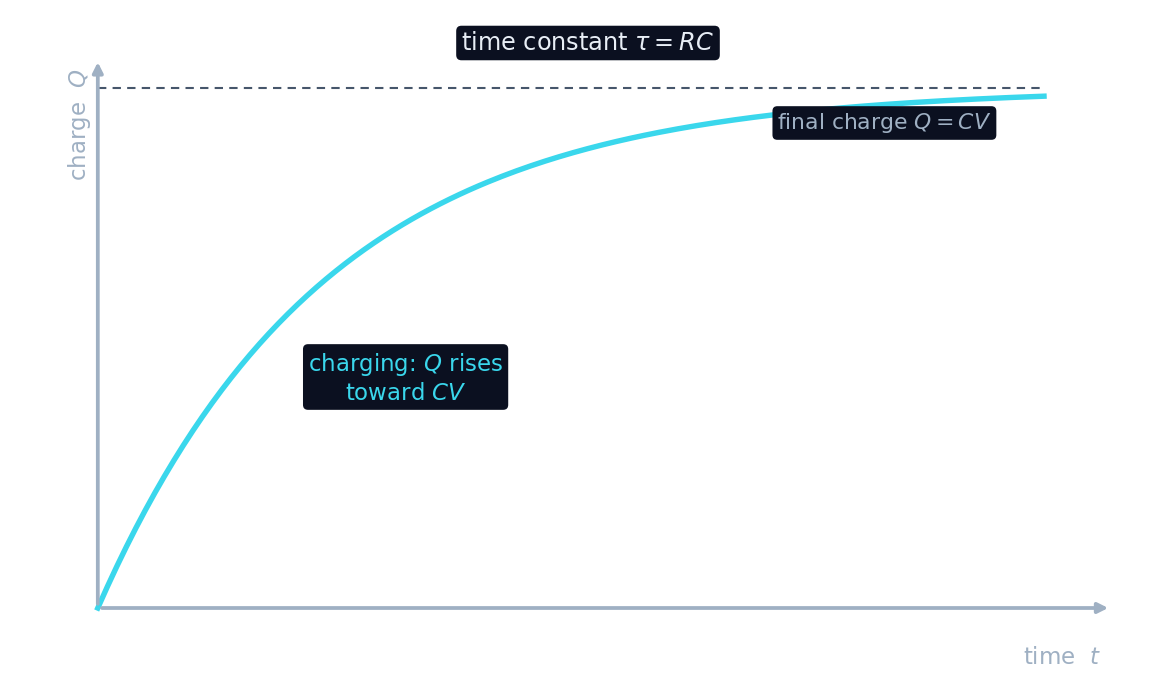
Charge through a resistor · Charge traversant une résistance
Watch the capacitor fill gradually and the charging current fade toward zero. · Observez le condensateur se charger progressivement et le courant de charge décroître vers zéro.
The time constant τ = RC
- The product $\tau = RC$ is the time constant 时间常数 — the natural timescale.
- In one $\tau$, the charge reaches about $63\%$ of its final value.
- After about $5\tau$, it is essentially fully charged.
- Bigger $R$ or bigger $C$ means slower charging.
La constante de temps τ = RC
- Le produit $\tau = RC$ est la constante de temps 时间常数 — l'échelle de temps naturelle.
- En un $\tau$, la charge atteint environ $63\%$ de sa valeur finale.
- Après environ $5\tau$, elle est essentiellement entièrement chargée.
- Une plus grande $R$ ou une plus grande $C$ signifie une recharge plus lente.
The time constant of an RC circuit is: · La constante de temps d'un circuit RC est :
$\tau = RC$ sets the charging and discharging timescale. · $\tau = RC$ définit l'échelle de temps de charge et de décharge.
A $5\ \Omega$ resistor charges a $4\ \text{F}$ capacitor. Find $\tau$ (in s). · Une résistance $5\ \Omega$ charge un condensateur $4\ \text{F}$. Trouver $\tau$ (en s).
$\tau = RC = 5 \times 4 = 20\ \text{s}$.
After one time constant, the charge reaches about 63% of its final value. · Après une constante de temps, la charge atteint environ 63 % de sa valeur finale.
$1 - e^{-1} \approx 0.63$ after one $\tau$. · $1 - e^{-1} \approx 0.63$ après une $\tau$.
Discharging fades away
- Disconnect the source and let the capacitor drive the resistor.
- The charge decays: $Q(t) = Q_0\, e^{-t/RC}$ — an exponential 指数 fall.
- The current and voltage decay with the same time constant $\tau = RC$.
- Each $\tau$ the charge drops to about $37\%$ of what it was.
La décharge s'estompe
- Déconnectez la source et laissez le condensateur alimenter la résistance.
- La charge décroît : $Q(t) = Q_0\, e^{-t/RC}$ — une chute exponentielle 指数.
- Le courant et la tension décroissent avec la même constante de temps $\tau = RC$.
- Chaque $\tau$, la charge tombe à environ $37\%$ de sa valeur précédente.
A discharging capacitor loses charge as an ____ decay, $Q = Q_0 e^{-t/RC}$. · Un condensateur en décharge perd sa charge selon une décroissance ____ , $Q = Q_0 e^{-t/RC}$.
Discharge is exponential: $Q = Q_0 e^{-t/RC}$. · La décharge est exponentielle : $Q = Q_0 e^{-t/RC}$.
The capacitor's two extremes
- At the first instant ($t = 0$): the empty capacitor acts like a plain wire.
- After a long time ($t \to \infty$): the full capacitor acts like an open gap.
- So current starts high and ends at zero as the capacitor fills.
- Those two limits let you check any RC answer quickly.
Les deux extrêmes du condensateur
- Au premier instant ($t = 0$) : le condensateur vide agit comme un simple fil.
- Après un long moment ($t \to \infty$) : le condensateur plein agit comme une rupture (circuite ouverte).
- Le courant commence fort et s'annule lorsque le condensateur se remplit.
- Ces deux limites permettent de vérifier rapidement n'importe quelle réponse RC.
At the first instant of charging ($t = 0$), an uncharged capacitor acts like: · Au premier instant de la charge ($t = 0$), un condensateur non chargé se comporte comme :
Empty, it offers no back-voltage, so it behaves like a wire (max current). · Vide, il ne présente aucune tension opposée, donc il se comporte comme un fil (courant max).
Select all · tout true statements about RC circuits. · Sélectionnez tous les énoncés vrais concernant les circuits RC.
Exponential charging, τ = RC, open gap when full. Charging is gradual, never instant. · Charge exponentielle, τ = RC, ouverture lorsqu'il est plein. La charge est progressive, jamais instantanée.
A $2\ \Omega$ resistor charges a $3\ \text{F}$ capacitor. Find the time constant.
- $\tau = RC = 2 \times 3 = 6\ \text{s}$.
- After $6\ \text{s}$ the charge is about $63\%$ of its final value.
Une résistance $2\ \Omega$ charge un condensateur $3\ \text{F}$. Trouvez la constante de temps.
- $\tau = RC = 2 \times 3 = 6\ \text{s}$.
- Après $6\ \text{s}$, la charge est d'environ $63\%$ de sa valeur finale.
At $t = 0$ an uncharged capacitor behaves like a wire (max current), and at $t \to \infty$ a charged one behaves like an open gap (zero current). Swapping these two limits is the classic RC mistake — check which instant the question asks about.
En $t = 0$, un condensateur non chargé se comporte comme un fil (courant max), et en $t \to \infty$, un condensateur chargé se comporte comme une rupture (courant nul). Inverser ces deux limites est l'erreur classique RC — vérifiez quel instant la question demande.
In an RC circuit, charging follows $Q = CV(1 - e^{-t/RC})$ and discharging $Q = Q_0 e^{-t/RC}$, both with time constant $\tau = RC$ (about $63\%$ per $\tau$). A capacitor starts like a wire ($t=0$) and ends like an open gap ($t\to\infty$).
Dans un circuit RC, la charge suit $Q = CV(1 - e^{-t/RC})$ et la décharge $Q = Q_0 e^{-t/RC}$, tous deux avec une constante de temps $\tau = RC$ (environ $63\%$ par $\tau$). Un condensateur commence comme un fil ($t=0$) et se termine comme une ouverture ($t\to\infty$).