Simple harmonic motion · Mouvement harmonique simple
| English | Français |
|---|---|
| simple harmonic motion/ˈsɪmpl hɑːˈmɒnɪk ˈməʊʃn/ | mouvement harmonique simple |
| displacement/dɪˈspleɪsmənt/ | déplacement |
| equilibrium/ˌiːkwɪˈlɪbrɪəm/ | équilibre |
| amplitude/ˈæmplɪtjuːd/ | amplitude |
| period/ˈpɪərɪəd/ | période |
| frequency/ˈfriːkwənsi/ | fréquence |
| angular frequency/ˈæŋɡjʊlə ˈfriːkwənsi/ | frquence angulaire |
The lamp that taught the world to keep time
- In 1583 a student in Pisa cathedral, bored during a sermon, timed a swinging lamp against his own pulse. Whether the lamp swung wide or narrow, each swing took the same time.
- That is not obvious and it is not true of most motions. It is true whenever the restoring force grows in proportion to how far the thing has been displaced, and that one condition defines the whole topic.
- Galileo's observation became the pendulum clock, and every clock for the next 300 years.
- This lesson is simple harmonic motion 简谐运动: its defining equation, the words that describe it, and how to read $\omega$ off a graph.
La lampe qui a appris au monde à garder le temps
- En 1583, un étudiant dans la cathédrale de Pise, ennuyé pendant un sermon, a chronométré une lampe oscillante contre son propre pouls. Que la lampe oscille largement ou étroitement, chaque oscillation prenait le même temps.
- Ce n'est pas évident et ce n'est vrai pour la plupart des mouvements. C'est vrai chaque fois que la force de rappel croît en proportion à la distance dont l'objet a été déplacé, et cette seule condition définit tout le sujet.
- L'observation de Galileo est devenue l'horloge à pendule, et chaque horloge pendant les 300 prochaines années.
- Cette leçon est le mouvement harmonique simple 简谐运动 : son équation définissante, les mots qui le décrivent, et comment lire $\omega$ sur un graphique.
The definition
- A body moves with simple harmonic motion when its acceleration is proportional to its displacement 位移 from a fixed point, and always directed towards that point.
- Both halves are needed for both marks. "Proportional to displacement" alone describes a force pushing it further away just as well.
- In symbols, with the minus sign carrying "towards the equilibrium position":
Displaced right, accelerating left; displaced left, accelerating right
La définition
- Un corps se meut avec un mouvement harmonique simple lorsque son accélération est proportionnelle à son déplacement 位移 depuis un point fixe, et toujours dirigée vers ce point.
- Les deux moitiés sont nécessaires pour les deux points. « Proportionnel au déplacement » seul décrit aussi bien une force qui le repousse davantage.
- En symboles, avec le signe moins portant « vers la position d'équilibre » :
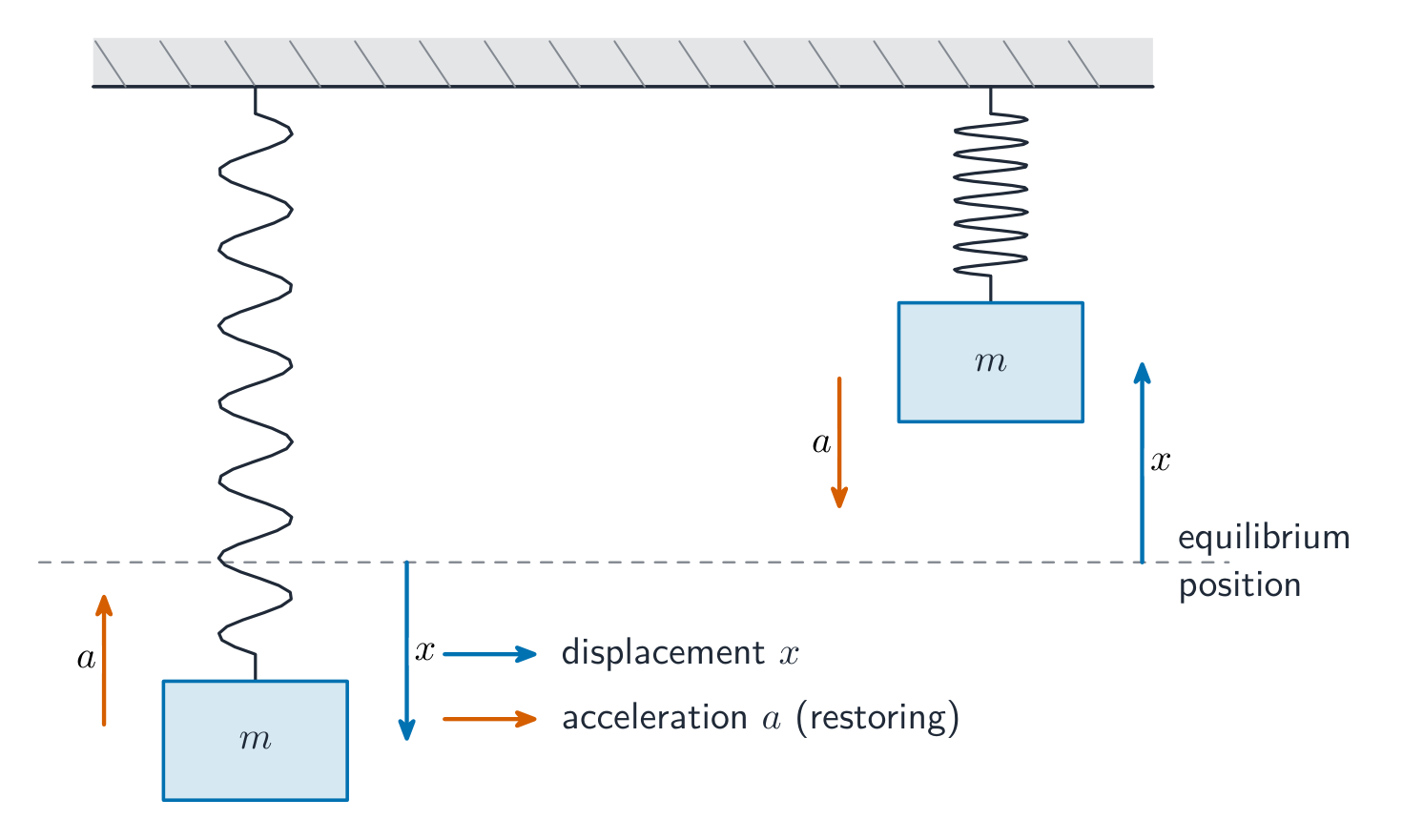
Déplacé à droite, accéléré vers la gauche ; déplacé à gauche, accéléré vers la droite
In simple harmonic motion, the acceleration is: · Dans le mouvement harmonique simple, l'accélération est :
That is exactly $a = -\omega^{2}x$ — bigger displacement, bigger pull back; always toward the middle. · C'est exactement $a = -\omega^{2}x$ — plus grand est le déplacement, plus forte est la force de rappel ; toujours vers le centre.
A full definition of simple harmonic motion needs which statements? Select all · tout that apply. · Quelles affirmations sont nécessaires pour une définition complète du mouvement harmonique simple ? Cochez toutes les réponses.
Those two statements are the definition and carry both marks. The constant period is a consequence of them, and the speed is certainly not constant. · Ces deux affirmations constituent la définition et valent les deux points. La période constante en est une conséquence, et la vitesse n'est certainement pas constante.
The vocabulary
- Displacement $x$: distance from the equilibrium 平衡 position, with a direction. Amplitude 振幅 $x_0$: the maximum displacement.
- Period 周期 $T$: the time for one complete oscillation. Frequency 频率 $f = 1/T$: oscillations per second, in hertz.
- Angular frequency 角频率 $\omega$: connects the two, $\omega = \dfrac{2\pi}{T} = 2\pi f$. Given any one of $\omega$, $f$ and $T$ you can find the others, and most questions start by doing exactly that.
Le vocabulaire
- Déplacement $x$ : distance depuis la position d'équilibre 平衡, avec une direction. Amplitude 振幅 $x_0$ : le déplacement maximum.
- Période 周期 $T$ : le temps pour une oscillation complète. Fréquence 频率 $f = 1/T$ : oscillations par seconde, en hertz.
- Fréquence angulaire 角频率 $\omega$ : relie les deux, $\omega = \dfrac{2\pi}{T} = 2\pi f$. Connaissant l'une quelconque de $\omega$, $f$ et $T$, vous pouvez trouver les autres, et la plupart des questions commencent par faire exactement cela.
Swing a pendulum · Balancer un pendule
Set it swinging, then change the start angle — the time for one swing stays the same (that is what makes it a good clock). Now make the string longer, or move to the Moon, and watch the period change. · Lancez-le en balancement, puis changez l'angle de départ — le temps pour un balancement reste identique (c'est ce qui en fait une bonne horloge). Maintenant, allongez la corde, ou déplacez-vous sur la Lune, et regardez la période changer.
An oscillation has a period of $2.0\ \text{s}$. What is its angular frequency $\omega$? · Une oscillation a une période de $2.0\ \text{s}$. Quelle est sa pulsation $\omega$ ?
$\omega = \dfrac{2\pi}{T} = \dfrac{2\pi}{2.0} = \pi \approx 3.14\ \dfrac{\text{rad}}{\text{s}}$.
Displacement with time
- Starting from the equilibrium position at $t = 0$: $x = x_0 \sin(\omega t)$. Starting from an extreme: $x = x_0 \cos(\omega t)$.
- Which you use depends only on where the motion starts. Read the question's opening condition before choosing.
- The graph is a sine curve of amplitude $x_0$ and period $T$, and the motion repeats exactly.
One period, one full cycle, and then the same again
Déplacement avec le temps
- Partant de la position d'équilibre à $t = 0$ : $x = x_0 \sin(\omega t)$. Partant d'une extrémité : $x = x_0 \cos(\omega t)$.
- Lequel utiliser dépend uniquement de là où commence le mouvement. Lisez la condition initiale de la question avant de choisir.
- Le graphique est une courbe sinusoïdale d'amplitude $x_0$ et de période $T$, et le mouvement se répète exactement.
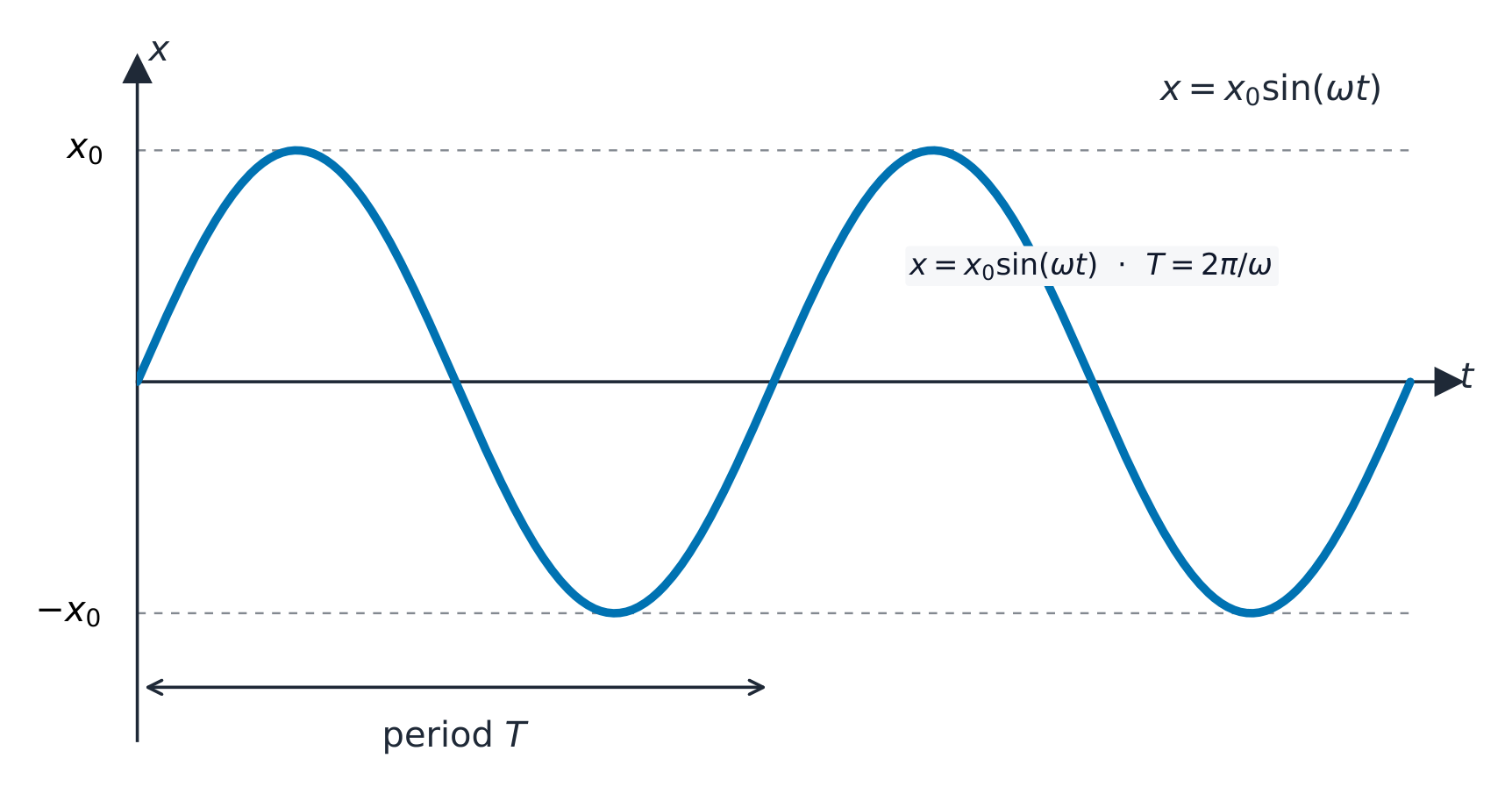
Une période, un cycle complet, puis le même encore
Speed anywhere in the motion
- The speed at displacement $x$, without needing the time:
- At the centre, $x = 0$, this gives the maximum speed $v_{\text{max}} = \omega x_0$. At the extremes, $x = \pm x_0$, it gives zero.
- That is the pattern to hold on to: fastest in the middle, momentarily at rest at each end, and the acceleration is the other way round, zero in the middle and greatest at the ends.
Vitesse n'importe où dans le mouvement
- La vitesse à un déplacement $x$, sans avoir besoin du temps :
- Au centre, $x = 0$, cela donne la vitesse maximale $v_{\text{max}} = \omega x_0$. Aux extrémités, $x = \pm x_0$, cela donne zéro.
- C'est le motif à retenir : le plus vite au milieu, momentanément au repos à chaque extrémité, et l'accélération est à l'opposé, zéro au milieu et maximale aux extrémités.
In SHM the speed is greatest at the ____ position. · En MHS, la vitesse est maximale à la position ____.
At the middle all the energy is kinetic, so the speed is maximum ($v = \omega x_0$). · Au centre, toute l'énergie est cinétique, donc la vitesse est maximale ($v = \omega x_0$).
At the extremes of the motion ($x = \pm x_0$), the speed is zero. · Aux extrémités du mouvement ($x = \pm x_0$), la vitesse est nulle.
The oscillator stops for an instant at each end before reversing — speed zero, acceleration maximum. · L'oscillateur s'arrête un instant à chaque extrémité avant de changer de sens — vitesse nulle, accélération maximale.
An oscillator has amplitude $0.10\ \text{m}$ and · et $\omega = 10\ \dfrac{\text{rad}}{\text{s}}$. What is its maximum speed? · Un oscillateur a une amplitude $0.10\ \text{m}$ et une $\omega = 10\ \dfrac{\text{rad}}{\text{s}}$. Quelle est sa vitesse maximale ?
Maximum speed $= \omega x_0 = 10 \times 0.10 = 1.0\ \dfrac{\text{m}}{\text{s}}$. · Vitesse maximale $= \omega x_0 = 10 \times 0.10 = 1.0\ \dfrac{\text{m}}{\text{s}}$.
Match each quantity to where in the oscillation it is greatest. · Reliez chaque grandeur à l'endroit où elle est maximale dans l'oscillation.
Speed and acceleration peak at opposite places, and they are never both maximum at the same instant. · La vitesse et l'accélération atteignent leur maximum à des endroits opposés et ne sont jamais toutes deux maximales au même instant.
Worked example: from period to maximum speed
- A mass oscillates with a period of $2.0\ \text{s}$ and an amplitude of $0.10\ \text{m}$. Find its maximum speed and its maximum acceleration.
- First $\omega$: $\omega = \dfrac{2\pi}{T} = \dfrac{2\pi}{2.0} = 3.14\ \text{rad/s}$. Almost every SHM question begins here.
- Maximum speed, at the centre: $v_{\text{max}} = \omega x_0 = 3.14 \times 0.10 = 0.31\ \text{m/s}$.
- Maximum acceleration, at the extremes: $a_{\text{max}} = \omega^2 x_0 = 3.14^2 \times 0.10 = 0.99\ \text{m/s}^2$.
- Note where each maximum occurs. A question asking "at what displacement" wants the centre for speed and the extremes for acceleration.
Exemple résolu : de la période à la vitesse maximale
- Une masse oscille avec une période de $2.0\ \text{s}$ et une amplitude de $0.10\ \text{m}$. Trouvez sa vitesse maximale et son accélération maximale.
- Premier $\omega$ : $\omega = \dfrac{2\pi}{T} = \dfrac{2\pi}{2.0} = 3.14\ \text{rad/s}$. Presque chaque question sur les OSS commence par là.
- Vitesse maximale, au centre : $v_{\text{max}} = \omega x_0 = 3.14 \times 0.10 = 0.31\ \text{m/s}$.
- Accélération maximale, aux extrémités : $a_{\text{max}} = \omega^2 x_0 = 3.14^2 \times 0.10 = 0.99\ \text{m/s}^2$.
- Notez où se produit chaque maximum. Une question demandant « à quel déplacement » attend le centre pour la vitesse et les extrémités pour l'accélération.
An oscillation has period 2.0 s and amplitude 0.10 m. What is its maximum speed in m/s? · Une oscillation a une période de 2.0 s et une amplitude de 0.10 m. Quelle est sa vitesse maximale en m/s ?
omega = 2 pi / T = 3.14 rad/s, and v_max = omega x0 = 0.31 m/s, which occurs at the centre. The maximum acceleration, at the ends, is omega squared times x0 = 0.99 m/s^2. · omega = 2 pi / T = 3.14 rad/s, et v_max = omega x0 = 0.31 m/s, ce qui se produit au centre. L'accélération maximale, aux extrémités, est omega au carré fois x0 = 0.99 m/s^2.
Reading the acceleration-displacement graph
- Because $a = -\omega^2 x$, a graph of acceleration against displacement is a straight line through the origin with a negative gradient.
- The gradient is $-\omega^2$, so $\omega = \sqrt{|\text{gradient}|}$ and then $T = 2\pi/\omega$.
- This is the standard way an exam gives you $\omega$ without stating it. A straight line through the origin with negative gradient is also the standard way of asking you to show that a motion is simple harmonic.
Straight, through the origin, negative: all three matter
Lire le graphique accélération-déplacement
- Comme $a = -\omega^2 x$, un graphique de l'accélération en fonction du déplacement est une droite passant par l'origine avec une pente négative.
- La pente est $-\omega^2$, donc $\omega = \sqrt{|\text{gradient}|}$ et ensuite $T = 2\pi/\omega$.
- C'est ainsi que les examens vous donnent généralement $\omega$ sans l'énoncer explicitement. Une droite passant par l'origine avec une pente négative est aussi la méthode standard pour vous demander de montrer qu'un mouvement est harmonique simple.
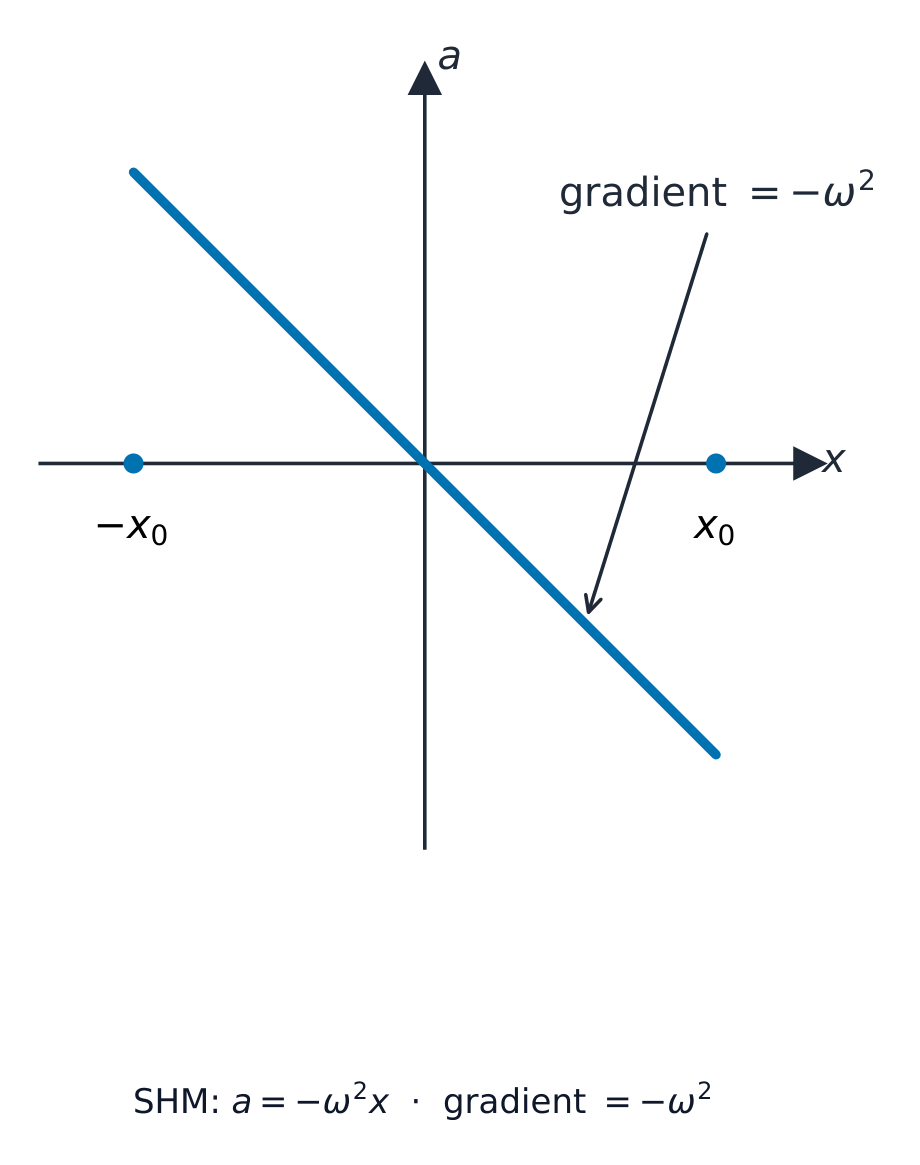
Droite, passant par l'origine, négative : les trois éléments comptent
On an acceleration-against-displacement graph for SHM, the gradient equals: · Sur un graphique de l'accélération en fonction du déplacement pour un MHS, la pente vaut :
$a = -\omega^{2}x$ is a straight line of gradient $-\omega^{2}$, so $\omega = \sqrt{|\text{gradient}|}$. · $a = -\omega^{2}x$ est une droite de pente $-\omega^{2}$, donc $\omega = \sqrt{|\text{gradient}|}$.
Worked example: is it simple harmonic?
- Measurements of a trolley's acceleration at various displacements give a straight line through the origin with gradient $-25\ \text{/s}^2$. Show that the motion is simple harmonic and find the period.
- The graph is a straight line, so $a \propto x$; it passes through the origin, so there is no constant term; and its gradient is negative, so the acceleration is directed towards the equilibrium position. Those three facts are the definition, so the motion is simple harmonic.
- The gradient is $-\omega^2 = -25$, so $\omega = 5.0\ \text{rad/s}$ and $T = \dfrac{2\pi}{5.0} = 1.3\ \text{s}$.
Exemple résolu : est-ce un mouvement harmonique simple ?
- Les mesures de l'accélération d'un chariot à divers déplacements donnent une droite passant par l'origine avec une pente de $-25\ \text{/s}^2$. Montrez que le mouvement est harmonique simple et trouvez la période.
- Le graphique est une droite, donc $a \propto x$ ; il passe par l'origine, donc il n'y a pas de terme constant ; et sa pente est négative, donc l'accélération est dirigée vers la position d'équilibre. Ces trois faits constituent la définition, donc le mouvement est harmonique simple.
- La pente est $-\omega^2 = -25$, donc $\omega = 5.0\ \text{rad/s}$ et $T = \dfrac{2\pi}{5.0} = 1.3\ \text{s}$.
An acceleration-displacement graph for an oscillator is a straight line through the origin of gradient -25 per second squared. What is the period, in seconds? · Un graphique accélération-déplacement pour un oscillateur est une droite passant par l'origine de pente -25 par seconde carrée. Quelle est la période, en secondes ?
The gradient is minus omega squared, so omega = 5.0 rad/s and T = 2 pi / 5.0 = 1.3 s. Straight, through the origin and negative is also the proof that the motion is simple harmonic. · La pente est moins omega carré, donc omega = 5.0 rad/s et T = 2 pi / 5.0 = 1.3 s. Droite passant par l'origine et négative constitue également la preuve que le mouvement est harmonique simple.
Marks that slip away
- The definition needs both halves: proportional to displacement and directed towards a fixed point. The minus sign is what carries the second.
- $\omega$ is in rad s$^{-1}$, not hertz. Convert with $\omega = 2\pi f$ before substituting.
- Speed is greatest at the centre; acceleration is greatest at the extremes. They are never both maximum at once.
- Choose sine or cosine from where the motion starts, not by habit.
Pièges qui font perdre des points
- La définition nécessite les deux moitiés : proportionnel au déplacement et dirigé vers un point fixe. Le signe moins porte cette deuxième condition.
- $\omega$ est en rad s$^{-1}$, pas en hertz. Convertissez avec $\omega = 2\pi f$ avant de substituer.
- La vitesse est maximale au centre ; l'accélération est maximale aux extrémités. Elles ne sont jamais toutes deux maximales en même temps.
- Choisissez sinus ou cosinus selon le point de départ du mouvement, pas par habitude.
You've got it
- SHM: acceleration proportional to displacement and directed towards a fixed point, so $a = -\omega^2 x$
- $\omega = \dfrac{2\pi}{T} = 2\pi f$, and almost every question starts by finding $\omega$
- $x = x_0\sin\omega t$ from the centre or $x_0\cos\omega t$ from an extreme; $v = \pm\omega\sqrt{x_0^2 - x^2}$, so $v_{\text{max}} = \omega x_0$ at the centre and $a_{\text{max}} = \omega^2 x_0$ at the ends
- an acceleration-displacement graph that is straight, through the origin and negative proves SHM, and its gradient is $-\omega^2$
Vous avez compris
- OSS : accélération proportionnelle au déplacement et dirigée vers un point fixe, donc $a = -\omega^2 x$
- $\omega = \dfrac{2\pi}{T} = 2\pi f$, et presque toutes les questions commencent par trouver $\omega$
- $x = x_0\sin\omega t$ au centre ou $x_0\cos\omega t$ depuis une extrémité ; $v = \pm\omega\sqrt{x_0^2 - x^2}$, donc $v_{\text{max}} = \omega x_0$ au centre et $a_{\text{max}} = \omega^2 x_0$ aux extrémités
- un graphique accélération-déplacement qui est droit, passe par l'origine et est négatif prouve l'OSS, et sa pente est $-\omega^2$