Polar coordinates · Coordonnées polaires
| English | Français |
|---|---|
| Cartesian/kɑːˈtiːzɪən/ | cartésien |
| polar coordinates/ˈpəʊlə kəʊˈɔːdɪnəts/ | coordonnées polaires |
| rotational symmetry/rəʊˈteɪʃənl ˈsɪmətri/ | symétrie rotationnelle |
| cardioid/ˈkɑːdɪəʊɪd/ | cardioïde |
| sector/ˈsektə/ | sectoriel |
The coordinate system that simplifies circles
- Describing a spiral or a circle in Cartesian 笛卡尔 coordinates requires messy equations. In polar coordinates 极坐标, a circle is just $r = \text{constant}$.
- Polar coordinates are natural for anything with rotational symmetry 旋转对称 — from planetary orbits to radar screens.
Le système de coordonnées qui simplifie les cercles
- Décrire une spirale ou un cercle en coordonnées cartésiennes 笛卡尔 nécessite des équations compliquées. En coordonnées polaires 极坐标, un cercle est simplement $r = \text{constant}$.
- Les coordonnées polaires sont naturelles pour tout ce qui a une symétrie de rotation 旋转对称 — des orbites planétaires aux écrans radar.
Polar coordinates
- Polar coordinates give a point by distance $r$ from the origin and angle $\theta$.
- Links to Cartesian:
Worked example. The point $(r, \theta) = (5, 60°)$ in Cartesian: $x = 5\cos 60° = 2.5$, $y = 5\sin 60° = 4.33$. So the point is $(2.5, 4.33)$.
Polar coordinates $(r,\theta)$ convert to Cartesian by $x=r\cos\theta$ and $y=r\sin\theta$
A spiral staircase: spirals are described naturally in polar coordinates (r, theta)
Coordonnées polaires
- Les coordonnées polaires donnent un point par distance $r$ à l'origine et angle $\theta$.
- Liens avec cartésiennes :
Exemple résolu. Le point $(r, \theta) = (5, 60°)$ en cartésien : $x = 5\cos 60° = 2.5$, $y = 5\sin 60° = 4.33$. Donc le point est $(2.5, 4.33)$.
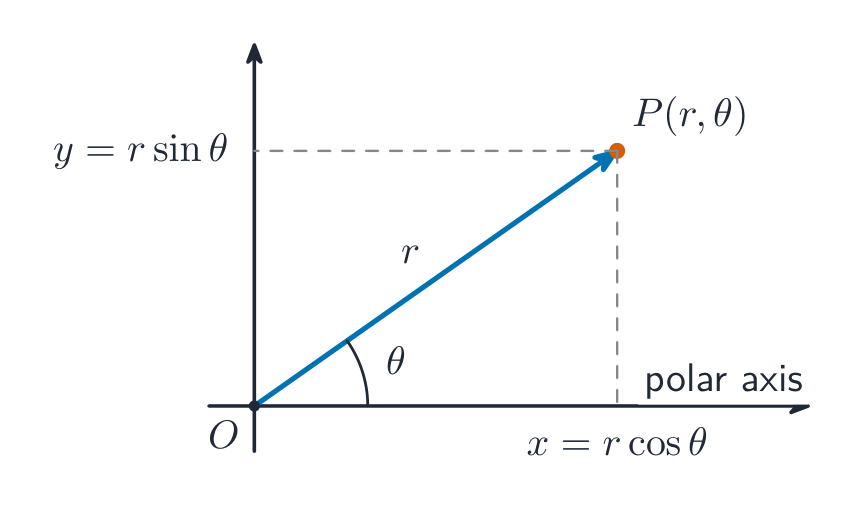
Les coordonnées polaires $(r,\theta)$ se convertissent en cartésiennes via $x=r\cos\theta$ et $y=r\sin\theta$

Un escalier en colimaçon : les spirales se décrivent naturellement en coordonnées polaires (r, theta)
Polar coordinates · Coordonnées polaires
r = f(θ)
In polar form a point is (r, θ). Beautiful curves — roses, cardioids, spirals — come from r = f(θ). · En forme polaire, un point est (r, θ). Des courbes magnifiques — roses, cardioides, spirales — proviennent de r = f(θ).
In polar coordinates, the x-coordinate is given by: · En coordonnées polaires, la coordonnée x est donnée par :
x = r cos θ and y = r sin θ. · x = r cos θ et y = r sin θ.
Convert (r, θ) = (5, 60°) to Cartesian. What is x = r cos 60°? · Convertir (r, θ) = (5, 60°) en cartésien. Quelle est x = r cos 60° ?
x = 5 cos 60° = 5 × 0.5 = 2.5.
For the point (3, 4) in Cartesian, r² = x² + y². Find r². · Pour le point (3, 4) en cartésien, r² = x² + y². Trouver r².
r² = 3² + 4² = 9 + 16 = 25.
Polar curves
- Common polar curves:
r = 4cos θ is a circle of radius 2 centred at (2, 0) — polar form makes it a one-line equation.
- $r = a$ — a circle of radius $a$ centred at the origin.
- $r = a\cos\theta$ — a circle of radius $\dfrac{a}{2}$ centred at $\left(\dfrac{a}{2}, 0\right)$.
- $r = a(1 + \cos\theta)$ — a cardioid 心脏线 (heart shape).
Courbes polaires
- Courbes polaires courantes :
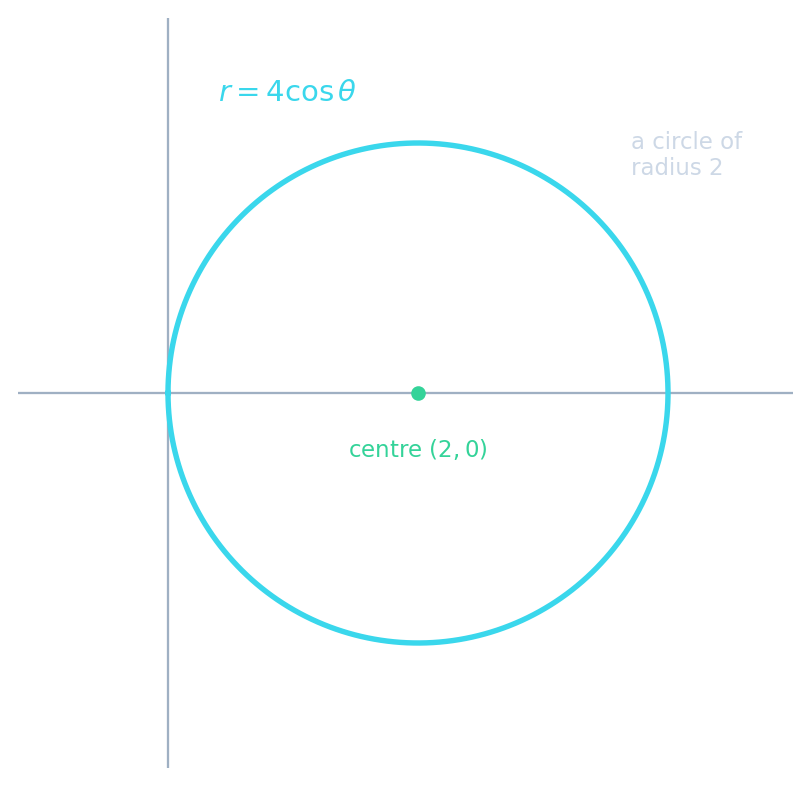
r = 4cos θ est un cercle de rayon 2 centré en (2, 0) — la forme polaire en fait une équation d'une seule ligne.
- $r = a$ — un cercle de rayon $a$ centré à l'origine.
- $r = a\cos\theta$ — un cercle de rayon $\dfrac{a}{2}$ centré en $\left(\dfrac{a}{2}, 0\right)$.
- $r = a(1 + \cos\theta)$ — une cardioïde 心脏线 (forme de cœur).
The polar curve r = 4cos θ is a circle. What is its radius? · La courbe polaire r = 4cos θ est un cercle. Quel est son rayon ?
r = 4cos θ gives x² + y² = 4x, i.e. (x−2)² + y² = 4 — a circle of radius 2. · r = 4cos θ donne x² + y² = 4x, soit (x−2)² + y² = 4 — un cercle de rayon 2.
The polar curve r = a(1 + cos θ) is called a: · La courbe polaire r = a(1 + cos θ) est appelée :
r = a(1 + cos θ) traces a heart-shaped curve called a cardioid. · r = a(1 + cos θ) trace une courbe en forme de cœur appelée cardioïde.
Polar area
- Sector 扇形 area: $\text{area} = \tfrac12\displaystyle\int_{\alpha}^{\beta} r^2\,d\theta$.
Don't forget the $\dfrac{1}{2}$. The polar area formula has a factor of $\dfrac{1}{2}$ that's easy to miss. It comes from the area of a thin triangular sector: $\dfrac{1}{2}r^2\,d\theta$.
A cardioid r = 1 + cos theta, a curve sketched directly in polar form
Aire polaire
- Aire de secteur 扇形 : $\text{area} = \tfrac12\displaystyle\int_{\alpha}^{\beta} r^2\,d\theta$.
N'oubliez pas le $\dfrac{1}{2}$. La formule d'aire polaire a un facteur de $\dfrac{1}{2}$ qui est facile à manquer. Il vient de l'aire d'un petit secteur triangulaire : $\dfrac{1}{2}r^2\,d\theta$.
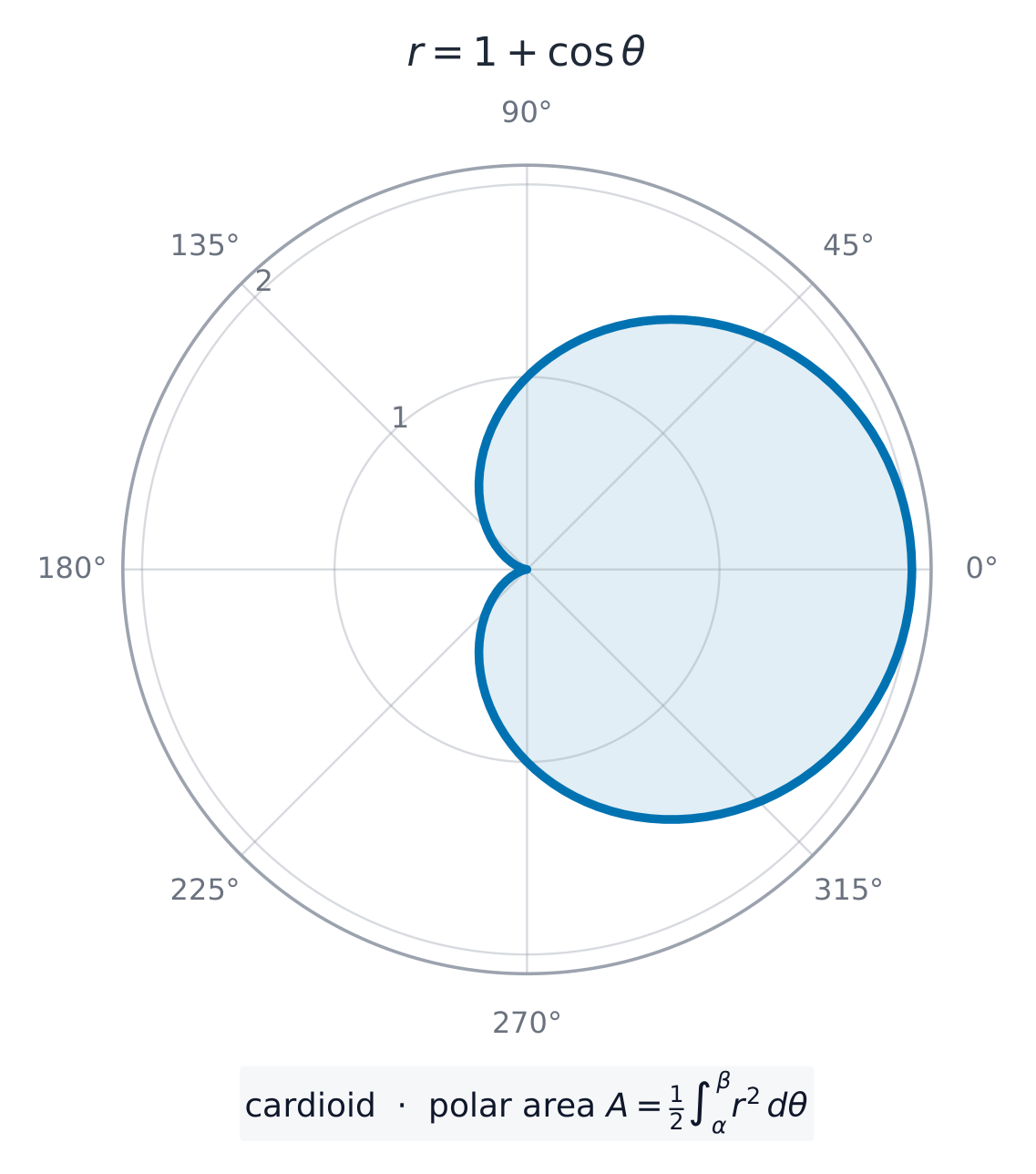
Une cardioïde r = 1 + cos theta, une courbe tracée directement en forme polaire
The area of a polar sector is ½∫r² dθ. · L'aire d'un secteur polaire est ½∫r² dθ.
This is the standard polar area formula. · C'est la formule standard d'aire polaire.
Converting curves
- Example: $r = 4\cos\theta$ → multiply by $r$: $r^2 = 4r\cos\theta$ → $x^2 + y^2 = 4x$ → $(x-2)^2 + y^2 = 4$, a circle radius $2$.
Conversion de courbes
- Exemple : $r = 4\cos\theta$ → multiplier par $r$ : $r^2 = 4r\cos\theta$ → $x^2 + y^2 = 4x$ → $(x-2)^2 + y^2 = 4$, un cercle de rayon $2$.
You've got it
- $x = r\cos\theta$, $y = r\sin\theta$, $r^2 = x^2 + y^2$
- polar sector area $= \tfrac12\int r^2\,d\theta$
- $r = 4\cos\theta$ is a circle of radius 2 centred at $(2, 0)$
Vous avez compris
- $x = r\cos\theta$, $y = r\sin\theta$, $r^2 = x^2 + y^2$
- aire de secteur polaire $= \tfrac12\int r^2\,d\theta$
- $r = 4\cos\theta$ est un cercle de rayon 2 centré en $(2, 0)$