Vectors (Further Pure 1) · Vecteurs (Further Pure 1)
| English | Français |
|---|---|
| plane/pleɪn/ | plan |
| skew/skjuː/ | asymétrie |
| vector product/ˈvektə ˈprɒdʌkt/ | produit vectoriel |
| normal vector/ˈnɔːml ˈvektə/ | vecteur normal |
| perpendicular/ˌpɜːpənˈdɪkjʊlə/ | perpendiculaires |
| parallelogram/ˌpærəˈleləɡræm/ | parallélogramme |
| anti-commutative/ˈænti ˈkɒmjuːtətɪv/ | anti-commutatif |
The mathematics of 3D space
- How do you find the distance from a point to a plane 平面? The angle between two surfaces? The shortest path between two skew 异面 lines?
- Planes and the vector product 向量积 give you the tools to solve all these problems — essential for engineering, architecture, and computer graphics.
Mathématiques de l'espace 3D
- Comment trouver la distance d'un point à un plan 平面 ? L'angle entre deux surfaces ? Le plus court chemin entre deux droites gauches 异面 ?
- Les plans et le produit vectoriel 向量积 vous donnent les outils pour résoudre tous ces problèmes — essentiels pour l'ingénierie, l'architecture et la graphisme informatique.
Equations of planes
- A plane can be written in several forms:
The normal vector 法向量 n is perpendicular 垂直 to the plane; the scalar-product form is n·r = d.
- Cartesian: $ax + by + cz = d$
- Vector: $\mathbf{r}\cdot\mathbf{n} = p$ (where $\mathbf{n}$ is the normal vector)
- Parametric: $\mathbf{r} = \mathbf{a} + \lambda\mathbf{b} + \mu\mathbf{c}$
Worked example. A plane has normal $\mathbf{n} = \begin{pmatrix} 2 \\ -1 \\ 3 \end{pmatrix}$ and passes through $(1, 0, 2)$. Equation: $2x - y + 3z = 2(1) - 0 + 3(2) = 8$.
Équations de plans
- Un plan peut s'écrire sous plusieurs formes :

Le vecteur normal 法向量 n est perpendiculaire 垂直 au plan ; la forme produit scalaire est n·r = d.
- Cartésien : $ax + by + cz = d$
- Vectoriel : $\mathbf{r}\cdot\mathbf{n} = p$ (où $\mathbf{n}$ est le vecteur normal)
- Paramétrique : $\mathbf{r} = \mathbf{a} + \lambda\mathbf{b} + \mu\mathbf{c}$
Exemple résolu. Un plan a pour normale $\mathbf{n} = \begin{pmatrix} 2 \\ -1 \\ 3 \end{pmatrix}$ et passe par $(1, 0, 2)$. Équation : $2x - y + 3z = 2(1) - 0 + 3(2) = 8$.
Vectors · Vecteurs
a · b = |a||b|cos θ
The · Le dot product is zero exactly when two vectors are perpendicular. · Le produit scalaire est zéro exactement lorsque deux vecteurs sont perpendiculaires.
Scalar and vector products can find the shortest distance between two skew lines. · Les produits scalaire et vectoriel peuvent trouver la distance la plus courte entre deux droites gauches.
These products let you compute distances, angles and intersections in 3D, including skew-line distances. · Ces produits vous permettent de calculer distances, angles et intersections en 3D, y compris les distances entre droites gauches.
A plane has equation 2x − y + 3z = 8. The normal vector has components (2, −1, ?). Find the missing component. · Un plan a pour équation 2x − y + 3z = 8. Le vecteur normal a pour composantes (2, −1, ?). Trouver la composante manquante.
The coefficients of x, y, z in ax + by + cz = d give the normal vector (a, b, c) = (2, −1, 3). · Les coefficients de x, y, z dans ax + by + cz = d donnent le vecteur normal (a, b, c) = (2, −1, 3).
The vector (cross) product
- The vector product $\mathbf{a}\times\mathbf{b} = |\mathbf{a}||\mathbf{b}|\sin\theta\,\hat{\mathbf{n}}$ gives a vector perpendicular to both.
- Its length equals the area of the parallelogram 平行四边形 spanned by $\mathbf{a}$ and $\mathbf{b}$.
Order matters. $\mathbf{a}\times\mathbf{b} = -\mathbf{b}\times\mathbf{a}$. The vector product is anti-commutative 反交换 — swapping the order reverses the direction.
Forces like wind and water are vectors, with both size and direction
Produit vectoriel (croisé)
- Le produit vectoriel $\mathbf{a}\times\mathbf{b} = |\mathbf{a}||\mathbf{b}|\sin\theta\,\hat{\mathbf{n}}$ donne un vecteur perpendiculaire aux deux.
- Sa longueur est égale à l'aire du parallélogramme 平行四边形 engendré par $\mathbf{a}$ et $\mathbf{b}$.
L'ordre compte. $\mathbf{a}\times\mathbf{b} = -\mathbf{b}\times\mathbf{a}$. Le produit vectoriel est anti-commutatif 反交换 — inverser l'ordre inverse la direction.

Les forces comme le vent et l'eau sont des vecteurs, ayant une grandeur et une direction
The vector product a × b gives a vector that is: · Le produit vectoriel a × b donne un vecteur qui est :
a × b is perpendicular to both vectors; its length is |a||b|sin θ. · a × b est perpendiculaire aux deux vecteurs ; sa longueur est |a||b|sin θ.
The magnitude |a × b| equals the: · La magnitude |a × b| correspond à la :
|a × b| = |a||b|sin θ, which is the parallelogram's area. · |a × b| = |a||b|sin θ, qui est l'aire du parallélogramme.
The vector product is commutative: a × b = b × a. · Le produit vectoriel est commutatif : a × b = b × a.
The vector product is anti-commutative: a × b = −(b × a). Swapping the order reverses the direction. · Le produit vectoriel est anticommutatif : a × b = −(b × a). Changer l'ordre inverse la direction.
If |a| = 3, |b| = 4, and the angle between them is 30°, |a × b| = |a||b|sin θ. Find it. · Si |a| = 3, |b| = 4, et l'angle entre eux est 30°, |a × b| = |a||b|sin θ. Trouver cette valeur.
|a × b| = 3 × 4 × sin 30° = 12 × 0.5 = 6.
Applications
- With scalar and vector products: distances, angles, where lines and planes meet, and the shortest distance between skew lines.
- Distance from point to plane: $d = \dfrac{|ax_0 + by_0 + cz_0 - d|}{\sqrt{a^2 + b^2 + c^2}}$.
The vector product is perpendicular to both vectors; its length is the parallelogram area
Applications
- Avec les produits scalaire et vectoriel : distances, angles, intersections de droites et plans, et la distance minimale entre droites gauches.
- Distance d'un point à un plan : $d = \dfrac{|ax_0 + by_0 + cz_0 - d|}{\sqrt{a^2 + b^2 + c^2}}$.
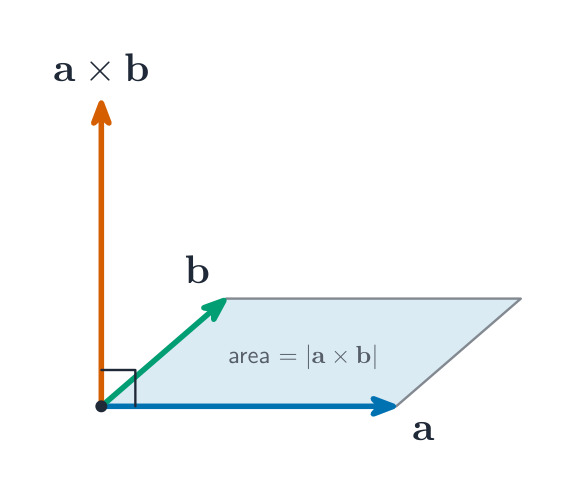
Le produit vectoriel est perpendiculaire aux deux vecteurs ; sa longueur est l'aire du parallélogramme
Finding the normal
- The normal to a plane containing two vectors $\mathbf{b}$ and $\mathbf{c}$ is $\mathbf{n} = \mathbf{b} \times \mathbf{c}$.
- This is the quickest way to find the Cartesian equation from a parametric form.
Trouver la normale
- La normale à un plan contenant deux vecteurs $\mathbf{b}$ et $\mathbf{c}$ est $\mathbf{n} = \mathbf{b} \times \mathbf{c}$.
- C'est le moyen le plus rapide de trouver l'équation cartésienne à partir d'une forme paramétrique.
You've got it
- a plane: $ax + by + cz = d$ or $\mathbf{r}\cdot\mathbf{n} = p$
- the vector product $\mathbf{a}\times\mathbf{b}$ is perpendicular to both; $|\mathbf{a}\times\mathbf{b}|$ = parallelogram area
- use it for distances, angles, intersections, and skew-line distances
Vous avez compris
- un plan : $ax + by + cz = d$ ou $\mathbf{r}\cdot\mathbf{n} = p$
- le produit vectoriel $\mathbf{a}\times\mathbf{b}$ est perpendiculaire aux deux ; $|\mathbf{a}\times\mathbf{b}|$ = aire du parallélogramme
- utilisez-le pour les distances, angles, intersections et distances entre droites gauches