Arenes and their reactions · Aènes et leurs réactions
| English | Français |
|---|---|
| arene/ˈæren/ | arène |
| electrophilic substitution/ɪˌlektrəʊˈfɪlɪk ˌsʌbstɪˈtjuːʃn/ | substitution électrophile |
| halogenation/həˌlɒdʒəˈneɪʃn/ | halogénation |
| nitration/naɪˈtreɪʃn/ | nitration |
| Friedel–Crafts/ˈfriːdl kræfts/ | Friedel–Crafts |
The chemistry of the ring
- Arenes 芳烃 are aromatic hydrocarbons, built on the benzene ring.
- The stable, electron-rich ring reacts mostly by electrophilic substitution 亲电取代.
- This keeps the ring, rather than destroying it by addition.
Chimie du cycle
- Les aromatiques 芳烃 sont des hydrocarbures aromatiques, construits sur le cycle du benzène.
- Le cycle stable et riche en électrons réagit principalement par substitution électrophile 亲电取代.
- Cela conserve le cycle, plutôt que de le détruire par addition.
Arene substitution route · Voie de substitution des arènes
Follow electrophilic substitution on benzene. · Suivez la substitution électrophile sur le benzène.
Benzene reacts mostly by electrophilic substitution because: · Le benzène réagit principalement par substitution électrophile car :
Substitution preserves the aromatic stabilisation; addition would break up the delocalised system. · La substitution préserve la stabilisation aromatique ; l'addition briserait le système délocalisé.
Arenes such as benzene typically react by: · Les arènes telles que le benzène réagissent généralement par :
Substitution keeps the stable ring intact. · La substitution conserve l'anneau stable intact.
Reactions of benzene
| Reaction | Reagents | Product |
|---|---|---|
| halogenation 卤化 | $\text{Cl}_2$/$\text{Br}_2$ + $\text{AlCl}_3$ | a halogenoarene |
| nitration 硝化 | conc. $\text{HNO}_3$ + conc. $\text{H}_2\text{SO}_4$ | nitrobenzene |
| Friedel–Crafts 傅-克反应 | $\text{RCl}$ or $\text{RCOCl}$ + $\text{AlCl}_3$ | adds an alkyl/acyl group |
| side-chain oxidation | hot alkaline $\text{KMnO}_4$ | benzoic acid |
| hydrogenation | $\text{H}_2$, Pt/Ni | cyclohexane |
The main reactions of benzene
Réactions du benzène
| Réaction | Réactifs | Produit |
|---|---|---|
| halogénation 卤化 | $\text{Cl}_2$/$\text{Br}_2$ + $\text{AlCl}_3$ | un halogénure d'aryle |
| nitration 硝化 | conc. $\text{HNO}_3$ + conc. $\text{H}_2\text{SO}_4$ | nitrobenzène |
| Friedel–Crafts 傅-克反应 | $\text{RCl}$ ou $\text{RCOCl}$ + $\text{AlCl}_3$ | ajoute un groupe alkyle/acyl |
| oxydation de chaîne latérale | base chaude $\text{KMnO}_4$ | acide benzoïque |
| hydrogénation | $\text{H}_2$, Pt/Ni | cyclohexane |
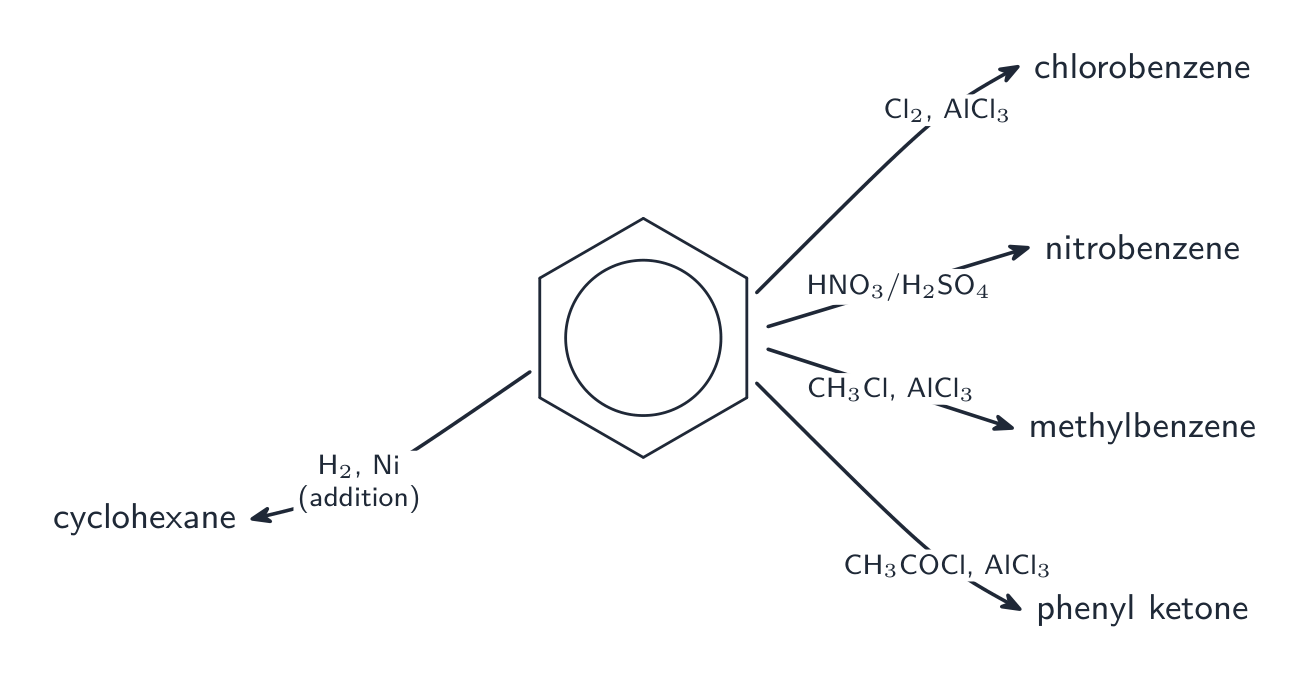
Les principales réactions du benzène
Nitration of benzene uses: · La nitration du benzène utilise :
The conc. acid mixture generates the NO₂⁺ electrophile, giving nitrobenzene. · Le mélange acide concentré génère l'électrophile NO₂⁺, donnant du nitrobenzène.
A Friedel–Crafts reaction (with AlCl₃) is used to: · Une réaction de Friedel-Crafts (avec AlCl₃) est utilisée pour :
Friedel–Crafts alkylation/acylation adds a carbon-based group to benzene. · L'alkylation/acylation de Friedel-Crafts ajoute un groupe carboné au benzène.
Match each term to its meaning. · Reliez chaque terme à sa signification.
Each item links the term to its correct meaning. · Chaque élément relie le terme à sa signification correcte.
Benzene reacts mainly by electrophilic substitution, not addition, because that keeps its stable delocalised ring intact. · Le benzène réagit principalement par substitution électrophile, pas par addition, car cela conserve son anneau délocalisé stable intact.
Addition would break the delocalised ring and lose its stability, so substitution (swapping an H) is favoured. · L'addition briserait l'anneau délocalisé et ferait perdre sa stabilité, donc la substitution (échange d'un H) est favorisée.
The mechanism (nitration)
- The acid mix makes the electrophile $\text{NO}_2^+$.
- the ring's delocalised electrons bond to the electrophile → an unstable intermediate.
- an $\text{H}^+$ is lost, restoring the stable ring.
- Substitution wins because it keeps the delocalisation; addition would destroy it.
Naphthalene, used in mothballs, is a simple arene of two fused benzene rings.
Mécanisme (nitration)
- Le mélange acide forme l'électrophile $\text{NO}_2^+$.
- les électrons délocalisés du cycle se lient à l'électrophile → un intermédiaire instable.
- un $\text{H}^+$ est perdu, restaurant le cycle stable.
- La substitution gagne car elle conserve la délocalisation ; l'addition la détruirait.
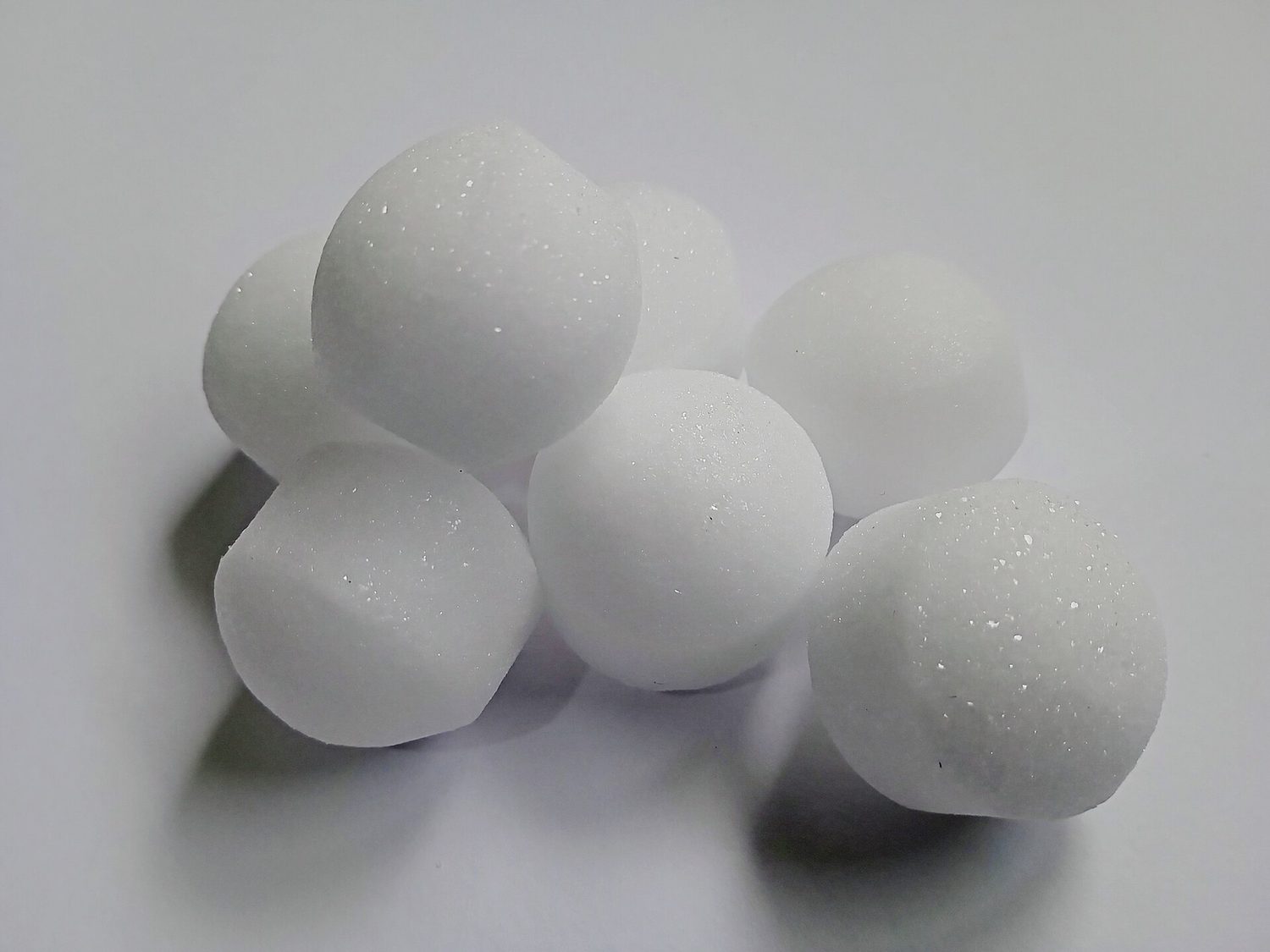
Le naphtalène, utilisé dans les boulettes de mites, est un arume simple composé de deux cycles de benzène condensés.
In electrophilic substitution, after the ring bonds to the electrophile: · En substitution électrophile, après que l'anneau se soit lié à l'électrophile :
Losing H⁺ from that carbon restores the delocalised ring, completing the substitution. · La perte de H⁺ de ce carbone restaure l'anneau délocalisé, complétant la substitution.
Why substitution, not addition
- Benzene reacts by substitution to preserve its stable delocalised ring.
- Addition would destroy the extra stability, so it is not favoured.
Friedel-Crafts: alkylation adds an alkyl group, acylation an acyl group
Pourquoi substitution, pas addition
- Le benzène réagit par substitution pour préserver son cycle stable délocalisé.
- L'addition détruirait cette stabilité supplémentaire, donc elle n'est pas favorisée.

Friedel-Crafts : alkylation ajoute un groupe alkyle, acylation ajoute un groupe acyl
You've got it
- arenes react by electrophilic substitution (keeping the ring)
- key reactions: halogenation, nitration, Friedel–Crafts (add alkyl/acyl), side-chain oxidation (→ benzoic acid), hydrogenation
- mechanism: ring attacks the electrophile → intermediate → loses H⁺ to restore the ring
Vous avez compris
- les aromes réagissent par substitution électrophile (en conservant le cycle)
- réactions clés : halogénation, nitration, Friedel–Crafts (ajout alkyle/acyl), oxydation de chaîne latérale (→ acide benzoïque), hydrogénation
- mécanisme : le cycle attaque l'électrophile → intermédiaire → perd H⁺ pour restaurer le cycle