Side-chain, ring and directing effects · Effets de chaîne latérale, d'anneau et d'orientation
| English | Français |
|---|---|
| side-chain/saɪd tʃeɪn/ | chaîne latérale |
| directing effect/daɪˈrektɪŋ ɪˈfekt/ | effet directeur |
| electron-donating/ɪˈlektrɒn dəʊˈneɪtɪŋ/ | donneur d'électrons |
| activated/ˈæktɪveɪtɪd/ | activé |
| electron-withdrawing/ɪˈlektrɒn wɪθˈdrɔːɪŋ/ | withdrawer d'électrons |
| deactivated/diːˈæktɪveɪtɪd/ | désactivé |
Side-chain 侧链 or ring, and directing
- A halogen can react in the ring or the side-chain.
- The conditions decide which.
- A group already on the ring directs the next one.
Chaîne latérale 侧链 ou cycle, et orientation
- Un halogène peut réagir dans le cycle ou la chaîne latérale.
- Les conditions décident de laquelle.
- Un groupe déjà présent sur le cycle oriente le suivant.
Directing effects lab · Laboratoire sur les effets d'orientation
Classify substituents by how they affect the benzene ring. · Classifiez les substituants selon la façon dont ils affectent l'anneau benzénique.
Groups already on a benzene ring direct where the next group attaches. · Les groupes déjà présents sur un cycle de benzène déterminent l'attache du prochain groupe.
This is the directing effect. · C'est l'effet orientant.
Side-chain vs ring
- with a halogen-carrier catalyst (AlCl₃) and no UV → substitution in the ring.
- with UV light and no catalyst → free-radical substitution in the side-chain.
The conditions choose the site: catalyst + no UV → ring; UV + no catalyst → side-chain
Directing effects 定位效应 of groups on a benzene ring
Chaîne latérale vs cycle
- avec un catalyseur porteur d'halogène (AlCl₃) et sans UV → substitution dans le cycle.
- avec lumière UV et sans catalyseur → substitution par radicaux libres dans la chaîne latérale.
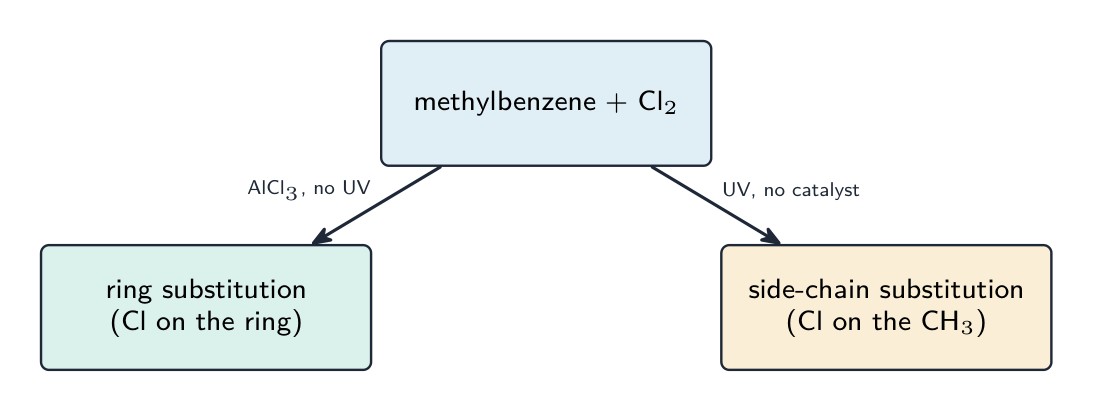
Les conditions choisissent le site : catalyseur + sans UV → cycle ; UV + sans catalyseur → chaîne latérale
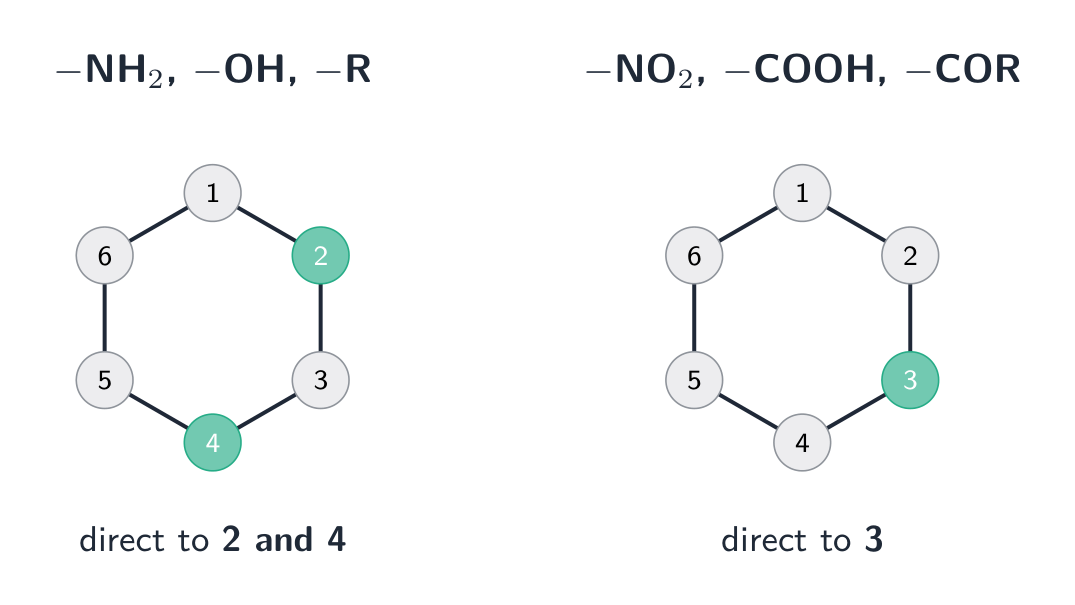
Effets orientateurs 定位效应 des groupes sur un cycle de benzène
A halogen reacts in the ring (not the side-chain) when there is: · Un halogène réagit sur le cycle (et non sur la chaîne latérale) lorsqu'il y a :
The catalyst makes the electrophile for ring substitution; UV with no catalyst gives side-chain free-radical substitution. · Le catalyseur génère l'électrophile pour la substitution cyclique ; les UV sans catalyseur provoquent une substitution radicalaire en chaîne latérale.
Under UV light with no catalyst, the halogen substitutes: · Sous lumière UV sans catalyseur, l'halogène se substitue :
UV light starts free-radical substitution in the alkyl side-chain. · Les UV amorcent la substitution radicalaire dans la chaîne alkyle latérale.
Directing effects
| Group already present | Directs the new group to |
|---|---|
| $\text{–NH}_2$, $\text{–OH}$, $\text{–R}$ | positions 2 and 4 |
| $\text{–NO}_2$, $\text{–COOH}$, $\text{–COR}$ | position 3 |
Electrophilic substitution: nitration of benzene
Effets orientateurs
| Groupe déjà présent | Oriente le nouveau groupe vers |
|---|---|
| $\text{–NH}_2$, $\text{–OH}$, $\text{–R}$ | positions 2 et 4 |
| $\text{–NO}_2$, $\text{–COOH}$, $\text{–COR}$ | position 3 |
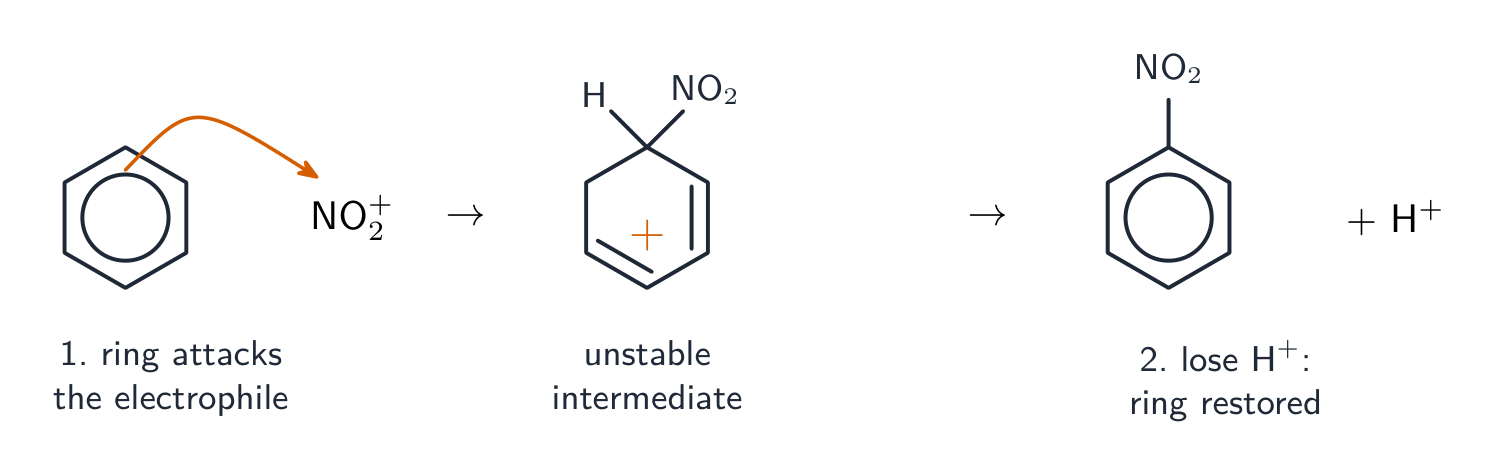
Substitution électrophile : nitration du benzène
An –OH group already on the ring directs the next substituent to: · Un groupe –OH déjà présent sur le cycle oriente le prochain substituant vers :
–NH₂, –OH and –R are 2,4-directing; –NO₂, –COOH and –COR are 3-directing. · –NH₂, –OH et –R sont orienteurs 2,4 ; –NO₂, –COOH et –COR sont orienteurs 3.
Match each group to where it directs the next substituent. · Associez chaque groupe à l'endroit où il oriente le prochain substituant.
Activating groups (–OH, –NH₂, –R) direct to 2,4; deactivating groups (–NO₂, –COOH, –COR) direct to 3. · Les groupes activateurs (–OH, –NH₂, –R) orientent vers 2,4 ; les groupes déactivateurs (–NO₂, –COOH, –COR) orientent vers 3.
Activators and deactivators
- Electron-donating 给电子 groups (–NH₂, –OH, –R) push electrons into the ring → it reacts faster (activated 活化) and they direct to 2,4.
- Electron-withdrawing 吸电子 groups (–NO₂, –COOH) pull electrons out → the ring reacts slower (deactivated 钝化) and they direct to 3.
Nitrating phenol: the –OH is electron-donating, so it activates the ring and directs to 2,4.
- Products: 2-nitrophenol and 4-nitrophenol.
- And phenol nitrates faster than benzene — so easily it even reacts with dilute nitric acid.
Activateurs et désactivateurs
- Les groupes donneurs d'électrons 给电子 (–NH₂, –OH, –R) poussent les électrons dans le cycle → il réagit plus vite (activé 活化) et orientent vers 2,4.
- Les groupes attracteurs d'électrons 吸电子 (–NO₂, –COOH) tirent les électrons hors → le cycle réagit plus lentement (désactivé 钝化) et orientent vers 3.
Nitrer le phénol : le groupe –OH est donneur d'électrons, donc il active le cycle et oriente vers 2,4.
- Produits : 2-nitrophénol et 4-nitrophénol.
- Et le phénol nitre plus vite que le benzène — si facilement qu'il réagit même avec l'acide nitrique dilué.
You've got it
- ring substitution: catalyst (AlCl₃) + no UV; side-chain: UV + no catalyst (free-radical)
- a group already on the ring directs the next: –NH₂/–OH/–R → 2,4; –NO₂/–COOH/–COR → 3
- donating groups activate (react faster); withdrawing groups deactivate (react slower)
Vous avez compris
- substitution cyclique : catalyseur (AlCl₃) + pas d'UV ; chaîne latérale : UV + pas de catalyseur (radical libre)
- un groupe déjà sur le cycle oriente le suivant : –NH₂/–OH/–R → 2,4 ; –NO₂/–COOH/–COR → 3
- les groupes donneurs activent (réagissent plus vite) ; les groupes attracteurs désactivent (réagissent plus lentement)