Acids and bases · Acides et bases
| English | Français |
|---|---|
| proton donor/ˈprəʊtɒn ˈdəʊnə/ | donneur de proton |
| proton acceptor/ˈprəʊtɒn əkˈseptə/ | accepteur de proton |
| alkali/ˈælkəlaɪ/ | base |
| conjugate/ˈkɒndʒuːɡeɪt/ | conjugué |
Donors and acceptors
- The Brønsted–Lowry theory defines acids and bases by what they do with protons.
- A proton is simply an $\text{H}^{+}$ ion.
- Every acid–base reaction transfers a proton.
Donateurs et accepteurs
- La théorie de Brønsted–Lowry définit les acides et bases selon leur comportement vis-à-vis des protons.
- Un proton est simplement un ion $\text{H}^{+}$.
- Chaque réaction acide-base implique un transfert de proton.
A proton, in this context, is: · Un proton, dans ce contexte, est :
A hydrogen ion (H⁺) is just a proton, which is what acids donate and bases accept. · Un ion hydrogène (H⁺) est juste un proton, ce que les acides donnent et les bases acceptent.
A Brønsted–Lowry acid is a proton (H⁺) ______. · Un acide Brønsted–Lowry est un donneur de proton (H⁺) ______.
A base is a proton acceptor. · Une base est un accepteur de proton.
Proton donors 质子供体 and acceptors
- an acid is a proton donor (it gives away $\text{H}^{+}$).
- a base is a proton acceptor 质子受体 (it takes $\text{H}^{+}$). A base that dissolves in water is an alkali 碱.
- When an acid gives a proton to a base, you get two conjugate 共轭 acid–base pairs.
Bronsted-Lowry: an acid donates a proton to a base, forming two conjugate pairs
Donateurs de protons 质子供体 et accepteurs
- un acide est un donneur de proton (il libère $\text{H}^{+}$).
- une base est un accepteur de proton 质子受体 (elle capte $\text{H}^{+}$). Une base soluble dans l'eau est une alkali 碱.
- Lorsqu'un acide donne un proton à une base, on obtient deux paires conjuguées 共轭 acide–base.
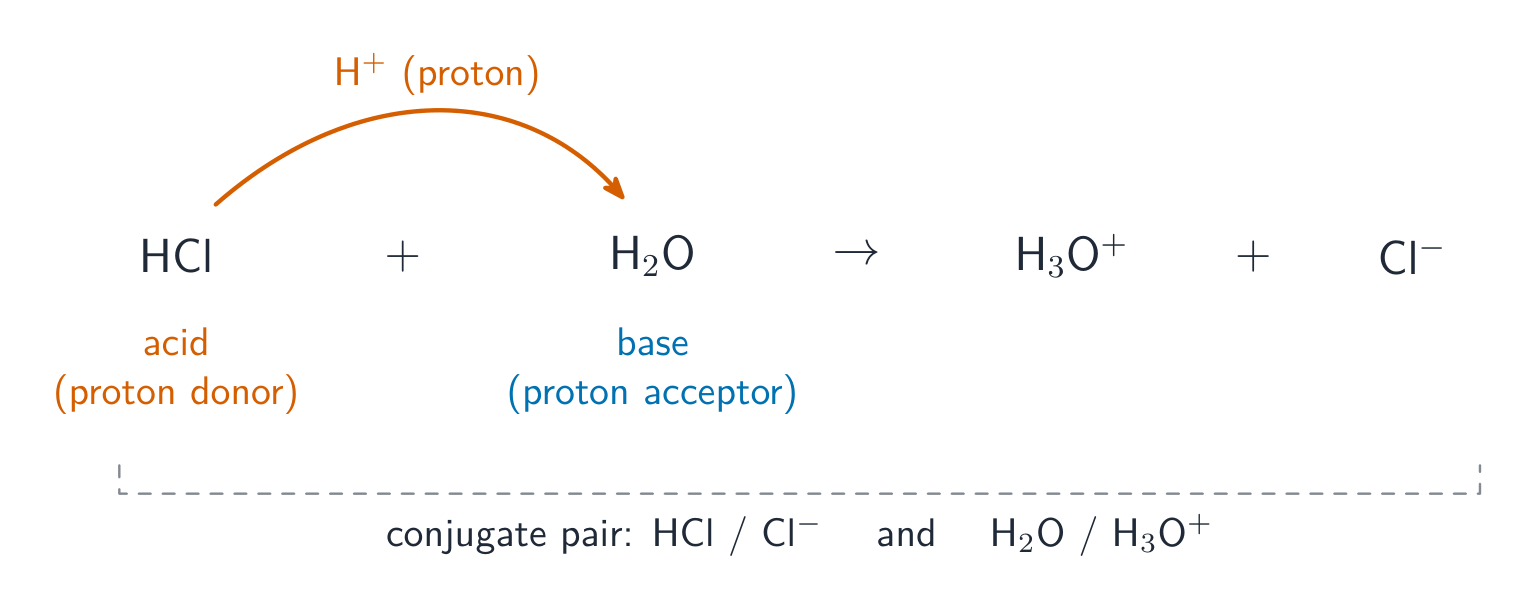
Bronsted-Lowry : un acide donne un proton à une base, formant deux paires conjuguées
The pH scale · L'échelle de pH
Slide the pH or tap a substance — each step down in pH means ten times more H⁺ ions; acids are below 7, alkalis above. · Faites glisser le pH ou tapez une substance — chaque palier descendu en pH signifie dix fois plus d'ions H⁺ ; acides sous 7, alcalins au-dessus.
In the Brønsted–Lowry theory, an acid is a: · Dans la théorie Brønsted–Lowry, un acide est un :
A Brønsted–Lowry acid donates a proton (H⁺); a base accepts one. · Un acide Brønsted–Lowry donne un proton (H⁺) ; une base en accepte un.
When an acid donates a proton to a base, the result is: · Lorsqu'un acide donne un proton à une base, le résultat est :
The acid becomes its conjugate base and the base becomes its conjugate acid — two pairs. · L'acide devient sa base conjuguée et la base devient son acide conjugué — deux paires.
Common ones to know
- Acids: $\text{HCl}$, $\text{H}_2\text{SO}_4$, $\text{HNO}_3$, ethanoic acid ($\text{CH}_3\text{COOH}$).
- Alkalis: $\text{NaOH}$, $\text{KOH}$, ammonia ($\text{NH}_3$).
Les plus courants à connaître
- Acides : $\text{HCl}$, $\text{H}_2\text{SO}_4$, $\text{HNO}_3$, acide éthanoïque ($\text{CH}_3\text{COOH}$).
- Alkalis : $\text{NaOH}$, $\text{KOH}$, ammoniaque ($\text{NH}_3$).
Which is an alkali (a soluble base)? · Quel est un alcali (base soluble) ?
NaOH, KOH and NH₃ are alkalis; HCl, H₂SO₄, HNO₃ and CH₃COOH are acids. · NaOH, KOH et NH₃ sont des alcalis ; HCl, H₂SO₄, HNO₃ et CH₃COOH sont des acides.
Match each acid-base term to its meaning. · Associez chaque terme acide-base à sa signification.
Each item links the term to its correct meaning. · Chaque élément relie le terme à sa signification correcte.
Conjugate pairs
- When an acid donates a proton it forms its conjugate base.
- HCl → Cl⁻ + H⁺: HCl and Cl⁻ are a conjugate acid–base pair.
Paires conjuguées
- Lorsqu'un acide donne un proton, il forme sa base conjuguée.
- HCl → Cl⁻ + H⁺ : HCl et Cl⁻ forment une paire acide–base conjuguée.
You've got it
- a proton is an $\text{H}^{+}$ ion
- acid = proton donor; base = proton acceptor; a soluble base is an alkali
- proton transfer makes two conjugate acid–base pairs
- acids: HCl, H₂SO₄, HNO₃, CH₃COOH; alkalis: NaOH, KOH, NH₃
Vous avez compris
- un proton est un ion $\text{H}^{+}$
- acide = donneur de proton ; base = accepteur de proton ; une base soluble est une alkali
- le transfert de proton crée deux paires acide–base conjuguées
- acides : HCl, H₂SO₄, HNO₃, CH₃COOH ; alkalis : NaOH, KOH, NH₃