English
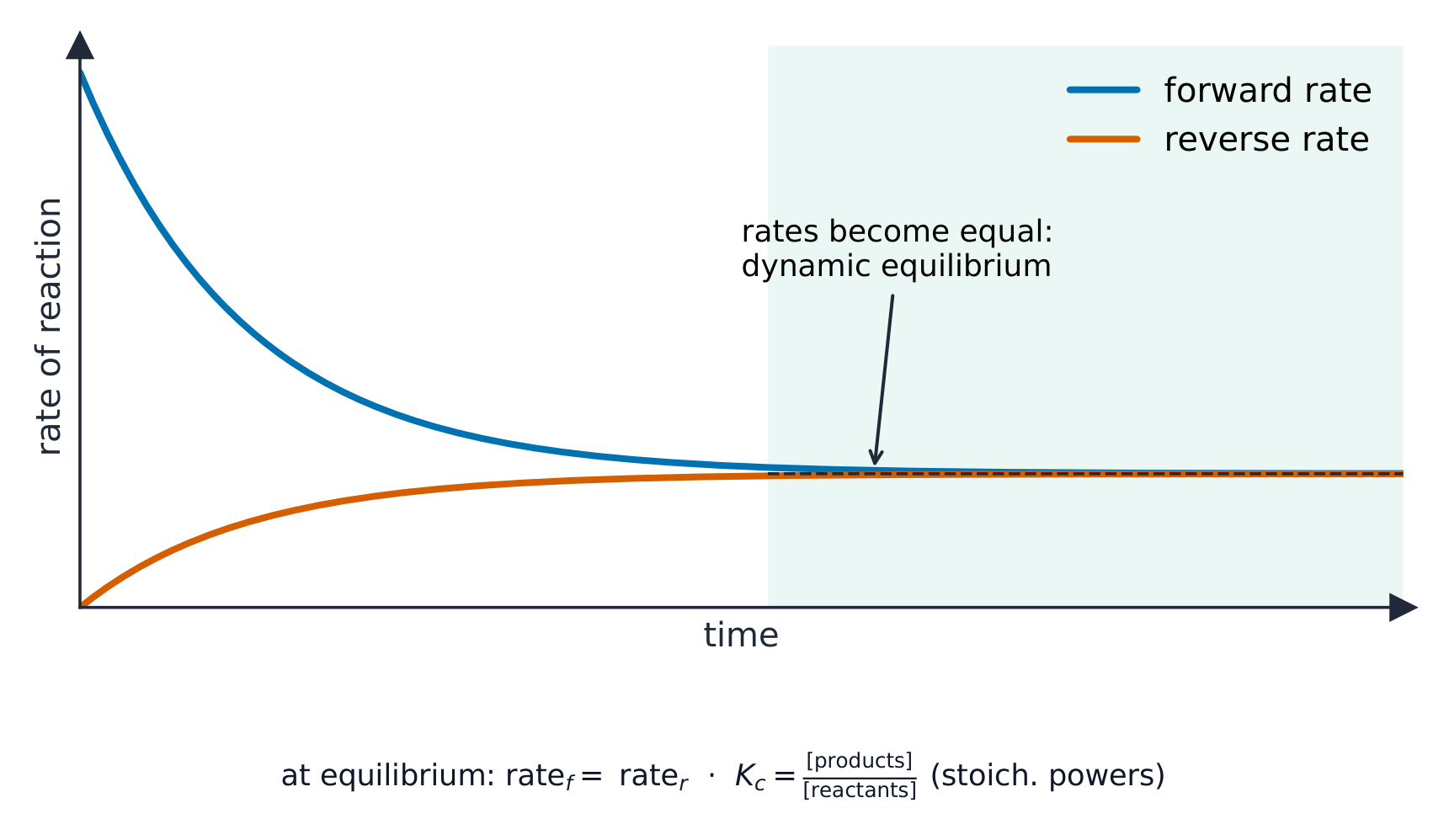
- (a) understand what is meant by a reversible reaction (b) understand what is meant by dynamic equilibrium in terms of the rate of forward and reverse reactions being equal and the concentration of reactants and products remaining constant (c) understand the need for a closed system in order to establish dynamic equilibrium
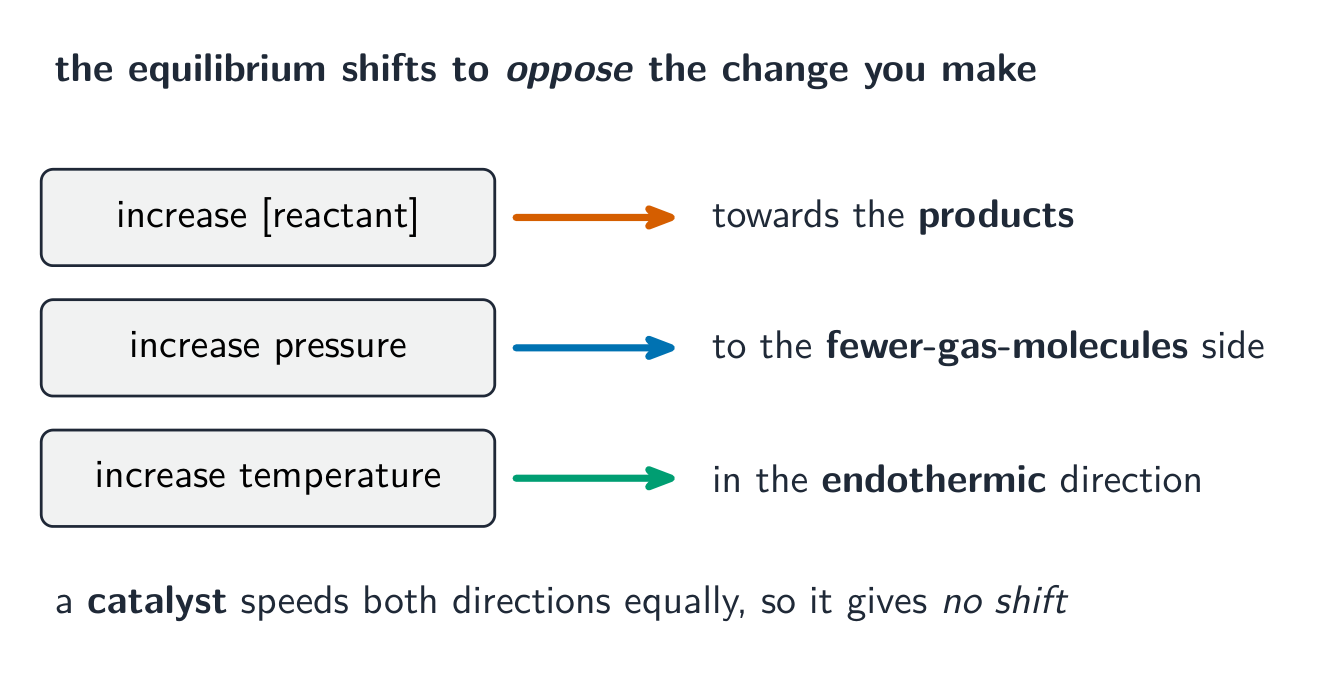
- define Le Chatelier’s principle as: if a change is made to a system at dynamic equilibrium, the position of equilibrium moves to minimise this change
- use Le Chatelier’s principle to deduce qualitatively (from appropriate information) the effects of changes in temperature, concentration, pressure or presence of a catalyst on a system at equilibrium
- deduce expressions for equilibrium constants in terms of concentrations, $K_c$
- use the terms mole fraction and partial pressure
- deduce expressions for equilibrium constants in terms of partial pressures, $K_p$ (use of the relationship between $K_p$ and $K_c$ is not required)
- use the $K_c$ and $K_p$ expressions to carry out calculations (such calculations will not require the solving of quadratic equations)
- calculate the quantities present at equilibrium, given appropriate data
- state whether changes in temperature, concentration or pressure or the presence of a catalyst affect the value of the equilibrium constant for a reaction
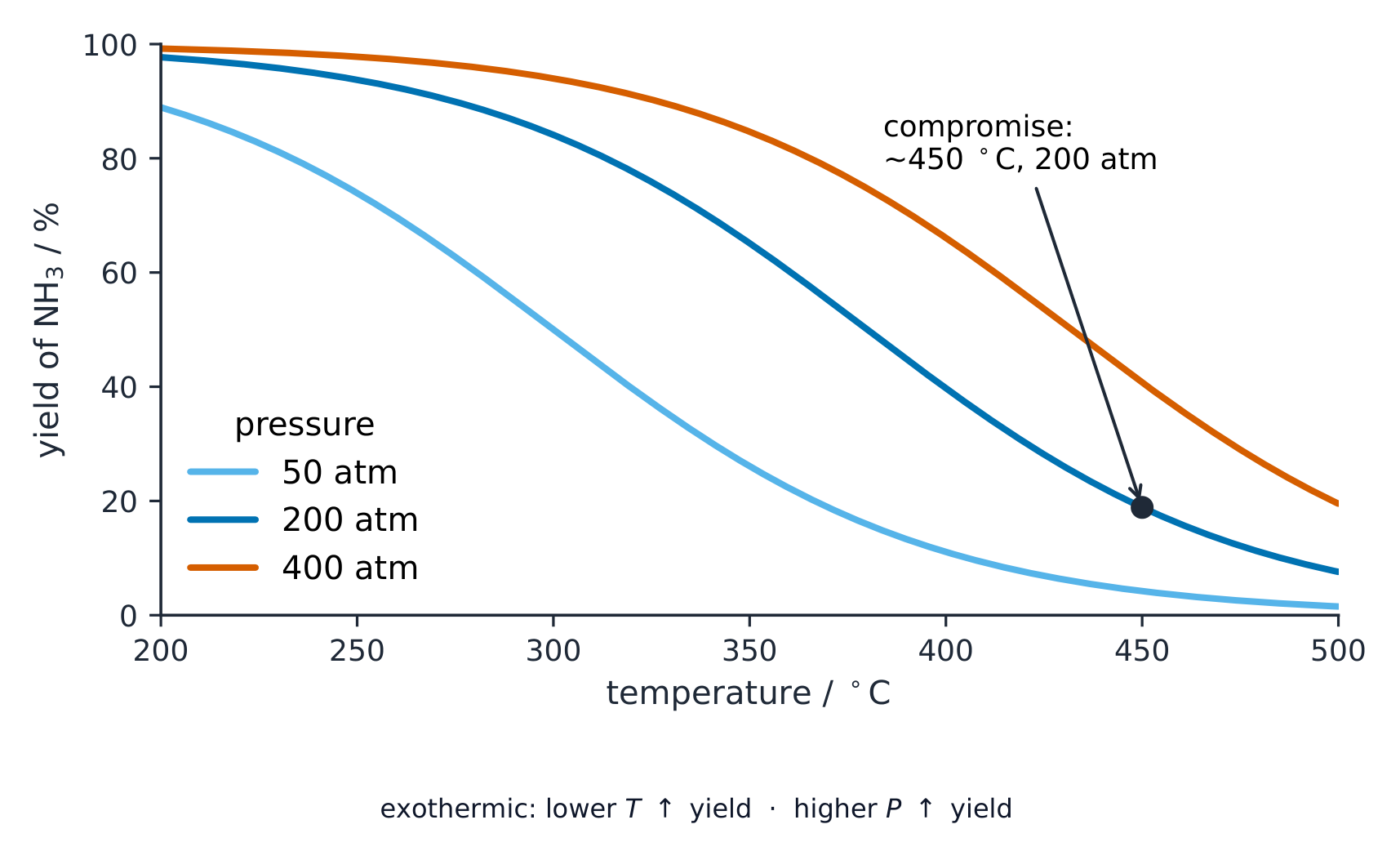
- describe and explain the conditions used in the Haber process and the Contact process, as examples of the importance of an understanding of dynamic equilibrium in the chemical industry and the application of Le Chatelier’s principle
Français
- (a) comprendre ce qu'est une réaction réversible (b) comprendre ce qu'est un équilibre dynamique en termes de vitesse des réactions directe et inverse égales et de concentration des réactifs et produits restant constante (c) comprendre la nécessité d'un système fermé pour établir un équilibre dynamique
- définir le principe de Le Chatelier comme suit : si un changement est apporté à un système à l'équilibre dynamique, la position de l'équilibre se déplace pour minimiser ce changement
- utiliser le principe de Le Chatelier pour déduire qualitativement (à partir d'informations appropriées) les effets des changements de température, de concentration, de pression ou de présence d'un catalyseur sur un système à l'équilibre
- déduire les expressions des constantes d'équilibre en fonction des concentrations, $K_c$
- utiliser les termes fraction molaire et pression partielle
- déduire les expressions des constantes d'équilibre en fonction des pressions partielles, $K_p$ (l'utilisation de la relation entre $K_p$ et $K_c$ n'est pas requise)
- utiliser les expressions $K_c$ et $K_p$ pour effectuer des calculs (ces calculs ne nécessiteront pas la résolution d'équations du second degré)
- calculer les quantités présentes à l'équilibre, à partir de données appropriées
- énoncer si les changements de température, de concentration ou de pression ou la présence d'un catalyseur affectent la valeur de la constante d'équilibre d'une réaction
- décrire et expliquer les conditions utilisées dans le procédé Haber et le procédé Contact, comme exemples de l'importance de la compréhension de l'équilibre dynamique dans l'industrie chimique et de l'application du principe de Le Chatelier