Ionic bonding · Liaison ionique
| English | Français |
|---|---|
| ionic bonding/aɪˈɒnɪk ˈbɒndɪŋ/ | liaison ionique |
| electrostatic attraction/ɪˌlektrəʊˈstætɪk əˈtrækʃn/ | attraction électrostatique |
| cation/ˈkætaɪən/ | cation |
| anion/ˈænaɪən/ | anion |
| lattice/ˈlætɪs/ | réseau |
| molten/ˈməʊltn/ | fondu |
Giving electrons away
- Ionic bonding 离子键 is the electrostatic attraction 静电引力 between oppositely charged ions.
- Positive cations 阳离子 attract negative anions 阴离子.
- The ions pack into a giant lattice 晶格.
Céder des électrons
- La liaison ionique 离子键 est l'attraction électrostatique 静电引力 entre des ions de charges opposées.
- Les cations positifs 阳离子 attirent les anions négatifs 阴离子.
- Les ions s'empaquent dans un réseau géant cristallin 晶格.
Ionic bonding is the electrostatic attraction between oppositely charged ions. · La liaison ionique est l'attraction électrostatique entre des ions de charges opposées.
It forms by transferring electrons from a metal to a non-metal. · Elle se forme par transfert d'électrons d'un métal vers un non-métal.
Ionic bonding is: · La liaison ionique est :
Ionic bonding is the attraction between positive cations and negative anions. · La liaison ionique est l'attraction entre des cations positifs et des anions négatifs.
How it forms
- A metal gives electrons to a non-metal — e.g. $\text{NaCl}$, $\text{MgO}$, $\text{CaF}_2$.
- The ions form a regular giant lattice, held by attraction in every direction.
A salt crystal's cubic shape comes straight from the giant ionic lattice inside.
Comment elle se forme
- Un métal cède des électrons à un non-métal — ex. $\text{NaCl}$, $\text{MgO}$, $\text{CaF}_2$.
- Les ions forment un réseau géant régulier, maintenu par attraction dans toutes les directions.
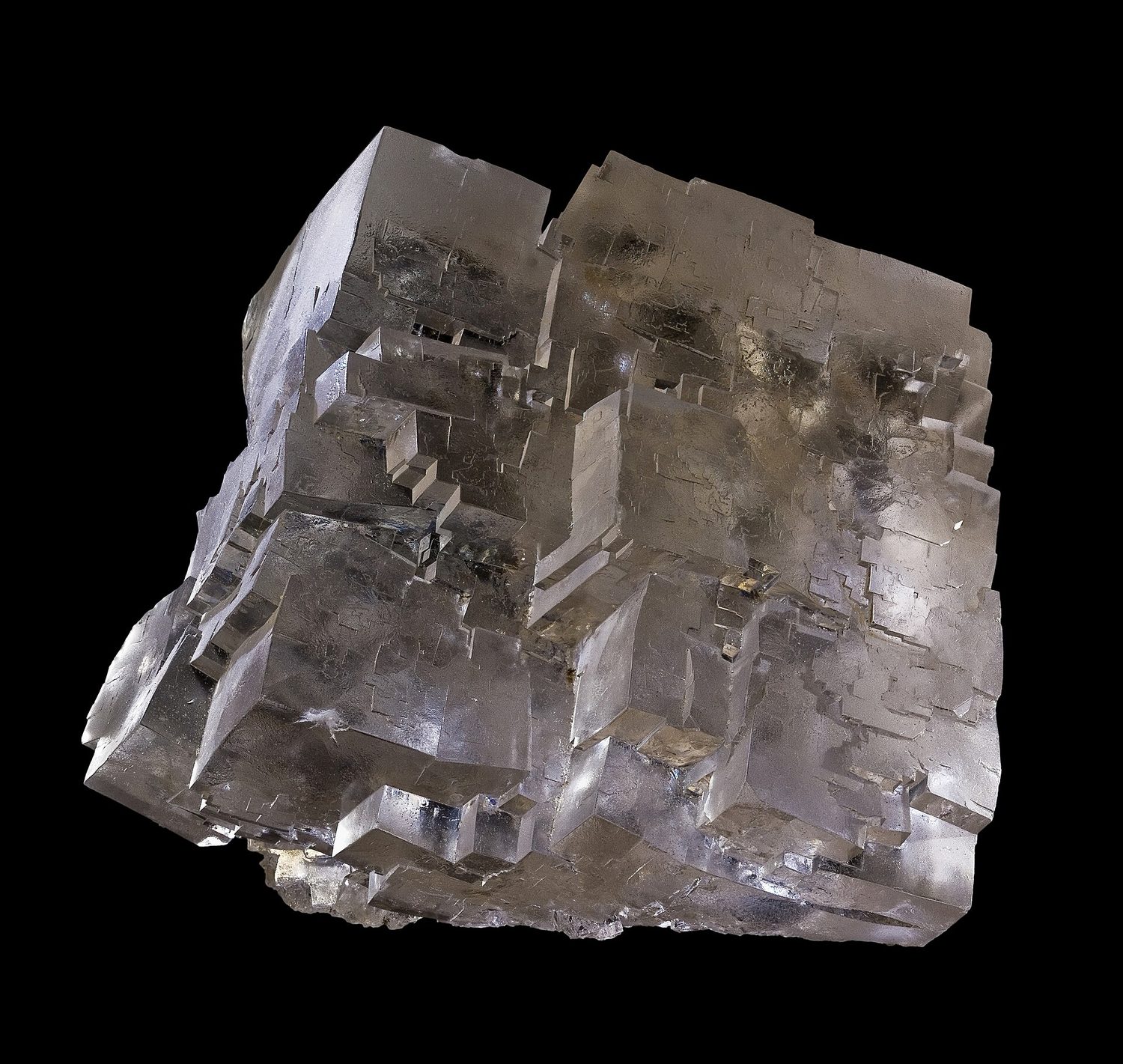
La forme cubique d'un cristal de sel vient directement du réseau ionique géant à l'intérieur.
Forming an ionic bond (NaCl) · Formation d'une liaison ionique (NaCl)
Step through it. A metal hands its outer electron to a non-metal; the oppositely charged ions then attract in a giant lattice. · Passez-y étape par étape. Un métal cède son électron externe à un non-métal ; les ions de charges opposées s'attirent ensuite dans un réseau géant.
Ionic bonding forms when: · La liaison ionique se forme lorsque :
A metal transfers electrons to a non-metal, making oppositely charged ions (e.g. NaCl). · Un métal transfère des électrons à un non-métal, formant des ions de charges opposées (ex. NaCl).
In an ionic solid the ions are packed into a regular giant ______, held by attraction in every direction. · Dans un solide ionique, les ions sont empilés en un réseau géant régulier ______, maintenu par attraction dans toutes les directions.
Each ion is surrounded by oppositely charged neighbours, so the structure is very strong. · Chaque ion est entouré de voisins de charge opposée, ce qui rend la structure très forte.
In an ionic solid, the ions are arranged in: · Dans un solide ionique, les ions sont disposés en :
Ions pack into a giant lattice, with each ion attracted to oppositely charged neighbours all around. · Les ions s'empilent dans un réseau géant, chaque ion étant attiré par ses voisins de charge opposée tout autour.
Dot-and-cross
- In $\text{NaCl}$, sodium transfers its single outer electron to chlorine.
- This gives $\text{Na}^{+}$ and a full-octet $\text{Cl}^{-}$, drawn with dots and crosses.
Sodium gives its single outer electron to chlorine, forming Na⁺ and a full-octet Cl⁻.
Point et croix
- Dans $\text{NaCl}$, le sodium transfère son unique électron externe vers le chlore.
- Cela donne $\text{Na}^{+}$ et un octet complet $\text{Cl}^{-}$, dessiné avec des points et des croix.

Le sodium donne son unique électron externe au chlore, formant Na⁺ et un Cl⁻ à octet complet.
In the NaCl dot-and-cross diagram: · Dans le diagramme point-croix de NaCl :
Sodium loses one electron to chlorine, forming Na⁺ and a full-octet Cl⁻. · Le sodium perd un électron pour le chlore, formant Na⁺ et un Cl⁻ à octet complet.
Put the formation of an ionic bond in order. · Mettez la formation d'une liaison ionique dans l'ordre.
Transfer the electron → make ions → they attract → giant lattice. · Transfert de l'électron → formation d'ions → attraction → réseau géant.
Properties from ionic bonding
- Ionic compounds have high melting points (strong attractions in a giant lattice).
- They conduct only when molten 熔融 or dissolved, when the ions are free to move.
Rock salt (halite): an ionic compound held in a giant lattice
Propriétés issues de la liaison ionique
- Les composés ioniques ont des points de fusion élevés (fortes attractions dans un réseau géant).
- Ils conduisent uniquement lorsqu'ils sont fondus 熔融 ou dissous, lorsque les ions sont libres de bouger.
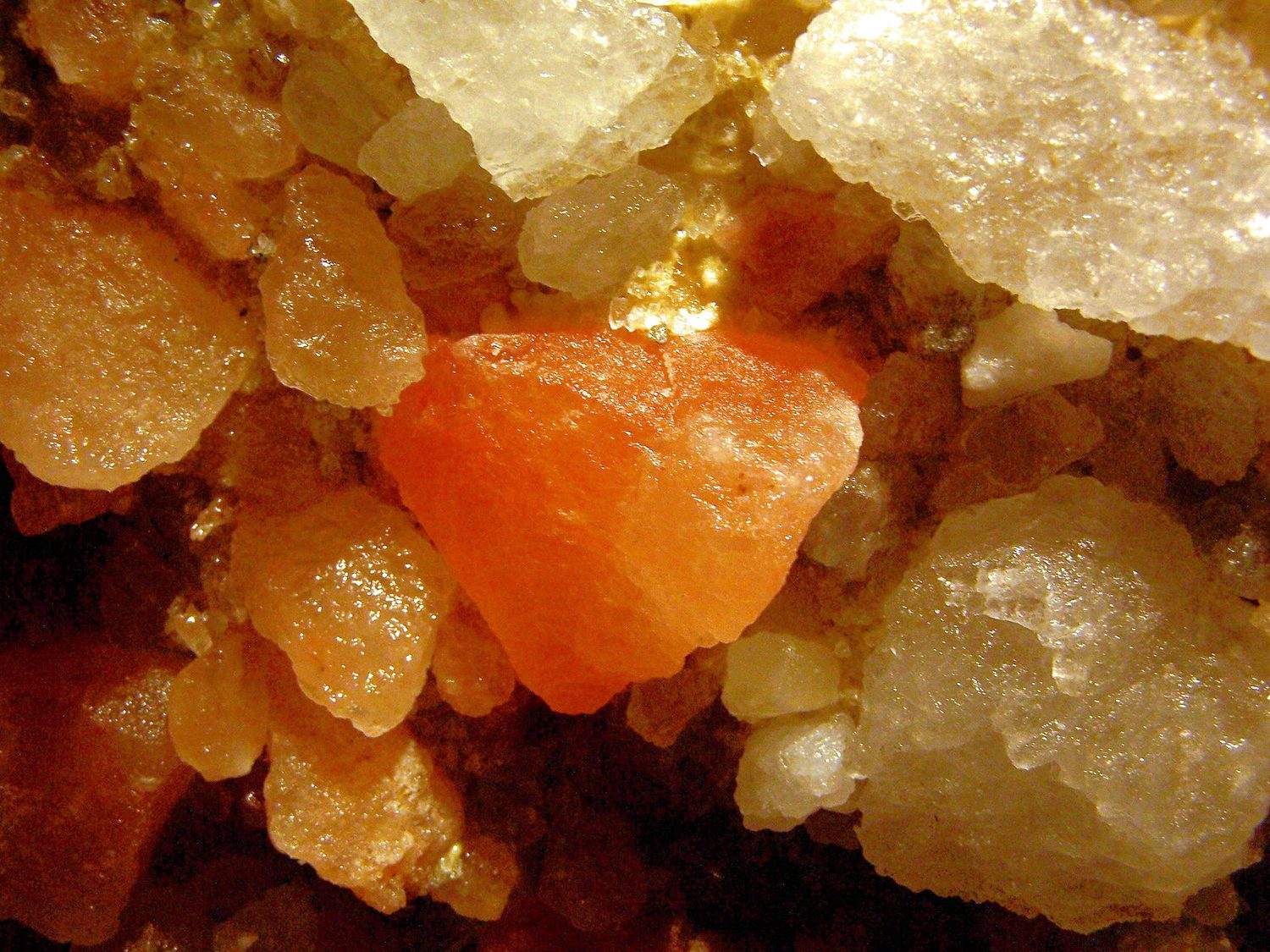
Sel de roche (halite) : un composé ionique maintenu dans un réseau géant
You've got it
- ionic bonding = electrostatic attraction between cations and anions
- forms when a metal transfers electrons to a non-metal ($\text{NaCl}$, $\text{MgO}$, $\text{CaF}_2$)
- the ions form a giant lattice held in every direction
Vous avez compris
- liaison ionique = attraction électrostatique entre cations et anions
- se forme quand un métal transfère des électrons à un non-métal ($\text{NaCl}$, $\text{MgO}$, $\text{CaF}_2$)
- les ions forment un réseau géant maintenu dans toutes les directions