Gradient · Pendiente
| English | Español |
|---|---|
| rise/raɪz/ | suben |
| run/rʌn/ | run |
| gradient/ˈɡreɪdɪənt/ | pendiente |
The steepest street on Earth
- Baldwin Street in Dunedin, New Zealand, climbs 35 m for every 100 m along the ground.
- That ratio — rise 上升量 ÷ run 水平量 — is what mathematicians call the gradient 斜率.
- A single number tells you exactly how steep something is, whether it's a street, a roof, or a line on a graph.
La calle más empinada de la Tierra
- Baldwin Street, en Dunedin (Nueva Zelanda), asciende 35 m por cada 100 m recorridos horizontalmente.
- Esa razón — elevación ÷ avance — es lo que los matemáticos llaman pendiente.
- Un único número indica exactamente qué tan empinada es una superficie, ya sea una calle, un tejado o una línea en un gráfico.
What gradient measures
- The gradient $m$ tells you two things about a straight line:
- How steep it is (larger absolute gradient = steeper).
- Which direction it goes (positive = up to the right, negative = down to the right).
- A gradient of $0$ means the line is perfectly horizontal — no rise at all.
A steep alpine pass: gradient measures steepness as rise over run
Qué mide la pendiente
- La pendiente $m$ informa sobre dos aspectos de una recta:
- Qué tan inclinada está (mayor pendiente absoluta = más inclinada).
- En qué dirección se orienta (positiva = hacia arriba a la derecha; negativa = hacia abajo a la derecha).
- Una pendiente de $0$ significa que la recta es perfectamente horizontal, sin ascenso alguno.

Un puerto de montaña muy inclinado: la pendiente mide la inclinación como razón entre el ascenso y el avance.
Gradient · Pendiente
y = ax + b
The · El gradient a measures steepness — rise over run. · La pendiente mide la inclinación — ascenso sobre avance.
A line that goes down as you move to the right has a gradient that is: · Una recta que desciende al moverse hacia la derecha tiene una pendiente que es:
Falling to the right means the change in y is negative for a positive change in x, so the gradient is negative. · Descender a la derecha significa que el cambio en y es negativo para un cambio positivo en x, por lo tanto la pendiente es negativa.
The gradient of a horizontal line is 0. · La pendiente de una línea horizontal es 0.
A horizontal line has no vertical change (rise = 0), so m = 0/run = 0. · Una línea horizontal no tiene cambio vertical (ascenso = 0), así que m = 0/avance = 0.
Gradient from a grid; coordinates in Extended
- Pick any two points on the line, $(x_1, y_1)$ and $(x_2, y_2)$:
- The rise is the vertical gap between the points; the run is the horizontal gap.
The gradient triangle: count the squares up (rise) and across (run), then divide.
Pendiente a partir de una cuadrícula; coordenadas extendidas
- Elija dos puntos cualesquiera sobre la recta, $(x_1, y_1)$ y $(x_2, y_2)$:
- La elevación es la diferencia vertical entre los puntos; el recorrido horizontal es la diferencia horizontal.
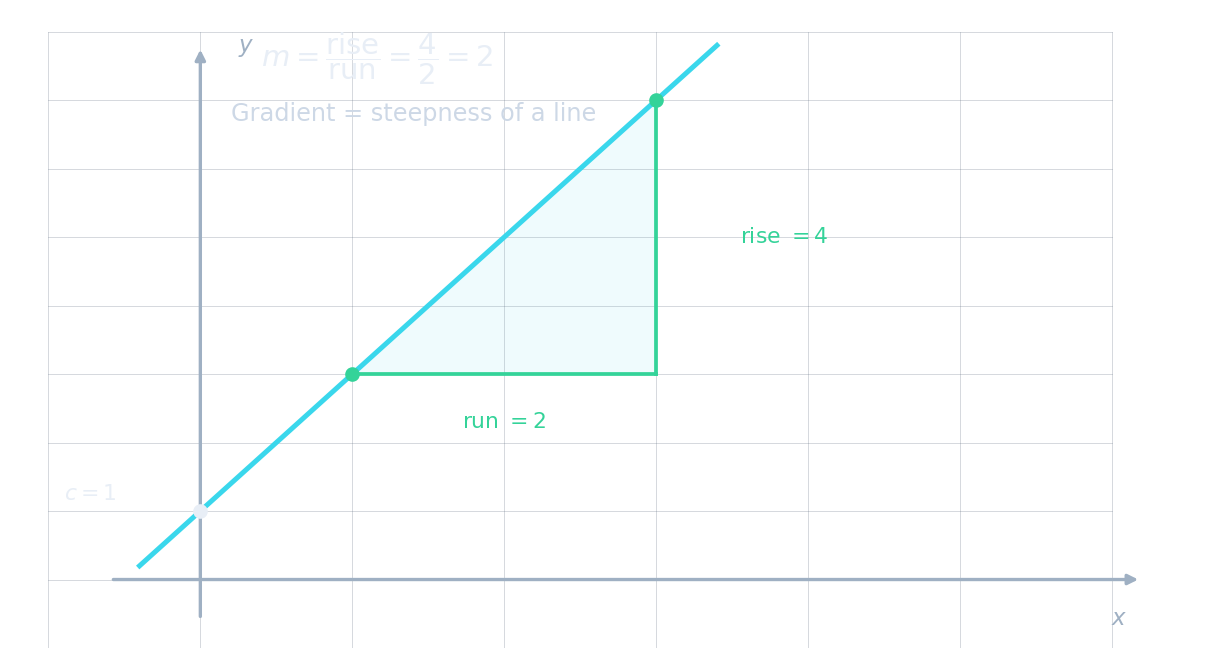
El triángulo de pendiente: cuente los cuadrados hacia arriba (elevación) y hacia los lados (recorrido horizontal), luego divida.
Complete the formula: m = (y₂ − y₁) / (? − x₁). · Complete la fórmula: m = (y₂ − y₁) / (? − x₁).
The full formula is m = (y₂ − y₁) / (x₂ − x₁). The denominator is the change in x, which is x₂ − x₁. · La fórmula completa es m = (y₂ − y₁) / (x₂ − x₁). El denominador es el cambio en x, que es x₂ − x₁.
Worked example
- Find the gradient of the line through $(1, 2)$ and $(4, 11)$.
- Rise $= 11 - 2 = 9$; run $= 4 - 1 = 3$.
- $m = \dfrac{9}{3} = 3$.
- The line climbs $3$ units up for every $1$ unit across — quite steep.
Quick check. Through $(0, 1)$ and $(2, 7)$: rise $= 7 - 1 = 6$, run $= 2 - 0 = 2$, so $m = \dfrac{6}{2} = 3$. Same gradient, same steepness — different line.
Ejemplo resuelto
- Encuentre la pendiente de la recta que pasa por $(1, 2)$ y $(4, 11)$.
- Ascenso $= 11 - 2 = 9$; avance $= 4 - 1 = 3$.
- $m = \dfrac{9}{3} = 3$.
- La recta asciende $3$ unidades hacia arriba por cada $1$ unidad hacia adelante — bastante pronunciada.
Comprobación rápida. A través de $(0, 1)$ y $(2, 7)$: ascenso $= 7 - 1 = 6$, recorrido $= 2 - 0 = 2$, por lo tanto $m = \dfrac{6}{2} = 3$. Misma pendiente, misma inclinación — línea diferente.
Find the gradient of the line through (1, 2) and (4, 11). · Encuentre la pendiente de la recta que pasa por (1, 2) y (4, 11).
(11 − 2)/(4 − 1) = 9/3 = 3.
Find the gradient of the line through (0, 1) and (2, 7). · Encuentre la pendiente de la recta que pasa por (0, 1) y (2, 7).
(7 − 1)/(2 − 0) = 6/2 = 3.
The subtraction trap
- You must subtract in the same order for both coordinates:
- $(y_2 - y_1)$ paired with $(x_2 - x_1)$, or $(y_1 - y_2)$ paired with $(x_1 - x_2)$.
- Mixing the order flips the sign and gives the wrong gradient.
Common mistake. Through $(1, 2)$ and $(4, 11)$: if you write $\dfrac{11 - 2}{1 - 4} = \dfrac{9}{-3} = -3$ you mixed the order — you took $y_2 - y_1$ on top but $x_1 - x_2$ on the bottom. Pick one point to be "first" and stick with it.
La trampa de la resta
- Debes restar en el mismo orden para ambas coordenadas:
- $(y_2 - y_1)$ con $(x_2 - x_1)$, o $(y_1 - y_2)$ con $(x_1 - x_2)$.
- Mezclar el orden invierte el signo y produce la pendiente incorrecta.
Error común. A través de $(1, 2)$ y $(4, 11)$: si escribes $\dfrac{11 - 2}{1 - 4} = \dfrac{9}{-3} = -3$, has mezclado el orden — pusiste $y_2 - y_1$ arriba pero $x_1 - x_2$ abajo. Elige un punto para ser el "primero" y mantén ese criterio.
Gradient in the real world
- Road signs show gradient as a percentage: a 10% hill rises 10 m for every 100 m along.
- Wheelchair ramps must have a gradient of at most $\dfrac{1}{12}$ (about 8%) — that's building code in many countries.
- Roof pitch is a gradient too — steeper roofs shed rain faster.
Gradiente en la vida real
- Las señales de tráfico muestran el gradiente como porcentaje: una colina del 10 % sube 10 m por cada 100 m recorridos.
- Las rampas para sillas de ruedas deben tener una pendiente como máximo de $\dfrac{1}{12}$ (aproximadamente 8%) — ese es el código de construcción en muchos países.
- La pendiente del techo también es una pendiente: los techos más empinados evacuan la lluvia más rápido.
Match each description to the correct gradient property. · Empareje cada descripción con la propiedad correcta de la pendiente.
Positive = rising rightward; zero = flat; negative = falling rightward; a larger magnitude means a steeper slope. · Positiva = ascendente hacia la derecha; cero = plana; negativa = descendente hacia la derecha; una mayor magnitud indica una pendiente más inclinada.
You've got it
- gradient $m = \dfrac{\text{rise}}{\text{run}} = \dfrac{y_2 - y_1}{x_2 - x_1}$
- positive gradient → line goes up to the right; negative → down to the right; zero → horizontal
- subtract in the same order for both coordinates — mixing up the order flips the sign
- through $(1,2)$ and $(4,11)$: $m = \dfrac{9}{3} = 3$
Lo has entendido
- gradiente $m = \dfrac{\text{rise}}{\text{run}} = \dfrac{y_2 - y_1}{x_2 - x_1}$
- gradiente positivo → la línea sube hacia la derecha; negativo → baja hacia la derecha; cero → horizontal
- resta en el mismo orden para ambas coordenadas: si cambias el orden, se invierte el signo
- a través de $(1,2)$ y $(4,11)$: $m = \dfrac{9}{3} = 3$