Direct and inverse proportion · Proporción directa e inversa
| English | Español |
|---|---|
| direct proportion/daɪˈrekt prəˈpɔːʃn/ | proporcionalidad directa |
| constant of proportionality/ˈkɒnstənt ɒv prəˌpɔːʃəˈnælɪti/ | constante de proporcionalidad |
| inverse proportion/ɪnˈvɜːs prəˈpɔːʃn/ | proporcionalidad inversa |
The golden ratio of recipes
- A pancake recipe for 4 needs 200 g flour. How much for 10 people? $200 \div 4 = 50$ g per person, $50 \times 10 = 500$ g.
- That's direct proportion 正比例: double the people, double the flour. The ratio stays the same.
Direct proportion · Proporcionalidad directa
- $y \propto x$ means $y = kx$ for some constant $k$ (the constant of proportionality 比例常数).
- If $y$ doubles, $x$ doubles too — they scale together.
- Find $k$ from a known pair, then use it.
$y \propto x$, $y = 12$ at $x = 3$. $k = \dfrac{12}{3} = 4$, so $y = 4x$. At $x = 7$: $y = 28$.
Inverse proportion · Proporción inversa
y = a/x
Inverse proportion: as x doubles, y halves — a reciprocal curve with two asymptotes. · Proporción inversa: cuando x se duplica, y se reduce a la mitad — una curva recíproca con dos asíntotas.
y is directly proportional to x, and y = 12 when x = 3. Find y when x = 7. · y es directamente proporcional a x, y y = 12 cuando x = 3. Encuentra y cuando x = 7.
k = 12/3 = 4, so y = 4x; at x = 7, y = 28. · k = 12/3 = 4, por lo tanto y = 4x; en x = 7, y = 28.
You find the constant of proportionality k from a known pair of values. · Encuentras la constante de proporcionalidad k a partir de un par de valores conocidos.
Substitute the known x and y to solve for k, then use the rule. · Sustituye los valores conocidos de x e y para resolver k, luego usa la regla.
Inverse proportion · Proporción inversa 反比例
- $y \propto \dfrac{1}{x}$ means $y = \dfrac{k}{x}$ — as one rises, the other falls.
- More workers → less time. More speed → less travel time.
Don't confuse the two. Direct: $y$ goes up · arriba as $x$ goes up ($y = kx$). Inverse: $y$ goes down · hacia abajo as $x$ goes up ($y = k/x$). The graph shapes are very different.
Inverse proportion y ∝ 1/x means: · La proporción inversa y ∝ 1/x significa:
Inverse proportion: as x rises, y falls, given by y = k/x. · Proporción inversa: a medida que x aumenta, y disminuye, dada por y = k/x.
y ∝ 1/x, and y = 6 when x = 4. Find y when x = 12. · y ∝ 1/x, y y = 6 cuando x = 4. Encuentra y cuando x = 12.
6 = k/4 → k = 24. At x = 12: y = 24/12 = 2. · 6 = k/4 → k = 24. En x = 12: y = 24/12 = 2.
Proportion to powers and roots
- Proportion can be to a square, cube, or square root:
- $y \propto x^2$: $y = kx^2$. If $x$ doubles, $y$ quadruples.
- $y \propto \sqrt{x}$: $y = k\sqrt{x}$.
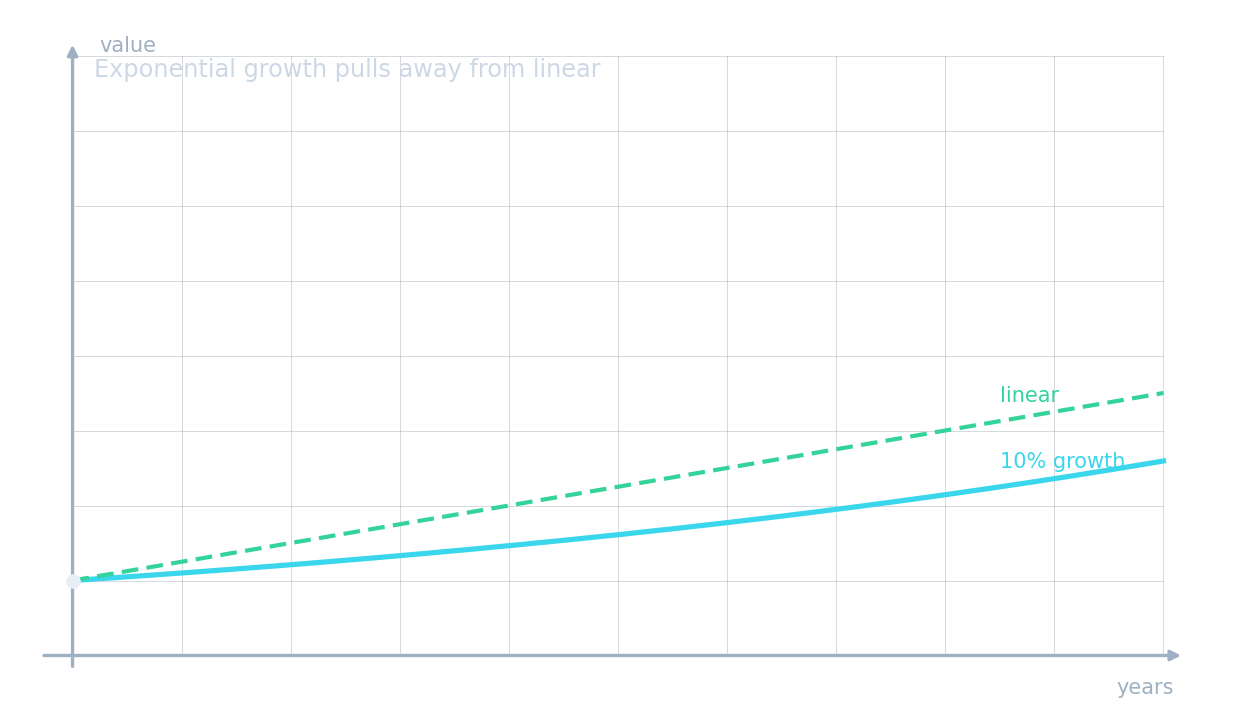
Direct proportion is a straight line through the origin. Non-linear proportion (to a square, cube, or root) curves away.
Worked example · Ejemplo resuelto
- $y \propto x^2$, and $y = 50$ when $x = 5$. Find $y$ when $x = 8$.
- $50 = k(5^2) = 25k \Rightarrow k = 2$.
- $y = 2(8^2) = 2(64) = 128$.
y ∝ x², and y = 50 when x = 5. Find y when x = 8. · y ∝ x², y y = 50 cuando x = 5. Encuentra y cuando x = 8.
50 = k(25) → k = 2. At x = 8: y = 2(64) = 128. · 50 = k(25) → k = 2. En x = 8: y = 2(64) = 128.
Match each proportion statement to its equation. · Empareja cada afirmación de proporcionalidad con su ecuación.
Direct: y = kx. Inverse: y = k/x. Proportional to x²: y = kx². Proportional to √x: y = k√x. · Directa: y = kx. Inversa: y = k/x. Proporcional a x²: y = kx². Proporcional a √x: y = k√x.
An inverse calculation
- Six equally productive workers take 10 days. With fixed work, $t=k/w$, so $k=tw=10(6)=60$ worker-days.
- Ten workers take $t=60/10=6$ days, assuming equal productivity. Do not use direct proportion: more workers should reduce the time.
Six workers take 10 days. At the same productivity, how many days do 10 workers take? · Seis trabajadores tardan 10 días. A la misma productividad, ¿cuántos días tardan 10 trabajadores?
The fixed work is 60 worker-days; 60 / 10 = 6 days. · El trabajo fijo es 60 jornada-trabajador; 60 / 10 = 6 días.
You've got it
- direct: $y = kx$; inverse: $y = \dfrac{k}{x}$
- find $k$ from a known pair, then substitute
- proportion can also be to a square ($kx^2$), cube ($kx^3$), or root ($k\sqrt{x}$)