Algebra basics and manipulation · Bases del álgebra y manipulación
| English | Español |
|---|---|
| algebra/ˈældʒɪbrə/ | álgebra |
| variable/ˈveərɪəbl/ | variable |
| substitute/ˈsʌbstɪtjuːt/ | sustituir |
| like terms/laɪk tɜːmz/ | términos semejantes |
| expanding/ekˈspændɪŋ/ | expansiva |
| factorising/ˈfæktəraɪzɪŋ/ | factorización |
| difference of two squares/ˈdɪfrəns ɒv tuː skweəz/ | diferencia de dos cuadrados |
The language of the unknown
- Al-Khwarizmi, a 9th-century Persian mathematician, wrote the first book on "al-jabr" — restoring and balancing. That's where "algebra 代数" comes from.
- He used words instead of letters. We use letters because they're faster — and because a single letter can stand for any number.
El lenguaje de lo desconocido
- Al-Khwarizmi, un matemático persa del siglo 9, escribió el primer libro sobre "al-jabr" — restauración y equilibrio. De ahí proviene la palabra "álgebra".
- Él usaba palabras en lugar de letras. Nosotros usamos letras porque son más rápidas — y porque una sola letra puede representar cualquier número.
Algebra manipulation route · Ruta de manipulación algebraica
Follow expression work from collecting terms to solving. · Seguir el trabajo con expresiones desde la agrupación de términos hasta la resolución.
Variables 变量 and substitution
- A variable is a letter that stands for a number. Its value can change.
- To substitute 代入 means to replace a letter with a specific number.
- Example: $3x^2 - 2y$ at $x = 4$, $y = 5$: $\;3(4)^2 - 2(5) = 48 - 10 = 38$.
Square first, then multiply. $3x^2$ at $x = 4$ is $3 \times 16 = 48$, not $(3 \times 4)^2 = 144$. Indices apply only to the letter immediately before them.
Collecting like terms: add terms with the same letter
Variables y sustitución
- Una variable es una letra que representa un número. Su valor puede cambiar.
- Sustituir significa reemplazar una letra por un número específico.
- Ejemplo: $3x^2 - 2y$ con $x = 4$, $y = 5$: $\;3(4)^2 - 2(5) = 48 - 10 = 38$.
Elevar al cuadrado primero, luego multiplicar. $3x^2$ cuando $x = 4$ es $3 \times 16 = 48$, no $(3 \times 4)^2 = 144$. Los exponentes se aplican solo a la letra inmediatamente anterior a ellos.

Reuniendo términos semejantes: sumar términos con la misma letra
Find the value of 3x² − 2y when x = 4 and y = 5. · Encontrar el valor de 3x² − 2y cuando x = 4 y y = 5.
3 × 4² − 2 × 5 = 3 × 16 − 10 = 48 − 10 = 38.
Collecting like terms 同类项
- Like terms have the same letter(s) raised to the same power(s).
- $2a^2 + 5a^2 = 7a^2$ (same letter, same power — collect them).
- $3x + 2y$ cannot be simplified — different letters.
Agrupando términos semejantes
- Los términos semejantes tienen las mismas letra(s) elevada(s) a la(s) misma(s) potencia(s).
- $2a^2 + 5a^2 = 7a^2$ (misma letra, misma potencia — se reúnen).
- $3x + 2y$ no se puede simplificar — letras diferentes.
Simplify 2a² + 5a² + 3a − a. What is the coefficient of a²? · Simplificar 2a² + 5a² + 3a − a. ¿Cuál es el coeficiente de a²?
2a² + 5a² = 7a²; 3a − a = 2a. The coefficient of a² is 7. · 2a² + 5a² = 7a²; 3a − a = 2a. El coeficiente de a² es 7.
Expanding 展开 brackets
- Single bracket: $3(2x + 5) = 6x + 15$.
- Double brackets (FOIL): $(2x + 1)(x - 4) = 2x^2 - 8x + x - 4 = 2x^2 - 7x - 4$.
Quick check. $(x + 3)(x + 5) = x^2 + 5x + 3x + 15 = x^2 + 8x + 15$. The constant term is $3 \times 5 = 15$.
Expandiendo paréntesis
- Paréntesis simple: $3(2x + 5) = 6x + 15$.
- Doble paréntesis (FOIL): $(2x + 1)(x - 4) = 2x^2 - 8x + x - 4 = 2x^2 - 7x - 4$.
Verificación rápida. $(x + 3)(x + 5) = x^2 + 5x + 3x + 15 = x^2 + 8x + 15$. El término independiente es $3 \times 5 = 15$.
Expand (2x + 1)(x − 4) = 2x² + bx + c. What is the constant term c? · Expandir (2x + 1)(x − 4) = 2x² + bx + c. ¿Cuál es el término constante c?
(2x+1)(x−4) = 2x² − 8x + x − 4 = 2x² − 7x − 4, so c = −4. · (2x+1)(x−4) = 2x² − 8x + x − 4 = 2x² − 7x − 4, por lo tanto c = −4.
(x + 3)(x + 5) = x² + 8x + 15.
x² + 5x + 3x + 15 = x² + 8x + 15. ✓
Factorising 因式分解
- Factorising is the reverse of expanding — write as a product.
- Common factor: $9x^2 + 15xy = 3x(3x + 5y)$.
- Extended quadratic factorisation: $x^2 + 5x + 6 = (x + 2)(x + 3)$.
- Extended difference of two squares 平方差: $9x^2 - 16 = (3x + 4)(3x - 4)$.
Factorising a difference of two squares ($a^2 - b^2$) is like comparing two square areas.
Factorización
- Factorizar es lo opuesto a expandir — escribir como un producto.
- Factor común: $9x^2 + 15xy = 3x(3x + 5y)$.
- Factorización cuadrática extendida: $x^2 + 5x + 6 = (x + 2)(x + 3)$.
- Diferencia de dos cuadrados extendida: $9x^2 - 16 = (3x + 4)(3x - 4)$.
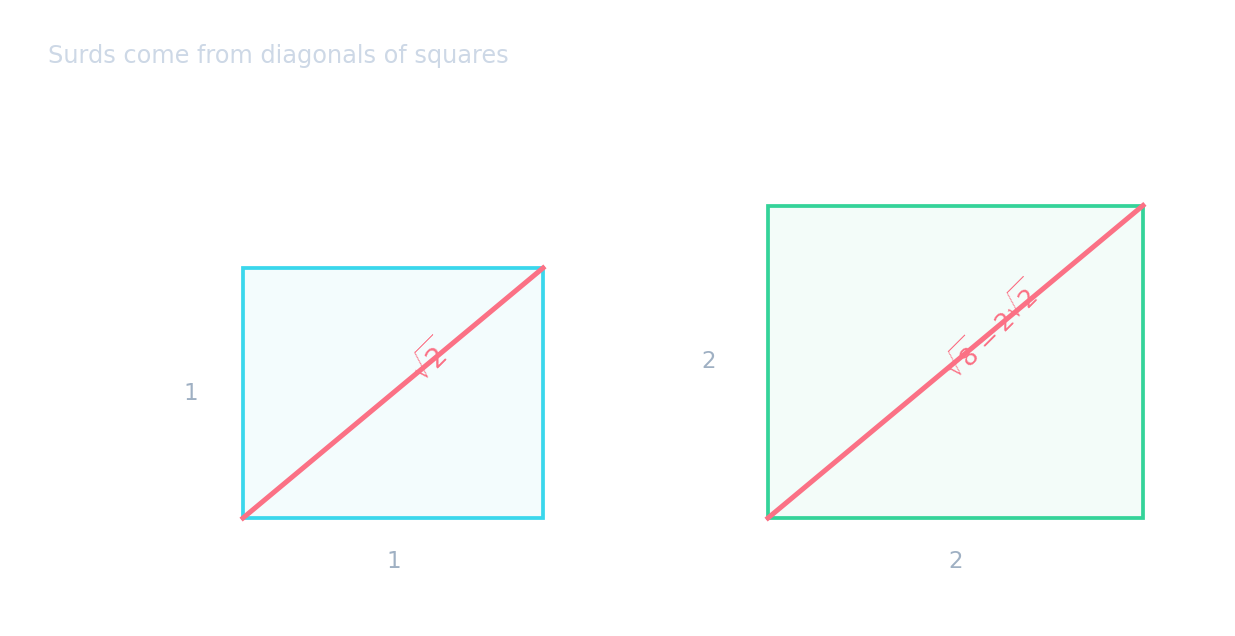
Factorizar una diferencia de dos cuadrados ($a^2 - b^2$) es como comparar dos áreas cuadradas.
Factorise the difference of two squares 9x² − 16. · Factorizar la diferencia de dos cuadrados 9x² − 16.
a² − b² = (a+b)(a−b), with a = 3x, b = 4. · a² − b² = (a+b)(a−b), con a = 3x, b = 4.
Match each expression to its factorisation. · Emparejar cada expresión con su factorización.
x²+7x+10: factors of 10 that add to 7 are 2 and 5. x²−9 = x²−3². 6x+9: HCF is 3. x²+4x+4 is a perfect square. · x²+7x+10: factores de 10 que suman 7 son 2 y 5. x²−9 = x²−3². 6x+9: MCD es 3. x²+4x+4 es un trinomio cuadrado perfecto.
You've got it
- substitute numbers for letters; collect like terms
- expand = multiply out brackets; factorise = write as a product
- (Extended) $a^2 - b^2 = (a+b)(a-b)$ — the difference of two squares
Lo has entendido
- sustituir números por letras; reunir términos semejantes
- expandir = multiplicar los paréntesis; factorizar = escribir como un producto
- (Extendido) $a^2 - b^2 = (a+b)(a-b)$ — la diferencia de dos cuadrados