Opportunity cost · Costo de oportunidad
| English | Español |
|---|---|
| opportunity cost/ɒpəˈtjuːnɪti kɒst/ | costo de oportunidad |
| next best alternative/nekst best ɔːlˈtɜːnətɪv/ | mejor alternativa descartada |
| consumers/kənˈsuːməz/ | los consumidores |
| producers/prəˈdjuːsəz/ | los productores |
| trade-off/treɪd ɒf/ | compromiso |
Every choice has a cost
- Spend your savings on a holiday and you can't also spend it on a bike. Choosing one means giving up the other.
- That sacrifice — the opportunity cost 机会成本 — is one of the most important ideas in economics.
Cada elección tiene un costo
- Si gastas tus ahorros en unas vacaciones, no podrás usarlos también para comprar una bicicleta. Elegir una significa renunciar a la otra.
- Ese sacrificio —el costo de oportunidad (opportunity cost)— es una de las ideas más importantes en economía.
Opportunity cost is: · El costo de oportunidad es:
It is the single next-best alternative sacrificed. · Es la única siguiente mejor alternativa sacrificada.
Opportunity cost is the value of the ______ best alternative given up. · El costo de oportunidad es el valor de la ______ mejor alternativa放弃.
The single next-best alternative. · La única siguiente mejor alternativa.
What opportunity cost is
- Opportunity cost = the next best alternative 次优选择 you give up when you make a choice.
- It applies to everyone: consumers 消费者, producers 生产者 and governments.
Worked example. A government spends its budget on a new hospital instead of a new school. The opportunity cost is the school it gave up.
Points on, inside and outside the production possibility curve
¿Qué es el costo de oportunidad?
- Costo de oportunidad = la alternativa siguiente mejor que se放弃 cuando se toma una decisión.
- Se aplica a todos: consumidores, productores y gobiernos.
Ejemplo resuelto. Un gobierno destina su presupuesto a construir un nuevo hospital en lugar de una nueva escuela. El costo de oportunidad es la escuela que se放弃了.
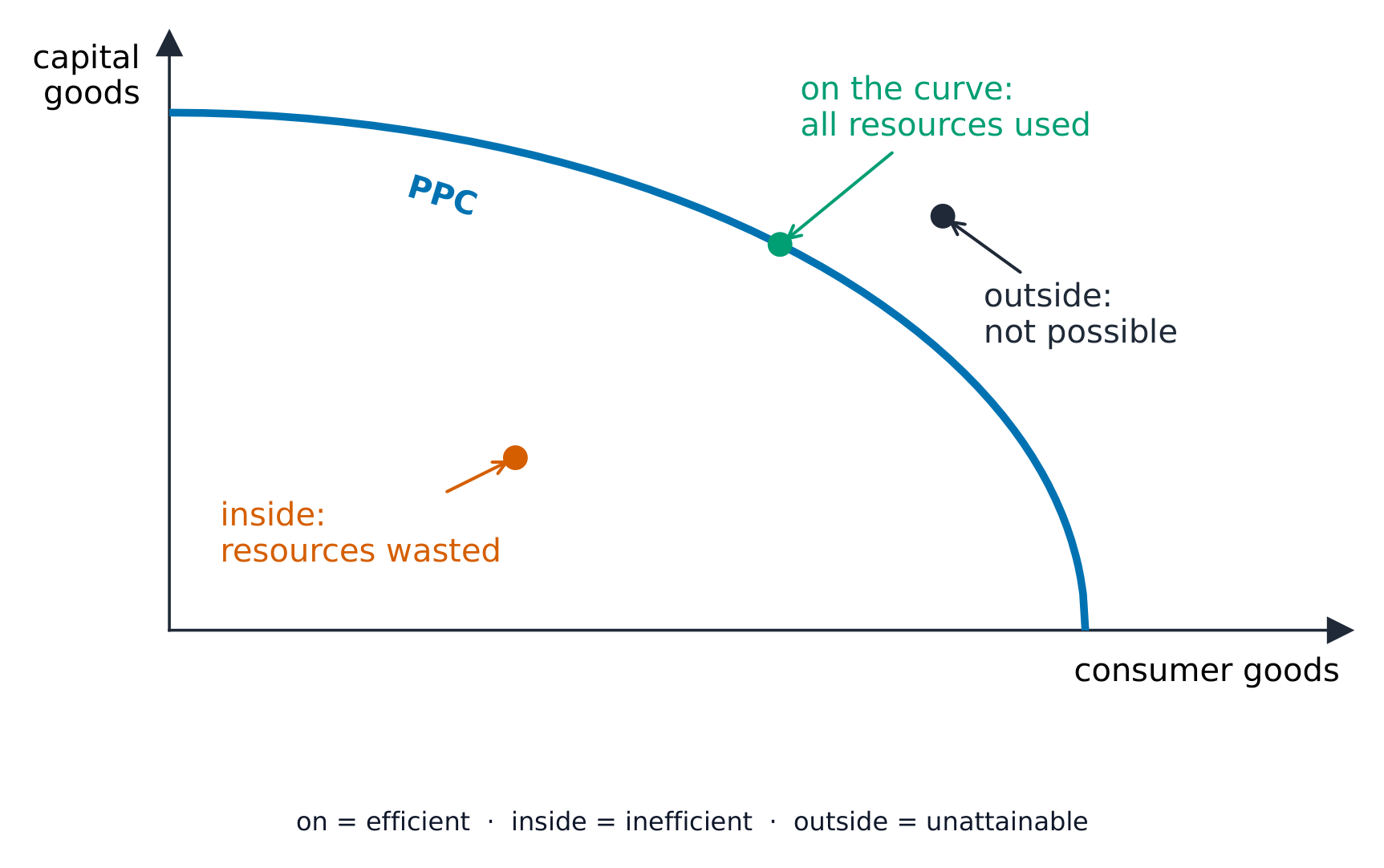
Puntos sobre, dentro y fuera de la curva de posibilidades de producción
Opportunity cost on the frontier · Costo de oportunidad en la frontera
Moving along the frontier, gaining more of one good always means giving up some of the other — that sacrifice is the opportunity cost. · Moverse a lo largo de la frontera, obtener más de un bien siempre significa renunciar a algo del otro —ese sacrificio es el costo de oportunidad.
A government builds a hospital instead of a school. The opportunity cost is: · Un gobierno construye un hospital en lugar de una escuela. El costo de oportunidad es:
The opportunity cost is the next best use of the budget — the school. · El costo de oportunidad es el siguiente mejor uso del presupuesto: la escuela.
Opportunity cost for everyone
- Consumers: a phone vs a holiday.
- Producers: making cars vs making trucks with the same factory.
- Governments: hospitals vs schools with the same budget.
Choosing one thing means giving up the next best alternative
Costo de oportunidad para todos
- Consumidores: un teléfono vs. unas vacaciones.
- Productores: fabricar autos vs. fabricar camiones con la misma fábrica.
- Gobiernos: hospitales vs. escuelas con el mismo presupuesto.

Elegir una cosa significa renunciar a la siguiente mejor alternativa
Opportunity cost applies to consumers, producers and governments. · El costo de oportunidad se aplica a consumidores, productores y gobiernos.
Anyone making a choice with scarce resources faces an opportunity cost. · Cualquiera que tome decisiones con recursos escaso enfrenta un costo de oportunidad.
Why it matters
- Thinking in opportunity cost forces you to compare the real trade-off 取舍, not just the money price.
- Good decisions weigh what you gain against what you give up.
Opportunity cost is the single best alternative, not all of them. If you skip studying to watch a film, nap or walk, the cost is just the one you'd most have wanted — not all three.
Por qué importa
- Pensar en términos de costo de oportunidad te obliga a comparar el verdadero compromiso (trade-off), no solo el precio monetario.
- Las buenas decisiones ponderan lo que ganas frente a lo que renuncias.
El costo de oportunidad es la única alternativa siguiente mejor, no todas ellas. Si dejas de estudiar para ver una película, dormir una siesta o dar un paseo, el costo es solo la una que más habrías querido hacer —no las tres.
Opportunity cost is useful because it measures: · El costo de oportunidad es útil porque mide:
It compares what you gain with what you give up. · Compara lo que se gana con lo que se放弃.
You've got it
- opportunity cost = the next best alternative given up
- it applies to consumers, producers and governments alike
- it captures the real trade-off, not just the money price
Lo has entendido
- costo de oportunidad = la alternativa siguiente mejor renunciada
- se aplica tanto a consumidores, productores como a gobiernos
- refleja el verdadero compromiso, no solo el precio monetario