Circuits with Resistors and Inductors (LR Circuits) · Circuitos con Resistencias e Inductores (Circuitos LR)
| English | Español |
|---|---|
| inductor/ɪnˈdʌktə/ | inductor |
Flip the switch and the current takes its time to rise
- Close a switch on a plain resistor and the current jumps up instantly.
- Add an inductor 电感器 and the current climbs gradually instead.
- The inductor's back-EMF fights the sudden change, slowing the rise.
- A resistor and inductor together make an LR circuit — the magnetic cousin of RC.
Al cerrar el interruptor, la corriente tarda en aumentar
- Al cerrar un interruptor en una resistencia simple, la corriente sube instantáneamente.
- Si se añade un inductor 电感器, la corriente asciende de forma gradual.
- La fuerza contraelectromotriz (f.c.e.m.) del inductor se opone al cambio repentino, frenando el aumento.
- Una resistencia y un inductor juntos forman un circuito LR, el pariente magnético del circuito RC.
The current rises exponentially
- Close the switch and the current climbs: $I(t) = \dfrac{\varepsilon}{R}\left(1 - e^{-t/\tau}\right)$.
- It starts at zero, rises fast, then eases toward its final value $\varepsilon/R$.
- The inductor's opposition is strongest at the start and fades as $I$ steadies.
- The shape is the same exponential curve as an RC charging capacitor.
La corriente aumenta exponencialmente
- Al cerrar el interruptor, la corriente asciende según: $I(t) = \dfrac{\varepsilon}{R}\left(1 - e^{-t/\tau}\right)$.
- Comienza en cero, sube rápidamente y luego se estabiliza hacia su valor final $\varepsilon/R$.
- La oposición del inductor es máxima al inicio y disminuye a medida que $I$ se estabiliza.
- La forma de la curva es la misma exponencial que en la carga de un capacitor RC.
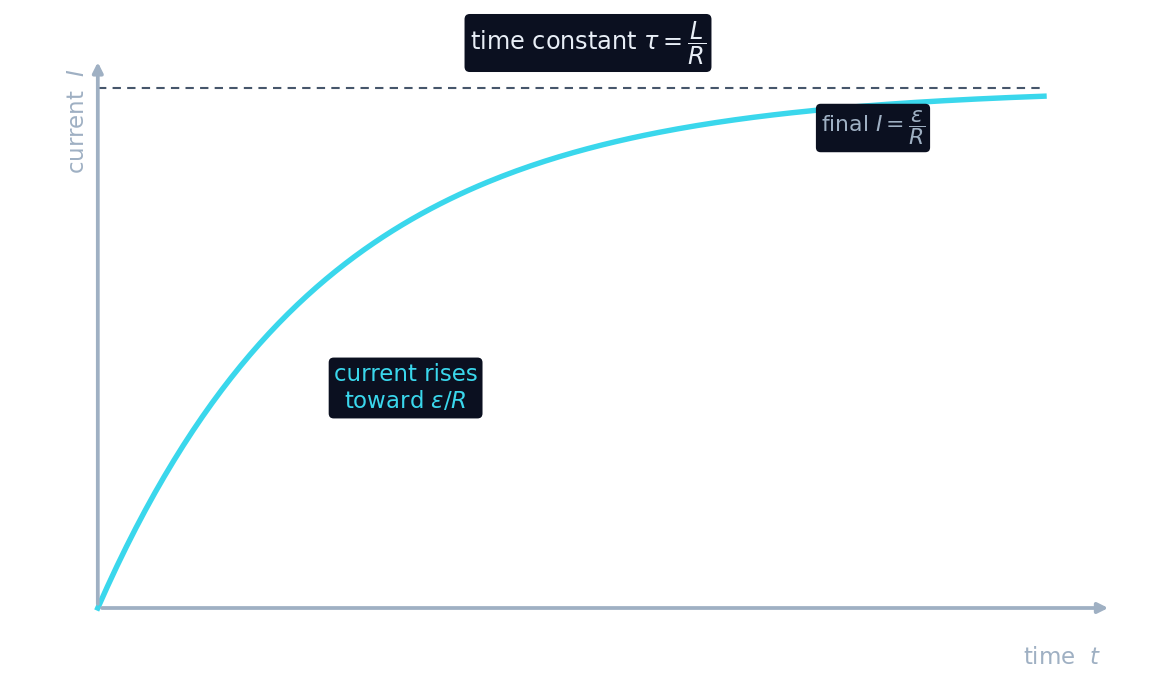
Long after the switch closes, the LR current settles at $\varepsilon/$ ____. · Mucho después de cerrar el interruptor, la corriente LR se estabiliza en $\varepsilon/$ ____.
The final steady current is $\varepsilon/R$ (inductor acts like a wire). · La corriente final en estado estacionario es $\varepsilon/R$ (el inductor actúa como un alambre).
The time constant τ = L/R
- The natural timescale here is $\tau = \dfrac{L}{R}$.
- In one $\tau$, the current reaches about $63\%$ of its final value.
- After about $5\tau$ it is essentially at $\varepsilon/R$.
- A bigger $L$ (more inertia) or smaller $R$ makes the rise slower.
La constante de tiempo τ = L/R
- La escala de tiempo natural aquí es $\tau = \dfrac{L}{R}$.
- En un intervalo de $\tau$, la corriente alcanza aproximadamente el $63\%$ de su valor final.
- Después de unos $5\tau$, se considera esencialmente igual a $\varepsilon/R$.
- Un valor mayor de $L$ (más inercia) o un valor menor de $R$ hacen que el aumento sea más lento.
The time constant of an LR circuit is: · La constante de tiempo de un circuito LR es:
For an LR circuit $\tau = L/R$. · Para un circuito LR $\tau = L/R$.
An LR circuit has $L = 10\ \text{H}$ and · y $R = 5\ \Omega$. Find $\tau$ (in s). · Un circuito LR tiene $L = 10\ \text{H}$ y $R = 5\ \Omega$. Calcule $\tau$ (en s).
$\tau = L/R = 10/5 = 2\ \text{s}$.
The inductor's two extremes
- At the first instant ($t = 0$): the inductor blocks the change, acting like an open gap (zero current).
- After a long time ($t \to \infty$): the current is steady, so the inductor acts like a plain wire.
- Notice this is the opposite of a capacitor's behaviour.
- Those two limits let you check any LR answer quickly.
Los dos extremos del inductor
- En el instante inicial ($t = 0$): el inductor bloquea el cambio, comportándose como una separación abierta (corriente cero).
- Después de mucho tiempo ($t \to \infty$): la corriente es constante, por lo que el inductor se comporta como un cable simple.
- Observe que esto es lo opuesto al comportamiento de un capacitor.
- Estos dos límites permiten verificar rápidamente cualquier respuesta en un circuito LR.
An LR circuit switching on · Un circuito LR cerrando
An inductor resists sudden change. Sort each fact by the moment it describes. · Un inductor se opone a cambios repentinos. Clasifique cada afirmación según el momento que describe.
At the first instant a switch closes, an inductor acts like: · En el instante inicial en que se cierra un interruptor, un inductor actúa como:
It blocks the sudden change, so at $t=0$ the current is zero (open gap). · Bloquea el cambio repentino, por lo que en $t=0$ la corriente es cero (brecha abierta).
An inductor's early and late behaviour is the reverse of a capacitor's. · El comportamiento temprano y tardío de un inductor es lo opuesto al de un capacitor.
Inductor: open then wire. Capacitor: wire then open. They are reversed. · Inductor: abierto luego alambre. Capacitor: alambre luego abierto. Están invertidos.
Switching off can spark
- Open the switch and the current tries to drop to zero at once.
- The inductor fights that huge $dI/dt$ with a large back-EMF.
- That surge can jump the switch gap as a spark.
- It is why circuits with big coils need protection when switched off.
Apagar puede generar chispas
- Al abrir el interruptor, la corriente intenta caer a cero de golpe.
- El inductor se opone a ese gran $dI/dt$ mediante una alta f.c.e.m.
- Ese pico puede saltar la separación del interruptor generando una chispa.
- Por eso los circuitos con bobinas grandes requieren protección al desconectarse.
Select all · todos true statements about LR circuits. · Seleccione todas las afirmaciones verdaderas sobre circuitos LR.
Exponential rise, τ = L/R, blocked at t = 0. The rise is gradual, not instant. · Aumento exponencial, τ = L/R, bloqueado en t = 0. El aumento es gradual, no instantáneo.
An LR circuit has $L = 6\ \text{H}$ and $R = 2\ \Omega$. Find its time constant.
- $\tau = \dfrac{L}{R} = \dfrac{6}{2} = 3\ \text{s}$.
- After $3\ \text{s}$ the current is about $63\%$ of $\varepsilon/R$.
Un circuito LR tiene $L = 6\ \text{H}$ y $R = 2\ \Omega$. Encuentre su constante de tiempo.
- $\tau = \dfrac{L}{R} = \dfrac{6}{2} = 3\ \text{s}$.
- Pasados $3\ \text{s}$, la corriente es aproximadamente el $63\%$ de $\varepsilon/R$.
An inductor's limits are the reverse of a capacitor's. At $t = 0$ an inductor acts like an open gap (blocks current), and at $t \to \infty$ like a plain wire. Swapping these — or confusing them with the capacitor's — is the classic LR mistake.
Los límites de un inductor son el opuesto a los de un capacitor. En $t = 0$, un inductor actúa como una separación abierta (bloquea la corriente), y en $t \to \infty$ como un cable simple. Intercambiar estos valores —o confundirlos con los de un capacitor— es el error clásico en circuitos LR.
In an LR circuit, the current rises as $I = \tfrac{\varepsilon}{R}(1 - e^{-t/\tau})$ with time constant $\tau = L/R$ (about $63\%$ per $\tau$). At $t=0$ the inductor acts like an open gap, and at $t\to\infty$ like a wire — the reverse of a capacitor.
En un circuito LR, la corriente aumenta según $I = \tfrac{\varepsilon}{R}(1 - e^{-t/\tau})$ con constante de tiempo $\tau = L/R$ (aproximadamente $63\%$ por cada $\tau$). En $t=0$ el inductor actúa como una separación abierta, y en $t\to\infty$ como un cable; lo opuesto a un capacitor.