Redistribution of Charge Between Conductors · Redistribución de Carga entre Conductores
| English | Español |
|---|---|
| grounding/ˈɡraʊndɪŋ/ | conexión a tierra |
| surface charge density/ˈsɜːfɪs tʃɑːdʒ ˈdensɪti/ | densidad superficial de carga |
Connect a big sphere to a small one — who gets more charge?
- Join two charged conductors with a wire and charge suddenly flows.
- It keeps flowing until something between them is equal.
- That something is potential, not charge — a subtle but key point.
- Get this right and you understand grounding, sharing, and lightning rods.
Conectar una esfera grande a una pequeña — ¿quién recibe más carga?
- Une dos conductores cargados con un alambre y la carga fluye de repente.
- Este flujo continúa hasta que algo entre ellos se iguala.
- Ese "algo" es el potencial, no la carga: un matiz pero punto clave.
- Entender esto bien te permite comprender la puesta a tierra, el reparto de carga y los pararrayos.
They end at the same potential
- Charge flows from high potential to low, just like water finding its level.
- It stops when both conductors sit at the same $V$.
- At that moment no potential difference remains to push charge.
- Equal potential — not equal charge — is the end state.
Terminan al mismo potencial
- La carga fluye del potencial alto al bajo, igual que el agua buscando su nivel.
- Deja de fluir cuando ambos conductores están al mismo $V$.
- En ese momento ya no queda diferencia de potencial para empujar la carga.
- El estado final es igual potencial — no igual carga.
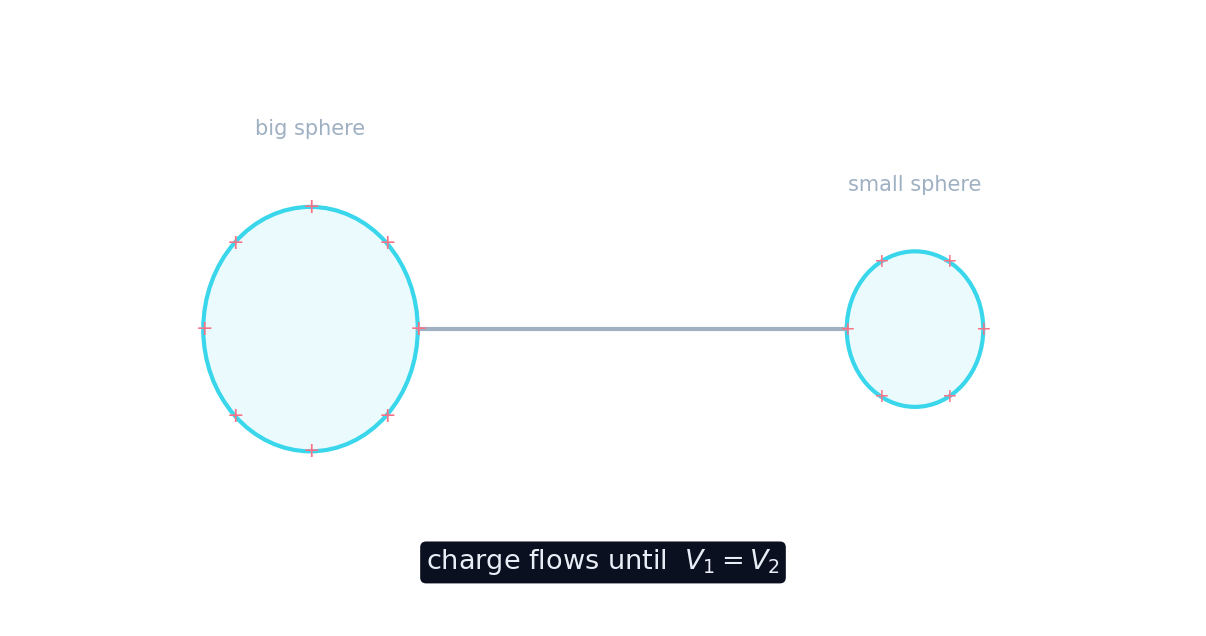
When two conductors are connected, charge flows until they have equal: · Cuando dos conductores están conectados, la carga fluye hasta que tienen igual:
Charge flows until the potentials are equal — no push remains. · La carga fluye hasta que los potenciales son iguales — no queda ninguna fuerza impulsora.
Bigger conductors hold more charge
- For a sphere, $V = \dfrac{kQ}{R}$, so equal $V$ means $Q \propto R$.
- The bigger sphere ends up with the larger share of charge.
- Double the radius and it holds double the charge at the same potential.
- Size sets how much charge a conductor can hold per volt.
Los conductores más grandes almacenan más carga
- Para una esfera, $V = \dfrac{kQ}{R}$, por lo tanto igual $V$ significa $Q \propto R$.
- La esfera grande termina con la parte más grande de carga.
- Si duplicas el radio, almacena el doble de carga al mismo potencial.
- El tamaño determina cuánta carga puede sostener un conductor por voltio.
At equal potential, the larger sphere holds more charge ($Q \propto R$). · A igual potencial, la esfera más grande sostiene más carga ($Q \propto R$).
$V = kQ/R$ equal means $Q \propto R$ — bigger holds more. · $V = kQ/R$ igual significa $Q \propto R$ — la mayor sostiene más.
A radius-$3R$ sphere shares charge with a radius-$R$ sphere. The big one holds how many times the charge of the small one? · Una esfera de radio-$3R$ comparte carga con una esfera de radio-$R$. ¿Cuántas veces la carga de la pequeña sostiene la grande?
$Q \propto R$, so the $3R$ sphere holds $3\times$ the charge. · $Q \propto R$, por lo tanto la esfera de $3R$ sostiene $3\times$ la carga.
But the small one has denser charge
- Surface charge density 面电荷密度 is $\sigma \propto \dfrac{1}{R}$ — higher on the smaller sphere.
- So the small, sharp conductor has the stronger surface field.
- That is the lightning-rod effect again: sharp $=$ dense $=$ strong field.
- Big total charge and high density live on different conductors.
Pero la pequeña tiene mayor densidad de carga
- La densidad superficial de carga 面电荷密度 es $\sigma \propto \dfrac{1}{R}$ — mayor en la esfera pequeña.
- Por eso, el conductor pequeño y puntiagudo tiene el campo superficial más fuerte.
- Esto es nuevamente el efecto pararrayo: punta estrecha $=$ alta densidad $=$ campo intenso.
- Una gran carga total y una alta densidad residen en conductores diferentes.
Sharing charge between conductors · Compartir carga entre conductores
When two conductors are connected, charge flows until they reach the same potential. · Cuando dos conductores están conectados, la carga fluye hasta que alcanzan el mismo potencial.
Which conductor has the higher surface charge density? · ¿Qué conductor tiene mayor densidad de carga superficial?
$\sigma \propto 1/R$, so the smaller conductor is denser. · $\sigma \propto 1/R$, así que el conductor más pequeño es más denso.
Select all · todos true statements about connected conductors. · Seleccione todas las afirmaciones verdaderas sobre conductores conectados.
Equal potential, $Q \propto R$, $\sigma \propto 1/R$. The split is by size, not 50/50. · Igual potencial, $Q \propto R$, $\sigma \propto 1/R$. La división es proporcional al tamaño, no 50/50.
Grounding is sharing with the Earth
- Grounding 接地 connects a conductor to the enormous Earth.
- The Earth is so big it holds any charge at essentially $V = 0$.
- Charge flows until the conductor also reaches $V = 0$.
- That is how induction charging "drains" the unwanted sign.
La puesta a tierra es compartir con la Tierra
- La puesta a tierra 接地 conecta un conductor con la inmensa Tierra.
- La Tierra es tan grande que puede contener cualquier carga esencialmente a $V = 0$.
- La carga fluye hasta que el conductor también alcanza $V = 0$.
- Así es como la carga por inducción "drena" el signo no deseado.
Grounding connects a conductor to the Earth, pulling it to a potential of ____. · Poner a tierra conecta un conductor a la Tierra, llevando su potencial a ____.
The Earth holds any charge at $V = 0$. · La Tierra absorbe cualquier carga a $V = 0$.
A sphere of radius $2R$ is joined to one of radius $R$, sharing charge.
- Equal potential: $Q \propto R$, so the big sphere holds twice the charge.
- But $\sigma \propto 1/R$, so the small sphere has the denser surface charge.
Una esfera de radio $2R$ se une a otra de radio $R$, compartiendo carga.
- Potencial igual: $Q \propto R$, así que la esfera grande tiene el doble de carga.
- Pero $\sigma \propto 1/R$, así que la esfera pequeña tiene la carga superficial más densa.
Connected conductors share to equal potential, not equal charge. Don't split the charge 50/50 — split it in proportion to size ($Q \propto R$ for spheres), and remember density runs the other way ($\sigma \propto 1/R$).
Los conductores conectados comparten para igualar el potencial, no la carga. No repartan la carga 50/50 — repártanla en proporción al tamaño ($Q \propto R$ para esferas), y recuerden que la densidad va en la dirección opuesta ($\sigma \propto 1/R$).
Connected conductors exchange charge until they reach the same potential. For spheres, $Q \propto R$ (the bigger holds more), while surface density $\sigma \propto 1/R$ (the smaller is denser). Grounding shares with the Earth, pulling a conductor to $V = 0$.
Los conductores conectados intercambian carga hasta alcanzar el mismo potencial. Para esferas, $Q \propto R$ (la grande tiene más), mientras que la densidad superficial $\sigma \propto 1/R$ (la pequeña es más densa). La puesta a tierra comparte con la Tierra, llevando un conductor a $V = 0$.