Electric Charge and the Process of Charging · Carga Eléctrica y el Proceso de Carga
| English | Español |
|---|---|
| electrons/ɪˈlektrɒnz/ | electrones |
| insulators/ˈɪnsjuːleɪtəz/ | aislantes |
| conductor/kənˈdʌktə/ | conductor |
| polarises/ˈpəʊləraɪzɪz/ | polariza |
| ground/ɡraʊnd/ | base |
| conservation of charge/ˌkɒnsəˈveɪʃn ɒv tʃɑːdʒ/ | conservación de la carga |
Three ways to move charge — none of them make new charge
- You can charge an object, but you never create charge.
- Charging just moves electrons 电子 from one place to another.
- One object gains electrons (goes negative); the other loses them (goes positive).
- There are three ways to do it: friction, conduction, and induction.
Tres formas de mover carga — ninguna crea nueva carga
- Puedes cargar un objeto, pero nunca creas carga.
- Cargar simplemente mueve los electrones de un lugar a otro.
- Un objeto gana electrones (se vuelve negativo); el otro los pierde (se vuelve positivo).
- Hay tres formas de hacerlo: fricción, conducción e inducción.
When you charge an object, what actually moves? · Cuando cargas un objeto, ¿qué se mueve realmente?
Charging moves electrons; protons stay locked in the nuclei. · La carga eléctrica mueve electrones; los protones permanecen fijos en los núcleos.
Charging by friction
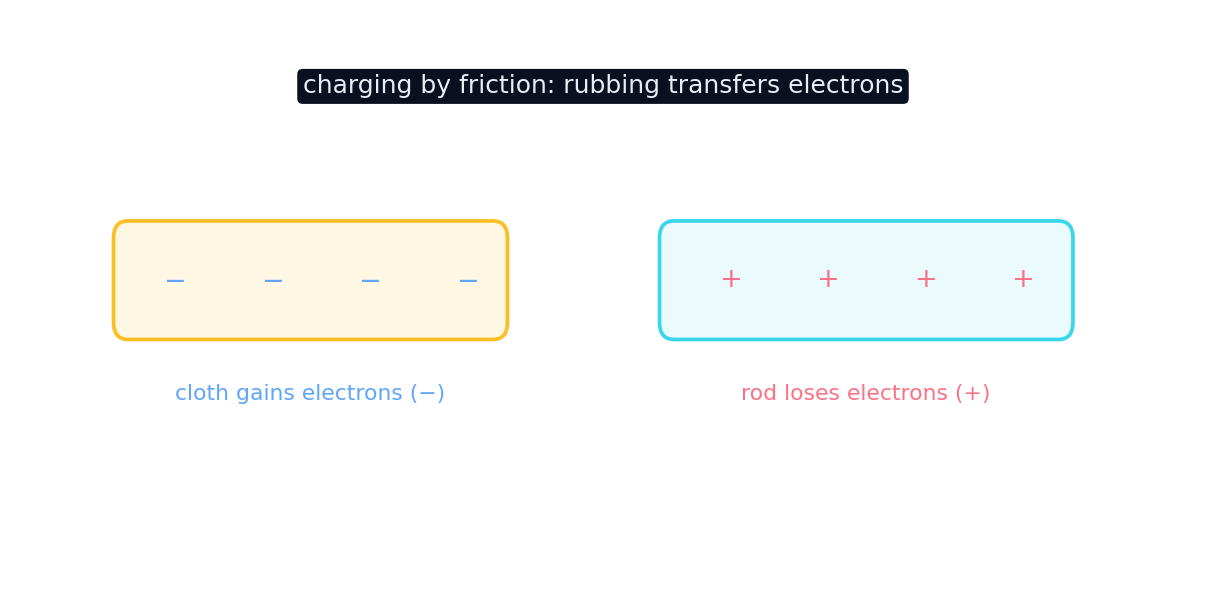
- Rub two different materials together and electrons rub off one onto the other.
- The material that grabs electrons becomes negative; the other becomes positive.
- This works best on insulators 绝缘体 like plastic or hair.
- The charge stays put where it was rubbed — insulators don't let it flow.
Carga por fricción
- Frota dos materiales diferentes y los electrones se desprenden de uno hacia el otro.
- El material que captura electrones queda negativo; el otro queda positivo.
- Esto funciona mejor en aislantes como plástico o cabello.
- La carga permanece en el lugar donde se frotó; los aislantes no permiten que fluya.
Rub and charge · Frotar y cargar
Rub the materials and watch electrons transfer, leaving equal and opposite charges. · Frota los materiales y observa la transferencia de electrones, dejando cargas iguales y opuestas.
A material that does not let charge flow through it is called an ____. · Un material que no permite que la carga fluya a través de él se llama ____."
Insulators (plastic, hair, glass) hold charge where it is placed. · Los aislantes (plástico, cabello, vidrio) retienen la carga donde se colocan.
Charging by conduction
- Touch a charged object to a neutral conductor 导体 and charge flows across.
- They share the charge, so both end up with the same sign.
- Conductors let charge move freely, so it spreads over the surface.
- Break contact and the conductor keeps its share.
Carga por conducción
- Toca un objeto cargado con un conductor neutro y la carga fluye entre ellos.
- Comparten la carga, por lo que ambos terminan con el mismo signo.
- Los conductores permiten que la carga se mueva libremente, así que se distribuye sobre la superficie.
- Al separar el contacto, el conductor conserva su parte de la carga.
Charging by conduction (direct contact) leaves the object with the same sign as the source. · La carga por conducción (contacto directo) deja al objeto con el mismo signo que la fuente.
Contact shares charge, so both end with the same sign. · El contacto comparte carga, por lo que ambos terminan con el mismo signo.
Charging by induction
- Bring a charged rod near (not touching) a conductor.
- The rod's field pushes like charges away and pulls opposite charges near — the conductor polarises 极化.
- Now ground 接地 the far side: unwanted charge escapes to the earth.
- Remove the ground, then the rod — the conductor keeps the opposite sign.
Carga por inducción
- Acerca una varilla cargada cerca (sin tocar) de un conductor.
- El campo de la varilla repele las cargas del mismo signo y atrae las opuestas cerca; el conductor se polariza.
- Ahora puesta a tierra el lado lejano: la carga no deseada escapa a la Tierra.
- Retira la conexión a tierra y luego la varilla; el conductor conserva el signo opuesto.
A positive rod charges a sphere by induction (with grounding). The sphere ends up: · Una varilla positiva carga una esfera por inducción (con puesta a tierra). La esfera termina con:
Induction leaves the opposite sign — a positive rod leaves a negative sphere. · La inducción deja el signo opuesto: una varilla positiva deja una esfera negativa.
Select all · todos correct statements about charging. · Selecciona todas las afirmaciones correctas sobre la carga.
Friction suits insulators, induction is contactless, conduction shares sign. Charging never creates charge. · La fricción es adecuada para aislantes, la inducción es sin contacto, la conducción comparte el signo. La carga nunca crea nueva carga.
Charge is always conserved
- Add up the charge before and after: the total never changes.
- Electrons only move; they are not made or destroyed.
- This is the law of conservation of charge 电荷守恒.
- It holds for every charging method and every circuit.
La carga siempre se conserva
- Suma la carga antes y después: el total nunca cambia.
- Solo se mueven electrones; no se crean ni se destruyen.
- Esta es la ley de conservación de la carga.
- Se cumple para cada método de carga y para todo circuito.
The total charge before and after any charging process is the same — charge is ____. · La carga total antes y después de cualquier proceso de carga es la misma; la carga es ____.
Charge is conserved; electrons only move. · La carga se conserva; solo se mueven los electrones.
You hold a negative rod near a metal sphere and ground the far side.
- The rod repels electrons to the far side, which then flow to ground.
- Remove the ground, then the rod: the sphere is left positive — opposite to the rod.
Sostienes una varilla negativa cerca de una esfera metálica y pones a tierra el lado lejano.
- La varilla repele los electrones hacia el lado lejano, que luego fluyen a tierra.
- Retiras la conexión a tierra y luego la varilla: la esfera queda positiva, opuesta a la varilla.
Conduction leaves the same sign as the source; induction leaves the opposite sign. Mixing these up is the classic charging mistake — check whether the source actually touched the object.
La conducción deja el mismo signo que la fuente; la inducción deja el opuesto. Confundir estos métodos es el error clásico al cargar objetos; verifica si la fuente realmente tocó el objeto.
Charging moves electrons, never creates them. Friction and conduction leave the same sign as the source; induction (polarise, then ground) leaves the opposite sign. In every case, charge is conserved.
Cargar mueve electrones, nunca los crea. La fricción y la conducción dejan el mismo signo que la fuente; la inducción (polarizar y luego poner a tierra) deja el signo opuesto. En todos los casos, la carga se conserva.