Defining Average and Instantaneous Rates of Change at a Point · Definición de Tasa de Cambio Promedio e Instantánea en un Punto
| English | Español |
|---|---|
| average rate of change/ˈævrɪdʒ reɪt ɒv tʃeɪndʒ/ | tasa promedio de cambio |
| instantaneous rate of change/ˌɪnstənˈteɪnɪəs reɪt ɒv tʃeɪndʒ/ | tasa instantánea de cambio |
| difference quotient/ˈdɪfrəns ˈkwəʊʃənt/ | cociente de diferencias |
| secant line/ˈsiːkənt laɪn/ | recta secante |
| tangent line/ˈtændʒənt laɪn/ | recta tangente |
From "over an interval" to "at an instant"
- Unit 1 built the idea of a limit. Now we use it to measure change.
- Over an interval, the average rate of change 平均变化率 is total change ÷ interval width.
- At a single instant, the instantaneous rate of change 瞬时变化率 is what a speedometer shows.
- The bridge between them is a limit — and that bridge is the whole point of Unit 2.
De "sobre un intervalo" a "en un instante"
- La Unidad 1 estableció la idea de un límite. Ahora lo usamos para medir el cambio.
- Sobre un intervalo, la tasa de cambio promedio 平均变化率 es el cambio total ÷ ancho del intervalo.
- En un instante único, la tasa de cambio instantánea 瞬时变化率 es lo que muestra un velocímetro.
- El puente entre ambos es un límite — y ese puente es el objetivo principal de la Unidad 2.
Average rate = slope of a secant
- The average rate of change of $f$ from $x=a$ to $x=b$ is the difference quotient 差商:
-
$$\frac{f(b)-f(a)}{b-a}$$
- Geometrically this is the slope of the secant line 割线 joining $\big(a,f(a)\big)$ and $\big(b,f(b)\big)$.
- It is an average: it smooths over everything that happened between $a$ and $b$.
Tasa promedio = pendiente de una secante
- La tasa de cambio promedio de $f$ desde $x=a$ hasta $x=b$ es el cociente de diferencias 差商:
-
$$\frac{f(b)-f(a)}{b-a}$$
- Geométricamente, esto es la pendiente de la recta secante 割ine que une $\big(a,f(a)\big)$ y $\big(b,f(b)\big)$.
- Es un promedio: suaviza todo lo que ocurrió entre $a$ y $b$.
Find the average rate of change of $f(x)=x^2$ on $[1,3]$. · Encuentra la tasa de cambio promedio de $f(x)=x^2$ en $[1,3]$.
$\dfrac{9-1}{3-1}=\dfrac{8}{2}=4$.
The average rate of change over an interval equals the slope of the... · La tasa de cambio promedio sobre un intervalo es igual a la pendiente de la...
Average rate = rise over run between the two endpoints = secant slope. · Tasa promedio = elevación sobre carrera entre los dos extremos = pendiente de la secante.
Shrink the interval
- To get the rate at $x=a$, slide $b$ toward $a$ and watch the secant slope.
- As the interval shrinks, the secant pivots toward the tangent line 切线 at $a$.
- The limiting slope is the instantaneous rate of change at $a$.
- No time actually passes at an instant — the limit is what makes "rate at a point" meaningful.
Reducir el intervalo
- Para obtener la tasa en $x=a$, desplaza $b$ hacia $a$ y observa cómo cambia la pendiente de la secante.
- A medida que se reduce el intervalo, la secante gira hacia la recta tangente 切线 en $a$.
- La pendiente límite es la tasa de cambio instantánea en $a$.
- No transcurre tiempo real en un instante — es el límite lo que da sentido a la "tasa en un punto".
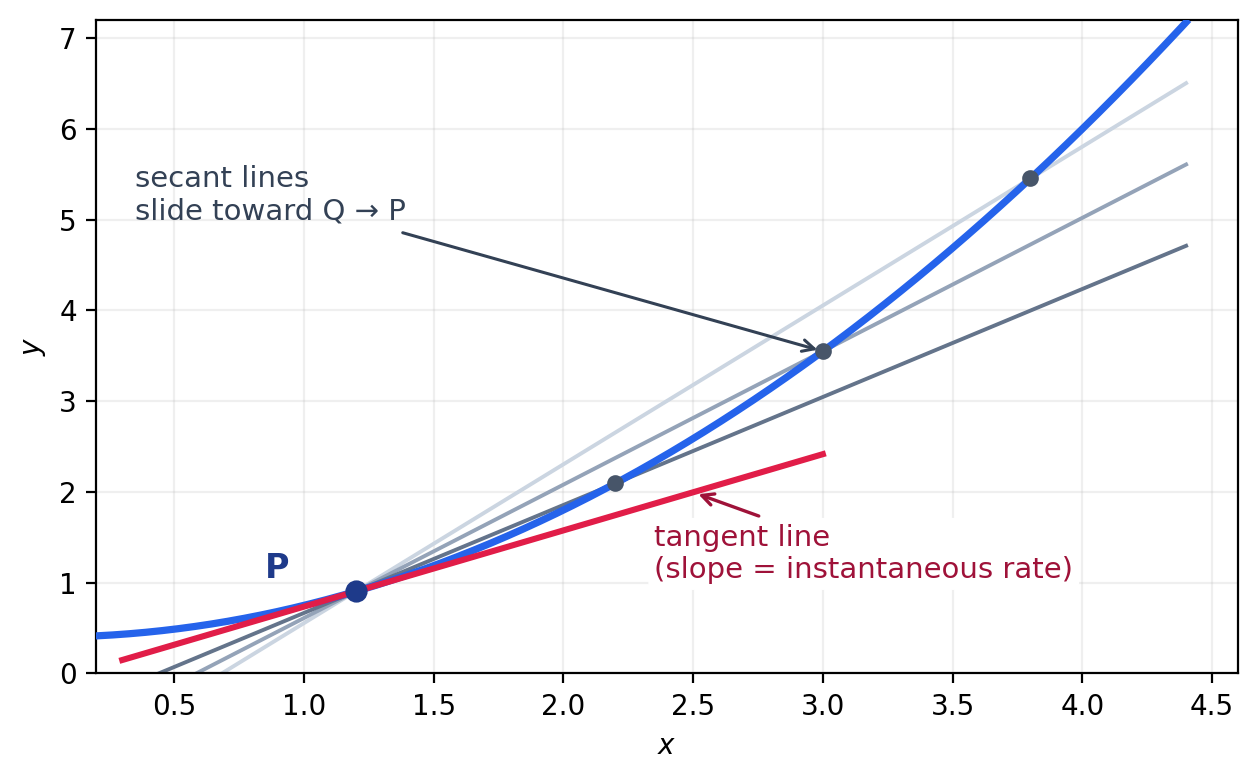
Slide the secant into a tangent · Desliza la secante para convertirla en una tangente
y = x²
Move the point along $y=x^2$ — the tangent slope you read off is the instantaneous rate, the limit of the secant slopes. · Mueve el punto a lo largo de $y=x^2$ — la pendiente de la tangente que se lee es la tasa instantánea, el límite de las pendientes de las secantes.
The instantaneous rate of change at a point equals the slope of the ____ line there. · La tasa de cambio instantánea en un punto es igual a la pendiente de la recta ____ en ese lugar.
It is the limit of secant slopes as the interval shrinks — the tangent slope. · Es el límite de las pendientes de las secantes a medida que el intervalo se encoge — la pendiente de la tangente.
Reading the rate in context
- The sign tells direction: positive rate → increasing, negative → decreasing.
- The size tells speed: a bigger magnitude means faster change.
- Units matter: for position in metres over time in seconds, the rate is in $\tfrac{\text{m}}{\text{s}}$ — a velocity.
- So average rate = secant slope (over an interval); instantaneous rate = tangent slope (at a point).
Interpretar la tasa en contexto
- El signo indica dirección: tasa positiva → creciente, negativa → decreciente.
- El valor absoluto indica velocidad: una magnitud mayor implica un cambio más rápido.
- Las unidades importan: para posición en metros respecto al tiempo en segundos, la tasa está en $\tfrac{\text{m}}{\text{s}}$ —una velocidad.
- Por tanto, tasa promedio = pendiente de la secante (sobre un intervalo); tasa instantánea = pendiente de la tangente (en un punto).
If the average rate of change of $f$ on $[0,4]$ is $0$, then $f$ must be constant on $[0,4]$. · Si la tasa de cambio promedio de $f$ en $[0,4]$ es $0$, entonces $f$ debe ser constante en $[0,4]$.
It only means $f(0)=f(4)$; $f$ could rise then fall (e.g. go out and come back). · Solo significa que $f(0)=f(4)$; $f$ podría aumentar y luego disminuir (por ejemplo, salir y volver).
For · A favor $f(x)=x^2$, average rates on $[3,3.1]$ and · y $[3,3.01]$ are $6.1$ and · y $6.01$. Estimate the instantaneous rate at $x=3$. · Para $f(x)=x^2$, las tasas promedio en $[3,3.1]$ y $[3,3.01]$ son $6.1$ y $6.01$. Estima la tasa instantánea en $x=3$.
The averages close in on $6$. · Los promedios se acercan a $6$.
A position function has instantaneous rate $-5\,\tfrac{\text{m}}{\text{s}}$ at time $t$. Select all · todos correct readings. · Una función de posición tiene una tasa instantánea de $-5\,\tfrac{\text{m}}{\text{s}}$ en el tiempo $t$. Selecciona todas las lecturas correctas.
Negative rate = moving in the negative direction (so position decreases); its magnitude is the speed; and it is the tangent slope. · Tasa negativa = movimiento en la dirección negativa (por lo tanto, la posición disminuye); su magnitud es la velocidad; y es la pendiente de la tangente.
Average and instantaneous rates are not interchangeable. The average rate over $[a,b]$ can be zero while the instantaneous rate is large at every interior point (imagine going out and coming back). Only in the limit of a shrinking interval does the average rate become the instantaneous rate.
Las tasas promedio e instantáneas no son intercambiables. La tasa promedio sobre $[a,b]$ puede ser cero mientras que la tasa instantánea es grande en cada punto interior (imagina salir y volver). Solo en el límite de un intervalo que se reduce la tasa promedio se convierte en la tasa instantánea.
For $f(x)=x^2$, find the average rate on $[2,4]$ and estimate the instantaneous rate at $x=2$.
- Average on $[2,4]$: $\dfrac{f(4)-f(2)}{4-2}=\dfrac{16-4}{2}=6$.
- Shrink toward $2$: on $[2,2.1]$, $\dfrac{4.41-4}{0.1}=4.1$; on $[2,2.01]$, $4.01$.
- The average rates close in on $4$ — the instantaneous rate at $x=2$ is $4$.
Para $f(x)=x^2$, encuentra la tasa promedio en $[2,4]$ y estima la tasa instantánea en $x=2$.
- Promedio en $[2,4]$: $\dfrac{f(4)-f(2)}{4-2}=\dfrac{16-4}{2}=6$.
- Acercándose a $2$: en $[2,2.1]$, $\dfrac{4.41-4}{0.1}=4.1$; en $[2,2.01]$, $4.01$.
- Las tasas promedio convergen hacia $4$ — la tasa instantánea en $x=2$ es $4$.
The average rate of change over $[a,b]$ is the difference quotient $\frac{f(b)-f(a)}{b-a}$ — the slope of a secant line. Shrinking the interval, the secant approaches the tangent line, whose slope is the instantaneous rate of change at that point.
La tasa de cambio promedio sobre $[a,b]$ es el cociente de diferencias $\frac{f(b)-f(a)}{b-a}$ —la pendiente de una recta secante. Al reducir el intervalo, la secante se aproxima a la recta tangente, cuya pendiente es la tasa de cambio instantánea en ese punto.