Energy levels and line spectra · Niveles de energía y espectros de líneas
| English | Español |
|---|---|
| discrete/dɪˈskriːt/ | discreta |
| energy levels/ˈenədʒi ˈlevlz/ | niveles de energía |
| ground state/ɡraʊnd steɪt/ | estado fundamental |
| excited states/ekˈsaɪtɪd steɪts/ | estados excitados |
| emission spectrum/ɪˈmɪʃn ˈspektrəm/ | espectro de emisión |
| transition/trænˈsɪʃn/ | transición |
| absorption spectrum/əbˈsɔːpʃn ˈspektrəm/ | espectro de absorción |
Every element has a barcode
- A sodium street lamp is orange. A neon sign is red. A mercury lamp is bluish-white. None of them can be persuaded to be any other colour.
- Split that light with a prism and you do not get a rainbow. You get a few sharp lines, always at the same wavelengths for that element.
- Those lines are how we know what the Sun and every distant star are made of, without going there.
- This lesson is why the lines exist: discrete energy levels 能级 inside the atom, and $hf = E_2 - E_1$.
Cada elemento tiene un código de barras
- Una lámpara de vapor de sodio es naranja. Un letrero de neón es rojo. Una lámpara de mercurio es blanco azulado. Ninguna de ellas puede ser persuadida para emitir otro color.
- Separe esa luz con un prisma y no obtendrá un arcoíris. Obtendrá unas pocas líneas nítidas, siempre en las mismas longitudes de onda para ese elemento.
- Esas líneas son la forma en que sabemos de qué están hechos el Sol y cada estrella distante, sin tener que ir allí.
- Esta lección explica por qué existen las líneas: niveles de energía discretos 能级 dentro del átomo, y $hf = E_2 - E_1$.
Discrete energy levels
- In an isolated atom an electron can sit only at certain discrete 分立 energies, never in between. The lowest is the ground state 基态; the rest are excited states 激发态.
- By convention the energies are written negative, with $E = 0$ for an electron just free of the atom. For hydrogen the ground state is $E_1 = -13.6\ \text{eV}$, and the higher levels creep up towards zero.
- The negative sign means bound. The number is how much energy you would have to supply to remove the electron altogether.
- The levels get closer together as they rise, which is why the spectral lines crowd towards the short-wavelength end.
Rungs that get closer as they climb
Niveles de energía discretos
- En un átomo aislado, un electrón solo puede estar en ciertas energías discretas 分立, nunca intermedias. La más baja es el estado fundamental 基态; el resto son estados excitados 激发态.
- Por convención, las energías se escriben negativas, con $E = 0$ para un electrón justo libre del átomo. Para el hidrógeno, el estado fundamental es $E_1 = -13.6\ \text{eV}$, y los niveles superiores se acercan gradualmente a cero.
- El signo negativo indica unido. El número indica cuánta energía habría que suministrar para eliminar el electrón por completo.
- Los niveles se van acercando entre sí a medida que suben, lo que explica por qué las líneas espectrales se agrupan hacia el extremo de longitud de onda corta.
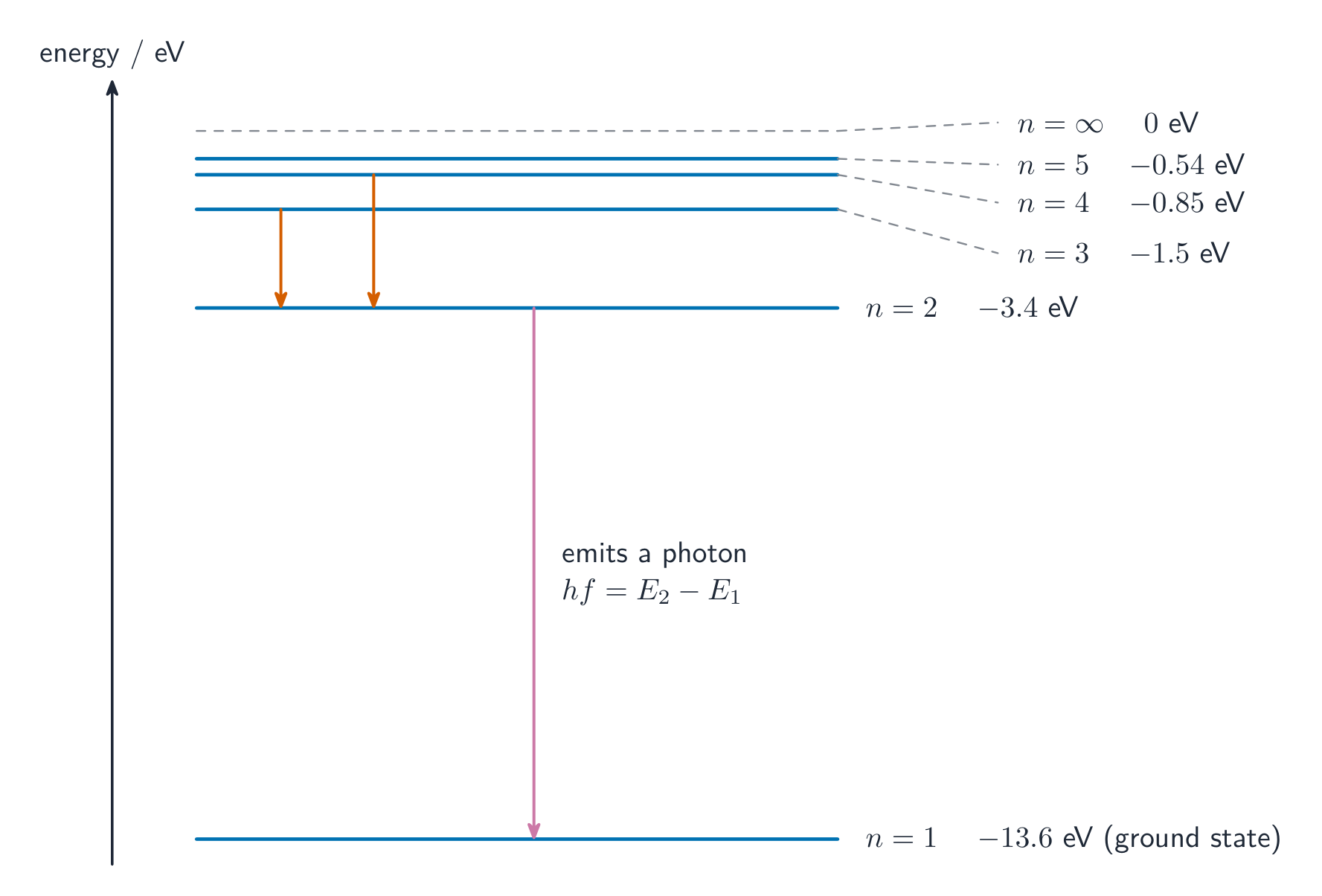
Escalones que se acercan mientras ascienden
Electrons in an atom can only occupy certain ____ energy levels. · Los electrones en un átomo solo pueden ocupar ciertos niveles de energía ____.
The levels are discrete (quantised) — an electron cannot have an energy in between them. · Los niveles son discretos (cuantizados): un electrón no puede tener una energía intermedia entre ellos.
Atomic energy levels are written as negative, with 0 for a just-free electron. · Los niveles de energía atómica se escriben como negativos, con 0 para un electrón libre.
The most tightly bound (ground) state is the most negative; energy rises toward 0 as the electron is freed. · El estado más fuertemente ligado (fundamental) es el más negativo; la energía aumenta hacia 0 a medida que el electrón se libera.
Emission: one drop, one photon
- When an electron falls from a higher level $E_2$ to a lower level $E_1$, it emits one photon:
- Both energies are negative and their difference is positive, so subtract carefully: $-3.40 - (-13.6) = 10.2\ \text{eV}$.
- Because the levels are discrete, only certain photon energies come out. The emission spectrum 发射光谱 is a set of sharp bright lines on a dark background, one line per transition 跃迁.
A handful of lines, always the same ones
Emisión: una caída, un fotón
- Cuando un electrón cae de un nivel superior $E_2$ a un nivel inferior $E_1$, emite un fotón:
- Ambas energías son negativas y su diferencia es positiva, así que reste con cuidado: $-3.40 - (-13.6) = 10.2\ \text{eV}$.
- Debido a que los niveles son discretos, solo salen energías de fotones ciertas. El espectro de emisión 发射光谱 es un conjunto de líneas brillantes nítidas sobre fondo oscuro, una línea por transición 跃迁.
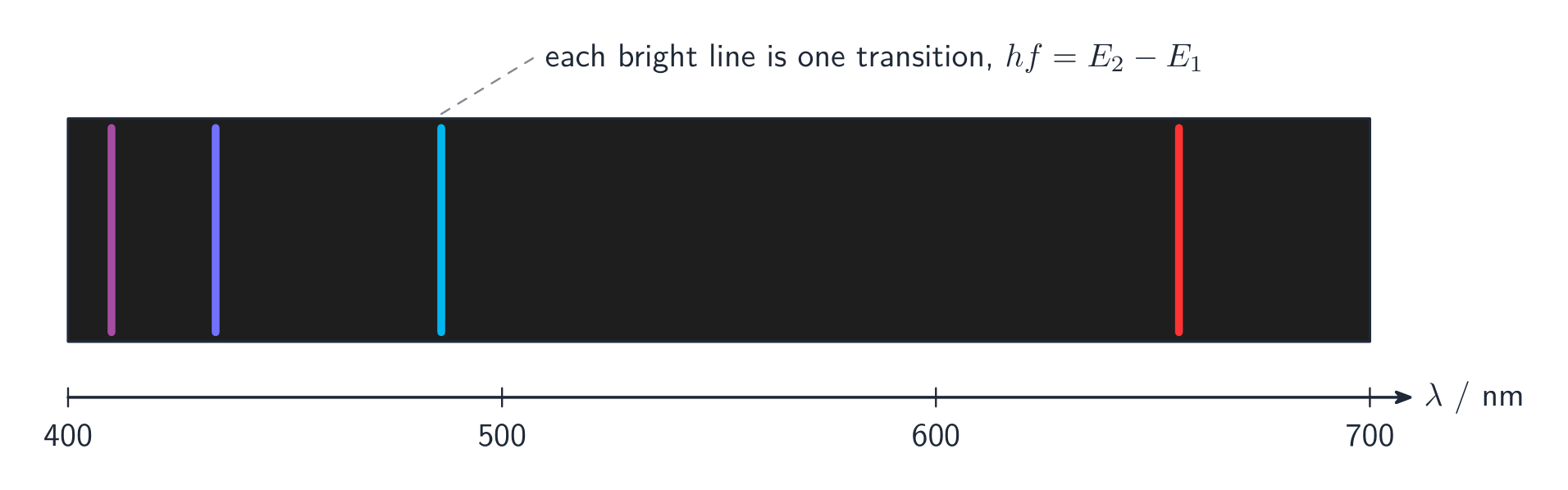
Un puñado de líneas, siempre las mismas
Make an element's spectral lines · Generar las líneas espectrales de un elemento
An electron dropping between fixed energy levels emits a photon of exactly the gap's energy — a fixed wavelength and colour. Each jump is one line of the element's barcode. · Un electrón que desciende entre niveles de energía fijos emite un fotón con exactamente la energía del salto — una longitud de onda y color fijos. Cada salto es una línea en el código de barras del elemento.
When an electron drops from level $E_2$ to · hasta $E_1$, the emitted photon has energy: · Cuando un electrón desciende desde el nivel $E_2$ hasta $E_1$, el fotón emitido tiene energía:
$hf = E_2 - E_1$ — a positive amount, since $E_2$ is the higher (less negative) level. · $hf = E_2 - E_1$ — una cantidad positiva, ya que $E_2$ es el nivel más alto (menos negativo).
Explaining a line spectrum, the standard four-marker
- One. The electrons in an isolated atom can occupy only discrete energy levels.
- Two. An electron in an excited state falls to a lower level, and the energy it loses is emitted as one photon.
- Three. The photon energy equals the difference between the two levels, $hf = E_2 - E_1$, so only certain frequencies are emitted.
- Four. Each possible transition gives one line, and the same set of levels always gives the same lines, which is why a spectrum identifies the element.
- All four are separate marks. Answers that stop after "the levels are discrete" collect one of them.
Explicación de un espectro de líneas, el estándar de cuatro marcadores
- Uno. Los electrones en un átomo aislado solo pueden ocupar niveles de energía discretos.
- Dos. Un electrón en un estado excitado cae a un nivel inferior, y la energía que pierde se emite como un fotón.
- Tres. La energía del fotón es igual a la diferencia entre los dos niveles, $hf = E_2 - E_1$, por lo que solo se emiten ciertas frecuencias.
- Cuatro. Cada transición posible produce una línea, y el mismo conjunto de niveles siempre produce las mismas líneas, por lo que un espectro identifica al elemento.
- Las cuatro son marcas separadas. Las respuestas que se detienen después de "los niveles son discretos" obtienen uno de ellos.
An emission spectrum looks like: · Un espectro de emisión se ve como:
Discrete transitions give discrete wavelengths — bright lines. (Dark lines on bright is an absorption spectrum.) · Las transiciones discretas dan longitudes de onda discretas — líneas brillantes. (Las líneas oscuras sobre fondo brillante son un espectro de absorción.)
Put the four-mark explanation of a line emission spectrum in order. · Ordena la explicación de cuatro puntos de un espectro de emisión de líneas.
All four ideas are separately marked. Stopping at "the levels are discrete" collects one mark of four. · Las cuatro ideas se califican por separado. Detenerse en "los niveles son discretos" obtiene uno de los cuatro puntos.
Worked example: hydrogen's ultraviolet lines
- The lowest four levels of hydrogen are $-13.6$, $-3.40$, $-1.51$ and $-0.85\ \text{eV}$. Find the wavelengths of the three lines from transitions to the ground state, and how many lines the four levels give altogether.
- $2 \to 1$: $\Delta E = 10.2\ \text{eV}$, so $\lambda = 1240/10.2 = 122\ \text{nm}$.
- $3 \to 1$: $12.09\ \text{eV}$, $\lambda = 103\ \text{nm}$. $4 \to 1$: $12.75\ \text{eV}$, $\lambda = 97.3\ \text{nm}$. All three are ultraviolet, and the largest jump gives the shortest wavelength.
- Altogether: $4\to3$, $4\to2$, $4\to1$, $3\to2$, $3\to1$, $2\to1$, so six lines. Count every downward pair, not just the drops to the ground state.
- The visible red line of hydrogen is $3\to2$: $1.89\ \text{eV}$, $656\ \text{nm}$.
Ejemplo resuelto: las líneas ultravioleta del hidrógeno
- Los cuatro niveles más bajos del hidrógeno son $-13.6$, $-3.40$, $-1.51$ y $-0.85\ \text{eV}$. Encuentre las longitudes de onda de las tres líneas provenientes de transiciones al estado fundamental, y cuántas líneas dan los cuatro niveles en total.
- $2 \to 1$: $\Delta E = 10.2\ \text{eV}$, por lo tanto $\lambda = 1240/10.2 = 122\ \text{nm}$.
- $3 \to 1$: $12.09\ \text{eV}$, $\lambda = 103\ \text{nm}$. $4 \to 1$: $12.75\ \text{eV}$, $\lambda = 97.3\ \text{nm}$. Las tres son ultravioleta, y el salto más grande da la longitud de onda más corta.
- En total: $4\to3$, $4\to2$, $4\to1$, $3\to2$, $3\to1$, $2\to1$, así que seis líneas. Cuente cada par descendente, no solo las caídas al estado fundamental.
- La línea roja visible del hidrógeno es $3\to2$: $1.89\ \text{eV}$, $656\ \text{nm}$.
An electron drops from $-1.5\ \text{eV}$ to · hasta $-3.4\ \text{eV}$. What is the energy of the emitted photon? · Un electrón desciende desde $-1.5\ \text{eV}$ hasta $-3.4\ \text{eV}$. ¿Cuál es la energía del fotón emitido?
$hf = E_2 - E_1 = (-1.5) - (-3.4) = 1.9\ \text{eV}$.
How many different spectral lines can four energy levels produce? · ¿Cuántas líneas espectrales diferentes pueden producir cuatro niveles de energía?
Every downward pair counts: 4-3, 4-2, 4-1, 3-2, 3-1, 2-1. In general n levels give n(n-1)/2 lines, not n-1. · Cada par descendente cuenta: 4-3, 4-2, 4-1, 3-2, 3-1, 2-1. En general, n niveles producen n(n-1)/2 líneas, no n-1.
From levels to lines
- The rule for matching a diagram to a spectrum is short: the largest energy gap gives the highest frequency and the shortest wavelength.
- So the widest arrow on the level diagram is the line furthest to the left on a wavelength scale.
- Two atoms with completely different levels but the same gap emit the same line. The gap fixes the colour, never either level on its own.
Widest arrow, leftmost line
De niveles a líneas
- La regla para emparejar un diagrama con un espectro es breve: la mayor brecha de energía da la mayor frecuencia y la longitud de onda más corta.
- Por lo tanto, la flecha más ancha en el diagrama de niveles es la línea más a la izquierda en una escala de longitudes de onda.
- Dos átomos con niveles completamente diferentes pero la misma brecha emiten la misma línea. La brecha fija el color, nunca ninguno de los niveles por sí solo.
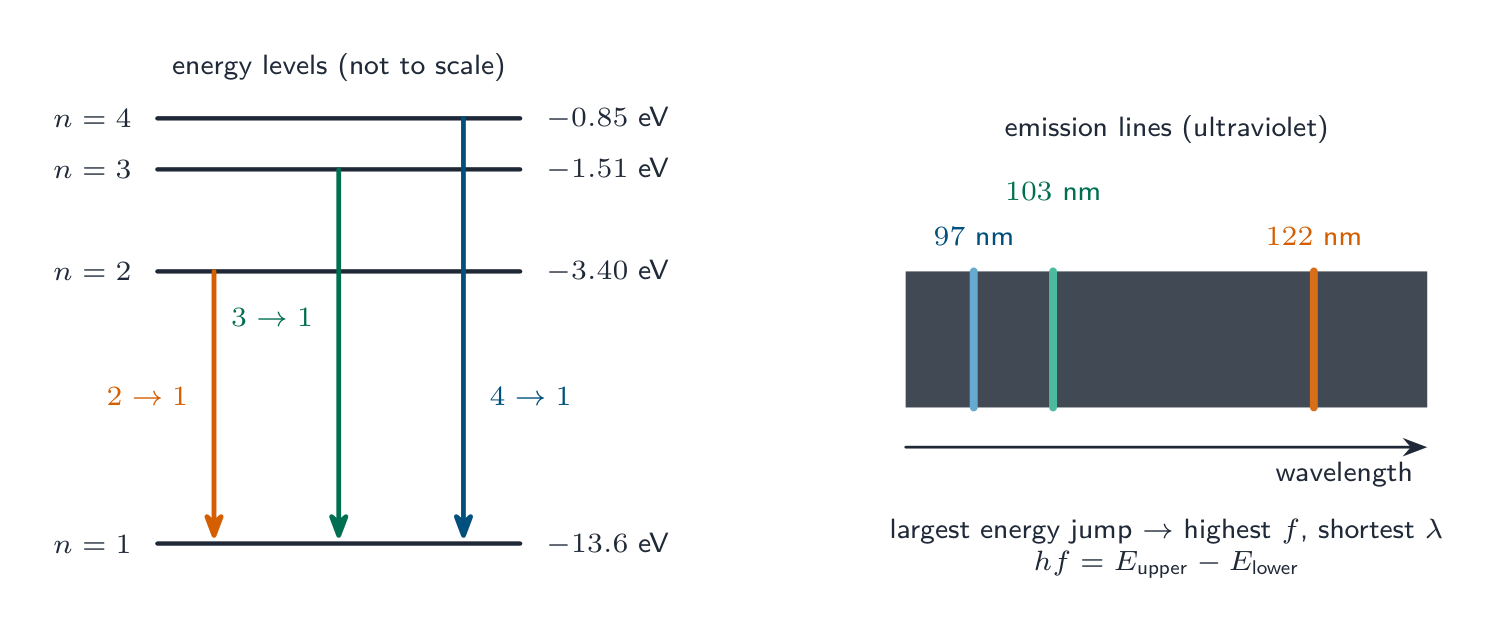
Flecha más ancha, línea más a la izquierda
Match each transition to the line it produces. · Asocia cada transición con la línea que produce.
Frequency and wavelength move in opposite directions, which is where most of the confusion in this question type comes from. · La frecuencia y la longitud de onda varían en direcciones opuestas, lo cual es donde reside la confusión principal en este tipo de preguntas.
On an energy-level diagram, the largest downward jump produces the line of ____ wavelength. · En un diagrama de niveles de energía, el salto descendente más grande produce la línea de ____ longitud de onda.
Largest gap, largest photon energy, highest frequency, shortest wavelength. On a wavelength scale that line sits furthest to the left. · Mayor brecha, mayor energía del fotón, mayor frecuencia, longitud de onda más corta. En una escala de longitudes de onda, esa línea se sitúa más a la izquierda.
Absorption: the same lines, dark
- Pass white light through a cool gas and photons whose energy exactly matches an upward transition are absorbed, lifting electrons to higher levels.
- The result is dark lines on a bright continuous background, the absorption spectrum 吸收光谱, at exactly the same wavelengths as that gas emits.
- The subtle part, and the marked part: the excited electron soon falls back and re-emits a photon of the same energy, but in a random direction, so almost none of it continues along the original beam.
- Everything else in the white light matches no gap and passes straight through. The Sun's dark lines are made by the cooler gases in its outer layers.
A rainbow with pieces missing
Absorción: las mismas líneas, oscuras
- Pase luz blanca a través de un gas frío y los fotones cuya energía coincide exactamente con una transición ascendente son absorbidos, elevando electrones a niveles superiores.
- El resultado es líneas oscuras sobre un fondo continuo brillante, el espectro de absorción 吸收光谱, en exactamente las mismas longitudes de onda que emite ese gas.
- La parte sutil, y la marcada: el electrón excitado pronto vuelve a caer y reemite un fotón de la misma energía, pero en una dirección aleatoria, por lo que casi nada de él continúa a lo largo del haz original.
- Todo lo demás en la luz blanca no coincide con ninguna brecha y pasa directamente. Las líneas oscuras del Sol están hechas por los gases más fríos en sus capas exteriores.
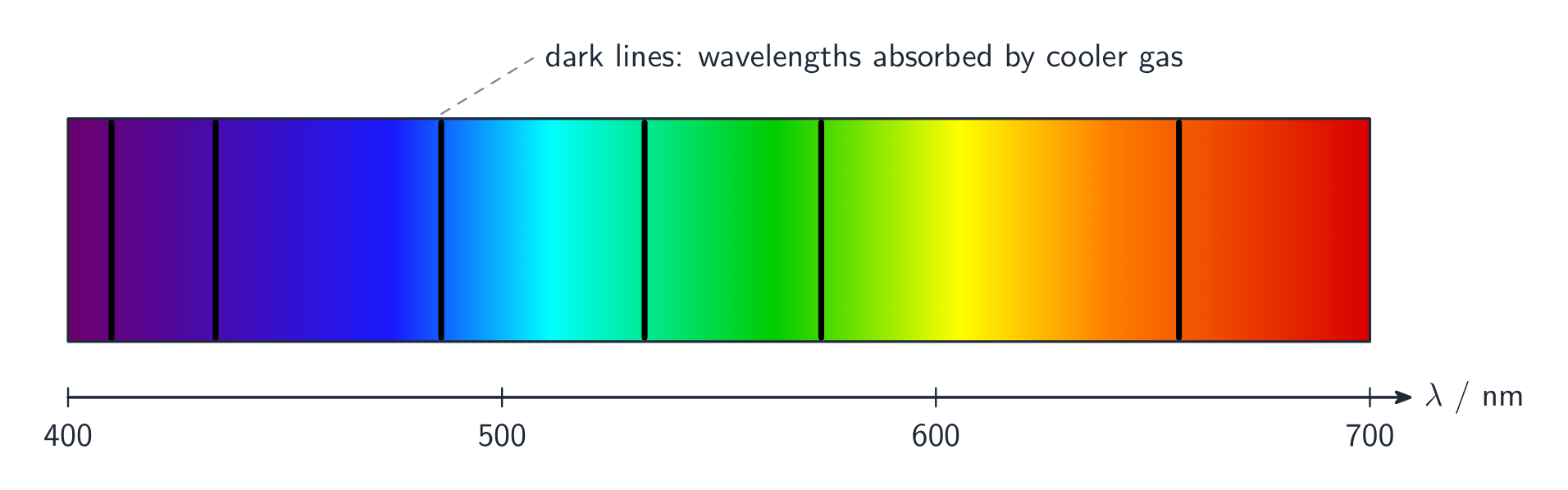
Un arcoíris con piezas faltantes
A gas absorbs light at the same wavelengths at which it emits. · Un gas absorbe luz en las mismas longitudes de onda en las que emite.
The same energy gaps work both ways — so absorption lines sit exactly where the emission lines are. · Las mismas brechas de energía funcionan en ambos sentidos: las líneas de absorción se sitúan exactamente donde están las líneas de emisión.
Why does a cool gas produce dark lines in a continuous spectrum? Select all · todos that apply. · ¿Por qué un gas frío produce líneas oscuras en un espectro continuo? Selecciona todas las que correspondan.
The random direction is the marked point. Absorption alone would not darken the line, because the energy could have carried on forwards. · La dirección aleatoria es el punto clave. La absorción sola no oscurecería la línea, porque la energía podría haber continuado hacia adelante.
Worked example: from a wavelength to a gap
- A laser emits red light of wavelength $650\ \text{nm}$ when electrons drop between two levels. Find the energy gap.
- $\Delta E = \dfrac{hc}{\lambda} = \dfrac{1240}{650} = 1.91\ \text{eV} = 3.1\times10^{-19}\ \text{J}$.
- Use $hc = 1240\ \text{eV nm}$ when the answer is wanted in eV, and $hc = 1.99\times10^{-25}\ \text{J m}$ when it is wanted in joules. Mixing them is the standard slip.
- Note what the question can and cannot tell you: the gap, not either level. Two different atoms with the same gap give the same line.
Ejemplo resuelto: de una longitud de onda a una brecha
- Un láser emite luz roja de longitud de onda $650\ \text{nm}$ cuando los electrones caen entre dos niveles. Encuentre la brecha de energía.
- $\Delta E = \dfrac{hc}{\lambda} = \dfrac{1240}{650} = 1.91\ \text{eV} = 3.1\times10^{-19}\ \text{J}$.
- Use $hc = 1240\ \text{eV nm}$ cuando la respuesta se pida en eV, y $hc = 1.99\times10^{-25}\ \text{J m}$ cuando se pida en julios. Mezclarlos es el error estándar.
- Note lo que la pregunta puede y no puede decirle: la brecha, no ninguno de los niveles. Dos átomos diferentes con la misma brecha dan la misma línea.
A laser emits light of wavelength 650 nm. What is the energy gap between the two levels, in eV? · Un láser emite luz de longitud de onda 650 nm. ¿Cuál es la brecha de energía entre los dos niveles, en eV?
1240/650 = 1.91 eV. The measurement fixes the GAP, not either level: two different atoms with the same gap emit the same line. · 1240/650 = 1.91 eV. La medición fija la BRECHA, no cada nivel: dos átomos diferentes con la misma brecha emiten la misma línea.
Marks that slip away
- Energy levels are negative. Subtracting them the wrong way round gives a negative photon energy and a negative wavelength.
- $n$ levels give $\tfrac{1}{2}n(n-1)$ lines, not $n - 1$. Count every pair.
- The largest gap gives the shortest wavelength. The two words move in opposite directions.
- For absorption, say the re-emission goes in a random direction. "The photon is absorbed" alone does not explain a dark line, since the energy could have carried on forwards.
- Convert eV to joules before mixing with SI quantities, or stay in eV and use $1240\ \text{eV nm}$ throughout.
Puntos que se pierden fácilmente
- Los niveles de energía son negativos. Restarlos en orden incorrecto da una energía de fotón negativa y una longitud de onda negativa.
- $n$ niveles dan $\tfrac{1}{2}n(n-1)$ líneas, no $n - 1$. Cuente cada par.
- La brecha más grande da la longitud de onda más corta. Las dos palabras se mueven en direcciones opuestas.
- Para la absorción, diga que la reemisión va en una dirección aleatoria. "El fotón es absorbido" por sí solo no explica una línea oscura, ya que la energía podría haber continuado hacia adelante.
- Convierta eV a julios antes de mezclar con cantidades del SI, o manténgase en eV y use $1240\ \text{eV nm}$ en todo momento.
You've got it
- electrons in an isolated atom occupy discrete, negative energy levels, the lowest being the ground state
- a drop from $E_2$ to $E_1$ emits one photon with $hf = E_2 - E_1$, giving sharp bright lines unique to the element
- an absorption spectrum is dark lines on a bright background at the same wavelengths, because the re-emitted photons go off in random directions
- the largest energy gap gives the highest frequency and shortest wavelength, and $n$ levels give $\tfrac{1}{2}n(n-1)$ possible lines
Lo has entendido
- los electrones en un átomo aislado ocupan niveles de energía discretos, negativos, siendo el más bajo el estado fundamental
- una caída de $E_2$ a $E_1$ emite un fotón con $hf = E_2 - E_1$, dando líneas brillantes nítidas únicas para el elemento
- un espectro de absorción son líneas oscuras sobre un fondo brillante en las mismas longitudes de onda, porque los fotones reemitidos se van en direcciones aleatorias
- la mayor brecha de energía da la mayor frecuencia y la longitud de onda más corta, y $n$ niveles dan $\tfrac{1}{2}n(n-1)$ líneas posibles