Simple harmonic motion · Movimiento armónico simple
| English | Español |
|---|---|
| simple harmonic motion/ˈsɪmpl hɑːˈmɒnɪk ˈməʊʃn/ | movimiento armónico simple |
| displacement/dɪˈspleɪsmənt/ | desplazamiento |
| equilibrium/ˌiːkwɪˈlɪbrɪəm/ | equilibrio |
| amplitude/ˈæmplɪtjuːd/ | amplitud |
| period/ˈpɪərɪəd/ | período |
| frequency/ˈfriːkwənsi/ | frecuencia |
| angular frequency/ˈæŋɡjʊlə ˈfriːkwənsi/ | frecuencia angular |
The lamp that taught the world to keep time
- In 1583 a student in Pisa cathedral, bored during a sermon, timed a swinging lamp against his own pulse. Whether the lamp swung wide or narrow, each swing took the same time.
- That is not obvious and it is not true of most motions. It is true whenever the restoring force grows in proportion to how far the thing has been displaced, and that one condition defines the whole topic.
- Galileo's observation became the pendulum clock, and every clock for the next 300 years.
- This lesson is simple harmonic motion 简谐运动: its defining equation, the words that describe it, and how to read $\omega$ off a graph.
La lámpara que enseñó al mundo a guardar el tiempo
- En 1583, un estudiante en la catedral de Pisa, aburrido durante un sermón, cronometró una lámpara oscilante contra su propio pulso. Ya fuera que la lámpara oscilara ampliamente o estrechamente, cada oscilación tomaba el mismo tiempo.
- Eso no es obvio y no ocurre en la mayoría de los movimientos. Ocurre siempre que la fuerza restauradora crece en proporción a cuánto se ha desplazado el objeto, y esa única condición define todo el tema.
- La observación de Galileo dio lugar al reloj de péndulo y a todos los relojes durante los siguientes 300 años.
- Esta lección trata sobre el movimiento armónico simple: su ecuación definitoria, las palabras que lo describen y cómo leer $\omega$ en una gráfica.
The definition
- A body moves with simple harmonic motion when its acceleration is proportional to its displacement 位移 from a fixed point, and always directed towards that point.
- Both halves are needed for both marks. "Proportional to displacement" alone describes a force pushing it further away just as well.
- In symbols, with the minus sign carrying "towards the equilibrium position":
Displaced right, accelerating left; displaced left, accelerating right
La definición
- Un cuerpo se mueve con movimiento armónico simple cuando su aceleración es proporcional a su desplazamiento desde un punto fijo, y siempre dirigida hacia ese punto.
- Se necesitan ambas partes para obtener la calificación completa. "Proporcional al desplazamiento" solo también describiría bien una fuerza que lo empuja aún más lejos.
- En símbolos, con el signo negativo indicando "hacia la posición de equilibrio":
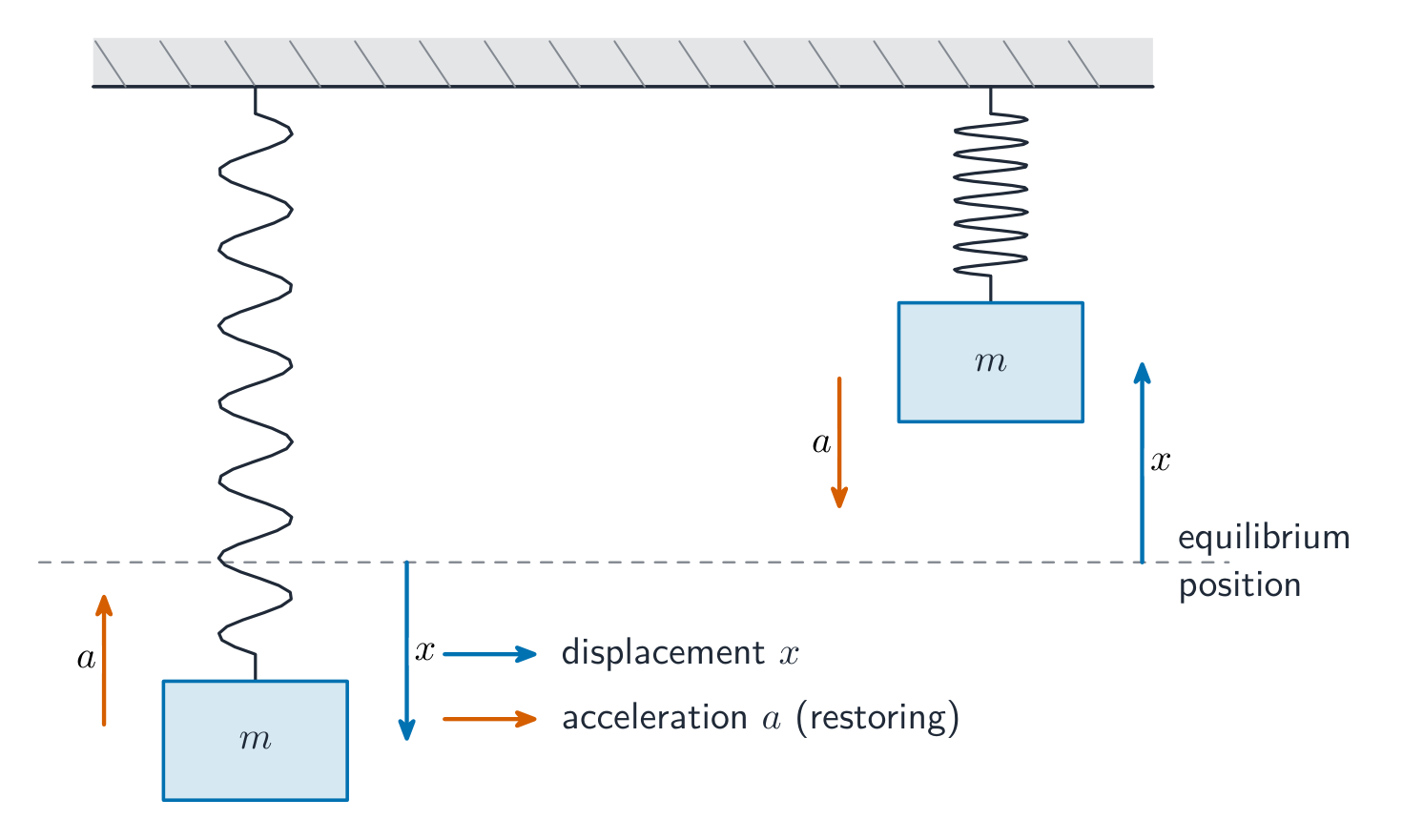
Desplazado a la derecha, acelerando a la izquierda; desplazado a la izquierda, acelerando a la derecha
In simple harmonic motion, the acceleration is: · En el movimiento armónico simple, la aceleración es:
That is exactly $a = -\omega^{2}x$ — bigger displacement, bigger pull back; always toward the middle. · Eso es exactamente $a = -\omega^{2}x$ — mayor desplazamiento, mayor fuerza de retorno; siempre hacia el centro.
A full definition of simple harmonic motion needs which statements? Select all · todos that apply. · Una definición completa del movimiento armónico simple necesita qué enunciados? Seleccione todos los que correspondan.
Those two statements are the definition and carry both marks. The constant period is a consequence of them, and the speed is certainly not constant. · Esos dos enunciados son la definición y otorgan ambos puntos. El periodo constante es una consecuencia de ellos, y la velocidad certainly no es constante.
The vocabulary
- Displacement $x$: distance from the equilibrium 平衡 position, with a direction. Amplitude 振幅 $x_0$: the maximum displacement.
- Period 周期 $T$: the time for one complete oscillation. Frequency 频率 $f = 1/T$: oscillations per second, in hertz.
- Angular frequency 角频率 $\omega$: connects the two, $\omega = \dfrac{2\pi}{T} = 2\pi f$. Given any one of $\omega$, $f$ and $T$ you can find the others, and most questions start by doing exactly that.
El vocabulario
- Desplazamiento $x$: distancia desde la posición de equilibrio, con dirección. Amplitud $x_0$: el desplazamiento máximo.
- Período $T$: el tiempo para una oscilación completa. Frecuencia $f = 1/T$: oscilaciones por segundo, en hertzios.
- Frecuencia angular $\omega$: conecta los dos, $\omega = \dfrac{2\pi}{T} = 2\pi f$. Dado cualquiera de $\omega$, $f$ y $T$, puedes encontrar los otros, y la mayoría de las preguntas comienzan haciendo exactamente eso.
Swing a pendulum · Balancea un péndulo
Set it swinging, then change the start angle — the time for one swing stays the same (that is what makes it a good clock). Now make the string longer, or move to the Moon, and watch the period change. · Hazlo oscilar y cambia el ángulo inicial: el tiempo para una oscilación permanece igual (eso es lo que lo convierte en un buen reloj). Ahora haz la cuerda más larga o muévete a la Luna y observa cómo cambia el período.
An oscillation has a period of $2.0\ \text{s}$. What is its angular frequency $\omega$? · Una oscilación tiene un periodo de $2.0\ \text{s}$. ¿Cuál es su frecuencia angular $\omega$?
$\omega = \dfrac{2\pi}{T} = \dfrac{2\pi}{2.0} = \pi \approx 3.14\ \dfrac{\text{rad}}{\text{s}}$.
Displacement with time
- Starting from the equilibrium position at $t = 0$: $x = x_0 \sin(\omega t)$. Starting from an extreme: $x = x_0 \cos(\omega t)$.
- Which you use depends only on where the motion starts. Read the question's opening condition before choosing.
- The graph is a sine curve of amplitude $x_0$ and period $T$, and the motion repeats exactly.
One period, one full cycle, and then the same again
Desplazamiento con respecto al tiempo
- Partiendo desde la posición de equilibrio en $t = 0$: $x = x_0 \sin(\omega t)$. Partiendo desde un extremo: $x = x_0 \cos(\omega t)$.
- Cuál usar depende únicamente de dónde comienza el movimiento. Lee la condición inicial del problema antes de elegir.
- La gráfica es una curva senoidal de amplitud $x_0$ y período $T$, y el movimiento se repite exactamente.
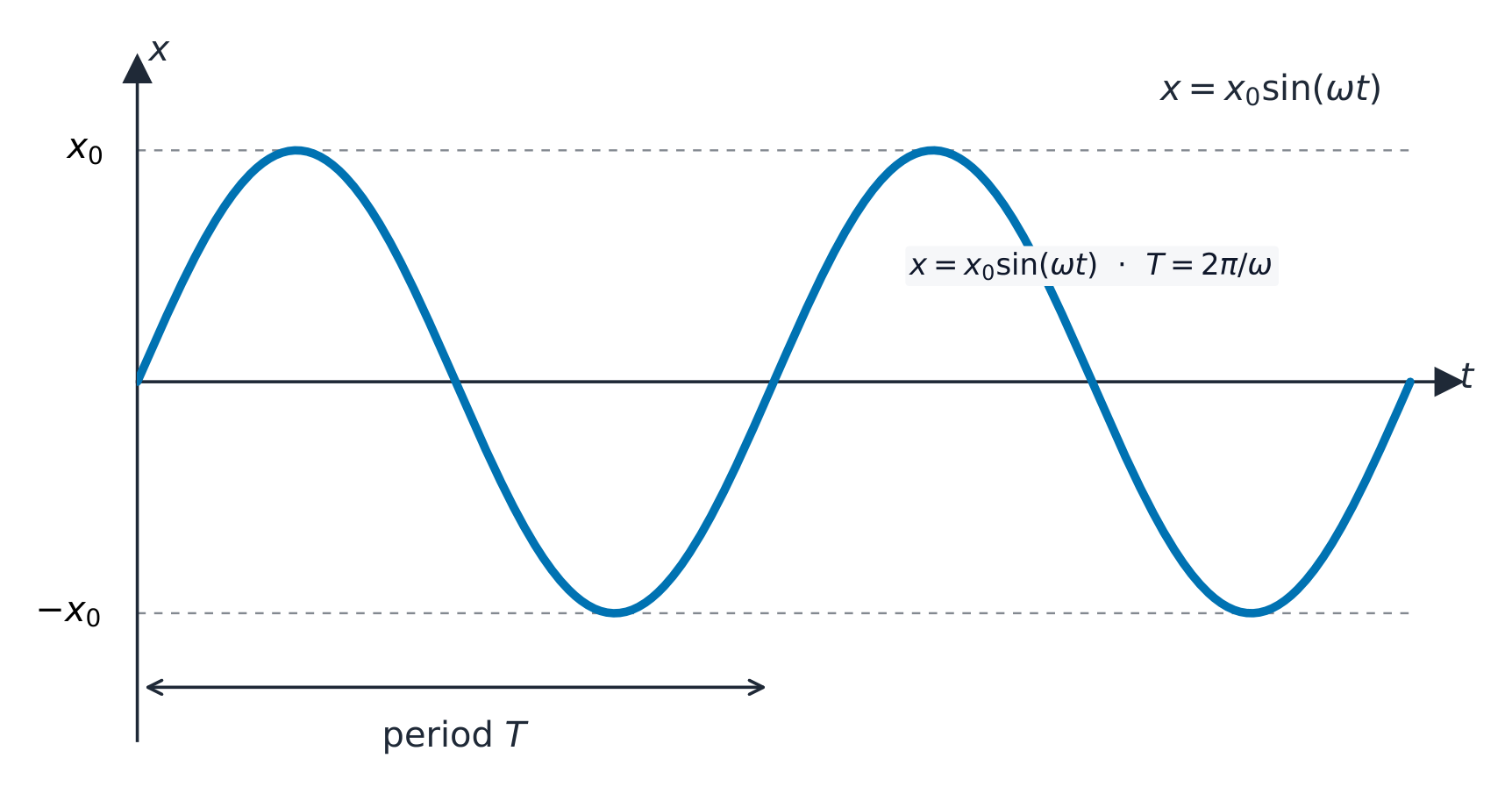
Un período, un ciclo completo, y luego lo mismo de nuevo
Speed anywhere in the motion
- The speed at displacement $x$, without needing the time:
- At the centre, $x = 0$, this gives the maximum speed $v_{\text{max}} = \omega x_0$. At the extremes, $x = \pm x_0$, it gives zero.
- That is the pattern to hold on to: fastest in the middle, momentarily at rest at each end, and the acceleration is the other way round, zero in the middle and greatest at the ends.
Velocidad en cualquier parte del movimiento
- La velocidad en el desplazamiento $x$, sin necesidad del tiempo:
- En el centro, $x = 0$, esto da la velocidad máxima $v_{\text{max}} = \omega x_0$. En los extremos, $x = \pm x_0$, da cero.
- Ese es el patrón que debes recordar: más rápido en el medio, momentáneamente en reposo en cada extremo, y la aceleración es al revés, cero en el medio y máxima en los extremos.
In SHM the speed is greatest at the ____ position. · En el MAS la velocidad es máxima en la posición de ____.
At the middle all the energy is kinetic, so the speed is maximum ($v = \omega x_0$). · En el centro toda la energía es cinética, por lo que la velocidad es máxima ($v = \omega x_0$).
At the extremes of the motion ($x = \pm x_0$), the speed is zero. · En los extremos del movimiento ($x = \pm x_0$), la velocidad es cero.
The oscillator stops for an instant at each end before reversing — speed zero, acceleration maximum. · El oscilador se detiene instantáneamente en cada extremo antes de invertir — velocidad cero, aceleración máxima.
An oscillator has amplitude $0.10\ \text{m}$ and · y $\omega = 10\ \dfrac{\text{rad}}{\text{s}}$. What is its maximum speed? · Un oscilador tiene amplitud $0.10\ \text{m}$ y $\omega = 10\ \dfrac{\text{rad}}{\text{s}}$. ¿Cuál es su velocidad máxima?
Maximum speed $= \omega x_0 = 10 \times 0.10 = 1.0\ \dfrac{\text{m}}{\text{s}}$. · Velocidad máxima $= \omega x_0 = 10 \times 0.10 = 1.0\ \dfrac{\text{m}}{\text{s}}$.
Match each quantity to where in the oscillation it is greatest. · Empareje cada cantidad con dónde en la oscilación es máxima.
Speed and acceleration peak at opposite places, and they are never both maximum at the same instant. · La velocidad y la aceleración alcanzan sus picos en lugares opuestos, y nunca son ambas máximas al mismo instante.
Worked example: from period to maximum speed
- A mass oscillates with a period of $2.0\ \text{s}$ and an amplitude of $0.10\ \text{m}$. Find its maximum speed and its maximum acceleration.
- First $\omega$: $\omega = \dfrac{2\pi}{T} = \dfrac{2\pi}{2.0} = 3.14\ \text{rad/s}$. Almost every SHM question begins here.
- Maximum speed, at the centre: $v_{\text{max}} = \omega x_0 = 3.14 \times 0.10 = 0.31\ \text{m/s}$.
- Maximum acceleration, at the extremes: $a_{\text{max}} = \omega^2 x_0 = 3.14^2 \times 0.10 = 0.99\ \text{m/s}^2$.
- Note where each maximum occurs. A question asking "at what displacement" wants the centre for speed and the extremes for acceleration.
Ejemplo resuelto: del período a la velocidad máxima
- Una masa oscila con un período de $2.0\ \text{s}$ y una amplitud de $0.10\ \text{m}$. Encuentra su velocidad máxima y su aceleración máxima.
- Primero $\omega$: $\omega = \dfrac{2\pi}{T} = \dfrac{2\pi}{2.0} = 3.14\ \text{rad/s}$. Casi todas las preguntas de MAS comienzan aquí.
- Velocidad máxima, en el centro: $v_{\text{max}} = \omega x_0 = 3.14 \times 0.10 = 0.31\ \text{m/s}$.
- Aceleración máxima, en los extremos: $a_{\text{max}} = \omega^2 x_0 = 3.14^2 \times 0.10 = 0.99\ \text{m/s}^2$.
- Nota dónde ocurre cada máximo. Una pregunta que pregunte "en qué desplazamiento" querrá el centro para la velocidad y los extremos para la aceleración.
An oscillation has period 2.0 s and amplitude 0.10 m. What is its maximum speed in m/s? · Una oscilación tiene periodo 2.0 s y amplitud 0.10 m. ¿Cuál es su velocidad máxima en m/s?
omega = 2 pi / T = 3.14 rad/s, and v_max = omega x0 = 0.31 m/s, which occurs at the centre. The maximum acceleration, at the ends, is omega squared times x0 = 0.99 m/s^2. · omega = 2 pi / T = 3.14 rad/s, y v_max = omega x0 = 0.31 m/s, lo cual ocurre en el centro. La aceleración máxima, en los extremos, es omega al cuadrado por x0 = 0.99 m/s^2.
Reading the acceleration-displacement graph
- Because $a = -\omega^2 x$, a graph of acceleration against displacement is a straight line through the origin with a negative gradient.
- The gradient is $-\omega^2$, so $\omega = \sqrt{|\text{gradient}|}$ and then $T = 2\pi/\omega$.
- This is the standard way an exam gives you $\omega$ without stating it. A straight line through the origin with negative gradient is also the standard way of asking you to show that a motion is simple harmonic.
Straight, through the origin, negative: all three matter
Leer la gráfica de aceleración vs. desplazamiento
- Debido a que $a = -\omega^2 x$, una gráfica de aceleración frente a desplazamiento es una línea recta que pasa por el origen con una pendiente negativa.
- La pendiente es $-\omega^2$, por lo tanto $\omega = \sqrt{|\text{gradient}|}$ y luego $T = 2\pi/\omega$.
- Esta es la forma estándar en que un examen te da $\omega$ sin declararlo explícitamente. Una línea recta que pasa por el origen con pendiente negativa es también la forma estándar de pedirte que demuestres que un movimiento es armónico simple.
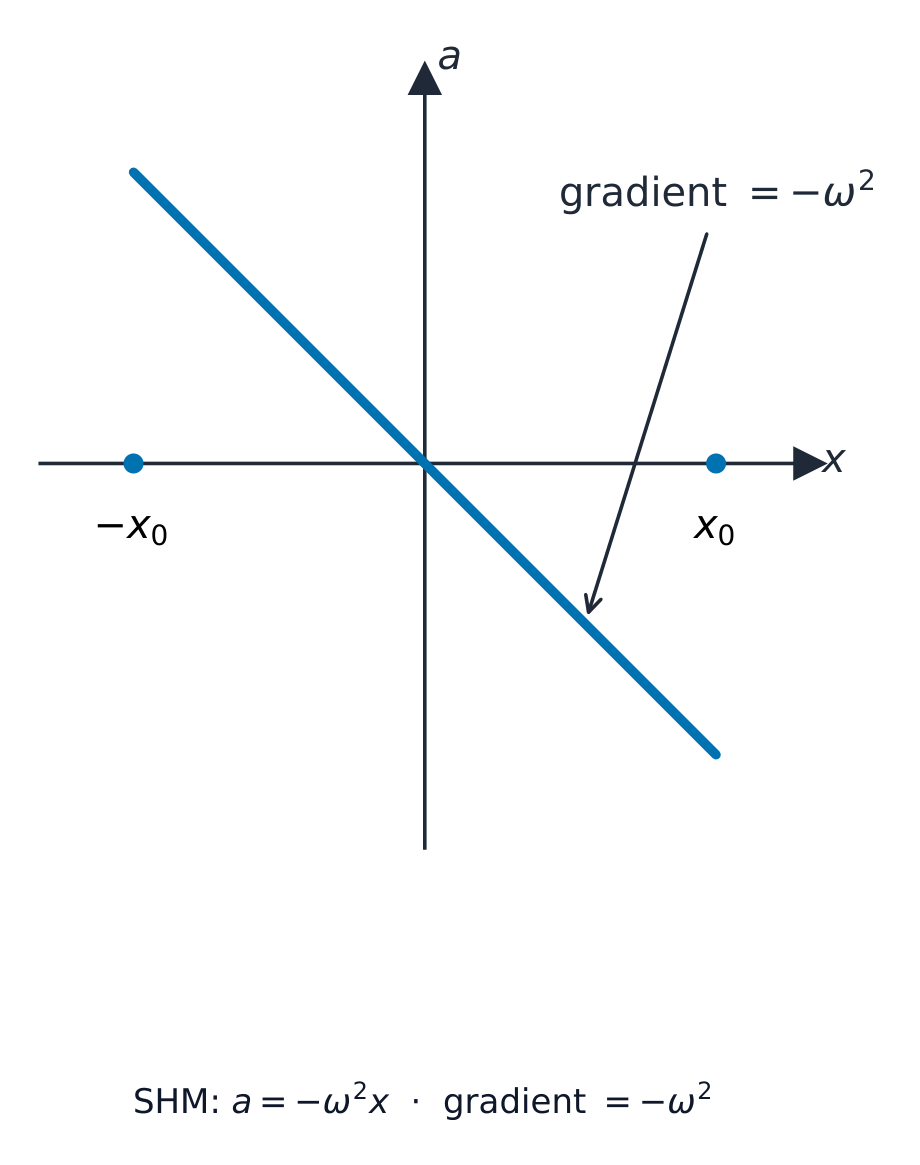
Straight (recta), a través del origen, negativa: los tres importan
On an acceleration-against-displacement graph for SHM, the gradient equals: · En una gráfica de aceleración contra desplazamiento para el MAS, la pendiente es igual a:
$a = -\omega^{2}x$ is a straight line of gradient $-\omega^{2}$, so $\omega = \sqrt{|\text{gradient}|}$. · $a = -\omega^{2}x$ es una línea recta con pendiente $-\omega^{2}$, por lo que $\omega = \sqrt{|\text{gradient}|}$.
Worked example: is it simple harmonic?
- Measurements of a trolley's acceleration at various displacements give a straight line through the origin with gradient $-25\ \text{/s}^2$. Show that the motion is simple harmonic and find the period.
- The graph is a straight line, so $a \propto x$; it passes through the origin, so there is no constant term; and its gradient is negative, so the acceleration is directed towards the equilibrium position. Those three facts are the definition, so the motion is simple harmonic.
- The gradient is $-\omega^2 = -25$, so $\omega = 5.0\ \text{rad/s}$ and $T = \dfrac{2\pi}{5.0} = 1.3\ \text{s}$.
Ejemplo resuelto: ¿es movimiento armónico simple?
- Las mediciones de la aceleración de un carrito en varios desplazamientos dan una línea recta que pasa por el origen con pendiente $-25\ \text{/s}^2$. Demuestra que el movimiento es armónico simple y encuentra el período.
- La gráfica es una línea recta, así que $a \propto x$; pasa por el origen, así que no hay término constante; y su pendiente es negativa, así que la aceleración está dirigida hacia la posición de equilibrio. Esos tres hechos son la definición, así que el movimiento es armónico simple.
- La pendiente es $-\omega^2 = -25$, así que $\omega = 5.0\ \text{rad/s}$ y $T = \dfrac{2\pi}{5.0} = 1.3\ \text{s}$.
An acceleration-displacement graph for an oscillator is a straight line through the origin of gradient -25 per second squared. What is the period, in seconds? · Una gráfica de aceleración-desplazamiento para un oscilador es una línea recta que pasa por el origen de pendiente -25 por segundo cuadrado. ¿Cuál es el periodo, en segundos?
The gradient is minus omega squared, so omega = 5.0 rad/s and T = 2 pi / 5.0 = 1.3 s. Straight, through the origin and negative is also the proof that the motion is simple harmonic. · La pendiente es menos omega cuadrado, así que omega = 5.0 rad/s y T = 2 pi / 5.0 = 1.3 s. Que sea recta, pase por el origen y sea negativa también es la prueba de que el movimiento es armónico simple.
Marks that slip away
- The definition needs both halves: proportional to displacement and directed towards a fixed point. The minus sign is what carries the second.
- $\omega$ is in rad s$^{-1}$, not hertz. Convert with $\omega = 2\pi f$ before substituting.
- Speed is greatest at the centre; acceleration is greatest at the extremes. They are never both maximum at once.
- Choose sine or cosine from where the motion starts, not by habit.
Puntos que se pierden fácilmente
- La definición necesita ambas mitades: proporcional al desplazamiento y dirigido hacia un punto fijo. El signo negativo es lo que transporta la segunda parte.
- $\omega$ está en rad s$^{-1}$, not hertz. Convert with $\omega = 2\pi f$ antes de sustituir.
- La velocidad es mayor en el centro; la aceleración es mayor en los extremos. Nunca son ambos máximos a la vez.
- Elige seno o coseno según dónde empieza el movimiento, no por hábito.
You've got it
- SHM: acceleration proportional to displacement and directed towards a fixed point, so $a = -\omega^2 x$
- $\omega = \dfrac{2\pi}{T} = 2\pi f$, and almost every question starts by finding $\omega$
- $x = x_0\sin\omega t$ from the centre or $x_0\cos\omega t$ from an extreme; $v = \pm\omega\sqrt{x_0^2 - x^2}$, so $v_{\text{max}} = \omega x_0$ at the centre and $a_{\text{max}} = \omega^2 x_0$ at the ends
- an acceleration-displacement graph that is straight, through the origin and negative proves SHM, and its gradient is $-\omega^2$
Lo has logrado
- MAS: aceleración proporcional al desplazamiento y dirigida hacia un punto fijo, por lo tanto $a = -\omega^2 x$
- $\omega = \dfrac{2\pi}{T} = 2\pi f$, y casi todas las preguntas comienzan encontrando $\omega$
- $x = x_0\sin\omega t$ desde el centro o $x_0\cos\omega t$ desde un extremo; $v = \pm\omega\sqrt{x_0^2 - x^2}$, por lo tanto $v_{\text{max}} = \omega x_0$ en el centro y $a_{\text{max}} = \omega^2 x_0$ en los extremos
- una gráfica de aceleración vs. desplazamiento que sea recta, que pase por el origen y tenga pendiente negativa demuestra el MAS, y su pendiente es $-\omega^2$