Gibbs free energy change · Cambio de energía libre de Gibbs
| English | Español |
|---|---|
| Gibbs free energy/ɡɪbz friː ˈenədʒi/ | Energía libre de Gibbs |
| enthalpy/enˈθælpi/ | entalpía |
| entropy/ˈentrəpi/ | entropía |
| feasible/ˈfiːzɪbl/ | factible |
| kelvin/ˈkelvɪn/ | kelvin |
Will it actually happen?
- Gibbs free energy 吉布斯自由能 decides whether a reaction can happen on its own.
- It combines enthalpy 焓 and entropy 熵 with temperature.
- A negative $\Delta G$ means the reaction is feasible 可行.
¿Ocurrirá realmente?
- La energía libre de Gibbs 吉布斯自由能 decide si una reacción puede ocurrir por sí sola.
- Combina la entalpía 焓 y la entropía 熵 con la temperatura.
- Un valor negativo de $\Delta G$ significa que la reacción es factible 可行.
Gibbs free energy lab · Laboratorio de energía libre de Gibbs
deltaG = deltaH - T deltaS
Move temperature and see when deltaG becomes negative. · Mueve la temperatura y observa cuándo deltaG se vuelve negativo.
A reaction is feasible when the Gibbs free energy change ΔG is ______. · Una reacción es factible cuando el cambio de energía libre de Gibbs ΔG es ______.
ΔG = ΔH − TΔS.
The equation
- $T$ is the temperature in kelvin 开尔文.
- A reaction is feasible (can happen) when $\Delta G \leq 0$.
When a reaction is feasible from the signs of enthalpy and entropy change
La ecuación
- $T$ es la temperatura en kelvin 开尔文.
- Una reacción es factible (puede ocurrir) cuando $\Delta G \leq 0$.
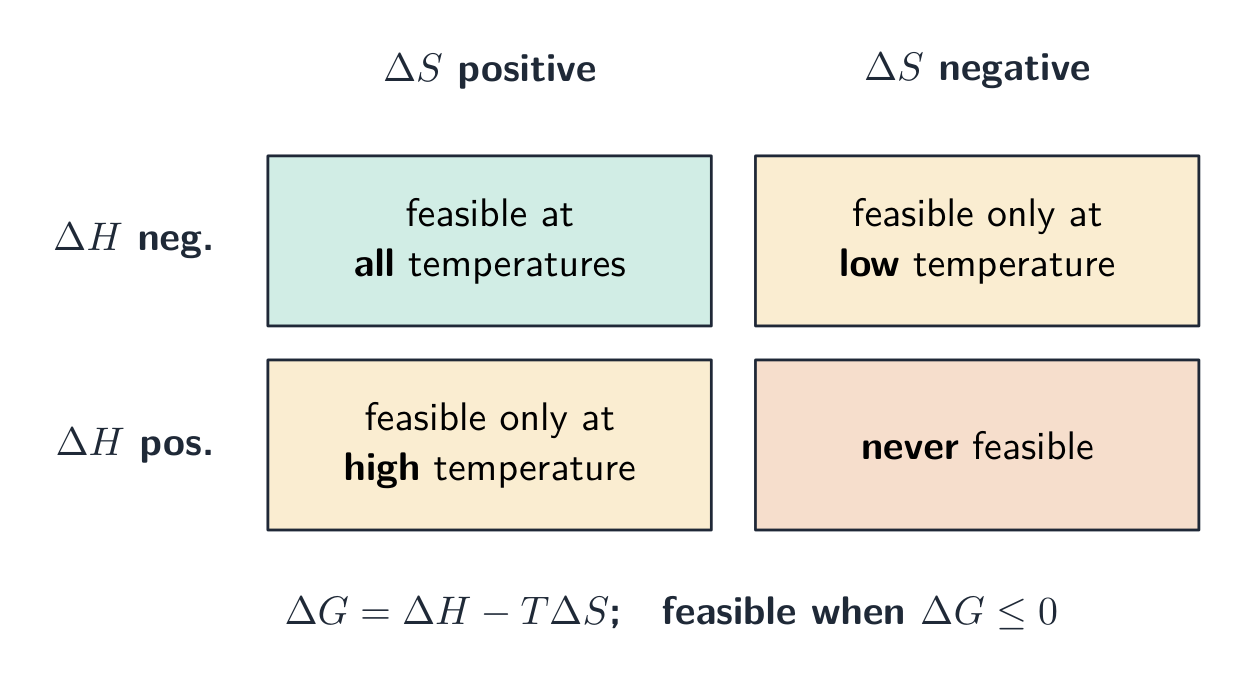
Cuando una reacción es factible a partir de los signos del cambio de entalpía y entropía
The Gibbs free energy change is calculated as: · El cambio de energía libre de Gibbs se calcula como:
ΔG° = ΔH° − TΔS°, with T in kelvin. · ΔG° = ΔH° − TΔS°, con T en kelvin.
A reaction is feasible when: · Una reacción es factible cuando:
A reaction can happen on its own when ΔG ≤ 0. · Una reacción puede ocurrir espontáneamente cuando ΔG ≤ 0.
Match each Gibbs idea. · Empareja cada idea de Gibbs.
Each item links the term to its correct meaning. · Cada elemento vincula el término con su significado correcto.
Feasibility and temperature
| $\Delta H$ | $\Delta S$ | Feasible |
|---|---|---|
| negative | positive | at all temperatures |
| positive | positive | only at high temperature |
| negative | negative | only at low temperature |
| positive | negative | never |
- The changeover temperature is found by setting $\Delta G = 0$, giving $T = \dfrac{\Delta H}{\Delta S}$.
A gaseous atom gains an electron, usually releasing energy
Factibilidad y temperatura
| $\Delta H$ | $\Delta S$ | Factible |
|---|---|---|
| negativa | positiva | a cualquier temperatura |
| positiva | positiva | solo a temperatura alta |
| negativa | negativa | solo a temperatura baja |
| positiva | negativa | nunca |
- La temperatura de transición se encuentra igualando $\Delta G = 0$, lo que da como resultado $T = \dfrac{\Delta H}{\Delta S}$.
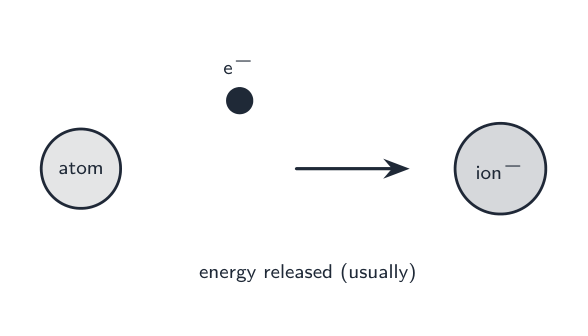
Un átomo gaseoso gana un electrón, generalmente liberando energía
A reaction with negative ΔH and positive ΔS is feasible: · Una reacción con ΔH negativo y ΔS positivo es factible:
With −ΔH and +ΔS, ΔG = ΔH − TΔS is always negative, so it is feasible at all temperatures. · Con −ΔH y +ΔS, ΔG = ΔH − TΔS es siempre negativo, por lo que es factible a todas las temperaturas.
The changeover temperature (where feasibility begins) is found by setting: · La temperatura de transición (donde comienza la factibilidad) se encuentra estableciendo:
At ΔG = 0 the reaction is on the verge of feasibility; rearranging gives T = ΔH/ΔS. · En ΔG = 0 la reacción está al borde de la factibilidad; reordenando da T = ΔH/ΔS.
A feasibility calculation
Worked example. ΔG = ΔH − TΔS. If ΔH = +20 kJ/mol and TΔS = +30 kJ/mol, then ΔG = 20 − 30 = −10 kJ/mol, so the reaction is feasible.
Cálculo de factibilidad
Ejemplo resuelto. ΔG = ΔH − TΔS. Si ΔH = +20 kJ/mol y TΔS = +30 kJ/mol, entonces ΔG = 20 − 30 = −10 kJ/mol, por lo tanto la reacción es factible.
You've got it
- $\Delta G^{\ominus} = \Delta H^{\ominus} - T\Delta S^{\ominus}$ (T in kelvin)
- a reaction is feasible when $\Delta G \leq 0$
- $-\Delta H$ & $+\Delta S$ → feasible at all T; $+\Delta H$ & $-\Delta S$ → never
- changeover temperature: set $\Delta G = 0$, so $T = \dfrac{\Delta H}{\Delta S}$
Lo has entendido
- $\Delta G^{\ominus} = \Delta H^{\ominus} - T\Delta S^{\ominus}$ (T en kelvin)
- una reacción es factible cuando $\Delta G \leq 0$
- $-\Delta H$ & $+\Delta S$ → factible a toda T; $+\Delta H$ & $-\Delta S$ → nunca
- temperatura de transición: igualar $\Delta G = 0$, así $T = \dfrac{\Delta H}{\Delta S}$