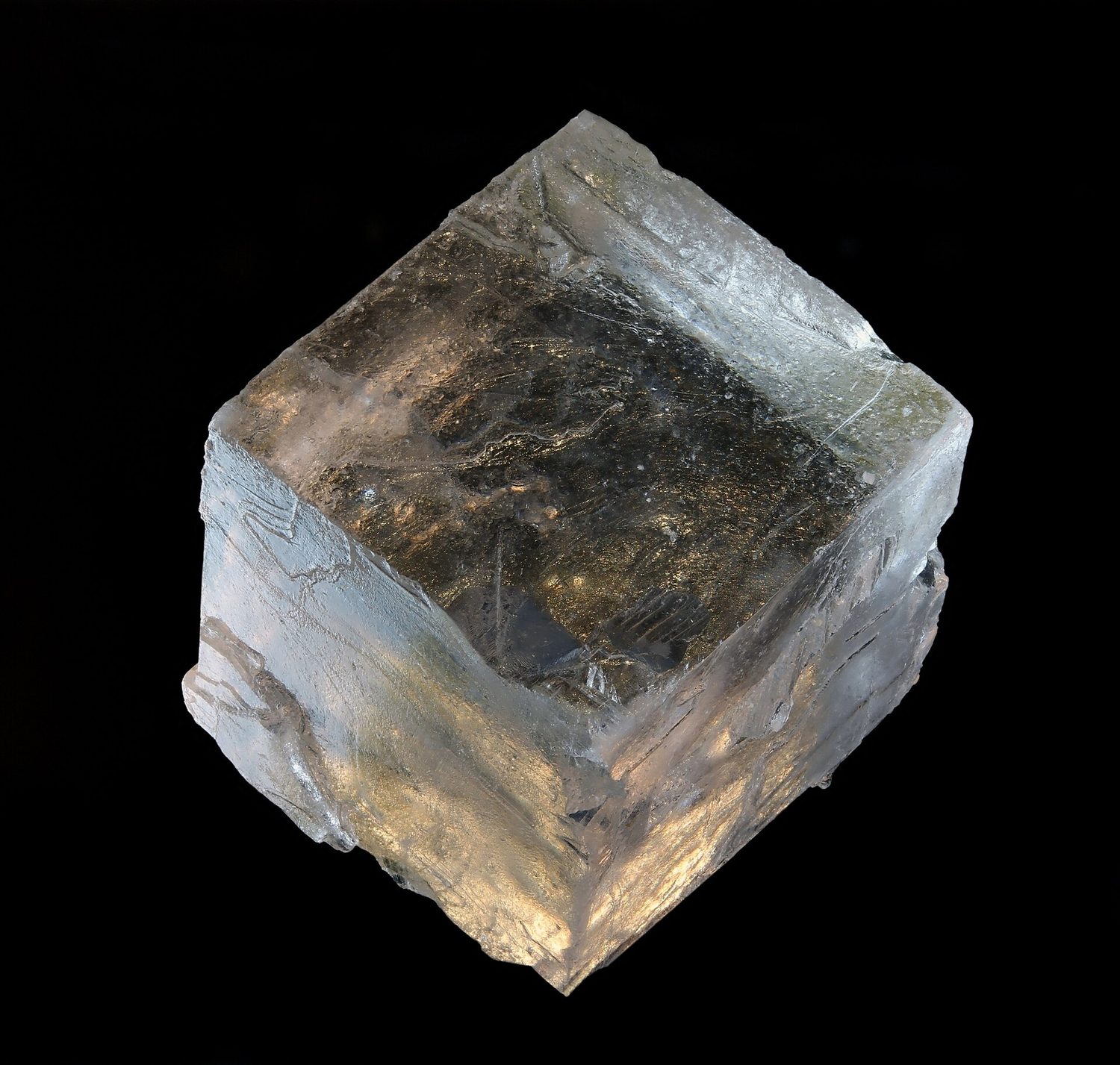
El sodio es un metal blando que arde en el aire. El cloro es un gas sofocante y venenoso. Juntarlos da sal de mesa. Formar una mol de ella libera una…
English narration · English + 中文 subtitles burned in · Narración en inglés · Subtítulos en inglés + 中文 quemados en pantalla
23.1
Lattice energy and Born–Haber cycles · Energía reticular y ciclos de Born–Haber
Syllabus
English
define and use the terms: (a) enthalpy change of atomisation, $\Delta H_{\text{at}}$ (b) lattice energy, $\Delta H_{\text{latt}}$ (the change from gas phase ions to solid lattice)
(a) define and use the term first electron affinity, EA (b) explain the factors affecting the electron affinities of elements (c) describe and explain the trends in the electron affinities of the Group 16 and Group 17 elements
construct and use Born–Haber cycles for ionic solids (limited to +1 and +2 cations, –1 and –2 anions)
carry out calculations involving Born–Haber cycles
explain, in qualitative terms, the effect of ionic charge and of ionic radius on the numerical magnitude of a lattice energy
Español
definir y utilizar los términos: (a) entalpía de atomización, $\Delta H_{\text{at}}$ (b) energía reticular, $\Delta H_{\text{latt}}$ (el cambio de iones en fase gaseosa a red cristalina sólida)
(a) definir y utilizar el término primera afinidad electrónica, EA (b) explicar los factores que afectan las afinidades electrónicas de los elementos (c) describir y explicar las tendencias en las afinidades electrónicas de los elementos del Grupo 16 y del Grupo 17
construir y utilizar ciclos de Born–Haber para sólidos iónicos (limitado a cationes +1 y +2, aniones –1 y –2)
realizar cálculos que involucren ciclos de Born–Haber
explicar, en términos cualitativos, el efecto de la carga iónica y del radio iónico sobre la magnitud numérica de una energía reticular
Source: Cambridge International syllabus · Fuente: Plan de estudios Cambridge International
English
These cycles use several enthalpy changes 焓变 ($\Delta H$). Two new ones are:
the enthalpy change of atomisation 原子化焓变, $\Delta H_{\text{at}}$ — the energy to make one mole of gaseous atoms from an element. It is always positive (bonds must break).
the lattice energy 晶格能, $\Delta H_{\text{latt}}$ — the energy change when one mole of a solid ionic lattice forms from its gaseous ions. It is always negative (strong bonds form).
Electron affinity
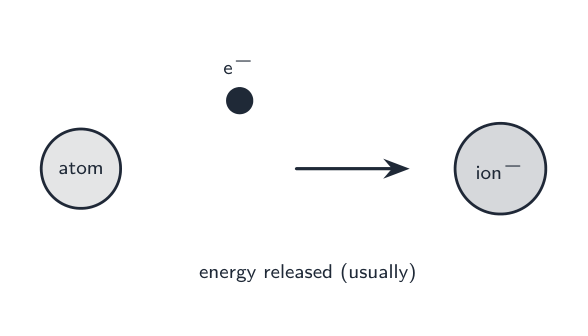
The first electron affinity 电子亲和能 (EA) is the energy change when one mole of gaseous atoms each gain one electron to form one mole of $1-$ ions. The first EA is usually negative.
The same factors as ionisation energy apply (nuclear charge, atomic radius, shielding). Going down Group 16 or 17, the EA becomes less exothermic, because the atom is larger and pulls the extra electron in less strongly. (The very top element is an exception: its atom is so small that electron repulsion makes its EA less exothermic than the one below it.)
Born–Haber cycles
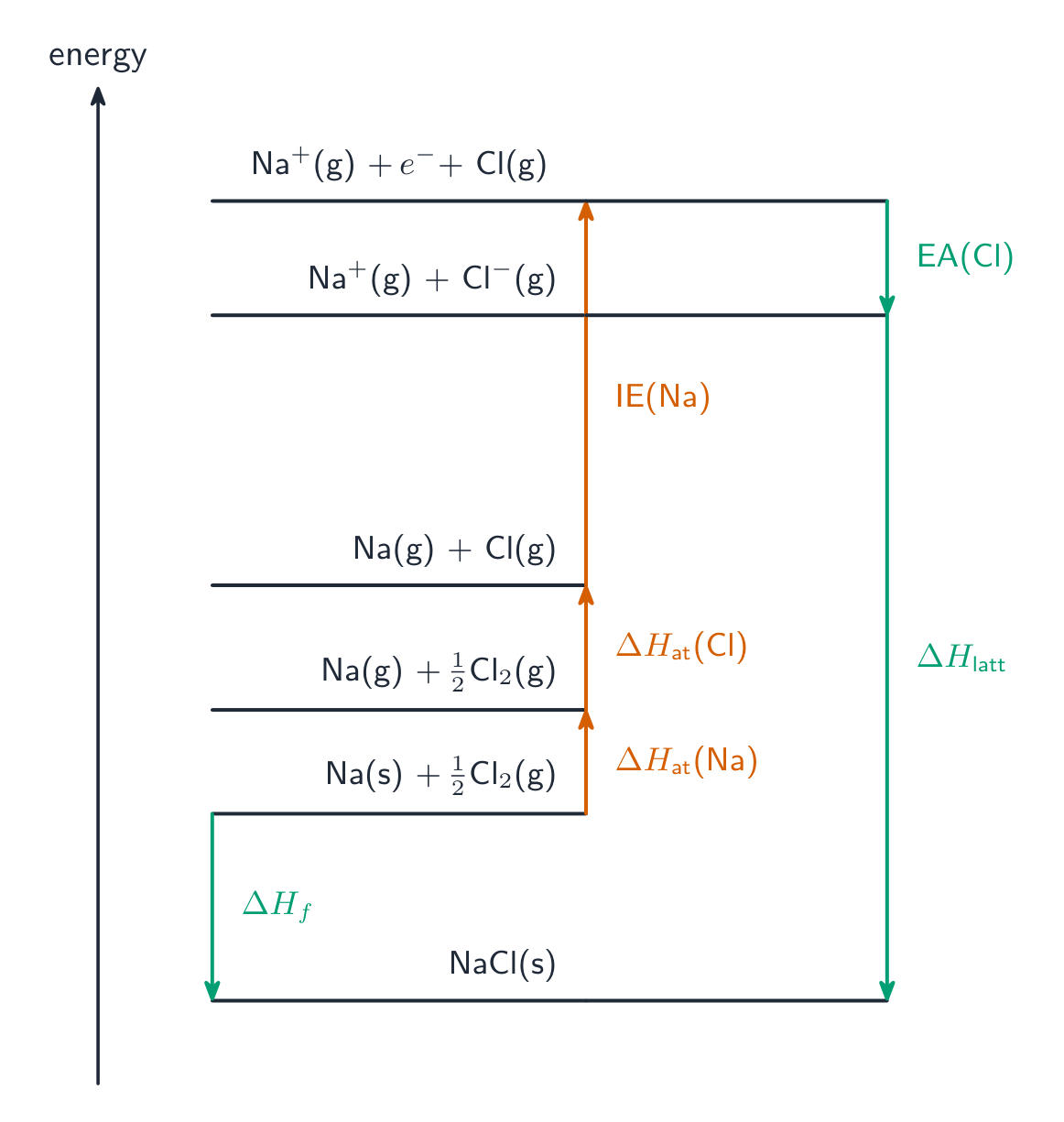
A Born–Haber cycle 玻恩哈伯循环 is an energy cycle that links the enthalpy change of formation of an ionic solid with its atomisation, ionisation energy, electron affinity and lattice energy. Using Hess's law, you go round the cycle to find any one unknown step. (You only need $+1$ and $+2$ cations and $-1$ and $-2$ anions.)
Worked example. Find the lattice energy of sodium chloride from these data (kJ mol⁻¹): enthalpy of formation $\Delta H_f = -411$; atomisation $\Delta H_{\text{at}}(\text{Na}) = +107$ and $\Delta H_{\text{at}}(\text{Cl}) = +122$; first ionisation energy of Na $= +496$; electron affinity of Cl $= -349$.
By Hess's law the direct formation route equals the route up and round the cycle:
The lattice energy is more negative (stronger) when:
the ionic charge is higher (e.g. $\text{Mg}^{2+}$ beats $\text{Na}^+$).
the ionic radius is smaller.
Both make the attraction between the ions stronger.
Español
Estos ciclos utilizan varios cambios de entalpía 焓变 ($\Delta H$). Dos de ellos son nuevos:
el cambio de entalpía de atomización 原子化焓变, $\Delta H_{\text{at}}$ — la energía necesaria para formar un mol de átomos gaseosos a partir de un elemento. Siempre es positivo (se deben romper enlaces).
la energía reticular 晶格能, $\Delta H_{\text{latt}}$ — el cambio de energía cuando se forma un mol de una red iónica sólida a partir de sus iones gaseosos. Siempre es negativa (se forman enlaces fuertes).
Un sólido iónico como el cloruro de sodio es una red gigante y regular de iones; la energía reticular se libera cuando se forma
Afinidad electrónica
La primera afinidad electrónica 电子亲和能 (AE) es el cambio de energía cuando un mol de átomos gaseosos gana cada uno un electrón para formar un mol de iones $1-$. La primera AE suele ser negativa.
Un átomo gaseoso gana un electrón, usualmente liberando energía
Los mismos factores que aplican a la energía de ionización lo hacen aquí (carga nuclear, radio atómico, apantallamiento). Al descender en el Grupo 16 o 17, la AE se vuelve menos exotérmica, porque el átomo es más grande y atrae al electrón extra con menos fuerza. (El elemento del extremo superior es una excepción: su átomo es tan pequeño que la repulsión entre electrones hace que su AE sea menos exotérmica que la del elemento inmediatamente inferior.)
Ciclos de Born–Haber
Un ciclo de Born–Haber 玻恩哈伯循环 es un ciclo energético que vincula el cambio de entalpía de formación de un sólido iónico con su atomización, energía de ionización, afinidad electrónica y energía reticular. Usando la ley de Hess, se recorre el ciclo para encontrar cualquier paso desconocido. (Solo se necesitan cationes $+1$ y $+2$ y aniones $-1$ y $-2$.)
Un ciclo de Born–Haber para NaCl: subir cuesta energía (atomización, ionización); bajar la libera (afinidad electrónica y la gran energía reticular)
Ejemplo resuelto. Encuentre la energía reticular del cloruro de sodio a partir de estos datos (kJ mol⁻¹): entalpía de formación $\Delta H_f = -411$; atomización $\Delta H_{\text{at}}(\text{Na}) = +107$ y $\Delta H_{\text{at}}(\text{Cl}) = +122$; primera energía de ionización del Na $= +496$; afinidad electrónica del Cl $= -349$.
Por la ley de Hess, la ruta de formación directa es igual a la ruta hacia arriba y alrededor del ciclo:
Enthalpies of solution and hydration · Entalpías de disolución e hidratación
Syllabus
English
define and use the term enthalpy change with reference to hydration, $\Delta H_{\text{hyd}}$, and solution, $\Delta H_{\text{sol}}$
construct and use an energy cycle involving enthalpy change of solution, lattice energy and enthalpy change of hydration
carry out calculations involving the energy cycles in 23.2.2
explain, in qualitative terms, the effect of ionic charge and of ionic radius on the numerical magnitude of an enthalpy change of hydration
Español
definir y utilizar el término cambio de entalpía con referencia a la hidratación, $\Delta H_{\text{hyd}}$, y la disolución, $\Delta H_{\text{sol}}$
construir y utilizar un ciclo energético que involucre el cambio de entalpía de disolución, la energía reticular y el cambio de entalpía de hidratación
realizar cálculos relacionados con los ciclos energéticos descritos en 23.2.2
explicar, en términos cualitativos, el efecto de la carga iónica y del radio iónico sobre la magnitud numérica de un cambio de entalpía de hidratación
Source: Cambridge International syllabus · Fuente: Plan de estudios Cambridge International
English
the enthalpy change of hydration 水合焓变, $\Delta H_{\text{hyd}}$ — the energy change when one mole of gaseous ions is surrounded by water to form aqueous ions. It is exothermic.
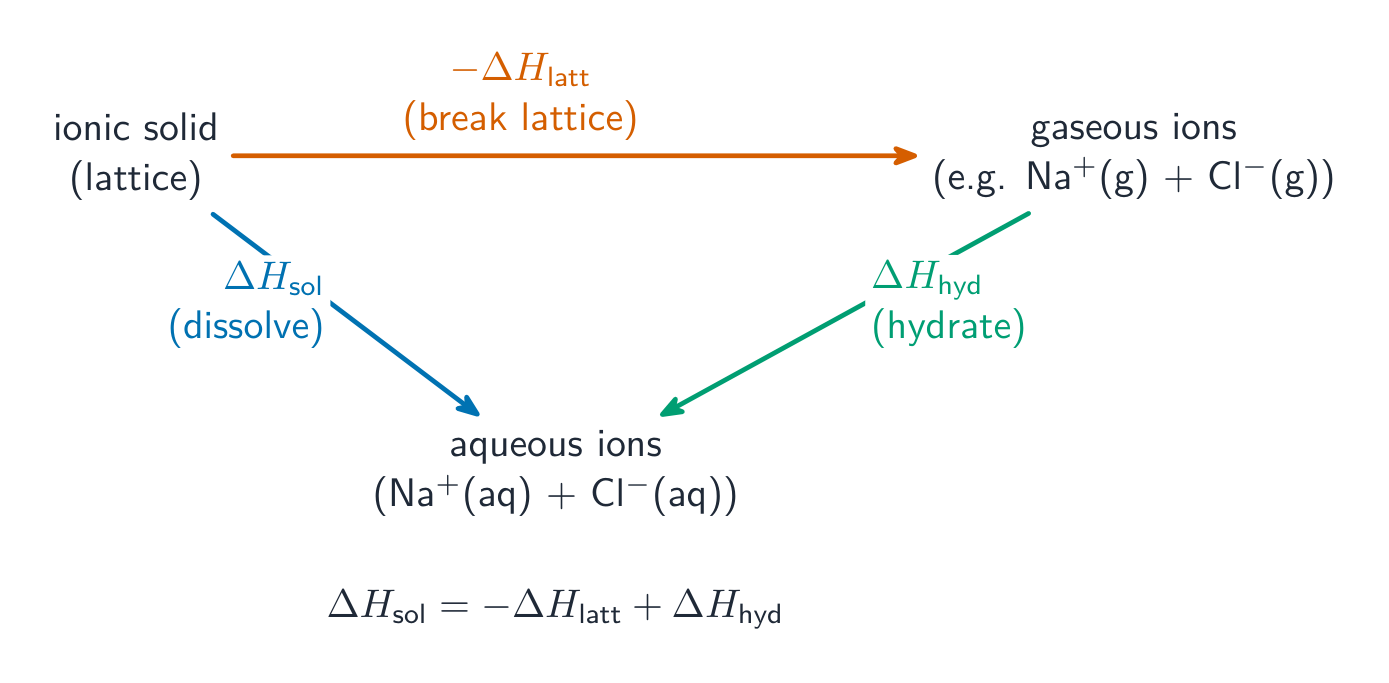
the enthalpy change of solution 溶解焓变, $\Delta H_{\text{sol}}$ — the energy change when one mole of solute dissolves fully in water.
(To dissolve, you first pull the lattice apart, then hydrate the ions.) Like lattice energy, $\Delta H_{\text{hyd}}$ is more exothermic for ions with a higher charge and a smaller radius.
Español
el cambio de entalpía de hidratación 水合焓变, $\Delta H_{\text{hyd}}$ — el cambio de energía cuando un mol de iones gaseosos queda rodeado por agua para formar iones acuosos. Es exotérmico.
el cambio de entalpía de disolución 溶解焓变, $\Delta H_{\text{sol}}$ — el cambio de energía cuando un mol de soluto se disuelve completamente en agua.
Una bolsa de frío instantánea se siente fría porque su sal se disuelve endotérmicamente (un $\Delta H_\text{sol}$ positivo), impulsada por el aumento de entropía
(Para disolver, primero se separa la red y luego se hidratan los iones.) Al igual que la energía reticular, $\Delta H_{\text{hyd}}$ es más exotérmico para iones con mayor carga y menor radio.
Ciclo de disolución: separar la red (energía reticular inversa), luego hidratar los iones gaseosos, por lo tanto $\Delta H_\text{sol} = -\Delta H_\text{latt} + \Delta H_\text{hyd}$
Explore · Explorar
Laboratorio de entalpía de disolución
deltaHsol = energía reticular + términos de hidratación
Cambiar la fuerza de hidratación y ver el desplazamiento de la entalpía de disolución.
define the term entropy, $S$, as the number of possible arrangements of the particles and their energy in a given system
predict and explain the sign of the entropy changes that occur: (a) during a change in state, e.g. melting, boiling and dissolving (and their reverse) (b) during a temperature change (c) during a reaction in which there is a change in the number of gaseous molecules
calculate the entropy change for a reaction, $\Delta S$, given the standard entropies, $S^\ominus$, of the reactants and products, $\Delta S^\ominus = \Sigma S^\ominus \text{(products)} - \Sigma S^\ominus \text{(reactants)}$ (use of $\Delta S^\ominus = \Delta S^\ominus_{\text{surr}} + \Delta S^\ominus_{\text{sys}}$ is not required)
Español
definir el término entropía, $S$, como el número de disposiciones posibles de las partículas y su energía en un sistema dado
predecir y explicar el signo de los cambios de entropía que ocurren: (a) durante un cambio de estado, por ejemplo, fusión, ebullición y disolución (y sus inversos) (b) durante un cambio de temperatura (c) durante una reacción en la que hay un cambio en el número de moléculas gaseosas
calcular el cambio de entropía para una reacción, $\Delta S$, dadas las entropías estándar, $S^\ominus$, de los reactivos y productos, $\Delta S^\ominus = \Sigma S^\ominus \text{(products)} - \Sigma S^\ominus \text{(reactants)}$ (no se requiere el uso de $\Delta S^\ominus = \Delta S^\ominus_{\text{surr}} + \Delta S^\ominus_{\text{sys}}$)
Source: Cambridge International syllabus · Fuente: Plan de estudios Cambridge International
English
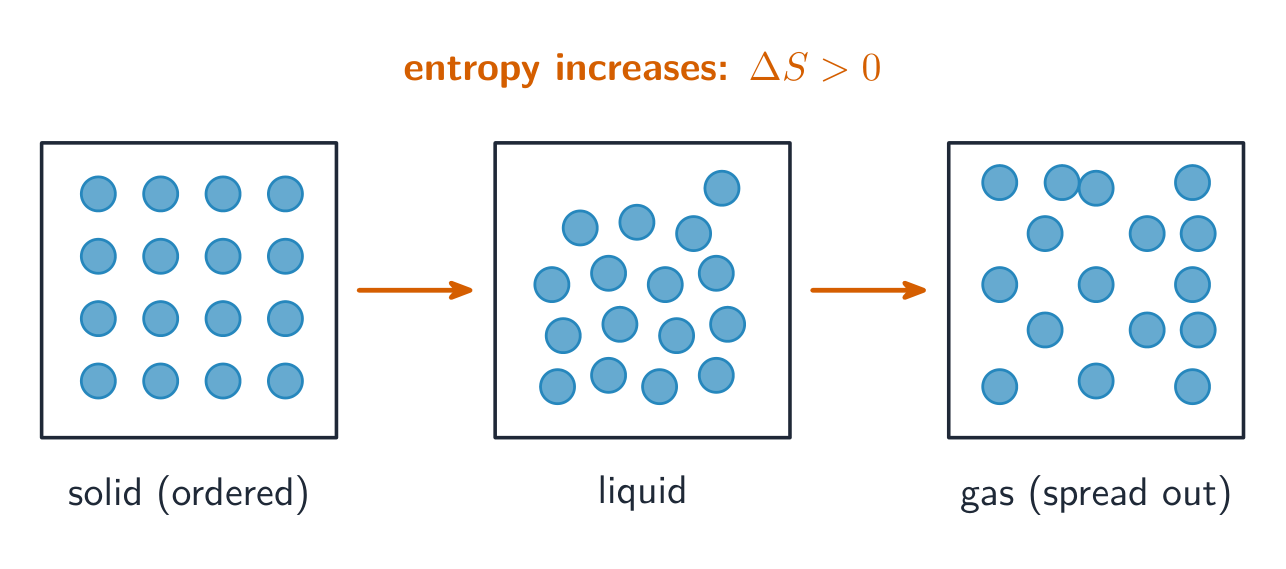
Entropy 熵 ($S$) measures the number of ways the particles and their energy can be arranged in a system. More ways means more "disorder".
The entropy change 熵变 ($\Delta S$) is positive when disorder increases, and negative when it falls:
Change
Sign of $\Delta S$
solid → liquid → gas (melting, boiling), or dissolving
La entropía 熵 ($S$) mide el número de formas en que las partículas y su energía pueden organizarse en un sistema. Más formas significan más "desorden".
La entropía aumenta de sólido a líquido a gas a medida que las partículas se distribuyen en más arreglos, por lo tanto $\Delta S$ es positivo
El cambio de entropía 熵变 ($\Delta S$) es positivo cuando aumenta el desorden, y negativo cuando disminuye:
Cambio
Signo de $\Delta S$
sólido → líquido → gas (fusión, ebullición) o disolución
positivo
un aumento de temperatura
positivo
una reacción que produce más moléculas de gas
positivo
una reacción que produce menos moléculas de gas
negativo
Se puede calcular a partir de las entropías estándar:
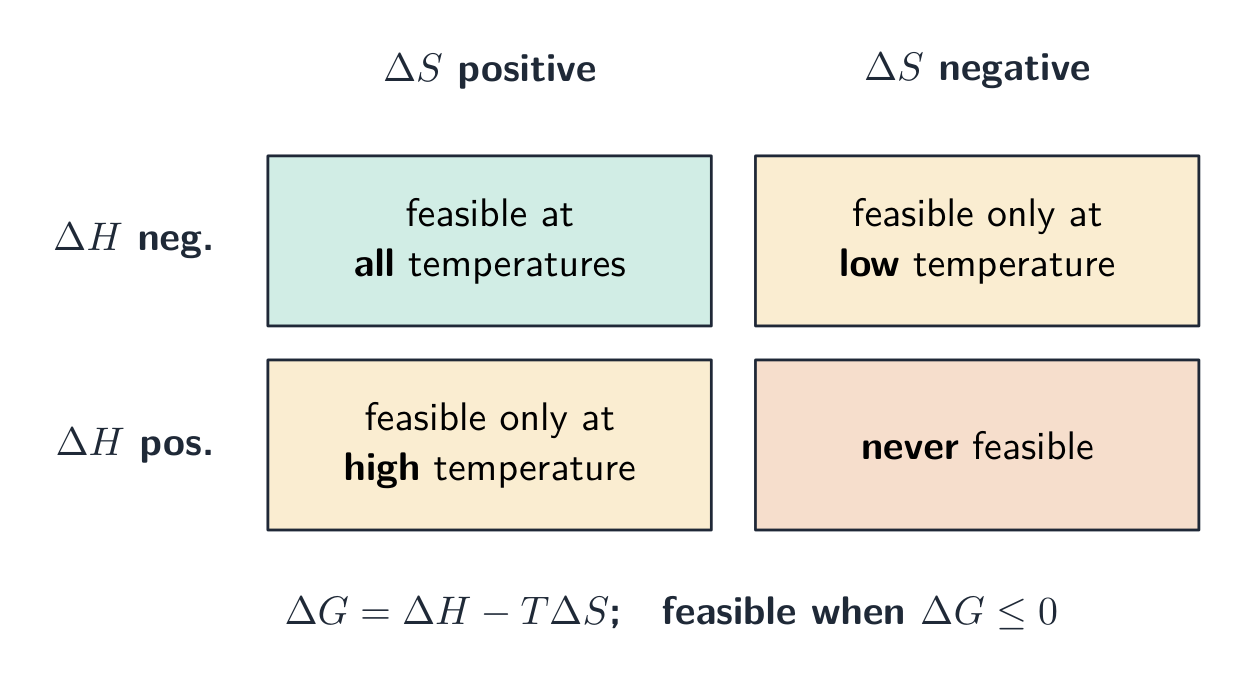
Here $T$ is the temperature in kelvin. A reaction is feasible (it can happen) when $\Delta G$ is negative or zero. The feasibility 可行性 therefore depends on temperature:
$\Delta H$
$\Delta S$
When feasible
negative
positive
at all temperatures
positive
positive
only at high temperature
negative
negative
only at low temperature
positive
negative
never
To find the changeover temperature, set $\Delta G = 0$, which gives $T = \Delta H / \Delta S$.
Worked example. A reaction has $\Delta H = +120\ \text{kJ mol}^{-1}$ and $\Delta S = +200\ \text{J K}^{-1}\,\text{mol}^{-1}$. Find $\Delta G$ at $298\ \text{K}$, and the temperature above which the reaction becomes feasible.
First match the units: $\Delta S = +0.200\ \text{kJ K}^{-1}\,\text{mol}^{-1}$. Then
$$\Delta G = \Delta H - T\Delta S = 120 - 298 \times 0.200 = +60\ \text{kJ mol}^{-1}\quad(\text{positive, so not yet feasible}).$$
Setting $\Delta G = 0$ gives $T = \Delta H/\Delta S = 120/0.200 = 600\ \text{K}$, so the reaction is feasible above $600\ \text{K}$.
Español
El cambio de energía libre de Gibbs 吉布斯自由能 decide si una reacción puede ocurrir espontáneamente:
Aquí $T$ es la temperatura en kelvin. Una reacción es factible (puede ocurrir) cuando $\Delta G$ es negativo o cero. Por lo tanto, la factibilidad 可行性 depende de la temperatura:
$\Delta H$
$\Delta S$
Cuándo es factible
negativo
positivo
a todas las temperaturas
positivo
positivo
solo a alta temperatura
negativo
negativo
solo a baja temperatura
positivo
negativo
nunca
Si una reacción es factible ($\Delta G \leq 0$) depende de los signos de $\Delta H$ y $\Delta S$, y a veces de la temperatura
Para encontrar la temperatura de transición, iguale $\Delta G = 0$, lo que da $T = \Delta H / \Delta S$.
Ejemplo resuelto. Una reacción tiene $\Delta H = +120\ \text{kJ mol}^{-1}$ y $\Delta S = +200\ \text{J K}^{-1}\,\text{mol}^{-1}$. Encuentre $\Delta G$ a $298\ \text{K}$ y la temperatura por encima de la cual la reacción se vuelve factible.
Primero igualar las unidades: $\Delta S = +0.200\ \text{kJ K}^{-1}\,\text{mol}^{-1}$. Entonces
$$\Delta G = \Delta H - T\Delta S = 120 - 298 \times 0.200 = +60\ \text{kJ mol}^{-1}\quad(\text{positive, so not yet feasible}).$$
Al igualar $\Delta G = 0$, se obtiene $T = \Delta H/\Delta S = 120/0.200 = 600\ \text{K}$, por lo que la reacción es factible por encima de $600\ \text{K}$.
Explore · Explorar
Laboratorio de energía libre de Gibbs
deltaG = deltaH - T deltaS
Mueve la temperatura y observa cuándo deltaG se vuelve negativo.
In a Born-Haber cycle get each step's direction and sign right (atomisation, ionisation $+$; electron affinity, lattice formation $-$) and apply Hess's law around it.
Lattice energy is more exothermic for smaller, more highly charged ions (higher charge density).
Predict the sign of $\Delta S$ from the state changes (more gas moles = more disorder).
Use $\Delta G = \Delta H - T\Delta S$; feasible when $\Delta G \le 0$ — convert $\Delta S$ from $\text{J K}^{-1}\,\text{mol}^{-1}$ ($\div 1000$).
Español
En un ciclo de Born–Haber, asegúrese de obtener correctamente la dirección y el signo de cada paso (atomización, ionización $+$; afinidad electrónica, formación de red $-$) y aplique la ley de Hess alrededor del mismo.
La energía reticular es más exotérmica para iones más pequeños y con mayor carga (mayor densidad de carga).
Prediga el signo de $\Delta S$ a partir de los cambios de estado (más moles de gas = más desorden).
Use $\Delta G = \Delta H - T\Delta S$; es factible cuando $\Delta G \le 0$ — convierta $\Delta S$ de $\text{J K}^{-1}\,\text{mol}^{-1}$ ($\div 1000$).
Interactive lessons on this topic · Lecciones interactivas sobre este tema
Work through it step by step, with instant-check exercises. · Trátalo paso a paso, con ejercicios de verificación instantánea.
Pick one and the site follows you — notes, papers, videos and practice all open on it. · Selecciona uno y el sitio te sigue — notas, documentos, videos y práctica se abren en él.
Type to search notes, lessons, code, vocabulary and past-paper questions across every subject. · Escribe para buscar notas, lecciones, código, vocabulario y preguntas de exámenes anteriores en todas las materias.