Vmax, Km and inhibitors · Vmax, Km e inhibidores
| English | Español |
|---|---|
| maximum rate/ˈmæksɪməm reɪt/ | velocidad máxima |
| Michaelis–Menten constant/ˈmaɪkəliz ˈmentn ˈkɒnstənt/ | constante de Michaelis–Menten |
| affinity/əˈfɪnɪti/ | afinidad |
| competitive/kəmˈpetɪtɪv/ | competitivo |
| non-competitive/nɒn kəmˈpetɪtɪv/ | no competitivo |
| immobilised enzyme/ɪˈməʊbəlaɪzd ˈenzaɪm/ | enzima inmovilizada |
Vmax and Km
- When every active site is full, the reaction hits a top speed — the maximum rate 最大速率, $V_{max}$.
- The curve of rate against substrate concentration climbs and then flattens at $V_{max}$.
Vmax y Km
- Cuando todos los sitios activos están llenos, la reacción alcanza su velocidad máxima: la velocidad máxima 最大速率, $V_{max}$.
- La curva de velocidad frente a la concentración de sustrato asciende y luego se estabiliza en $V_{max}$.
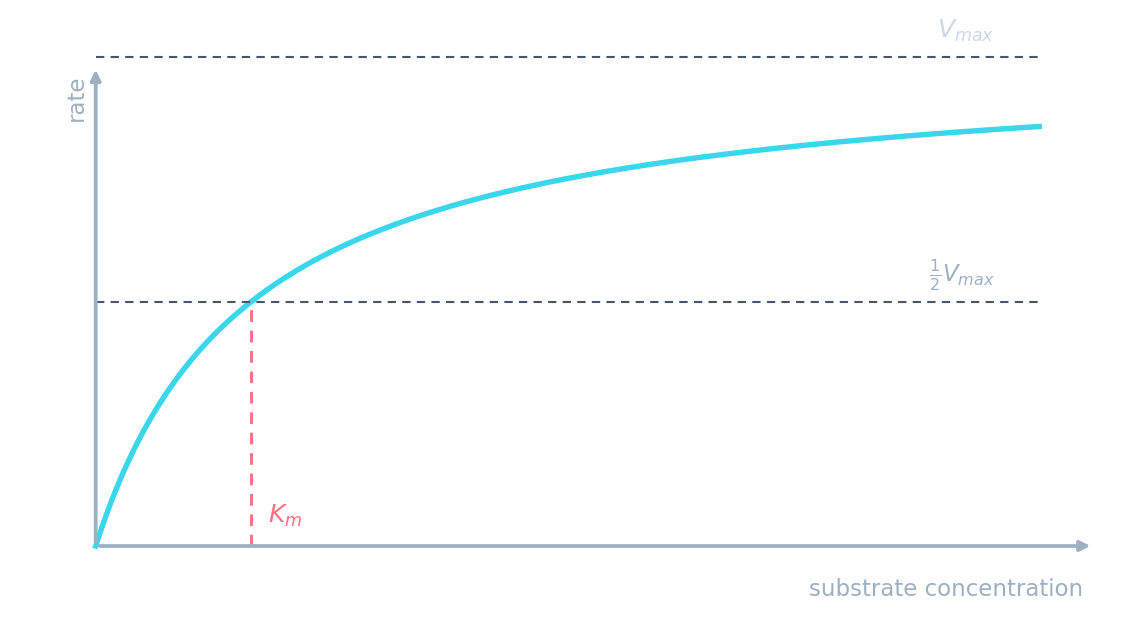
What does V_max represent? · ¿Qué representa V_max?
V_max is the top rate; the curve flattens there because every active site is busy. · V_max es la velocidad máxima; la curva se aplana allí porque cada sitio activo está ocupado.
What Km tells you
- The Michaelis–Menten constant 米氏常数, $K_m$, is the substrate concentration that gives half of $V_{max}$.
- It measures the enzyme's affinity 亲和力 (pulling power) for its substrate:
- low $K_m$ → reaches half-speed at low substrate → high affinity.
- high $K_m$ → needs lots of substrate → low affinity.
- So $K_m$ lets you compare how strongly different enzymes hold their substrates.
Both reach the same $V_{max}$, but the low-$K_m$ enzyme gets to half-speed on far less substrate — it grips its substrate more tightly.
Lo que te dice el Km
- La constante de Michaelis–Menten 米氏常数, $K_m$, es la concentración de sustrato que produce la mitad de $V_{max}$.
- Mide la afinidad 亲和力 (fuerza de atracción) de la enzima por su sustrato:
- bajo $K_m$ → alcanza la mitad de la velocidad con poco sustrato → alta afinidad.
- alto $K_m$ → necesita mucho sustrato → baja afinidad.
- Por tanto, $K_m$ permite comparar cuán fuertemente diferentes enzimas retienen sus sustratos.
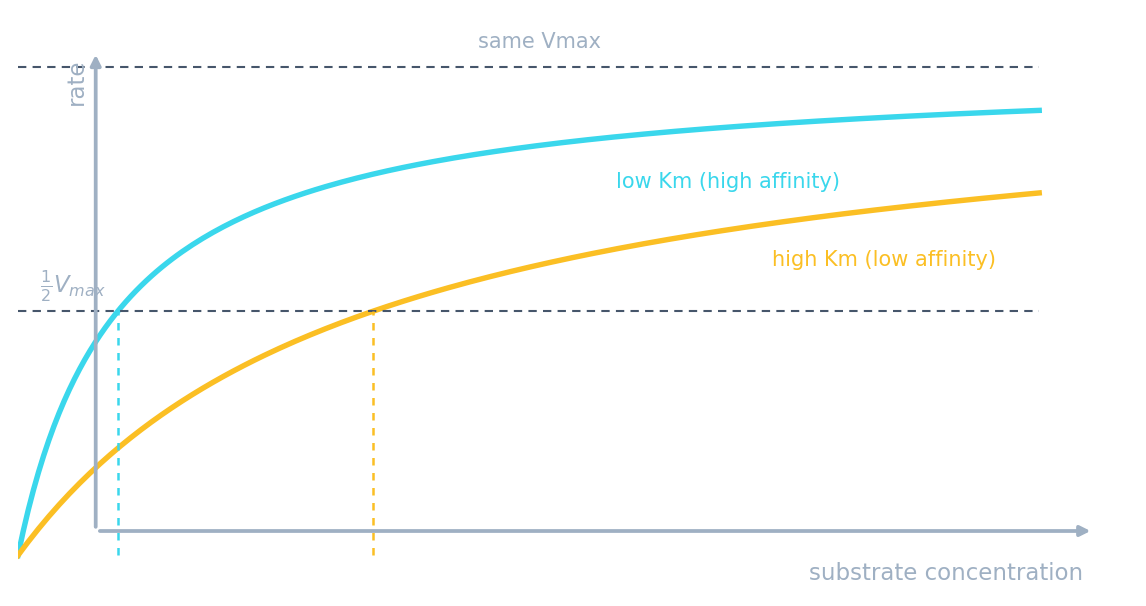
Ambas alcanzan el mismo $V_{max}$, pero la enzima de bajo-$K_m$ llega a la mitad de su velocidad con mucho menos sustrato — sujeta su sustrato con mayor fuerza.
Vmax and Km · Vmax y Km
rate = Vmax·[S] / (Km + [S]) · tasa = Vmax·[S] / (Km + [S])
Drag the substrate. The rate approaches Vmax; the substrate that gives half · la mitad of Vmax is Km — a measure of how tightly the enzyme binds. · Arrastra el sustrato. La velocidad se acerca a Vmax; el sustrato que produce la mitad de Vmax es Km — una medida de qué tan estrechamente la enzima se une.
An enzyme has V_max = 80 units. At a substrate concentration equal to its Km, what is the rate? · Una enzima tiene V_max = 80 unidades. A una concentración de sustrato igual a su Km, ¿cuál es la velocidad?
By definition Km is the substrate concentration that gives half · la mitad of V_max, so the rate is 80 ÷ 2 = 40 units. · Por definición, Km es la concentración de sustrato que produce la mitad de V_max, por lo tanto la velocidad es 80 ÷ 2 = 40 unidades.
A LOW Km means the enzyme only reaches half its maximum rate at a HIGH substrate concentration. · Un Km BAJO significa que la enzima solo alcanza la mitad de su velocidad máxima a una ALTA concentración de sustrato.
The opposite: low Km means half-speed is reached at LOW substrate — a high affinity, gripping the substrate tightly. · Lo contrario: un Km bajo significa que la velocidad media se alcanza a BAJA concentración de sustrato — una alta afinidad, sujetando el sustrato firmemente.
Reversible inhibitors
- An inhibitor slows an enzyme; a reversible one can leave again. Two types:
| Type | Binds | Add more substrate? | $V_{max}$ | $K_m$ |
|---|---|---|---|---|
| competitive 竞争性 | the active site (similar shape to substrate) | out-competes it — effect drops | unchanged | rises |
| non-competitive 非竞争性 | a different site (changes the active site) | does not help | falls | unchanged |
Inhibidores reversibles
- Un inhibidor reduce la actividad de una enzima; un reversible puede desvincularse posteriormente. Hay dos tipos:
| Tipo | Se une a | ¿Añadir más sustrato ayuda? | $V_{max}$ | $K_m$ |
|---|---|---|---|---|
| competitivo 竞争性 | el sitio activo (forma similar al sustrato) | lo desplaza — el efecto disminuye | sin cambios | aumenta |
| no competitivo 非竞争性 | otro sitio (altera el sitio activo) | no ayuda | disminuye | sin cambios |
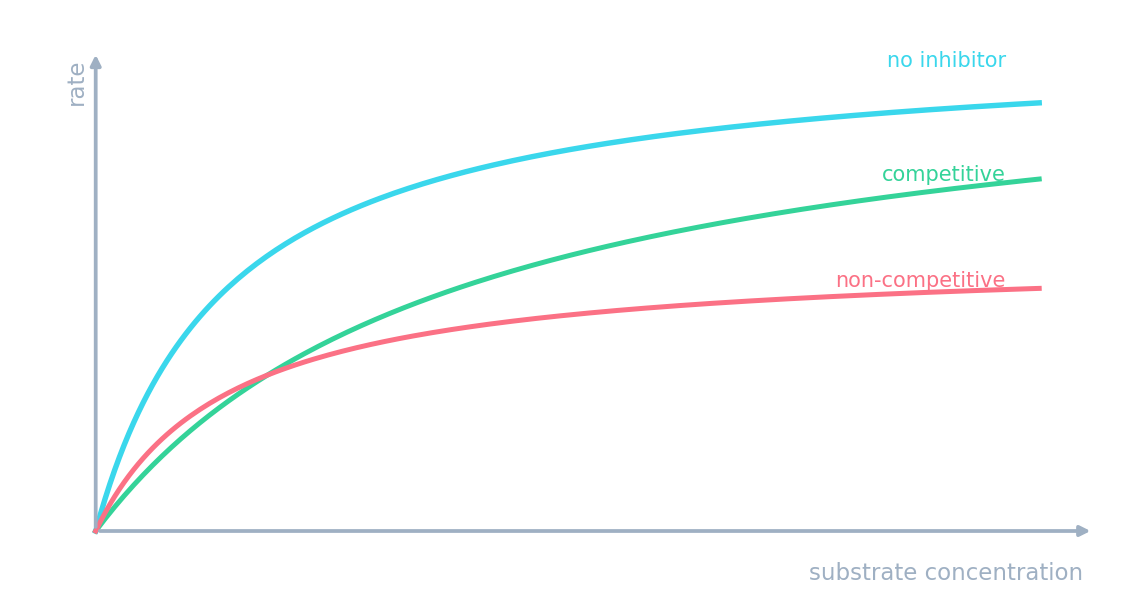
Match each inhibitor effect to the right outcome. · Empareja cada efecto del inhibidor con el resultado correcto.
A competitive inhibitor blocks the active site (raises Km, same Vmax); a non-competitive one binds elsewhere and lowers Vmax (Km unchanged). · Un inhibidor competitivo bloquea el sitio activo (aumenta Km, misma Vmax); uno no competitivo se une en otro lugar y reduce Vmax (Km inalterado).
Adding more substrate overcomes a competitive inhibitor but not a non-competitive one. Why? · Añadir más sustrato supera a un inhibidor competitivo pero no a uno no competitivo. ¿Por qué?
A competitive inhibitor blocks the active site, so flooding with substrate wins the competition. A non-competitive inhibitor binds elsewhere, so substrate cannot displace it. · Un inhibidor competitivo bloquea el sitio activo, por lo que inundar con sustrato gana la competición. Un inhibidor no competitivo se une en otro lugar, por lo que el sustrato no puede desplazarlo.
Immobilised enzymes 固定化酶
- An immobilised enzyme is fixed in place — e.g. trapped in alginate beads — while substrate flows past.
- A free enzyme works a little faster, but immobilising it brings big practical wins:
- it is not washed away, so it can be reused.
- the product is pure (not mixed with enzyme).
- it is more stable to changes in temperature and pH.
- the process can run continuously.
- Used industrially — e.g. lactase beads make lactose-free milk.
Enzimas inmovilizadas 固定化酶
- Una enzima inmovilizada está fija en su lugar —p. ej., atrapada en perlas de alginato— mientras fluye el sustrato.
- Una enzima libre reacciona ligeramente más rápido, pero inmovilizarla ofrece grandes ventajas prácticas:
- no se lava, por lo que puede reutilizarse.
- el producto es puro (no mezclado con enzima).
- es más estable ante cambios de temperatura y pH.
- el proceso puede funcionar de forma continua.
- Uso industrial —p. ej., las perlas de lactasa producen leche sin lactosa.
Select all · todos the advantages of immobilising an enzyme (e.g. in alginate beads). · Selecciona todas las ventajas de inmovilizar una enzima (ej. en perlas de alginato).
Immobilised enzymes are reusable, give a pure product and are more stable — but a free enzyme actually works a little faster. · Las enzimas inmovilizadas son reutilizables, producen un producto puro y son más estables — pero una enzima libre realmente funciona un poco más rápido.
An enzyme fixed in place (e.g. trapped in alginate beads) so it can be reused is described as ______. · Una enzima fija en su lugar (ej. atrapada en perlas de alginato) para que pueda reutilizarse se describe como ______.
Immobilising the enzyme lets it be recovered and reused, and keeps the product enzyme-free. · Inmovilizar la enzima permite recuperarla y reutilizarla, y mantiene el producto libre de enzima.
You've got it
- $V_{max}$ = top rate (all active sites full); $K_m$ = substrate concentration giving half $V_{max}$
- low $K_m$ = high affinity; high $K_m$ = low affinity
- competitive inhibitor: active site, raises $K_m$, $V_{max}$ unchanged (more substrate overcomes it)
- non-competitive inhibitor: other site, lowers $V_{max}$, $K_m$ unchanged
- immobilised enzymes: reusable, pure product, more stable, continuous
Ya lo tienes
- $V_{max}$ = velocidad máxima (todos los sitios activos llenos); $K_m$ = concentración de sustrato que produce la mitad de $V_{max}$
- bajo $K_m$ = alta afinidad; alto $K_m$ = baja afinidad
- Inhibidor competitivo: sitio activo, aumenta $K_m$, $V_{max}$ sin cambios (más sustrato lo supera)
- Inhibidor no competitivo: otro sitio, disminuye $V_{max}$, $K_m$ sin cambios
- Enzimas inmovilizadas: reutilizables, producto puro, más estables, continuo