Skip to content · ⁨Saltar al contenido⁩

Medios, Materiales y Técnicas 2D

AP Arte y Diseño 2D · Topic 3 · ⁨Tema 3⁩

Train · ⁨Entrenar⁩
Video lesson for this topic · ⁨Lección de video para este tema⁩ Open the video page · ⁨Abrir la página de video⁩
8:00

Medios 2-D, Materiales y Técnicas

Mira de cerca. No hay tinta gris en este dibujo. Cada sombra suave está hecha de líneas separadas, dibujadas una junto a la otra. Donde las líneas se amontonan…

English narration · English + 中文 subtitles burned in · ⁨Narración en inglés · Subtítulos en inglés + 中文 quemados en pantalla⁩

3.1

Drawing Media · ⁨Medios de Dibujo⁩

Syllabus
English

Focus: Drawing media make marks directly on a surface — the foundation of most 2-D work.

  • Dry media: graphite (pencil), charcoal, conte, chalk and oil pastel, coloured pencil.
  • Wet media: pen and ink, brush and ink, markers.
  • Mark-making techniques: hatching, cross-hatching, stippling, blending, and scribbling.
  • Choice of media and paper (tooth/texture) changes the line and value possible.
  • Drawing is used both to investigate ideas (studies, sketches) and to make finished works.
Español

Enfoque: Los medios de dibujo realizan marcas directamente sobre una superficie — la base de la mayoría del trabajo en dos dimensiones.

  • Medios secos: grafito (lápiz), carbón, conte, tiza y pastel graso, lápices de colores.
  • Medios húmedos: pluma y tinta, pincel y tinta, marcadores.
  • Técnicas de creación de marcas: trazos paralelos, tramado cruzado, punteado, difuminado y garabateo.
  • La elección del medio y del papel (grano/textura) cambia la línea y el valor posibles.
  • El dibujo se utiliza tanto para investigar ideas (estudios, bocetos) como para crear obras terminadas.

Source: College Board AP Course and Exam Description · ⁨Fuente: College Board AP Course and Exam Description⁩

English

Media 媒介 are the materials an artist works with. Drawing media make marks directly on a surface and are the foundation of most 2-D work.

  • Dry media 干性媒介: graphite (pencil), charcoal, conté, chalk and oil pastel, coloured pencil.
  • Wet media 湿性媒介: pen and ink, brush and ink, markers.
  • Mark-making techniques: hatching 排线, cross-hatching 交叉排线, stippling 点画, blending, and scribbling.
  • The tooth 纸纹 (texture) of the paper changes the line and value possible.

Drawing is used both to investigate ideas (studies and sketches) and to make finished works.

Español

Los medios 媒介 son los materiales con los que trabaja un artista. Los medios de dibujo dejan marcas directamente sobre una superficie y constituyen la base de la mayoría del trabajo en dos dimensiones (2-D).

  • Medios secos 干性媒介: grafito (lápiz), carbón, conté, tiza, pastel al óleo y lápices de color.
  • Medios húmedos 湿性媒介: pluma y tinta, pincel y tinta, marcadores.
  • Técnicas de marcaje: trazo hachurado 排线, trazo entrecruzado 交叉排线, punteado 点画, difuminado y garabateo.
  • La textura 纸纹 (grano) del papel cambia el tipo de línea y valor posible.

El dibujo se utiliza tanto para investigar ideas (estudios y bocetos) como para crear obras terminadas.
3.2

Painting Media · ⁨Medios de Pintura⁩

Syllabus
English

Focus: Painting applies pigment suspended in a binder to a surface, building colour, value, and texture.

  • Common media: watercolour (transparent), gouache (opaque water-based), acrylic (fast-drying), oil (slow, blendable).
  • Support and ground (paper, canvas, board; primer/gesso) affect how paint behaves.
  • Techniques: washes, glazing, wet-on-wet, dry-brush, impasto, and layering.
  • Water-based paints dry quickly and clean with water; oils dry slowly and blend richly.
  • Brush choice, dilution, and paint thickness control mark, edge, and texture.
Español

Enfoque: La pintura aplica pigmento suspendido en un aglutinante sobre una superficie, construyendo color, valor y textura.

  • Medios comunes: acuarela (transparente), témpera (aguatinta opaca a base de agua), acrílica (de secado rápido) y óleo (de secado lento y mezcla rica).
  • El soporte y la preparación (papel, lienzo, tabla; imprimación/ginger) afectan el comportamiento de la pintura.
  • Técnicas: lavados, vidriado, húmedo sobre húmedo, pincel seco, empaste y superposición de capas.
  • Las pinturas a base de agua se secan rápidamente y se limpian con agua; los aceites se secan lentamente y permiten mezclas ricas.
  • La elección del pincel, la dilución y el espesor de la pintura controlan la marca, el borde y la textura.

Source: College Board AP Course and Exam Description · ⁨Fuente: College Board AP Course and Exam Description⁩

English

Painting 绘画 applies pigment held in a binder 粘合剂 to a surface, building colour, value, and texture.

  • Watercolour 水彩 is transparent; gouache 水粉 is opaque and water-based; acrylic 丙烯 dries fast; oil 油画 dries slowly and blends richly.
  • The support 底材 and ground (paper, canvas, board; primer or gesso 石膏底料) affect how paint behaves.
  • Techniques include washes, glazing 罩染, wet-on-wet, dry-brush, and impasto.
Español

La pintura 绘画 aplica pigmento suspendido en un aglutinante 粘合剂 a una superficie, construyendo color, valor y textura.

  • El acuarela 水彩 es transparente; el gouache 水粉 es opaco y a base de agua; el acrílico 丙烯 seca rápidamente; el óleo 油画 seca lentamente y permite mezclas ricas.
  • El soporte 底材 y la preparación (papel, lienzo, tablero; imprimación o gesso 石膏底料) afectan cómo se comporta la pintura.
  • Las técnicas incluyen lavados, veladuras 罩染, húmedo sobre húmedo, pincel seco e impasto.
La pintura al óleo construye el color en capas: las elecciones de medios moldean la superficie, el valor y el espacio
La pintura al óleo construye el color en capas: las decisiones de medio modelan la superficie, el valor y el espacio.
Vocabulary · ⁨Vocabulario⁩ Train · ⁨Entrenar⁩
English · ⁨Inglés⁩ Chinese · ⁨Chino⁩ Pinyin
Media/ˈmiːdiːə/ 媒介 méi jiè
Dry media/draɪ ˈmiːdiːə/ 干性媒介 gàn xìng méi jiè
Wet media/wet ˈmiːdiːə/ 湿性媒介 shī xìng méi jiè
hatching/ˈhætʃɪŋ/ 排线 pái xiàn
cross-hatching/krɒs ˈhætʃɪŋ/ 交叉排线 jiāo chā pái xiàn
stippling/ˈstɪplɪŋ/ 点画 diǎn huà
tooth/tuːθ/ 纸纹 zhǐ wén
Painting/ˈpeɪntɪŋ/ 绘画 huì huà
binder/ˈbaɪndə/ 粘合剂 nián hé jì
Watercolour/ˈwɔːtəkʌlə/ 水彩 shuǐ cǎi
gouache/ɡwɑːtʃ/ 水粉 shuǐ fěn
acrylic/əˈkrɪlɪk/ 丙烯 bǐng xī
oil/ɔɪl/ 油画 yóu huà
support/səˈpɔːt/ 底材 dǐ cái
gesso/ˈdʒesəʊ/ 石膏底料 shí gāo dǐ liào
glazing/ˈɡleɪzɪŋ/ 罩染 zhào rǎn
3.3

Printmaking · ⁨Grabado⁩

Syllabus
English

Focus: Printmaking transfers an image from a prepared surface (matrix) to paper, allowing multiple copies (an edition).

  • Relief (linocut, woodcut): ink the raised surface; the cut-away areas stay blank.
  • Intaglio (etching, engraving): ink sits in incised lines below the surface.
  • Planographic (lithography): image and non-image areas are on the same level, using grease and water.
  • Stencil (screen printing): ink is pushed through open areas of a mesh.
  • Prints are usually made in a numbered edition; the reversed matrix flips the image.
Español

Enfoque: El grabado transfiere una imagen desde una superficie preparada (matriz) al papel, permitiendo realizar múltiples copias (una edición).

  • Relieve (linóleo, xilografía): se aplica tinta en la superficie elevada; las zonas talladas permanecen en blanco.
  • Hueco (aguafuerte, grabado a buril): la tinta se asienta en las líneas incisas por debajo de la superficie.
  • Planográfico (litografía): las áreas con imagen y sin imagen están al mismo nivel, utilizando grasa y agua.
  • Plantilla (serigrafía): la tinta es empujada a través de las aberturas de una malla.
  • Las impresiones suelen realizarse en una edición numerada; la matriz invertida voltea la imagen.

Source: College Board AP Course and Exam Description · ⁨Fuente: College Board AP Course and Exam Description⁩

English

Printmaking 版画 transfers an image from a prepared surface (the matrix 版) to paper, so many copies (an edition 版数) can be made.

  • Relief 凸版 (linocut, woodcut) — ink sits on the raised surface; cut-away areas stay blank.
  • Intaglio 凹版 (etching, engraving) — ink sits in lines cut below the surface.
  • Planographic 平版 (lithography) — image and non-image areas are on the same level, using grease and water.
  • Stencil 孔版 (screen printing) — ink is pushed through open areas of a mesh.

The matrix is reversed, so the printed image is a mirror of the plate.

Español

El grabado 版画 transfiere una imagen desde una superficie preparada (la placa matriz 版) al papel, permitiendo realizar múltiples copias (una edición 版数).

Four printmaking families: relief, intaglio, planographic, and stencil
Grabados en relieve de la superficie elevada; grabados en hueco de líneas incisas; planográficos de una imagen grasa plana; estarcidos que empujan la tinta a través de una malla.
  • Relieve 凸版 (linoleum, xilografía): la tinta se asienta sobre la superficie elevada; las áreas cortadas permanecen en blanco.
  • Hueco 凹版 (aguafuerte, buril): la tinta se asienta en las líneas cortadas por debajo de la superficie.
  • Planográfico 平版 (litografía): las áreas de imagen y no imagen están al mismo nivel, utilizando grasa y agua.
  • Estarcido 孔版 (serigrafía): la tinta es empujada a través de las áreas abiertas de una malla.

La placa matriz está invertida, por lo que la imagen impresa es un espejo de la placa.

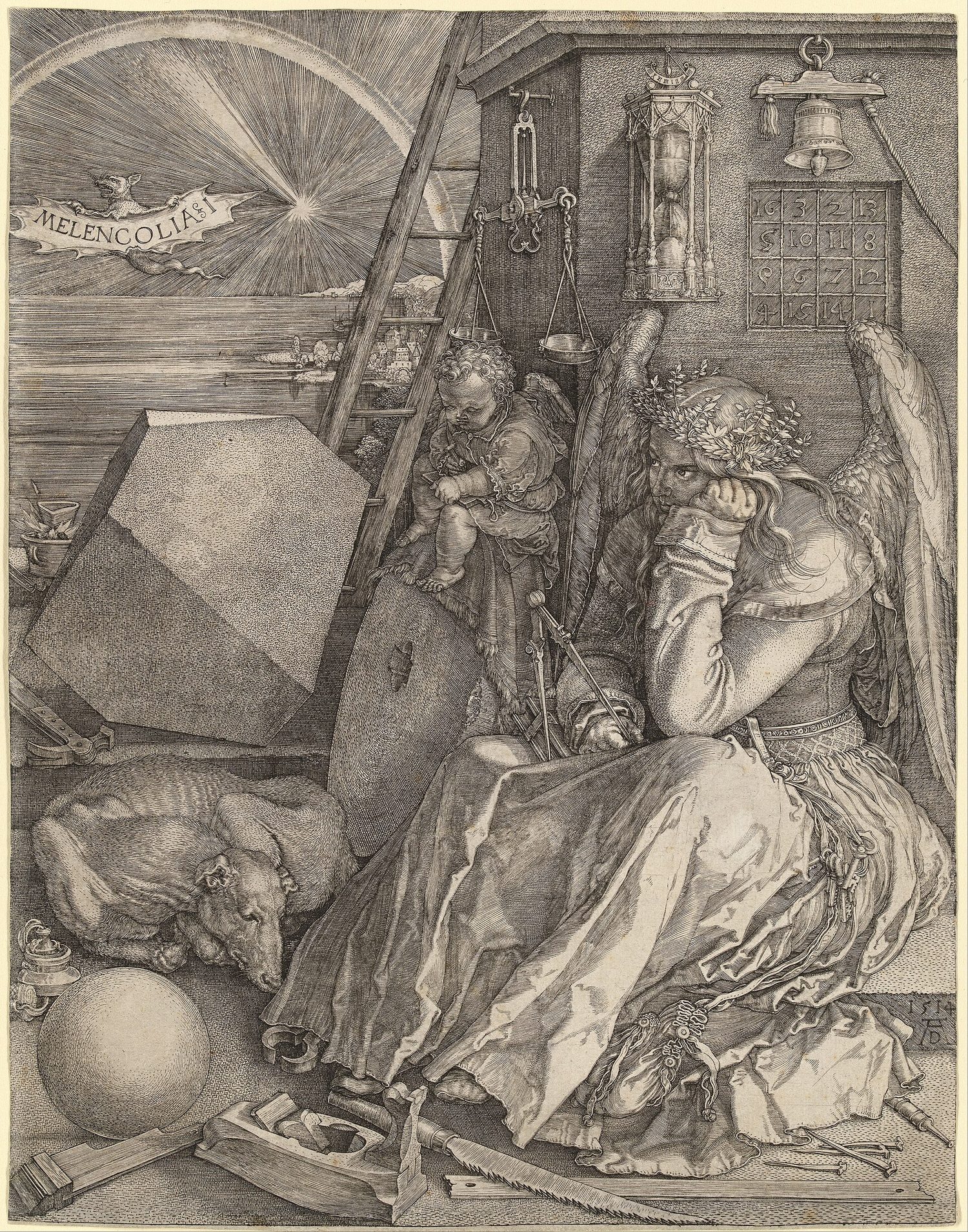
Una impresión antigua densa y muy detallada de una figura sentada con alas rodeada de herramientas y símbolos, todo construido a partir de finas líneas grabadas
Grabado Melencolia I de Dürer: en el grabado en hueco, las líneas se tallan en una placa metálica, y las líneas finas y densas que permite el grabado crean sombras profundas y detalles ricos.
Explore · ⁨Explorar⁩

¿Qué proceso de grabado?

Relieve imprime desde la superficie elevada; grabado en hueco desde líneas cortadas debajo de la superficie; planográfico desde una imagen grasa plana; plantilla empuja tinta a través de una malla.

Vocabulary · ⁨Vocabulario⁩ Train · ⁨Entrenar⁩
English · ⁨Inglés⁩ Chinese · ⁨Chino⁩ Pinyin
Printmaking/ˈprɪntmeɪkɪŋ/ 版画 bǎn huà
matrix/ˈmeɪtrɪks/ 版 bǎn
edition/ɪˈdɪʃn/ 版数 bǎn shù
Relief/rɪˈliːf/ 凸版 tū bǎn
Intaglio/ɪnˈtæɡlɪəʊ/ 凹版 āo bǎn
Planographic/ˌplænəˈɡræfɪk/ 平版 píng bǎn
Stencil/ˈstensl/ 孔版 kǒng bǎn
3.4

Collage and Mixed Media · ⁨Collage y Medios Híbridos⁩

Syllabus
English

Focus: Collage assembles found materials onto a surface; mixed media combines two or more materials or processes.

  • Collage glues papers, photos, fabric, or found objects into a composition.
  • Mixed media layers, for example, drawing over paint, or print with stitching.
  • These processes add actual texture and unexpected juxtapositions of image and meaning.
  • Materials can carry meaning (a ticket, a map) beyond their visual role.
  • Good mixed-media work still uses the elements and principles to stay unified.
Español

Enfoque: El collage ensambla materiales encontrados sobre una superficie; los medios mixtos combinan dos o más materiales o procesos.

  • Collage pega papeles, fotografías, telas u objetos encontrados en una composición.
  • Medios mixtos superponen capas, por ejemplo, dibujar sobre pintura, o imprimir con costuras.
  • Estos procesos añaden textura real y yuxtaposiciones inesperadas de imagen y significado.
  • Los materiales pueden portar significado (un boleto, un mapa) más allá de su función visual.
  • Una buena obra en medios mixtos sigue utilizando los elementos y principios para mantener la unidad.

Source: College Board AP Course and Exam Description · ⁨Fuente: College Board AP Course and Exam Description⁩

English

Collage 拼贴 assembles found materials onto a surface; mixed media 综合媒介 combines two or more materials or processes.

  • Collage glues papers, photos, fabric, or found objects into a composition.
  • Mixed media layers processes — for example, drawing over paint, or print with stitching.
  • These add actual texture and unexpected meaning; a found material (a ticket, a map) can carry meaning beyond its look.
Español

El collage 拼贴 ensambla materiales encontrados sobre una superficie; los medios híbridos 综合媒介 combinan dos o más materiales o procesos.

  • El collage pega papeles, fotos, tela u objetos encontrados en una composición.
  • Los medios híbridos superponen procesos —por ejemplo, dibujar sobre pintura, o imprimir con costuras—.
  • Estos añaden textura real y significado inesperado; un material encontrado (un boleto, un mapa) puede tener un significado más allá de su apariencia.
Vocabulary · ⁨Vocabulario⁩ Train · ⁨Entrenar⁩
English · ⁨Inglés⁩ Chinese · ⁨Chino⁩ Pinyin
Collage/kɒˈlɑːʒ/ 拼贴 pīn tiē
mixed media/mɪkst ˈmiːdiːə/ 综合媒介 zōng hé méi jiè
3.5

Photography and Lens-Based Media · ⁨Fotografía y Medios Basados en Lente⁩

Syllabus
English

Focus: Photography makes images with light and a lens; the same elements and principles apply to the frame.

  • Key controls: framing/composition, focus, exposure (light), depth of field, and viewpoint.
  • The rule of thirds, leading lines, and negative space compose a photograph.
  • Light direction and quality (hard/soft) shape value, form, and mood.
  • Editing (cropping, contrast, colour) is part of the creative process, not just correction.
  • Digital and darkroom processes both count as lens-based 2-D art and design.
Español

Enfoque: La fotografía crea imágenes con luz y una lente; los mismos elementos y principios se aplican al encuadre.

  • Controles clave: encuadre/composición, enfoque, exposición (luz), profundidad de campo y punto de vista.
  • La regla de los tercios, líneas guía y espacio negativo componen una fotografía.
  • La dirección y calidad de la luz (dura/suave) dan forma a los valores, las formas y el ambiente.
  • El edición (recorte, contraste, color) es parte del proceso creativo, no solo de corrección.
  • Los procesos digitales y de cuarto oscuro cuentan ambos como arte y diseño bidimensional basado en lentes.

Source: College Board AP Course and Exam Description · ⁨Fuente: College Board AP Course and Exam Description⁩

English

Photography 摄影 makes images with light and a lens; the elements and principles apply to the frame just as in any 2-D work.

  • Key controls: framing, focus 对焦, exposure 曝光 (light), depth of field 景深, and viewpoint.
  • The rule of thirds, leading lines, and negative space compose a photograph.
  • Editing 后期 (cropping, contrast, colour) is part of the creative process, not just correction.
Español

Fotografía 摄影 crea imágenes con luz y una lente; los elementos y principios se aplican al encuadre de la misma manera que en cualquier obra 2-D.

Una fotografía en blanco y negro de pasajeros en un barco lleno, divididos por un pasillo en dos niveles, formando formas geométricas fuertes
The Steerage de Alfred Stieglitz, una famosa fotografía artística temprana: el pasillo, la chimenea y las figuras forman una composición geométrica fuerte, por lo que los elementos y principios se aplican también a una foto.
  • Controles clave: encuadre, enfoque 对焦, exposición 曝光 (luz), profundidad de campo 景深 y punto de vista.
  • La regla de los tercios, las líneas guía y el espacio negativo componen una fotografía.
  • Edición 后期 (recorte, contraste, color) es parte del proceso creativo, no solo de la corrección.
Vocabulary · ⁨Vocabulario⁩ Train · ⁨Entrenar⁩
English · ⁨Inglés⁩ Chinese · ⁨Chino⁩ Pinyin
Photography/fəˈtɒɡrəfi/ 摄影 shè yǐng
focus/ˈfəʊkəs/ 对焦 duì jiāo
exposure/ekˈspəʊʒə/ 曝光 bào guāng
depth of field/depθ ɒv fiːld/ 景深 jǐng shēn
Editing/ˈedɪtɪŋ/ 后期 hòu qī
Digital media/ˈdɪdʒɪtl ˈmiːdiːə/ 数字媒介 shù zì méi jiè
3.6

Digital Art and Design · ⁨Arte y Diseño Digital⁩

Syllabus
English

Focus: Digital tools create and edit images on a computer or tablet, working in layers and pixels or vectors.

  • Raster images are made of pixels (photo editing, painting apps); vector images use math paths (scalable).
  • Layers let an artist build, mask, and revise non-destructively.
  • Digital colour uses RGB (screen, additive) or CMYK (print, subtractive).
  • Resolution (DPI/PPI) affects print quality; keep files high-resolution for the portfolio.
  • The same elements and principles guide digital work as any other 2-D medium.
Español

Enfoque: Las herramientas digitales crean y editan imágenes en una computadora o tableta, trabajando con capas y píxeles o vectores.

  • Las imágenes raster están compuestas por píxeles (edición de fotos, aplicaciones de pintura); las imágenes vectoriales utilizan trayectorias matemáticas (escalables).
  • Las capas permiten al artista construir, enmascarar y revisar de forma no destructiva.
  • El color digital utiliza RGB (pantalla, aditivo) o CMYK (impresión, sustractivo).
  • La resolución (DPI/PPI) afecta la calidad de impresión; mantenga los archivos de alta resolución para el portafolio.
  • Los mismos elementos y principios guían el trabajo digital que cualquier otro medio bidimensional.

Source: College Board AP Course and Exam Description · ⁨Fuente: College Board AP Course and Exam Description⁩

English

Digital media 数字媒介 create and edit images on a computer or tablet, working in layers.

  • Raster 位图 images are made of pixels (photo editing, digital painting); vector 矢量 images use maths paths and scale without losing quality.
  • Layers 图层 let an artist build, mask, and revise without damaging earlier work.
  • Digital colour uses RGB (screen, additive) or CMYK (print, subtractive); keep files high-resolution 分辨率 for the portfolio.
Español

Los medios digitales 数字媒介 crean y editan imágenes en una computadora o tableta, trabajando en capas.

  • Las imágenes raster 位图 están hechas de píxeles (edición fotográfica, pintura digital); las imágenes vector 矢量 usan trayectos matemáticos y escalan sin perder calidad.
  • Las capas 图层 permiten al artista construir, enmascarar y revisar sin dañar el trabajo anterior.
  • El color digital usa RGB (pantalla, aditivo) o CMYK (impresión, sustractivo); mantenga los archivos de alta-resolución 分辨率 para el portafolio.
Additive versus subtractive colour
Mezclar luz (RGB) ilumina hacia el blanco; mezclar pigmento (CMY) oscurece hacia el negro.
Vocabulary · ⁨Vocabulario⁩ Train · ⁨Entrenar⁩
English · ⁨Inglés⁩ Chinese · ⁨Chino⁩ Pinyin
Raster/ˈræstə/ 位图 wèi tú
vector/ˈvektə/ 矢量 shǐ liàng
Layers/ˈleɪəz/ 图层 tú céng
resolution/ˌrezəˈluːʃn/ 分辨率 fēn biàn lǜ
Graphic design/ˈɡræfɪk dɪˈzaɪn/ 平面设计 píng miàn shè jì
illustration/ˌɪləˈstreɪʃn/ 插画 chā huà
type/taɪp/ 字体 zì tǐ
Typography/taɪˈpɒɡrəfi/ 字体排印 zì tǐ pái yìn
3.7

Graphic Design and Illustration · ⁨Diseño Gráfico e Ilustración⁩

Syllabus
English

Focus: Graphic design communicates a message visually; illustration makes images that support or tell a story.

  • Design combines type, image, colour, and layout to communicate to a viewer or client.
  • Visual hierarchy (size, weight, contrast, placement) guides the eye to what matters first.
  • Typography — typeface, size, spacing, alignment — is a core design element.
  • Illustration serves a purpose: editorial, book, product, poster, or narrative.
  • Design and illustration are problem-solving: audience and message shape every choice.
Español

Enfoque: El diseño gráfico comunica un mensaje visualmente; la ilustración crea imágenes que apoyan o narran una historia.

  • El diseño combina tipo, imagen, color y composición para comunicarse con un espectador o cliente.
  • La jerarquía visual (tamaño, peso, contraste, ubicación) guía la mirada hacia lo que es importante primero.
  • La tipografía — tipografía, tamaño, espaciado, alineación — es un elemento central del diseño.
  • La ilustración cumple una función: editorial, de libro, de producto, de póster o narrativa.
  • El diseño y la ilustración son formas de resolución de problemas: el público y el mensaje guían cada elección.

Source: College Board AP Course and Exam Description · ⁨Fuente: College Board AP Course and Exam Description⁩

English

Graphic design 平面设计 communicates a message visually; illustration 插画 makes images that support or tell a story.

  • Design combines type 字体, image, colour, and layout to reach a viewer or client.
  • Visual hierarchy guides the eye to what matters first, through size, weight, and placement.
  • Typography 字体排印 — typeface, size, spacing, alignment — is a core design tool.
  • Design and illustration are problem-solving: the audience and message shape every choice.

Worked example (writing about process). When your written evidence must explain a material and process: "I used charcoal on toned paper because its soft, smudgeable line let me build deep shadow quickly, and I lifted highlights with an eraser to suggest form." Notice the shape — name the medium, say why you chose it, and connect it to the idea you were exploring. Listing a material with no reason earns little.

Español

El diseño gráfico 平面设计 comunica un mensaje visualmente; la ilustración 插画 crea imágenes que apoyan o cuentan una historia.

  • El diseño combina tipografía 字体, imagen, color y maquetación para llegar a un espectador o cliente.
  • La jerarquía visual guía la mirada hacia lo importante primero, mediante tamaño, peso y posición.
  • Tipografía 字体排印 — tipo de letra, tamaño, espaciado, alineación — es una herramienta fundamental del diseño.
  • El diseño y la ilustración son de resolución de problemas: la audiencia y el mensaje determinan cada elección.

Ejemplo resuelto (escribir sobre el proceso). Cuando la evidencia escrita debe explicar un material y proceso: "Usé carbón sobre papel toneado porque su línea suave y borrosa me permitió construir sombras profundas rápidamente, y levanté los brillos con una goma de borrar para sugerir forma." Observe la estructura: nombre el medio, explique por qué lo eligió y conéctelo con la idea que estaba explorando. Listar un material sin razón otorga pocos puntos.

3.7

Exam tips · ⁨Consejos para el examen⁩

English
  • Match the medium to the intended effect, and justify the choice.
  • For printmaking, state relief versus intaglio, and remember the printed image reverses.
  • Explain transparent versus opaque paint, and layers and vector versus raster in digital work.
  • Treat collage and mixed media materials as meaning, not just texture.
  • In graphic design, show a clear visual hierarchy serving the message.
Español
  • Ajuste el medio al efecto deseado y justifique la elección.
  • Para el grabado, indique si es relieve versus hueco, y recuerde que la imagen impresa se invierte.
  • Explique la diferencia entre pintura transparente y opaca, y entre capas y vectorial versus raster en el trabajo digital.
  • Trate los materiales de collage y medios híbridos como portadores de significado, no solo de textura.
  • En el diseño gráfico, demuestre una jerarquía visual clara que sirva al mensaje.

Interactive lessons on this topic · ⁨Lecciones interactivas sobre este tema⁩

Work through it step by step, with instant-check exercises. · ⁨Trátalo paso a paso, con ejercicios de verificación instantánea.⁩

More topics in AP Arte y Diseño 2D · ⁨Más temas en AP Arte y Diseño 2D⁩

Log in or create account · ⁨Iniciar sesión o crear cuenta⁩

IGCSE, A-Level & AP