Printmaking
Introduced| English | Meaning |
|---|---|
| matrix/ˈmeɪtrɪks/ | The block or plate that carries the image to be printed. |
| edition/ɪˈdɪʃn/ | The number of prints issued together, which may be pulled from more than one plate. |
| relief/rɪˈliːf/ | relief |
| intaglio/ɪnˈtæɡlɪəʊ/ | intaglio |
| planographic/ˌplænəˈɡræfɪk/ | planographic |
| stencil/ˈstensl/ | stencil |
Many copies from one plate
- A print transfers an image from a prepared surface (the matrix 版) to paper.
- This lets an artist make many copies — an edition 版数.
- The matrix is reversed, so the print is a mirror of the plate.
A printmaking matrix prints exactly the same way round as it was carved.
Difficulty 1/5 · 100 coins + a small bonus on first completion today
False. The matrix is a mirror of the final print, so the image (and any text) comes out reversed.
A numbered set of identical prints from one matrix is called an ____.
Difficulty 1/5 · 100 coins + a small bonus on first completion today
An edition is the set of prints from one matrix.
Relief and intaglio
- Relief 凸版 (linocut, woodcut): ink the raised surface; cut-away areas stay blank.
- Intaglio 凹版 (etching, engraving): ink sits in lines cut below the surface.
- These are opposites — printing from what is up vs what is down.
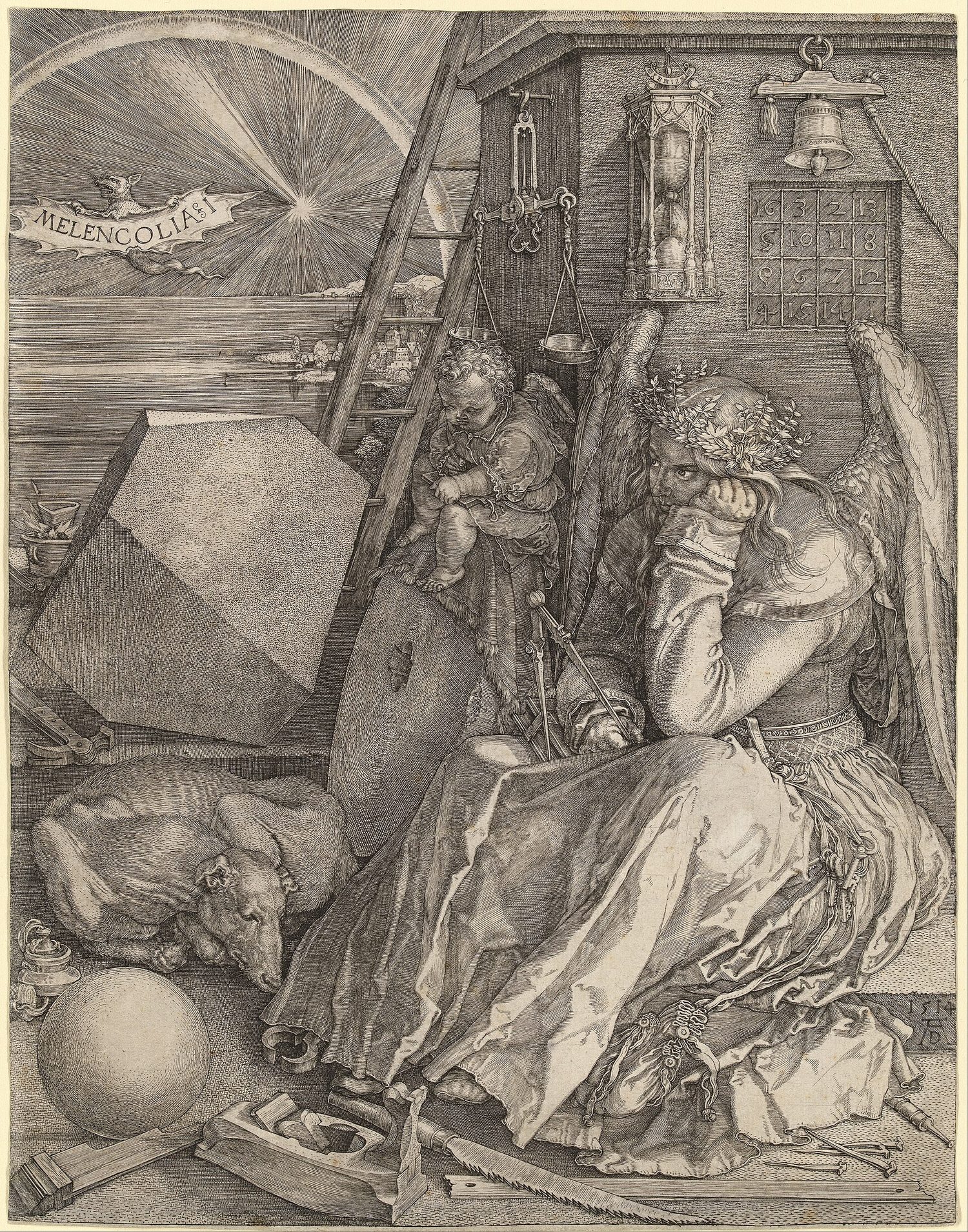
Dürer's engraving Melencolia I: in intaglio the lines are cut into a metal plate, and the fine, dense lines that engraving allows build deep shadow and rich detail
Which printmaking family?
Sort each print by its printmaking family.
In which print family does ink sit in lines cut below the surface?
Difficulty 1/5 · 100 coins + a small bonus on first completion today
Intaglio prints from ink in incised (below-surface) lines.
Select all relief printmaking methods.
Difficulty 2/5 · 140 coins + a small bonus on first completion today
Linocut and woodcut are relief; etching is intaglio and screen print is stencil.
Match each family to its ink location.
Difficulty 2/5 · 140 coins + a small bonus on first completion today
Relief = raised; intaglio = below; stencil = through mesh.
Planographic and stencil
- Planographic 平版 (lithography): image and non-image areas are on the same level, using grease and water.
- Stencil 孔版 (screen printing): ink is pushed through open areas of a mesh.
- Each family gives a different look and process.
The four families differ by where the ink sits: relief on the raised surface, intaglio in cut-below lines, planographic on a flat greasy image, stencil through open mesh. Get this straight and you can identify any print process on the exam.
A linocut is a relief print: the artist carves away the background so the raised design takes the ink. An etching is the opposite — an intaglio print where ink fills lines bitten into the metal plate. Same paper, opposite methods.
A print transfers an image from a matrix to paper, in an edition. The four families are relief (ink the raised surface), intaglio (ink incised lines), planographic (flat, grease vs water), and stencil (push ink through a mesh). The matrix is reversed.
Write from one plate and 5 prints
- One carved plate is inked and printed 5 times.
- Each pull is a print.
A student carves one plate and pulls 5 prints from it. Why are the 5 results prints rather than 5 original drawings?
One matrix can transfer the image more than once.
What are the 5 images?
Difficulty 1/5 · 100 coins + a small bonus on first completion today
Each image was transferred from the same plate.