Tres cosas muy diferentes: un tinte naranja brillante, un analgésico y un plástico resistente. Los tres comienzan como el mismo líquido incoloro —benceno. Pero ninguna sola…
English narration · English + 中文 subtitles burned in · Narración en inglés · Subtítulos en inglés + 中文 quemados en pantalla
36.1
Organic synthesis · Síntesis orgánica
Syllabus
English
for an organic molecule containing several functional groups: (a) identify organic functional groups using the reactions in the syllabus (b) predict properties and reactions
devise multi-step synthetic routes for preparing organic molecules using the reactions in the syllabus
analyse a given synthetic route in terms of type of reaction and reagents used for each step of it, and possible by-products
Español
para una molécula orgánica que contiene varios grupos funcionales: (a) identificar grupos funcionales orgánicos utilizando las reacciones del programa de estudios; (b) predecir propiedades y reacciones
diseñar rutas sintéticas en múltiples pasos para la preparación de moléculas orgánicas utilizando las reacciones del programa de estudios
analizar una ruta sintética dada en términos del tipo de reacción y los reactivos utilizados en cada paso, así como los posibles subproductos
Source: Cambridge International syllabus · Fuente: Plan de estudios Cambridge International
English
Like the AS synthesis topic, this asks you to join up known reactions to build a target molecule. Now you also have the A Level reactions of arenes, phenol, amines, amides and acyl chlorides.
Identifying functional groups
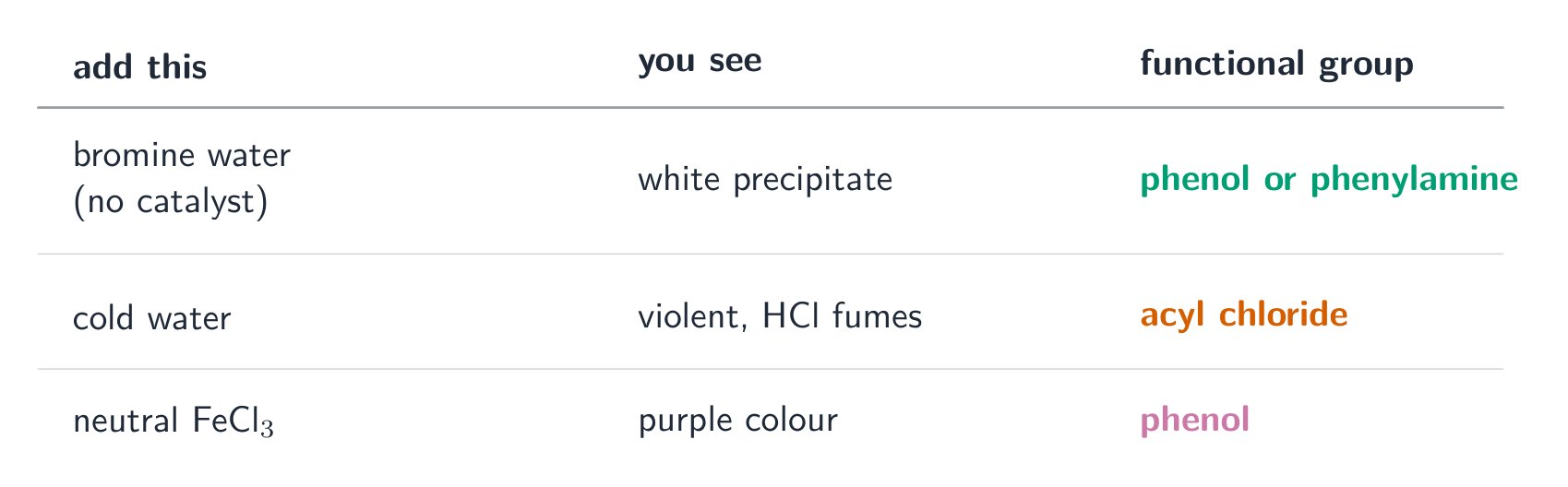
A molecule may carry several functional group 官能团 types. Use the test reactions to spot each one, then predict its behaviour. For example:
decolourises bromine water with no catalyst, giving a white precipitate → a phenol or a phenylamine (the ring is activated).
reacts violently with cold water, giving fumes of $\text{HCl}$ → an acyl chloride 酰氯.
gives a purple colour with neutral $\text{FeCl}_3$ → a phenol 苯酚.
$\text{Sn}$ / conc $\text{HCl}$, then $\text{NaOH}$ (reduction 还原)
phenylamine
phenylamine
$\text{HNO}_2$, below $10\,°\text{C}$
a diazonium salt
diazonium salt
warm water
phenol; or couple with phenol → azo dye
methylbenzene
hot $\text{KMnO}_4$ (oxidation 氧化)
benzoic acid
carboxylic acid 羧酸
$\text{SOCl}_2$ or $\text{PCl}_5$
acyl chloride
acyl chloride
alcohol / phenol
an ester 酯
acyl chloride
ammonia / amine 胺
an amide 酰胺
amide or nitrile 腈
$\text{LiAlH}_4$
an amine
halogenoalkane
$\text{KCN}$
a nitrile (adds one carbon)
Planning and analysing a route
To devise a synthetic route 合成路线, work backwards from the target: which single reaction makes it, and from what? Repeat until you reach the starting material, then write each step with its reagent 试剂 and conditions.
When you analyse a route, state the type of reaction for each step (for example electrophilic substitution, addition–elimination 加成消去, oxidation or reduction) and watch for likely by-products 副产物 — for example, making an amine from a halogenoalkane also gives over-substituted amines, lowering the yield.
Worked example. Devise a route from benzene to phenylamine, $\text{C}_6\text{H}_5\text{NH}_2$. Work backwards: phenylamine comes from reducing nitrobenzene, and nitrobenzene comes from nitrating benzene - so the route is two steps. Step 1: benzene with concentrated $\text{HNO}_3$ and concentrated $\text{H}_2\text{SO}_4$ at $55\ °\text{C}$; electrophilic substitution gives nitrobenzene (keep below $55\ °\text{C}$, or further substitution follows). Step 2: reduce the nitrobenzene with tin and concentrated $\text{HCl}$, then add $\text{NaOH}$ to free the amine from its salt. There is no direct route - you cannot put an $\text{–NH}_2$ straight onto a ring, which is exactly why this nitrate-then-reduce pair is worth knowing by heart.
Español
Al igual que el tema de síntesis de AS, se trata de combinar reacciones conocidas para construir una molécula objetivo. Ahora también tienes las reacciones de nivel A de los arenos, fenoles, aminas, amidas y cloruros de acilo.
Identificación de grupos funcionales
Una molécula puede llevar varios tipos de grupos funcionales. Utiliza las reacciones de prueba para detectar cada uno y predecir su comportamiento. Por ejemplo:
decoloriza el agua de bromo sin catalizador, produciendo un precipitado blanco → un fenol o una anilina (el anillo está activado).
reacciona violentamente con agua fría, produciendo humos de $\text{HCl}$ → un cloruro de acilo.
produce un color púrpura con $\text{FeCl}_3$ neutro → un fenol.
Pruebas de identificación añadidas en Nivel A: cada reactivo da un resultado característico que apunta a un grupo funcional
$\text{Sn}$ / $\text{HCl}$ concentrado, luego $\text{NaOH}$ (reducción)
anilina
anilina
$\text{HNO}_2$, por debajo de $10\,°\text{C}$
una sal de diazonio
sal de diazonio
agua tibia
fenol; o acoplarse con un fenol → colorante azo
metilbenceno
$\text{KMnO}_4$ caliente (oxidación)
ácido benzoico
ácido carboxílico
$\text{SOCl}_2$ o $\text{PCl}_5$
cloruro de acilo
cloruro de acilo
alcohol / fenol
un éster
cloruro de acilo
amoníaco / amina
una amida
amida o nitrilo
$\text{LiAlH}_4$
una amina
halogenoalcano
$\text{KCN}$
un nitrilo (añade un carbono)
Un mapa de las reacciones de nivel A: la cadena aromática (arriba) y la cadena de cloruro de acilo (abajo), con sus entradas. Trabaja hacia atrás desde tu objetivo.
Planificación y análisis de una ruta
Para diseñar una ruta sintética, trabaja hacia atrás desde el objetivo: ¿qué reacción única lo forma y a partir de qué? Repite hasta llegar al material de partida, y escribe cada paso con su reactivo y condiciones.
Planifica una ruta trabajando hacia atrás desde el objetivo, una reacción a la vez, hasta llegar al material de partida.
Cuando analices una ruta, indica el tipo de reacción para cada paso (por ejemplo, sustitución electrofílica, adición-eliminación, oxidación o reducción) y vigila los posibles subproductos — por ejemplo, obtener una amina a partir de un halogenoalcano también produce aminas sobre-sustituidas, reduciendo el rendimiento.
Ejemplo resuelto. Diseña una ruta desde benceno hasta anilina, $\text{C}_6\text{H}_5\text{NH}_2$. Trabaja hacia atrás: la anilina proviene de reducir el nitrobenceno, y el nitrobenceno proviene de nitrar el benceno - así que la ruta son dos pasos. Paso 1: benceno con $\text{HNO}_3$ concentrado y $\text{H}_2\text{SO}_4$ concentrado a $55\ °\text{C}$; la sustitución electrofílica produce nitrobenceno (mantener por debajo de $55\ °\text{C}$, o seguirá una sustitución adicional). Paso 2: reducir el nitrobenceno con estaño y $\text{HCl}$ concentrado, luego añadir $\text{NaOH}$ para liberar la amina de su sal. No existe una ruta directa - no puedes poner un grupo $\text{–NH}_2$ directamente sobre un anillo, lo cual es exactamente por qué vale la pena saberse de memoria este par de nitrar-luego-reducir.
Explore · Explorar
Planificador de síntesis Nivel A
Construya una ruta haciendo coincidir los cambios de grupo funcional con los reactivos.
Pick one and the site follows you — notes, papers, videos and practice all open on it. · Selecciona uno y el sitio te sigue — notas, documentos, videos y práctica se abren en él.
Type to search notes, lessons, code, vocabulary and past-paper questions across every subject. · Escribe para buscar notas, lecciones, código, vocabulario y preguntas de exámenes anteriores en todas las materias.