English
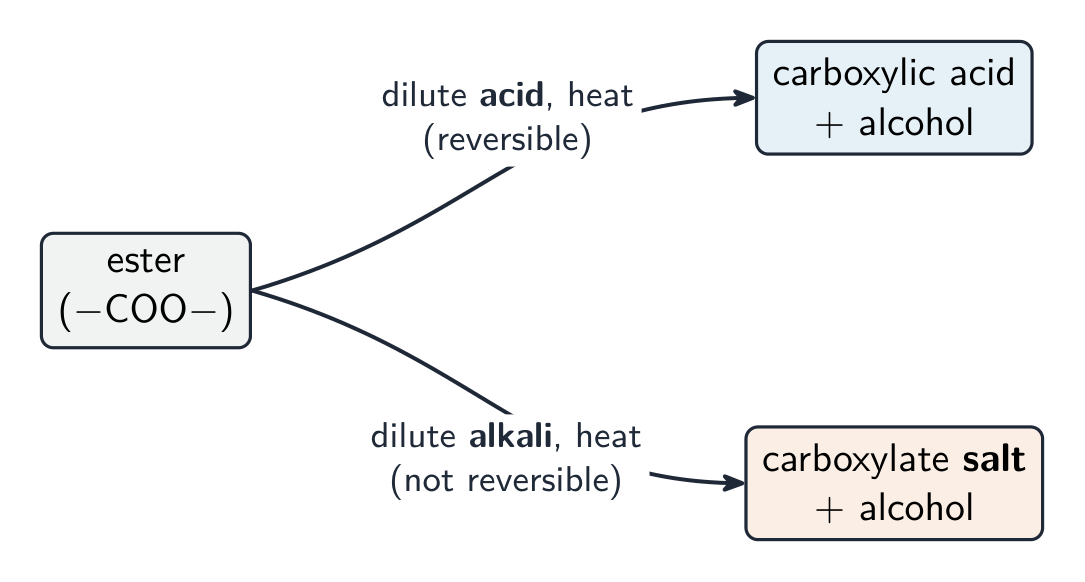
- recall the reactions by which carboxylic acids can be produced: (a) oxidation of primary alcohols and aldehydes with acidified $\text{K}_2\text{Cr}_2\text{O}_7$ or acidified $\text{KMnO}_4$ and refluxing (b) hydrolysis of nitriles with dilute acid or dilute alkali followed by acidification (c) hydrolysis of esters with dilute acid or dilute alkali and heat followed by acidification
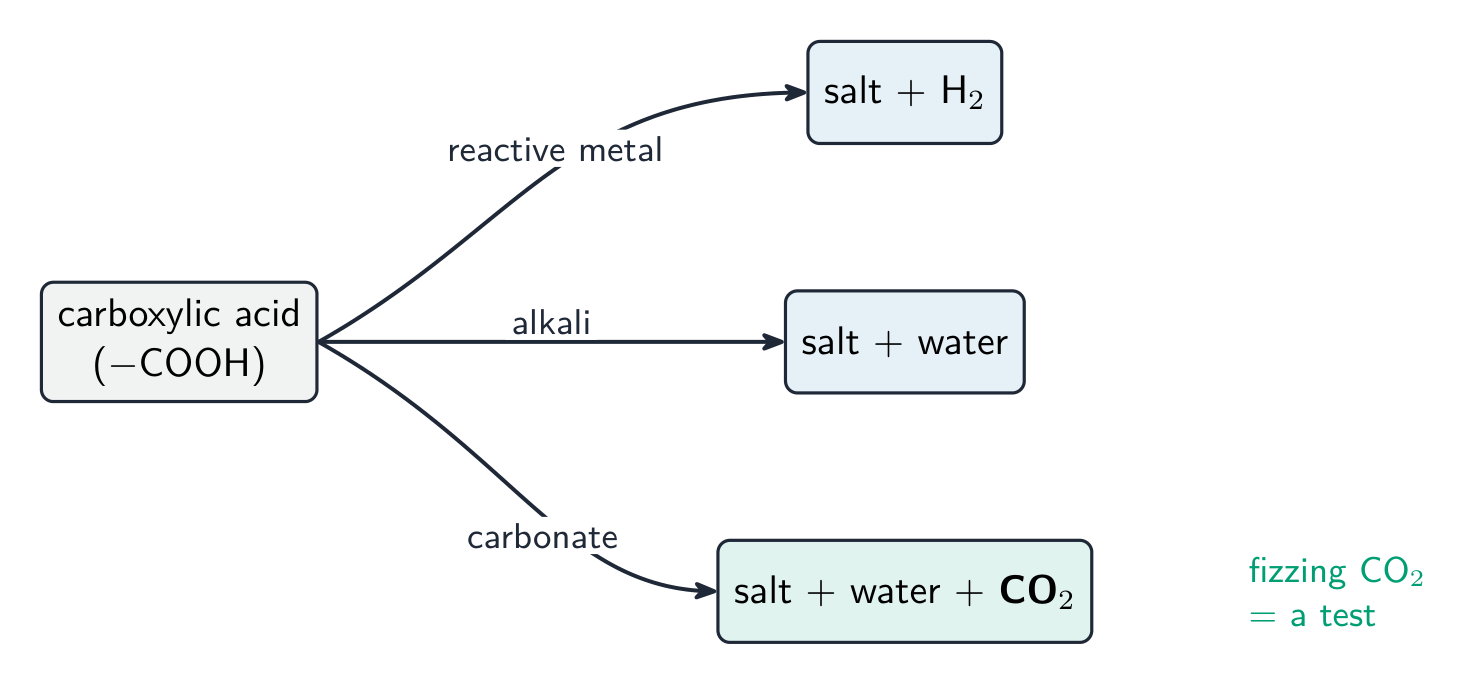
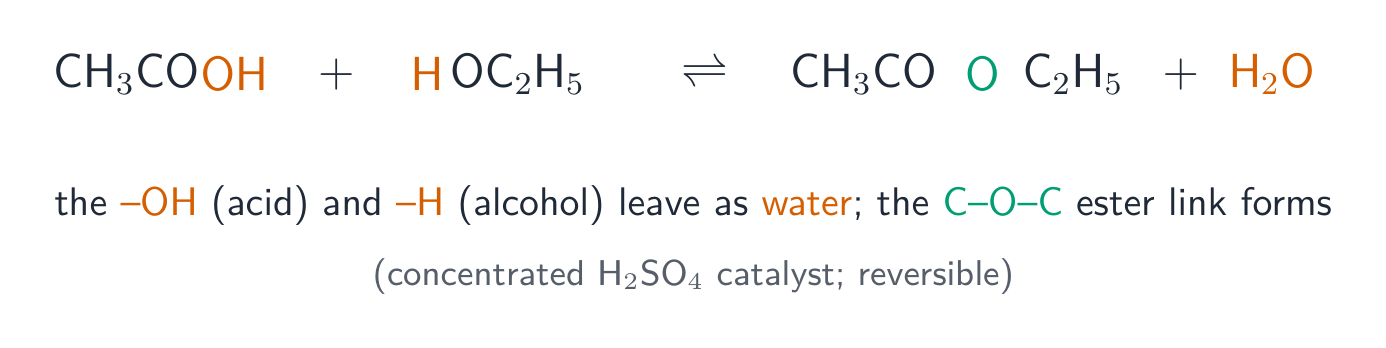
- describe: (a) the redox reaction with reactive metals to produce a salt and $\text{H}_2(\text{g})$ (b) the neutralisation reaction with alkalis to produce a salt and $\text{H}_2\text{O}(\text{l})$ (c) the acid–base reaction with carbonates to produce a salt and $\text{H}_2\text{O}(\text{l})$ and $\text{CO}_2(\text{g})$ (d) esterification with alcohols with concentrated $\text{H}_2\text{SO}_4$ as catalyst (e) reduction by $\text{LiAlH}_4$ to form a primary alcohol
Español
- Recordar las reacciones mediante las cuales se pueden producir ácidos carboxílicos: (a) oxidación de alcoholes primarios y aldehídos con $\text{K}_2\text{Cr}_2\text{O}_7$ acidulado o $\text{KMnO}_4$ acidulado, en condiciones de reflujo; (b) hidrólisis de nitrilos con ácido diluido o base diluida, seguida de acidificación; (c) hidrólisis de ésteres con ácido diluido o base diluida, con calentamiento, seguida de acidificación.
- Describir: (a) la reacción de redox con metales reactivos para producir una sal y $\text{H}_2(\text{g})$; (b) la reacción de neutralización con bases para producir una sal y $\text{H}_2\text{O}(\text{l})$; (c) la reacción ácido-base con carbonatos para producir una sal, $\text{H}_2\text{O}(\text{l})$ y $\text{CO}_2(\text{g})$; (d) la esterificación con alcoholes, utilizando $\text{H}_2\text{SO}_4$ concentrado como catalizador; (e) la reducción por $\text{LiAlH}_4$ para formar un alcohol primario.