English
- recall the reactions (reagents and conditions) by which halogenoalkanes can be produced: (a) the free-radical substitution of alkanes by $\text{Cl}_2$ or $\text{Br}_2$ in the presence of ultraviolet light, as exemplified by the reactions of ethane (b) electrophilic addition of an alkene with a halogen, $\text{X}_2$, or hydrogen halide, $\text{HX(g)}$, at room temperature (c) substitution of an alcohol, e.g. by reaction with $\text{HX(g)}$; or with $\text{KCl}$ and concentrated $\text{H}_2\text{SO}_4$ or concentrated $\text{H}_3\text{PO}_4$; or with $\text{PCl}_3$ and heat; or with $\text{PCl}_5$; or with $\text{SOCl}_2$
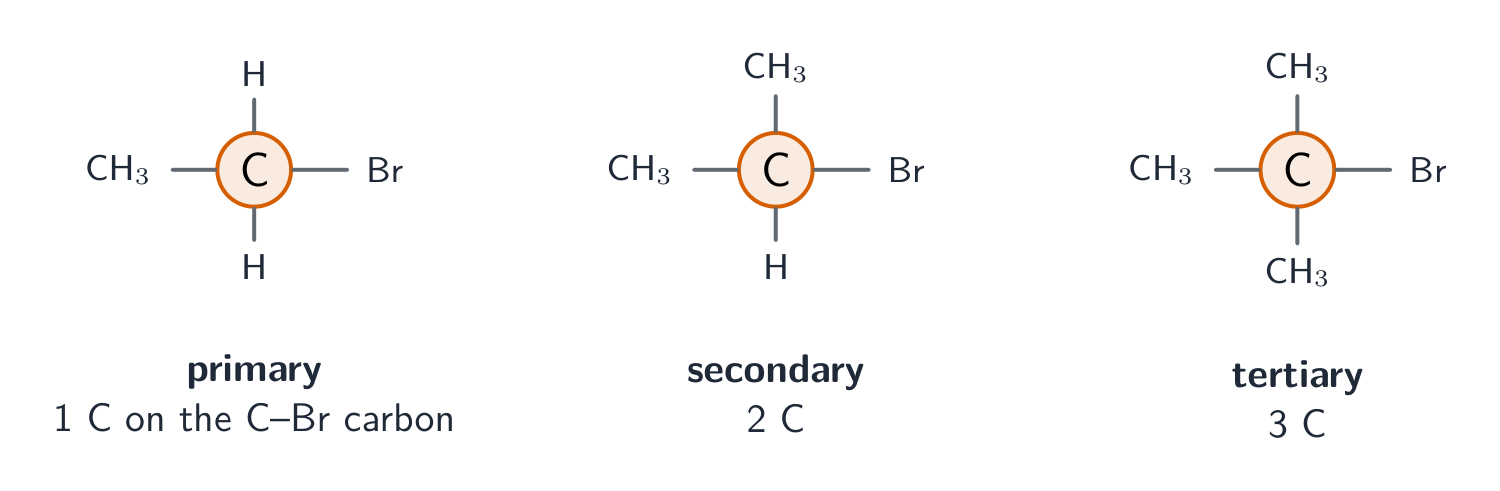
- classify halogenoalkanes into primary, secondary and tertiary
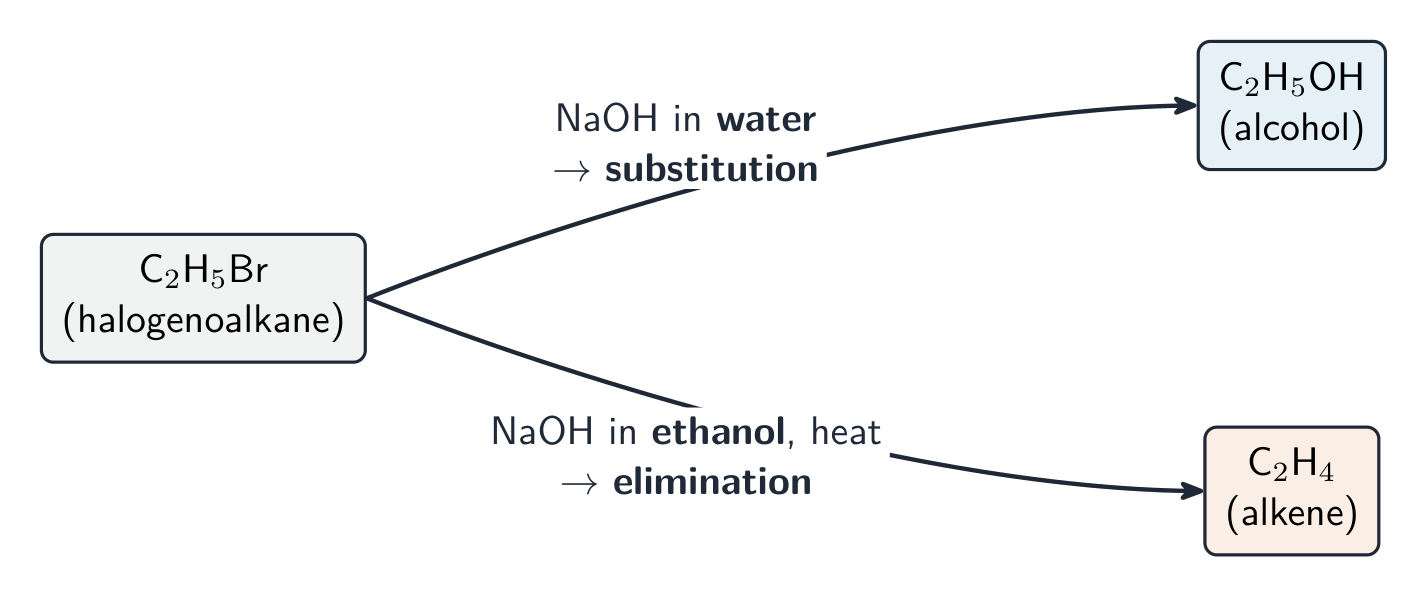
- describe the following nucleophilic substitution reactions: (a) the reaction with $\text{NaOH(aq)}$ and heat to produce an alcohol (b) the reaction with $\text{KCN}$ in ethanol and heat to produce a nitrile (c) the reaction with $\text{NH}_3$ in ethanol heated under pressure to produce an amine (d) the reaction with aqueous silver nitrate in ethanol as a method of identifying the halogen present as exemplified by bromoethane
- describe the elimination reaction with $\text{NaOH}$ in ethanol and heat to produce an alkene as exemplified by bromoethane
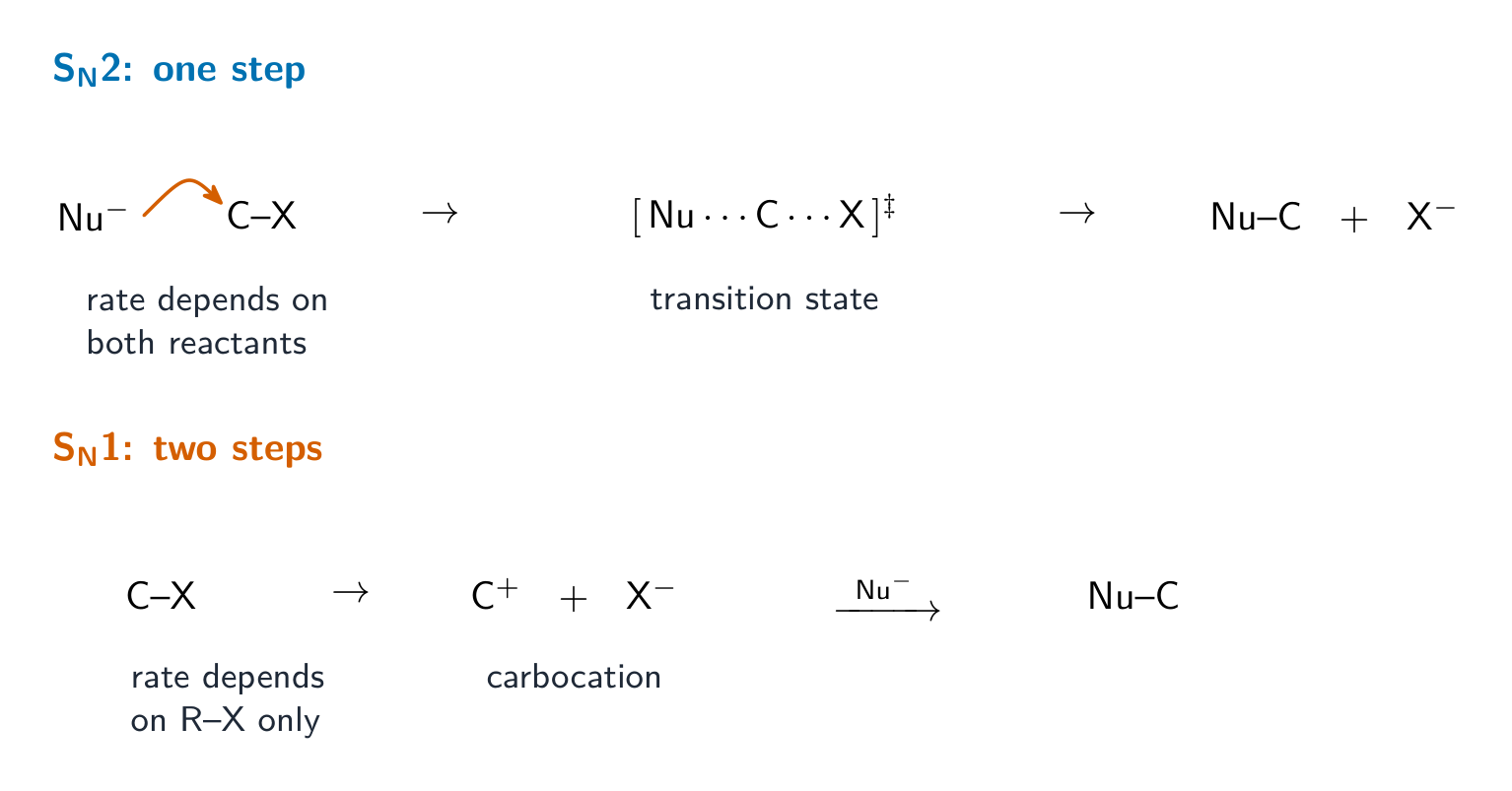
- describe the $\text{S}_\text{N}1$ and $\text{S}_\text{N}2$ mechanisms of nucleophilic substitution in halogenoalkanes including the inductive effects of alkyl groups
- recall that primary halogenoalkanes tend to react via the $\text{S}_\text{N}2$ mechanism; tertiary halogenoalkanes via the $\text{S}_\text{N}1$ mechanism; and secondary halogenoalkanes by a mixture of the two, depending on structure
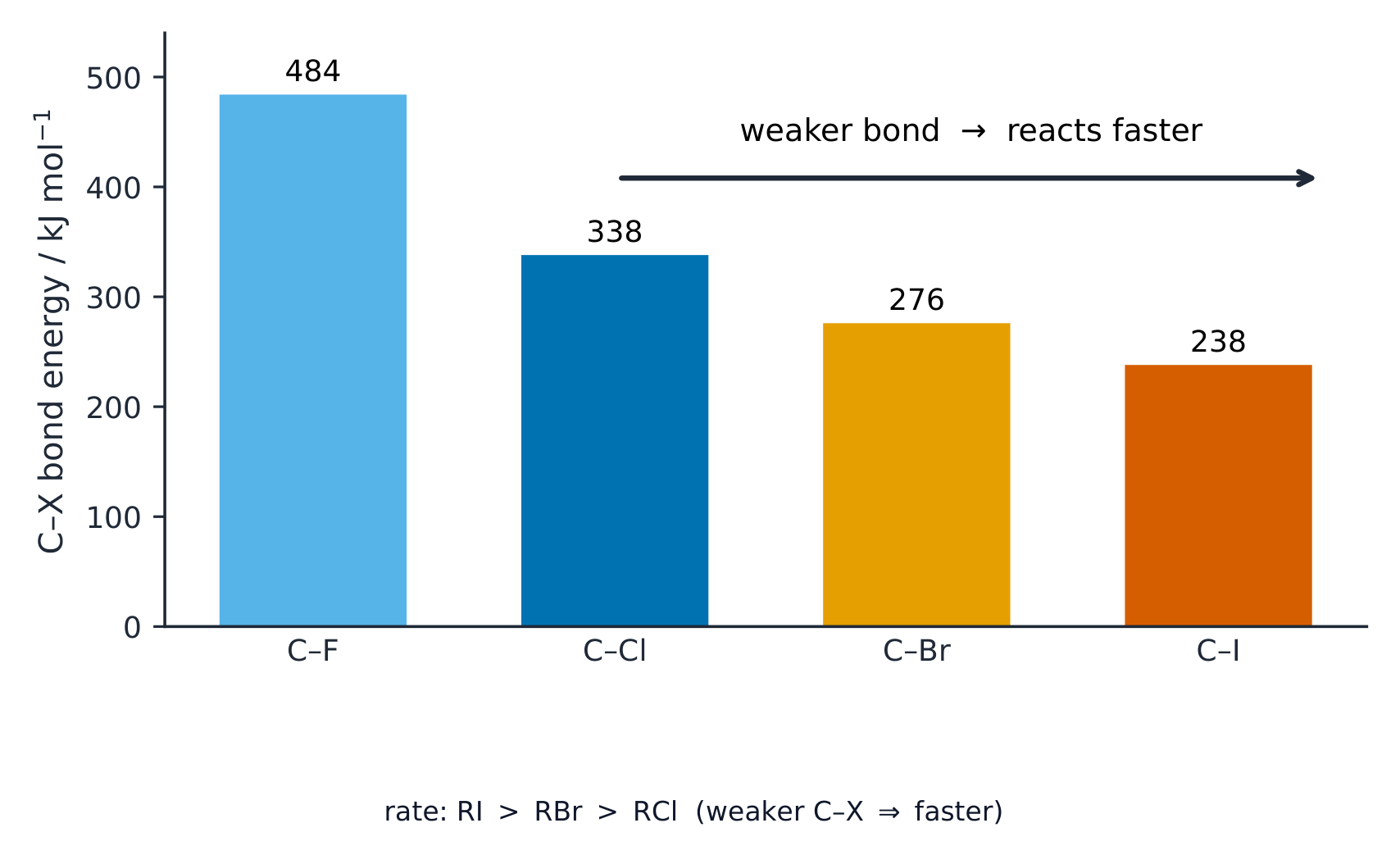
- describe and explain the different reactivities of halogenoalkanes (with particular reference to the relative strengths of the C–X bonds as exemplified by the reactions of halogenoalkanes with aqueous silver nitrates)
Español
- Recordar las reacciones (reactivos y condiciones) mediante las cuales se pueden obtener haluroalcanos: (a) la sustitución de radicales libres de alcanos por $\text{Cl}_2$ o $\text{Br}_2$ en presencia de luz ultravioleta, ejemplificada por las reacciones del etano; (b) la adición electrofílica de un alqueno con un halógeno, $\text{X}_2$, o un haluro de hidrógeno, $\text{HX(g)}$, a temperatura ambiente; (c) la sustitución de un alcohol, p. ej., mediante reacción con $\text{HX(g)}$; o con $\text{KCl}$ y ácido sulfúrico concentrado ($\text{H}_2\text{SO}_4$) o ácido fosfórico concentrado ($\text{H}_3\text{PO}_4$); o con $\text{PCl}_3$ y calor; o con $\text{PCl}_5$; o con $\text{SOCl}_2$.
- Clasificar los haluroalcanos en primarios, secundarios y terciarios.
- Describir las siguientes reacciones de sustitución nucleofílica: (a) la reacción con $\text{NaOH(aq)}$ y calor para producir un alcohol; (b) la reacción con $\text{KCN}$ en etanol y calor para producir un nitrilo; (c) la reacción con $\text{NH}_3$ en etanol calentado bajo presión para producir una amina; (d) la reacción con nitrato de plata acuoso en etanol como método para identificar el halógeno presente, ejemplificado por el bromoetano.
- Describir la reacción de eliminación con $\text{NaOH}$ en etanol y calor para producir un alqueno, ejemplificada por el bromoetano.
- Describir los mecanismos $\text{S}_\text{N}1$ y $\text{S}_\text{N}2$ de sustitución nucleofílica en haluroalcanos, incluyendo los efectos inductivos de los grupos alquilo.
- Recordar que los haluroalcanos primarios tienden a reaccionar a través del mecanismo $\text{S}_\text{N}2$; los haluroalcanos terciarios, a través del mecanismo $\text{S}_\text{N}1$; y los haluroalcanos secundarios, mediante una mezcla de ambos, dependiendo de la estructura.
- Describir y explicar las diferentes reactividades de los haluroalcanos (con referencia particular a las fuerzas relativas de los enlaces C–X, ejemplificadas por las reacciones de haluroalcanos con nitratos de plata acuosos).