Toma una respiración. Casi cuatro quintas partes de lo que acabas de inhalar era nitrógeno —y salió todo de nuevo, completamente sin cambios. El nitrógeno es…
English narration · English + 中文 subtitles burned in · Narración en inglés · Subtítulos en inglés + 中文 quemados en pantalla
12.1
Why nitrogen is unreactive · Por qué el nitrógeno es poco reactivo
Syllabus
English
explain the lack of reactivity of nitrogen, with reference to triple bond strength and lack of polarity
describe and explain: (a) the basicity of ammonia, using the Brønsted–Lowry theory (b) the structure of the ammonium ion and its formation by an acid–base reaction (c) the displacement of ammonia from ammonium salts by an acid–base reaction
state and explain the natural and man-made occurrences of oxides of nitrogen and their catalytic removal from the exhaust gases of internal combustion engines
understand that atmospheric oxides of nitrogen ($\text{NO}$ and $\text{NO}_2$) can react with unburned hydrocarbons to form peroxyacetyl nitrate, PAN, which is a component of photochemical smog
describe the role of $\text{NO}$ and $\text{NO}_2$ in the formation of acid rain both directly and in their catalytic role in the oxidation of atmospheric sulfur dioxide
Español
explicar la falta de reactividad del nitrógeno, con referencia a la fuerza del enlace triple y la ausencia de polaridad
describir y explicar: (a) la basicidad del amoníaco, utilizando la teoría de Brønsted–Lowry (b) la estructura del ion amonio y su formación mediante una reacción ácido-base (c) el desplazamiento del amoníaco de las sales de amonio mediante una reacción ácido-base
exponer y explicar los orígenes naturales y antropogénicos de los óxidos de nitrógeno y su eliminación catalítica en los gases de escape de los motores de combustión interna
comprender que los óxidos de nitrógeno atmosféricos ($\text{NO}$ y $\text{NO}_2$) pueden reaccionar con hidrocarburos no quemados para formar peroxiacetilnitrato, PAN, que es un componente del smog fotoquímico
describir el papel del $\text{NO}$ y el $\text{NO}_2$ en la formación de lluvia ácida, tanto directamente como en su función catalítica en la oxidación del dióxido de azufre atmosférico
Source: Cambridge International syllabus · Fuente: Plan de estudios Cambridge International
English
Nitrogen gas, $\text{N}_2$, makes up most of the air but reacts with very little. There are two reasons:
the two nitrogen atoms are joined by a triple bond 三键, which has a very high bond energy 键能. A lot of energy is needed to break it.
the molecule has no polarity 极性 — it is perfectly symmetrical, so nothing pulls other molecules towards it.
Español
El gas nitrógeno, $\text{N}_2$, constituye la mayor parte del aire pero reacciona con muy pocas sustancias. Hay dos razones:
los dos átomos de nitrógeno están unidos por un enlace triple 三键, que tiene una energía de enlace 键能 muy alta. Se necesita mucha energía para romperlo.
la molécula no tiene polaridad 极性 — es perfectamente simétrica, por lo que nada atrae otras moléculas hacia ella.
El nitrógeno es poco reactivo por dos razones: un enlace triple muy fuerte y una molécula simétrica y no polar
Explore · Explorar
La forma del amoníaco
El amoníaco tiene tres pares de enlace y un par libre: el par libre empuja los enlaces hacia abajo formando una forma piramidal (aproximadamente 107°).
12.1
Ammonia and the ammonium ion · Amoníaco e ion amonio
English
Basicity of ammonia
The basicity 碱性 of ammonia (its ability to act as a base) comes from the lone pair 孤对电子 of electrons on the nitrogen atom. Using the Brønsted–Lowry theory, ammonia is a base because this lone pair can accept a proton 质子 ($\text{H}^+$):
When the lone pair forms a bond to $\text{H}^+$, it makes the ammonium ion 铵离子, $\text{NH}_4^+$. Because both shared electrons came from the nitrogen, this new bond is a coordinate bond 配位键. The ion has four identical N–H bonds and a tetrahedral shape.
Displacement of ammonia from its salts
If you warm an ammonium salt with a base (such as sodium hydroxide), you push out ammonia gas. This is an acid–base displacement 置换:
The sharp smell of ammonia, and damp red litmus turning blue, is a test for an ammonium salt.
Español
El amoníaco se convierte en fertilizantes nitrogenados en plantas industriales a gran escala.
Basicidad del amoníaco
La basicidad 碱性 del amoníaco (su capacidad para actuar como base) proviene del par libre 孤对电子 de electrones en el átomo de nitrógeno. Según la teoría de Brønsted–Lowry, el amoníaco es una base porque este par libre puede aceptar un protón 质子 ($\text{H}^+$):
El amoníaco actúa como base porque el par libre en su nitrógeno acepta un protón, formando el ion amonio
El ion amonio
Cuando el par libre forma un enlace con $\text{H}^+$, se forma el ion amonio 铵离子, $\text{NH}_4^+$. Como ambos electrones compartidos provenían del nitrógeno, este nuevo enlace es un enlace coordinado 配位键. El ion tiene cuatro enlaces N–H idénticos y una forma tetraédrica.
Desplazamiento del amoníaco de sus sales
Si calienta una sal de amonio con una base (como hidróxido de sodio), se libera gas amoníaco. Esto es una desplazamiento ácido-base 置换:
In sunlight, $\text{NO}$ and $\text{NO}_2$ react with unburned hydrocarbons to form peroxyacetyl nitrate (PAN). PAN is a harmful part of photochemical smog 光化学烟雾, the brown haze seen over busy cities.
Acid rain
The oxides of nitrogen also help make acid rain 酸雨 in two ways:
directly: $\text{NO}_2$ dissolves in rain to form nitric acid.
as a catalyst: $\text{NO}_2$ speeds up the oxidation of atmospheric sulfur dioxide 二氧化硫 ($\text{SO}_2$) into $\text{SO}_3$, which then forms sulfuric acid in the rain.
Worked example. A white solid is warmed with aqueous $\text{NaOH}$, and a gas is released that turns damp red litmus blue. Identify the gas and the ion in the solid, and explain the reaction. The only common gas that turns damp red litmus blue is ammonia, $\text{NH}_3$, so the solid contains the ammonium ion, $\text{NH}_4^{+}$. The hydroxide ion is the stronger base, so it takes the proton back from the ammonium ion:
This is the standard test for $\text{NH}_4^{+}$. Always say the litmus is damp: the ammonia must dissolve in the water before it can show its basicity, so dry litmus would give no colour change at all.
Español
De dónde provienen
Los óxidos de nitrógeno ($\text{NO}$ y $\text{NO}_2$, llamados juntos $\text{NO}_x$) provienen de dos fuentes:
natural: los rayos proporcionan suficiente energía para que el nitrógeno y el oxígeno del aire se combinen.
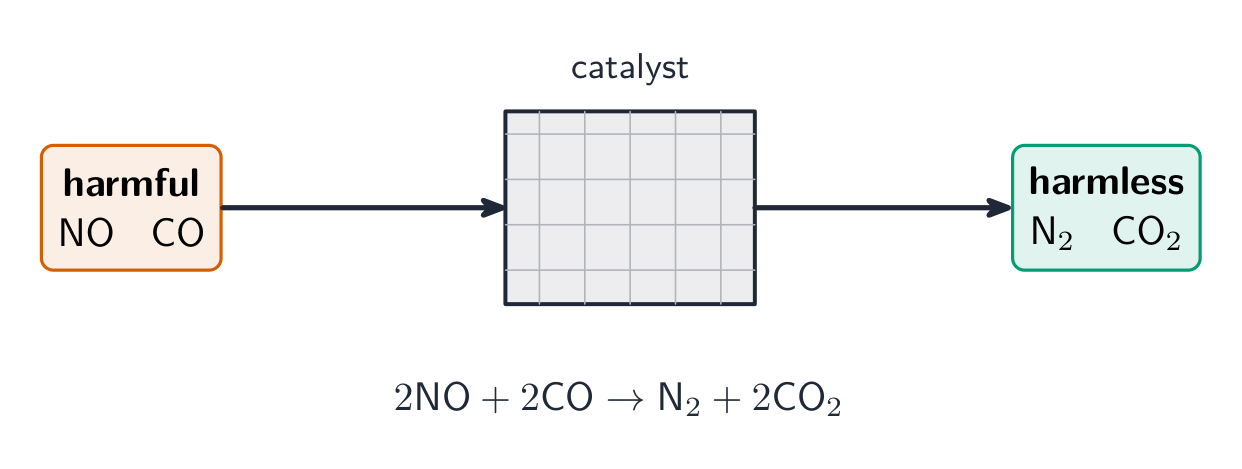
artificial: la alta temperatura dentro de un motor de combustión interna 内燃 hace que el nitrógeno y el oxígeno reaccionen:
En un catalizador, los gases nocivos NO y CO reaccionan sobre el catalizador para formar N$_2$ and CO$_2$ inocuo
Smog fotoquímico
A la luz del sol, $\text{NO}$ y $\text{NO}_2$ reaccionan con hidrocarburos no quemados para formar peroxiacetilnitrato (PAN). El PAN es una parte dañina del smog fotoquímico 光化学烟雾, la bruma marrón que se observa sobre las ciudades transitadas.
Smog fotoquímico sobre una gran ciudad. La capa marrón está atrapada cerca del suelo, exactamente donde están los gases de escape; la luz solar convierte esos óxidos de nitrógeno e hidrocarburos no quemados en la bruma que se ve
Lluvia ácida
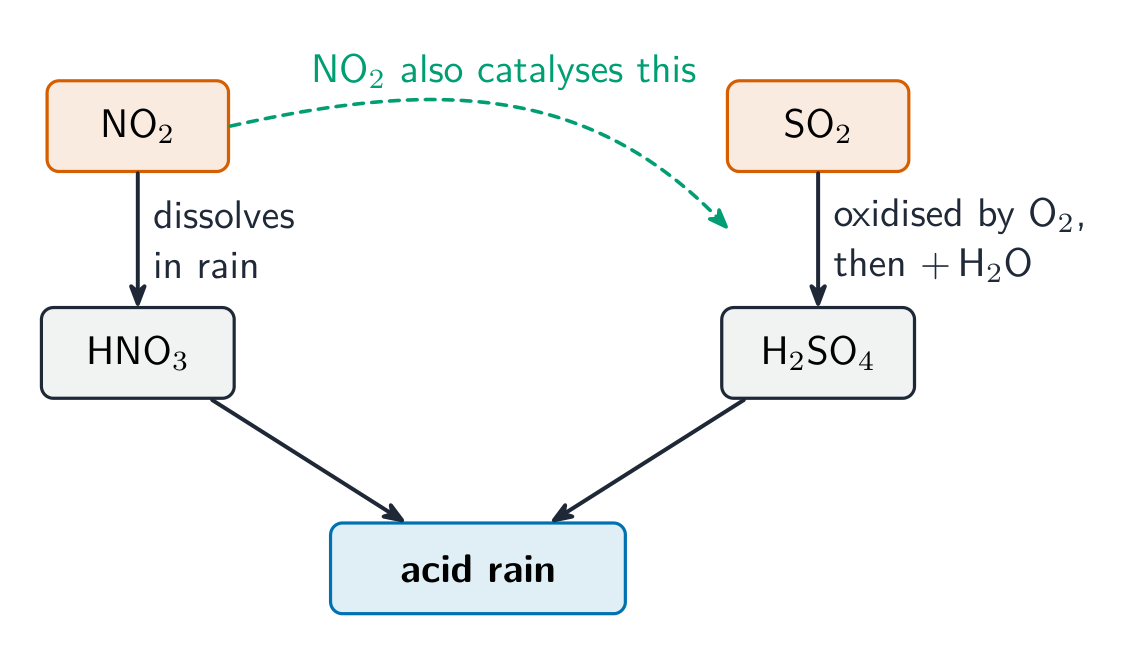
Los óxidos de nitrógeno también contribuyen a la formación de lluvia ácida 酸雨 de dos formas:
directamente: $\text{NO}_2$ se disuelve en la lluvia para formar ácido nítrico.
como catalizador: $\text{NO}_2$ acelera la oxidación del dióxido de azufre atmosférico 二氧化硫 ($\text{SO}_2$) hacia $\text{SO}_3$, que luego forma ácido sulfúrico en la lluvia.
Los óxidos de nitrógeno y azufre producen lluvia ácida: NO$_2$ forms nitric acid directly and also catalyses the oxidation of SO$_2$ a ácido sulfúrico
Ejemplo resuelto. Un sólido blanco se calienta con $\text{NaOH}$ acuoso, y se desprende un gas que vuelve azul el papel tornasol rojo húmedo. Identifique el gas y el ion en el sólido, y explique la reacción. El único gas común que vuelve azul el papel tornasol rojo húmedo es el amoníaco, $\text{NH}_3$, por lo tanto el sólido contiene el ion amonio, $\text{NH}_4^{+}$. El ion hidróxido es una base más fuerte, por lo que recupera el protón del ion amonio:
Esta es la prueba estándar para $\text{NH}_4^{+}$. Indique siempre que el papel tornasol está húmedo: el amoníaco debe disolverse en el agua antes de poder mostrar su carácter básico, por lo que el papel tornasol seco no provocaría ningún cambio de color.
Explore · Explorar
Ruta de la contaminación por NOx
Trazar los óxidos de nitrógeno desde motores calientes hasta el daño ambiental.
Pick one and the site follows you — notes, papers, videos and practice all open on it. · Selecciona uno y el sitio te sigue — notas, documentos, videos y práctica se abren en él.
Type to search notes, lessons, code, vocabulary and past-paper questions across every subject. · Escribe para buscar notas, lecciones, código, vocabulario y preguntas de exámenes anteriores en todas las materias.