تُحيط الخلية غشاء، ويجب أن تستمر في التبادل مع العالم الخارجي. يجب أن يدخل الأكسجين. ويجب أن يخرج ثاني أكسيد الكربون. يتحرك الماء في كلا الاتجاهين…
English narration · English + 中文 subtitles burned in · سرد باللغة الإنجليزية · ترجمة مدمجة بالإنجليزية + الصينية
3.1
Diffusion · الانتشار
Syllabus · المنهج
English
Core
Supplement
1 Describe diffusion as the net movement of particles from a region of their higher concentration to a region of their lower concentration (i.e. down a concentration gradient), as a result of their random movement
2 State that the energy for diffusion comes from the kinetic energy of random movement of molecules and ions
3 State that some substances move into and out of cells by diffusion through the cell membrane
4 Describe the importance of diffusion of gases and solutes in living organisms
5 Investigate the factors that influence diffusion, limited to: surface area, temperature, concentration gradient and distance
العربية
أساسي
تكميلي
1 صف الانتشار بأنه الحركة الصافية للجسيمات من منطقة ذات تركيز أعلى إلى منطقة ذات تركيز أقل (أي顺着 التركيز)، نتيجة لحركتها العشوائية
2 نصّ على أن الطاقة اللازمة للانتشار تأتي من الطاقة الحركية للحركة العشوائية للجزيئات والأيونات
3 نصّ على أن بعض المواد تنتقل إلى داخل وخارج الخلايا عن طريق الانتشار عبر غشاء الخلية
4 صف أهمية انتشار الغازات والمذيبات في الكائنات الحية
5 تحقق من العوامل المؤثرة على الانتشار، ومحدود بـ: مساحة السطح، درجة الحرارة، تدرج التركيز والمسافة
Source: Cambridge International syllabus · المصدر: منهج كامبريدج الدولي
English
Diffusion: random motion, one-way flow
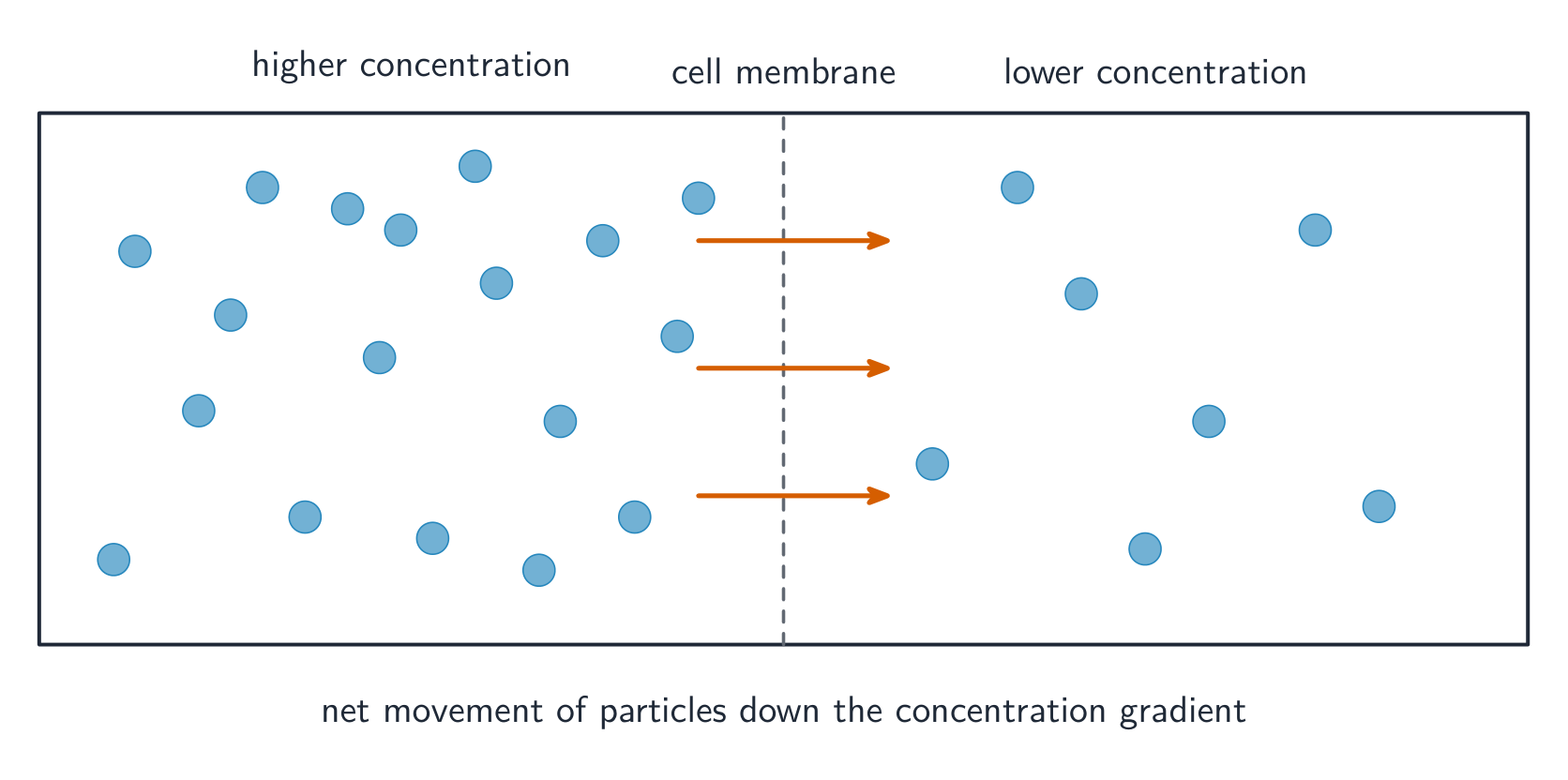
Diffusion 扩散 is the net movement 净移动 of particles 粒子 from a region of their higher concentration 浓度 to a region of their lower concentration. We say the particles move down a concentration gradient 浓度梯度.
The particles spread out because of their own random movement 随机运动. The energy 能量 for diffusion comes from the kinetic energy 动能 of the random movement of molecules 分子 and ions 离子 — so diffusion needs no extra energy.
Some substances pass into and out of cells by diffusion through the cell membrane 细胞膜.
Why diffusion matters. Many gases 气体 and dissolved substances (solutes 溶质) move by diffusion in living things. For example, oxygen 氧气 diffuses into cells for respiration, and carbon dioxide 二氧化碳 diffuses out.
The rate of diffusion changes with four factors:
Factor
Diffusion is faster when…
surface area 表面积
the surface is larger
temperature 温度
it is hotter (particles move faster)
concentration gradient
the difference in concentration is bigger
distance
the distance to travel is shorter (a thinner barrier)
العربية
الانتشار: حركة عشوائية، تدفق أحادي الاتجاه
الانتشار هو الحركة الصافية لـ الجزيئات من منطقة ذات تركيز أعلى إلى منطقة ذات تركيز أقل. نقول إن الجزيئات تتحرك 顺着 التركيز (down a concentration gradient).
تنتشر الجزيئات بسبب حركتها العشوائية الخاصة بها. تأتي الطاقة اللازمة للانتشار من الطاقة الحركية للحركة العشوائية لـ الجزيئات والأيونات — لذلك لا يحتاج الانتشار إلى طاقة إضافية.
بعض المواد تمر إلى داخل وخارج الخلايا عن طريق الانتشار عبر غشاء الخلية.
الانتشار: تتحرك الجزيئات من التركيز العالي إلى التركيز المنخفض،顺着 التركيز
لماذا يهم الانتشار. تتحرك العديد من الغازات والمواد المذابة (المذابات) عن طريق الانتشار في الكائنات الحية. على سبيل المثال، ينتشر الأكسجين إلى الخلايا للتنفس، وينتشر ثاني أكسيد الكربون خارجاً.
يتغير معدل الانتشار بناءً على أربعة عوامل:
العامل
يكون الانتشار أسرع عندما…
مساحة السطح
كانت السطح أكبر
درجة الحرارة
كان الجو أكثر حرارة (تتحرك الجزيئات بشكل أسرع)
فرق التركيز
كان الفرق في التركيز أكبر
المسافة
كانت المسافة المقطوعة أقصر (حاجز أدق)
Explore · استكشف
Diffusion and osmosis · الانتشار والانتشار عبر الأغشية
Set the concentration on each side and watch particles spread from high to low until balanced. · حدد التركيز على كل جانب وراقب الجسيمات تنتشر من مرتفع إلى منخفض حتى تتوازن.
1 Describe the role of water as a solvent in organisms with reference to digestion, excretion and transport
7 Describe osmosis as the net movement of water molecules from a region of higher water potential (dilute solution) to a region of lower water potential (concentrated solution), through a partially permeable membrane
2 State that water diffuses through partially permeable membranes by osmosis
3 State that water moves into and out of cells by osmosis through the cell membrane
4 Investigate osmosis using materials such as dialysis tubing
5 Investigate and describe the effects on plant tissues of immersing them in solutions of different concentrations
8 Explain the effects on plant cells of immersing them in solutions of different concentrations by using the terms: turgid, turgor pressure, plasmolysis, flaccid
9 Explain the importance of water potential and osmosis in the uptake and loss of water by organisms
6 State that plants are supported by the pressure of water inside the cells pressing outwards on the cell wall
العربية
أساسي
تكميلي
1 صف دور الماء كمذيب في الكائنات الحية فيما يتعلق بهضم الطعام والإخراج والنقل
7 اصف الأسموزية بأنها الحركة الصافية لجزيئات الماء من منطقة ذات جهد ماء أعلى (محلول مخفف) إلى منطقة ذات جهد ماء أقل (محلول مركز)، عبر غشاء شبه منفذ
2 نصّ على أن الماء ينتشر عبر الأغشية شبه المنفذ عن طريق الأسموزية
3 نصّ على أن الماء يتحرك إلى داخل وخارج الخلايا عن طريق الأسموزية عبر غشاء الخلية
4 تحقق من الأسموزية باستخدام مواد مثل أنابيب Dialysis
5 تحقق وصف تأثير غمر الأنسجة النباتية في محاليل ذات تراكيز مختلفة على أنسجة النباتات
8 اشرح التأثيرات على خلايا النباتات عند غمرها في محاليل ذات تراكيز مختلفة باستخدام المصطلحات: منتفخة، ضغط الامتلاء، انكماش السيتوبلازم، ذابلة
9 اشرح أهمية جهد الماء والأسموزية في امتصاص وفقدان الماء بواسطة الكائنات الحية
6 نصّ على أن النباتات تُدعم بضغط الماء داخل الخلايا الذي يضغط خارجاً على جدار الخلية
Source: Cambridge International syllabus · المصدر: منهج كامبريدج الدولي
English
Osmosis: water crosses the membrane
Water as a solvent
Water is a very good solvent 溶剂 — many substances dissolve 溶解 in it to make a solution 溶液. This matters for digestion 消化 (food must dissolve before it can be used), excretion 排泄 (wastes are carried away dissolved in water) and transport 运输 (substances travel around the body dissolved in blood and sap).
What osmosis is
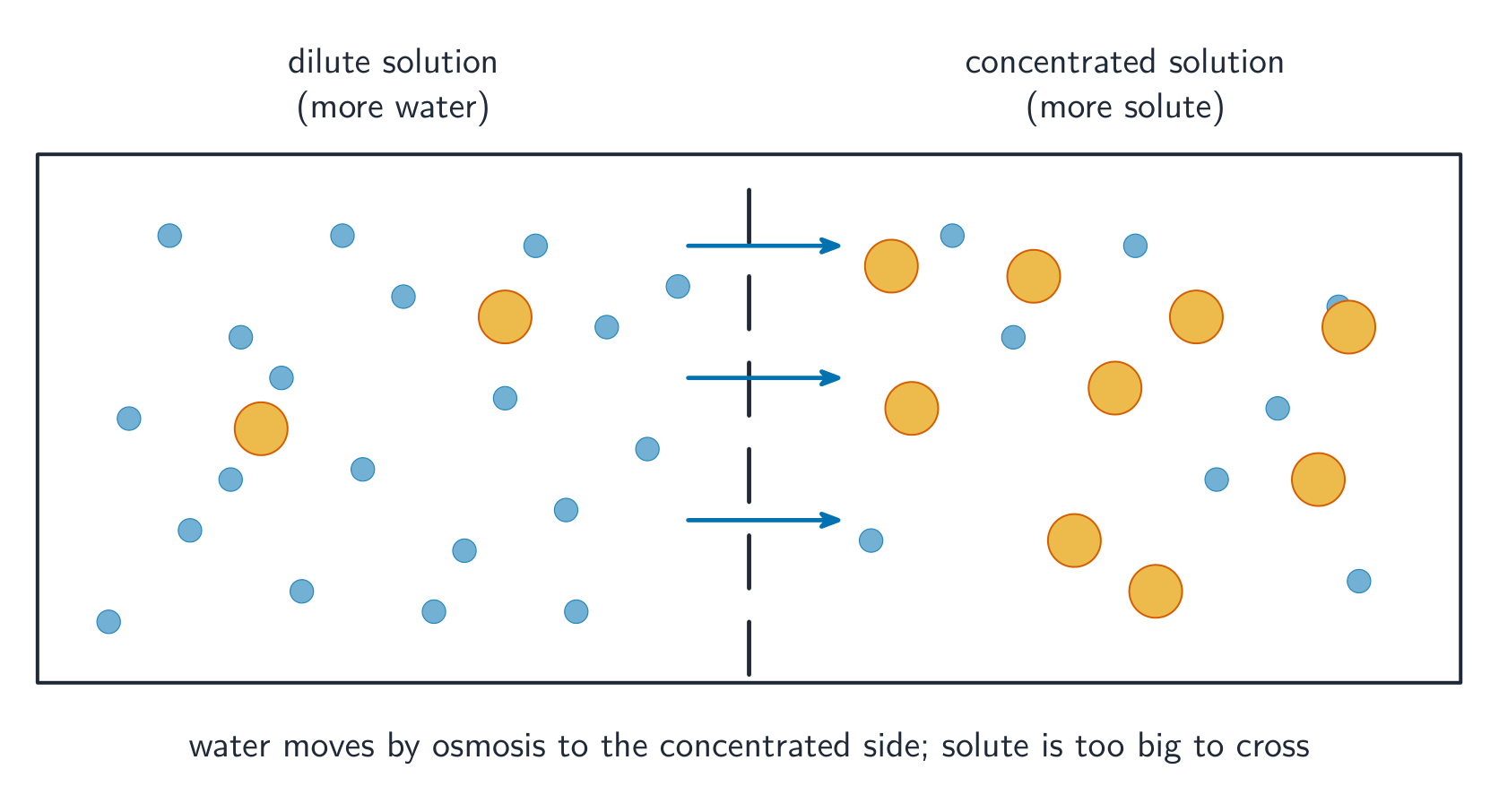
Osmosis 渗透 is a special kind of diffusion: the net movement of water across a partially permeable membrane 半透膜. This kind of membrane has tiny holes that let small water molecules through but hold back larger solute particles. Water moves into and out of cells by osmosis through the cell membrane.
A concentrated solution has a lot of dissolved solute and little water. A dilute solution has little solute and a lot of water.
(Supplement) Osmosis is the net movement of water molecules from a region of higher water potential 水势 (a dilute solution — more water) to a region of lower water potential (a concentrated solution — less water), through a partially permeable membrane.
Osmosis and plant cells
When you put plant tissue into different solutions, water moves by osmosis:
In pure water or a dilute solution, water moves into the cells. The cells swell and become firm, or turgid 膨胀. The water presses outward on the cell wall; this outward push is the turgor pressure 膨压. Turgid cells make a plant stand up straight — this is how plants are supported.
In a concentrated solution, water moves out of the cells. The cells lose their firmness and become soft, or flaccid 松软.
(Supplement) If even more water leaves, the cell membrane pulls away from the cell wall. This is plasmolysis 质壁分离.
You can investigate osmosis using dialysis tubing 透析管 (an artificial partially permeable membrane), or using cylinders cut from a potato. Measure their length or mass before and after soaking. Cylinders in pure water or a dilute solution gain length and mass; cylinders in a concentrated solution lose length and mass; in a solution of equal concentration there is no change.
Worked example. A potato cylinder has a mass of 5.0 g before soaking and 5.6 g after soaking in a dilute solution. Find the percentage change in mass.
A positive answer means the cylinder gained water, so the solution was more dilute than the cell contents. Always work out the percentage change, not just the change in grams — it lets you compare cylinders that started at different masses fairly.
العربية
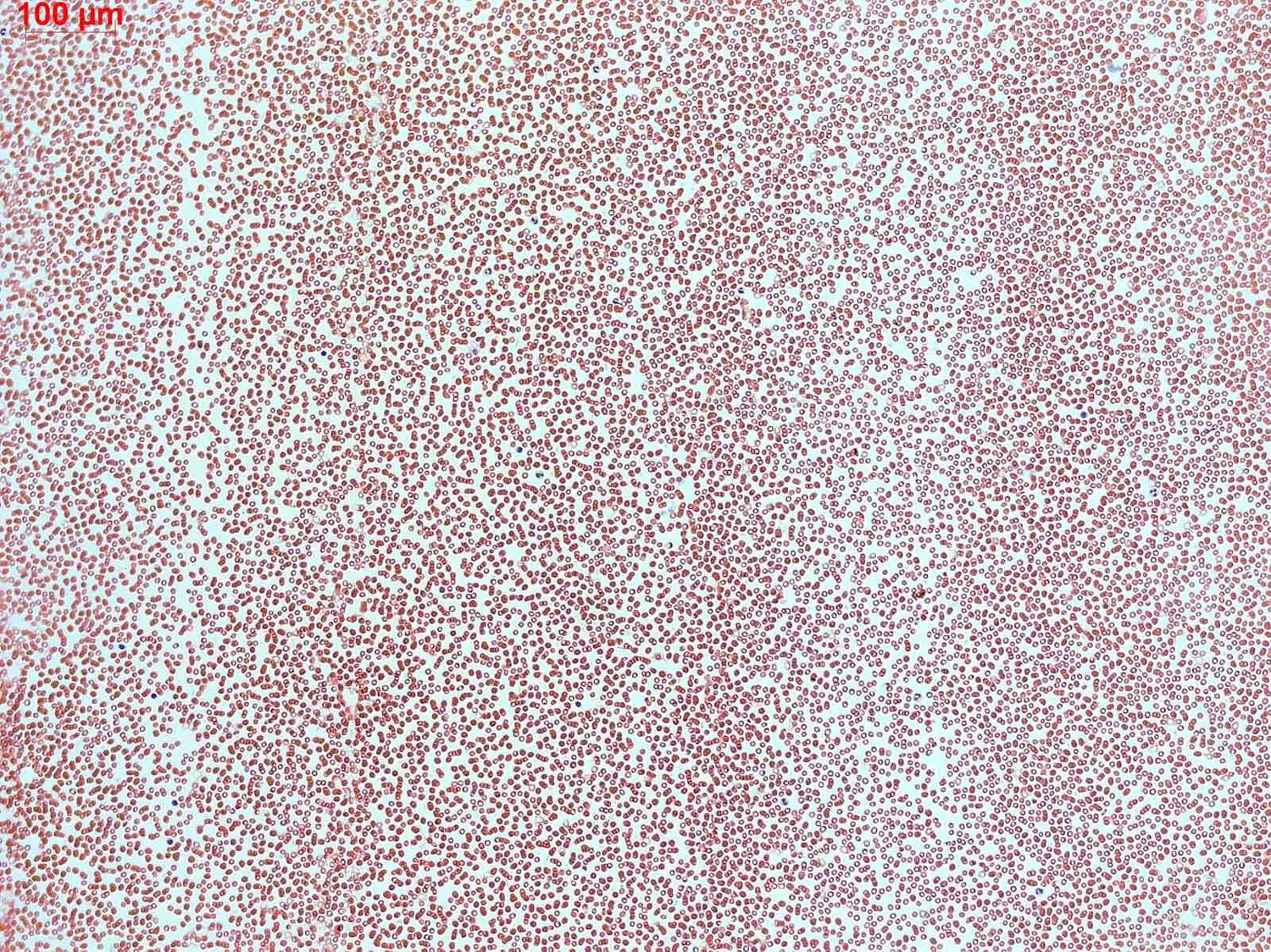
الانتشار الأسموزي: عبور الماء عبر الغشاءكرات الدم الحمراء: يتحرك الماء إلى داخل وخارج الخلايا عن طريق الانتفاذ.
الماء كمذيب
الماء مذيب جيد جداً — تذوب فيه مواد عديدة لتكون محلولاً. وهذا مهم لـ الهضم (يجب أن يذوب الطعام قبل استخدامه)، والإخراج (تُزال الفضلات مذابة في الماء)، والنقل (تنقل المواد حول الجسم مذابة في الدم والعصير النباتي).
ما هو الانتفاذ
الانتشار الانتقالي (الأوسmosis) هو نوع خاص من الانتشار: وهو الحركة الصافية للمياه عبر غشاء شبه منفذ. يتميز هذا النوع من الأغشية بفتحات دقيقة تسمح بمرور جزيئات الماء الصغيرة لكنها تحبس الجسيمات الأكبر للذائب. تتحرك المياه إلى داخل وخارج الخلايا عن طريق الأوسmosis عبر غشاء الخلية.
المحلول المركّز يحتوي على كمية كبيرة من الذائب المذاب وقليل من الماء. أما المحلول المخفّف فيحتوي على القليل من الذائب وكثير من الماء.
الأوسmosis: الماء يعبر الغشاء شبه المنفذ؛ الذائب لا يستطيع العبور
(مكمل) الأوسmosis هي الحركة الصافية لجزيئات الماء من منطقة ذات جهد مائي أعلى (محلول مخفف - ماء أكثر) إلى منطقة ذات جهد مائي أقل (محلول مركّز - ماء أقل)، عبر غشاء شبه منفذ.
الأوسmosis والخلايا النباتية
عند وضع أنسجة نباتية في محاليل مختلفة، تتحرك المياه بواسطة الأوسmosis:
في الماء النقي أو المحلول المخفف، تتحرك المياه إلى داخل الخلايا. تنتفخ الخلايا وتصبح صلبة، أو متوترة. يضغط الماء للخارج على جدار الخلية؛ هذا الدفع الخارجي هو ضغط التوتر. الخلايا المتوترة تجعل النبات يقف مستقيمًا — هكذا يتم دعم النباتات.
في محلول مركّز، تتحرك المياه خارج الخلايا. تفقد الخلايا صلابتها وتصبح رخوة، أو مرنة/بطيئة. (ملاحظة: الترجمة الدقيقة لـ flaccid هنا هي "رخوة" أو "غير متوترة").
(مكمل) إذا خرج المزيد من الماء، ينسحب غشاء الخلية بعيدًا عن جدار الخلية. هذه عملية انضغاط السيتوبلازم (plasmolysis). (التصحيح: انضغاط الغشاء الخلوي أو الانسحاب).
دخول أو خروج الماء من خلية نباتية يجعلها متورمة أو مرنة أو ذات انكماش بلازميخلايا البصل الأحمر المنضغطة الغشاء: انسحبت المحتويات البنفسجية بعيدًا عن الجدران الخلوية
يمكنك استقصاء الأوسmosis باستخدام أنبوب تنقية (dialysis tubing) (وهو غشاء شبه منفذ اصطناعي)، أو باستخدام أسطوانات مقطوعة من البطاطا. قِس طولها أو كتلتها قبل وبعد النقع. تكتسب الأسطوانات في الماء النقي أو المحلول المخفف الطول والكتلة؛ تفقد الأسطوانات في المحلول المركّز الطول والكتلة؛ وفي المحلول المتساوي التركيز لا يحدث تغيير.
مثال محلول. أسطوانة بطاطا كتلتها 5.0 جم قبل النقع و5.6 جم بعد النقع في محلول مخفف. أوجد النسبة المئوية للتغير في الكتلة.
الإجابة الموجبة تعني أن الأسطوانة اكتسبت الماء، لذا كان المحلول أكثر تخفيفًا من محتويات الخلية. احسب دائمًا النسبة المئوية للتغير، وليس مجرد التغير بالجرام — فهذا يسمح لك بمقارنة الأسطوانات التي بدأت بكتل مختلفة بشكل عادل.
Explore · استكشف
Osmosis · الانتشار الأسموزي
net movement down the gradient · الحركة الصافية مع المنحدر
A difference in concentration drives net movement until both sides are equal. · الفرق في التركيز يدفع الحركة الصافية حتى يتساوى الجانبان.
1 Describe active transport as the movement of particles through a cell membrane from a region of lower concentration to a region of higher concentration (i.e. against a concentration gradient), using energy from respiration
2 Explain the importance of active transport as a process for movement of molecules or ions across membranes, including ion uptake by root hairs
3 State that protein carriers move molecules or ions across a membrane during active transport
العربية
أساسي
تكميلي
1 صف النقل النشط بأنه حركة الجسيمات عبر غشاء خلوي من منطقة ذات تركيز منخفض إلى منطقة ذات تركيز أعلى (أي عكس تدرج التركيز)، باستخدام الطاقة المستمدة من التنفس
2 اشرح أهمية النقل النشط كعملية لحركة الجزيئات أو الأيونات عبر الأغشية، بما في ذلك امتصاص الأيونات بواسطة الشعيرات الجذرية
3 نصّ على أن ناقلات البروتين تحرك الجزيئات أو الأيونات عبر الغشاء خلال عملية النقل النشط
Source: Cambridge International syllabus · المصدر: منهج كامبريدج الدولي
English
Active transport vs diffusion
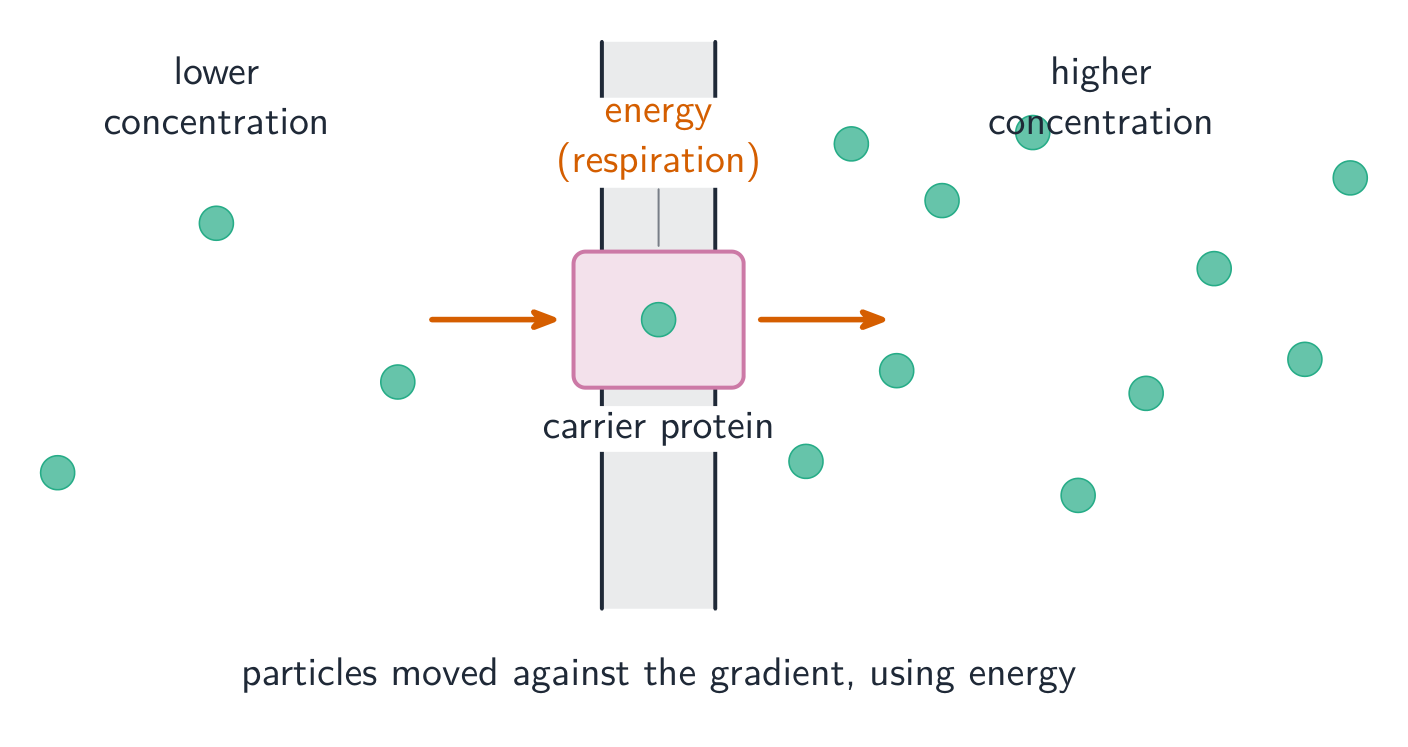
Active transport 主动运输 is the movement of particles through a cell membrane from a region of lower concentration to a region of higher concentration — that is, against the concentration gradient. Because this is "uphill", it needs energy from respiration 呼吸作用.
(Supplement) Active transport lets a cell take in useful molecules or ions even when they are already more concentrated inside the cell. For example, root hairs 根毛 take up mineral ions from the soil by active transport. Protein carriers 载体蛋白 in the membrane pick up the molecules or ions and carry them across, using energy.
العربية
النقل النشط مقابل الانتشار
النقل النشط هو حركة الجسيمات عبر غشاء الخلية من منطقة ذات تركيز أقل إلى منطقة ذات تركيز أعلى — أي عكس تدرج التركيز. ولأن هذا يُعدّ "صعودًا للأعلى"، فإنه يحتاج إلى طاقة من التنفس. (التصحيح: التنفس الخلوي / الاستقلاب).
يستخدم النقل النشط الطاقة وبروتين ناقل لتحريك الجسيمات عكس التدرج
(مكمل) يتيح النقل النشط للخلية امتصاص جزيئات أو أيونات مفيدة حتى عندما تكون تركيزاتها أعلى بالفعل داخل الخلية. على سبيل المثال، تمتص الشعيرات الجذرية أيونات المعادن من التربة عن طريق النقل النشط. تقوم ناقلات البروتين في الغشاء بأخذ الجزيئات أو الأيونات وحملها عبر الغشاء، مستخدمةً الطاقة.
Explore · استكشف
Active transport step by step · النقل النشط خطوة بخطوة
Step the carrier protein through its cycle: it uses energy from ATP to move a particle against the gradient, from low to high. · مرّر البروتين الناقل خلال دورته: يستخدم الطاقة من ATP لتحريك جسيم عكس المنحدر، من منخفض إلى عالي.
Explore · استكشف
Active transport — pumping uphill · النقل النشط — الضخ للأعلى
Unlike diffusion, active transport moves substances AGAINST the concentration gradient, so it needs energy. · على عكس الانتشار، النقل النشط يحرك المواد عَكس منحدر التركيز، لذا يحتاج طاقة.
Pick one and the site follows you — notes, papers, videos and practice all open on it. · اختر واحدًا وسيتبعك الموقع — الملاحظات، الأوراق، الفيديوهات والتدريب جميعها تفتح عليه.
Type to search notes, lessons, code, vocabulary and past-paper questions across every subject. · اكتب للبحث عن ملاحظات، دروس، أكواد، مفردات وأسئلة امتحانات سابقة عبر جميع المواد.