Active transport
Introduced| English | Meaning |
|---|---|
| active transport/ˈæktɪv ˈtrænspɔːt/ | The movement of substances across a cell membrane against their concentration gradient using energy and carrier proteins. |
| passive/ˈpæsɪv/ | passive |
How can a root collect scarce mineral ions?
- A root hair cell may already contain more nitrate ions than the surrounding soil water. Diffusion cannot give net nitrate uptake against that concentration gradient.
- Active transport 主动运输 allows the cell to take up these ions using energy released by respiration.
Connect the direction, membrane and energy
- Active transport moves particles through a cell membrane from lower to higher concentration, against their concentration gradient.
- Supplement: membrane carrier proteins move the particles using energy from respiration. Water entering by osmosis is a separate movement and does not carry the ions through by active transport.
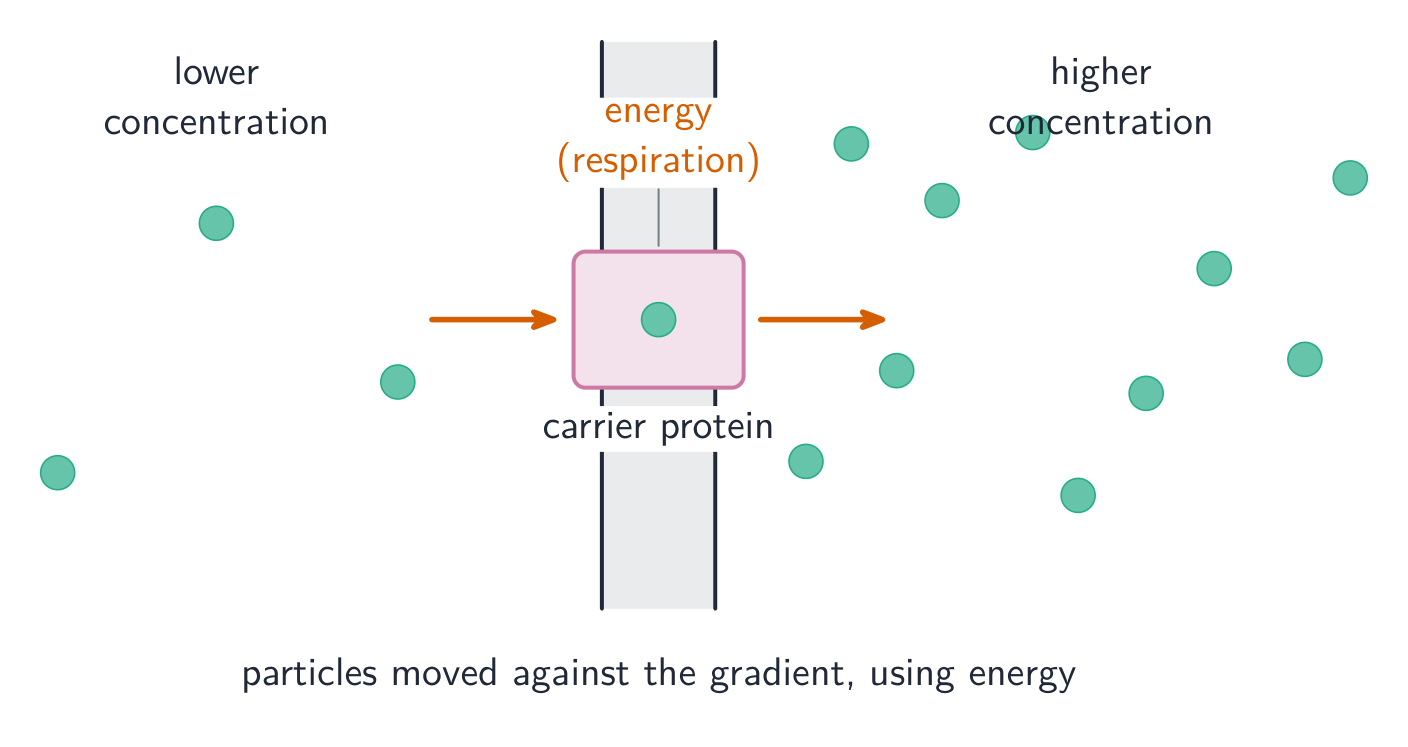
Compare concentrations of the same ion on both sides before identifying its transport process.
ATP supplies energy to the carrier; the ions do not gain a new identity.
Active transport step by step
Step the carrier protein through its cycle: it uses energy from ATP to move a particle against the gradient, from low to high.
Active transport — pumping uphill
Unlike diffusion, active transport moves substances AGAINST the concentration gradient, so it needs energy.
Active transport moves particles:
Difficulty 1/5 · 100 coins + a small bonus on first completion today
Active transport goes against the gradient and needs energy.
The energy for active transport comes from:
Difficulty 1/5 · 100 coins + a small bonus on first completion today
Respiration releases the energy used.
Active transport moves substances ______ the concentration gradient.
Difficulty 1/5 · 100 coins + a small bonus on first completion today
From low to high concentration, unlike diffusion.
Use both concentrations as evidence
- Root hair cells absorb mineral ions even when their concentration in soil water is lower than inside the cells. The large root-hair surface provides space for uptake.
- “The soil is dilute” alone is insufficient evidence for active transport. State that the ion concentration is lower outside than inside, so net uptake goes against the gradient.
A root cell contains nitrate ions at 4 arbitrary concentration units; the soil water contains them at 1 unit. Net uptake is from 1 to 4, so it requires active transport. Oxygen could simultaneously diffuse into the same cell down its own gradient.
The nitrate concentration is lower in soil water than inside a root hair cell. Net nitrate uptake therefore requires:
Difficulty 1/5 · 100 coins + a small bonus on first completion today
Compare the same ion on both sides: uptake is from lower to higher concentration and needs energy from respiration.
Which observation best establishes uptake against a concentration gradient?
Difficulty 1/5 · 100 coins + a small bonus on first completion today
Use concentrations of the same substance on both sides, plus its net movement.
Keep the three processes distinct
- Diffusion moves particles down their concentration gradient. Osmosis moves water through a partially permeable membrane. Both are passive 被动的: neither needs energy supplied by the cell.
- Active transport moves particles against their gradient and needs energy from respiration. “Into the cell” is not a definition: direction relative to the gradient is what matters.

Diffusion and osmosis need no energy supplied by respiration, while active transport requires energy from respiration.
Difficulty 1/5 · 100 coins + a small bonus on first completion today
Passive particles still have kinetic energy. Active transport additionally requires energy from respiration.
A root cell gains water from dilute surroundings and nitrate ions from a lower external to a higher internal nitrate concentration. Name and distinguish the two processes.
Water enters by osmosis through a partially permeable membrane without energy supplied by the cell. Nitrate enters by active transport against its own concentration gradient using energy from respiration.
Predict the effect of less respiration
- If a treatment reduces the energy available from respiration, the rate of active transport can fall. Keep other conditions comparable when using this as experimental evidence.
- Do not say every transport process stops: diffusion and osmosis do not directly require that energy supply. Oxygen shortage may reduce aerobic respiration, but it does not prove that all respiration immediately stops.
A substance being useful or entering a living cell does not prove active transport. Use the concentration comparison and the need for energy. Avoid describing mineral ions as soil “food”; plants make sugars by photosynthesis.
Energy available from respiration falls. Which prediction is justified?
Difficulty 1/5 · 100 coins + a small bonus on first completion today
Active transport depends on an energy supply; passive particle motion does not directly depend on it.
Explain uptake after a treatment
- A root cell absorbs nitrate ions from a lower external concentration into a higher internal concentration. A treatment then reduces the energy available from respiration.
- Explain the original uptake and predict the treatment's effect on its rate. Keep the ion movement separate from water movement.
A root absorbs nitrate from a lower external concentration into a higher internal concentration. A treatment reduces energy available from respiration. Explain the original uptake and predict its rate after treatment.
Active transport uses membrane carrier proteins and energy from respiration to move nitrate ions against their gradient. Reducing that energy supply can reduce the uptake rate. Water movement by osmosis is separate; passive movement does not directly need the respiration energy supply.
Give the evidence for active transport
- Identify movement through a membrane from lower to higher concentration of the same substance.
- Name active transport and the energy supplied by respiration through carrier proteins.
- Compare both sides: dilute soil alone does not establish the direction of the gradient.
A substance crosses into a cell from a higher concentration outside to a lower concentration inside. Does inward movement alone prove active transport?
Difficulty 1/5 · 100 coins + a small bonus on first completion today
Direction relative to the substance’s gradient matters. Entry alone is not evidence of active transport; osmosis concerns water.
An energy-reducing treatment lowers ion uptake against the gradient. Suggest two controls and explain why the result supports, but does not alone prove, active transport.
Check your reasoning against each criterion; other wording is valid if it explains the same evidence.
Which membrane component moves molecules or ions during active transport?
Difficulty 1/5 · 100 coins + a small bonus on first completion today
Carrier proteins in the cell membrane transport the particles. The cell wall is not the active-transport machinery.