Osmosis
Introduced| English | Meaning |
|---|---|
| osmosis/ɒzˈməʊsɪs/ | The net movement of water molecules through a partially permeable membrane from higher to lower water potential. |
| dilute/daɪˈluːt/ | dilute |
| partially permeable membrane/ˈpɑːʃəli ˈpɜːməbl ˈmembreɪn/ | A barrier that allows some substances to pass through but restricts others. |
| turgid/ˈtɜːdʒɪd/ | Describing a plant cell swollen and firm because water entering by osmosis produces pressure against its cell wall. |
| flaccid/ˈflæsɪd/ | Describes a plant cell or plant that has lost water and gone soft. |
| wilts/wɪlts/ | Droops when cells lose turgor through lack of water. |
Why does a wilted plant become firm in water?
- A wilted plant can become firm again when its cells gain water. The movement across their membranes is osmosis 渗透.
- To predict the direction, compare the solutions on both sides. Water does not always enter a cell: in a sufficiently concentrated surrounding solution, it leaves.
Name the moving particles and the barrier
- Osmosis is the net movement of water molecules from a dilute 稀的 solution to a more concentrated solution through a partially permeable membrane 半透膜.
- Supplement: osmosis moves water from higher to lower water potential. In these simple solutions, the dilute side has a higher water potential. The membrane lets water cross but prevents some solutes from crossing freely; the net water movement needs no energy supplied by the cell.
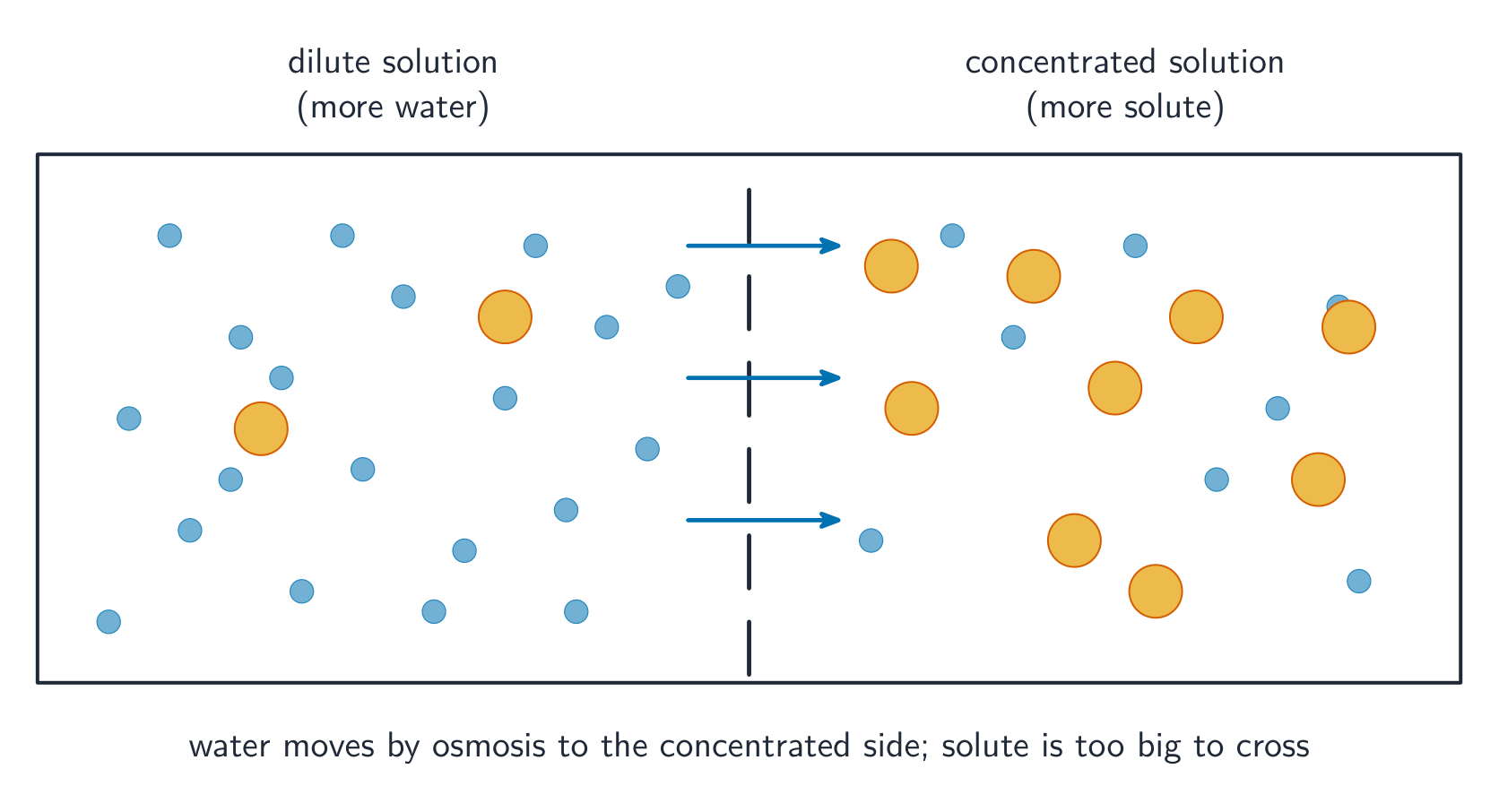
“Concentrated” here means more solute, not more water. Follow water separately from solute.
Water moves both ways; the arrow represents the initial net movement.
Osmosis is the net movement of:
Difficulty 1/5 · 100 coins + a small bonus on first completion today
Osmosis is specifically water across a partially permeable membrane.
Osmosis requires energy from the cell.
Difficulty 1/5 · 100 coins + a small bonus on first completion today
Like diffusion, osmosis is passive.
Osmosis happens across a partially ______ membrane.
Difficulty 1/5 · 100 coins + a small bonus on first completion today
The membrane allows water across but prevents some solutes from crossing freely.
Compare animal cells in two solutions
- In pure water, an animal cell gains water, swells and may burst because it has no cell wall to resist expansion.
- In a solution more concentrated than its contents, it loses water and shrinks. With no water-potential difference there is no net water movement, although water molecules still cross both ways.
Predict the direction of water movement before predicting the change in cell size.
An animal cell placed in pure water will:
Difficulty 1/5 · 100 coins + a small bonus on first completion today
Water enters by osmosis, swelling the cell.
A plant cell's wall changes the outcome
- As water enters a plant cell, its vacuole expands and the contents press against the cell wall. The cell becomes turgid 膨胀 (firm); the wall resists further expansion and normally prevents bursting. This outward pressure is turgor pressure (Supplement).
- When water leaves, the cell becomes flaccid 松软 and the plant wilts 萎蔫. With sufficient water loss, the membrane pulls away from the wall. This separation is plasmolysis (Supplement). The wall itself does not shrink with the contents.

The outer cell wall and the inner cell membrane are different structures.
Water enters a plant cell
Connect a water-potential difference to water movement, then to pressure against the cell wall.
A plant cell full of water and firm is described as:
Difficulty 1/5 · 100 coins + a small bonus on first completion today
Turgid cells support the plant; flaccid cells cause wilting.
A plant cell loses enough water for its membrane to pull away from its wall. Which description is correct?
Difficulty 1/5 · 100 coins + a small bonus on first completion today
Water loss reduces the cell contents. The wall does not shrink along with them.
Use mass changes as evidence
- Put equal-sized potato pieces in different sugar solutions for the same time. Blot each piece in the same way before weighing so surface liquid does not distort the result.
- A mass increase supports net water entry; a decrease supports net water loss. Keep time, temperature and starting piece size comparable, and use repeated measurements.
A potato piece changes from 5.0 g to 5.5 g. Its percentage mass change is (5.5 − 5.0) ÷ 5.0 × 100 = +10%. Water entered by osmosis. A zero mass change suggests no net water movement under the experiment's conditions, not that all water molecules stopped.
Osmosis moves water across a partially permeable membrane. Salt moving into water is not osmosis. A turgid plant cell can also stop gaining water because pressure from its wall balances the tendency for water to enter; the solutions need not become equally concentrated.
A potato piece changes from 5.0 g to 5.5 g. What is its percentage mass increase? Enter the number without the percent sign.
Difficulty 2/5 · 140 coins + a small bonus on first completion today
(5.5 − 5.0) ÷ 5.0 × 100 = 10%. Divide by the starting mass.
A potato piece loses mass in concentrated sugar solution. Explain the movement and state one weighing precaution.
Water moves net out through partially permeable cell membranes by osmosis, towards the more concentrated surrounding solution. Blot pieces consistently before weighing to remove surface liquid.
Explain two different cells
- An animal cell and a flaccid plant cell are placed in pure water. Both have more concentrated contents than their surroundings.
- Explain their initial water movement, then use the cell wall to explain why the final outcomes differ.
An animal cell and a flaccid plant cell have contents more concentrated than pure water. Both are placed in pure water. Explain the initial movement of water and why their outcomes differ.
Water initially enters both cells by osmosis through partially permeable membranes, from dilute surroundings to more concentrated contents. The animal cell swells and may burst. The plant cell becomes turgid as its contents press against its cell wall, which resists expansion. Neither movement needs energy from the cell.
Test a membrane model and identify a solvent
- A sealed dialysis tube containing sugar solution can gain mass in pure water if its membrane passes water but not sugar. Check for leaks, blot before weighing, and compare with a tube containing pure water. Gain supports net water entry; it does not show that sugar crossed.
- Water also acts as a solvent: digestion products dissolve before absorption, urea dissolves in urine for excretion, and dissolved substances travel in blood plasma. These roles are different from the direction of osmosis.
A turgid plant cell stops gaining water. Which statement is justified?
Difficulty 1/5 · 100 coins + a small bonus on first completion today
Water still crosses both ways. Cell-wall resistance can balance water entry without equal solute concentrations.
A potato cylinder changes from 4.0 g to 3.6 g. Calculate the percentage mass change, including its sign.
Difficulty 2/5 · 140 coins + a small bonus on first completion today
(3.6 − 4.0) ÷ 4.0 × 100 = −10%. The negative sign indicates net water loss.
Why should each potato cylinder be gently blotted in the same way before its final mass is measured?
Check your reasoning against each criterion; other wording is valid if it explains the same evidence.
A leak-free tube holds sugar solution in pure water. Its membrane passes water but not sugar. The tube gains mass. What explains the gain?
Difficulty 1/5 · 100 coins + a small bonus on first completion today
Water moves into the more concentrated solution through the partially permeable membrane. The stated membrane prevents sugar crossing; the model does not respire.
Predict water first, then the cell
- Osmosis is net water movement through a partially permeable membrane, from dilute to more concentrated solution in the simple cases here.
- Animal cells may burst in pure water; plant cell walls resist expansion and allow cells to become turgid.
- Mass changes provide evidence of net water movement. Water still moves at equilibrium; the net movement is zero.