Source: Cambridge International syllabus · المصدر: منهج كامبريدج الدولي
English
A wave 波 carries energy 能量 from one place to another without moving matter overall. The particles of the medium 介质oscillate 振动 about fixed rest positions; only the disturbance (and its energy) propagates 传播. Examples: a transverse wave 横波 on a rope, a longitudinal wave 纵波 on a slinky spring, ripples on water, and sound in air. A wave that travels and carries energy is a progressive wave 行波.
Wave motion 波动 is a series of oscillations of the particles of a medium, each passing the disturbance on to the next: shake one end of a rope, push one end of a spring, or touch the surface of the water in a ripple tank 水波槽, and the oscillation travels away from where it started. For the one-mark definition, a progressive wave transfers energy from one place to another without transferring matter; the particles only oscillate about their rest positions.
Key terms
displacement 位移$y$ — how far a particle has moved from its rest position at a moment. A vector 矢量.
amplitude 振幅$A$ — the largest displacement from the rest position.
wavelength 波长$\lambda$ — the shortest distance along the wave between two points that move in phase 同相 (for example, two next-door crests 波峰).
period 周期$T$ — the time for one full oscillation of a particle.
frequency 频率$f$ — the number of full oscillations per second; $f = 1/T$. Unit: hertz 赫兹, $\text{Hz}$.
speed 速率$v$ — how fast a crest travels along the medium.
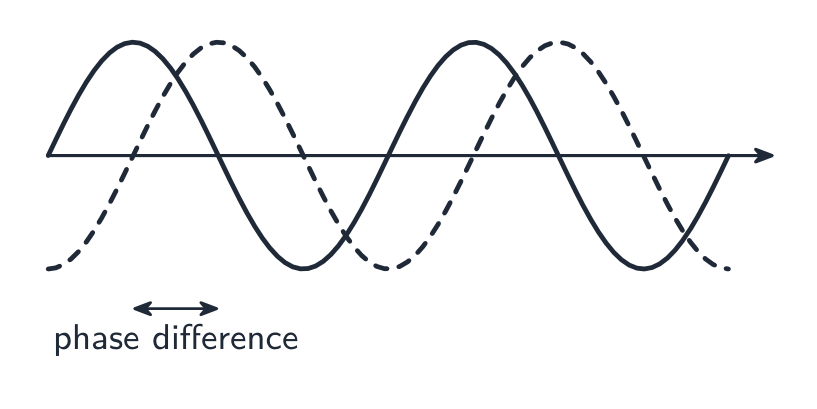
phase difference 相位差 — the fraction of a cycle by which one oscillation leads or lags another. Given in radians 弧度 (a full cycle is $2\pi$) or degrees (a full cycle is $360°$).
Two points one wavelength apart are in phase (phase difference 0 or $2\pi$). Two points half a wavelength apart are exactly out of phase (phase difference $\pi$).
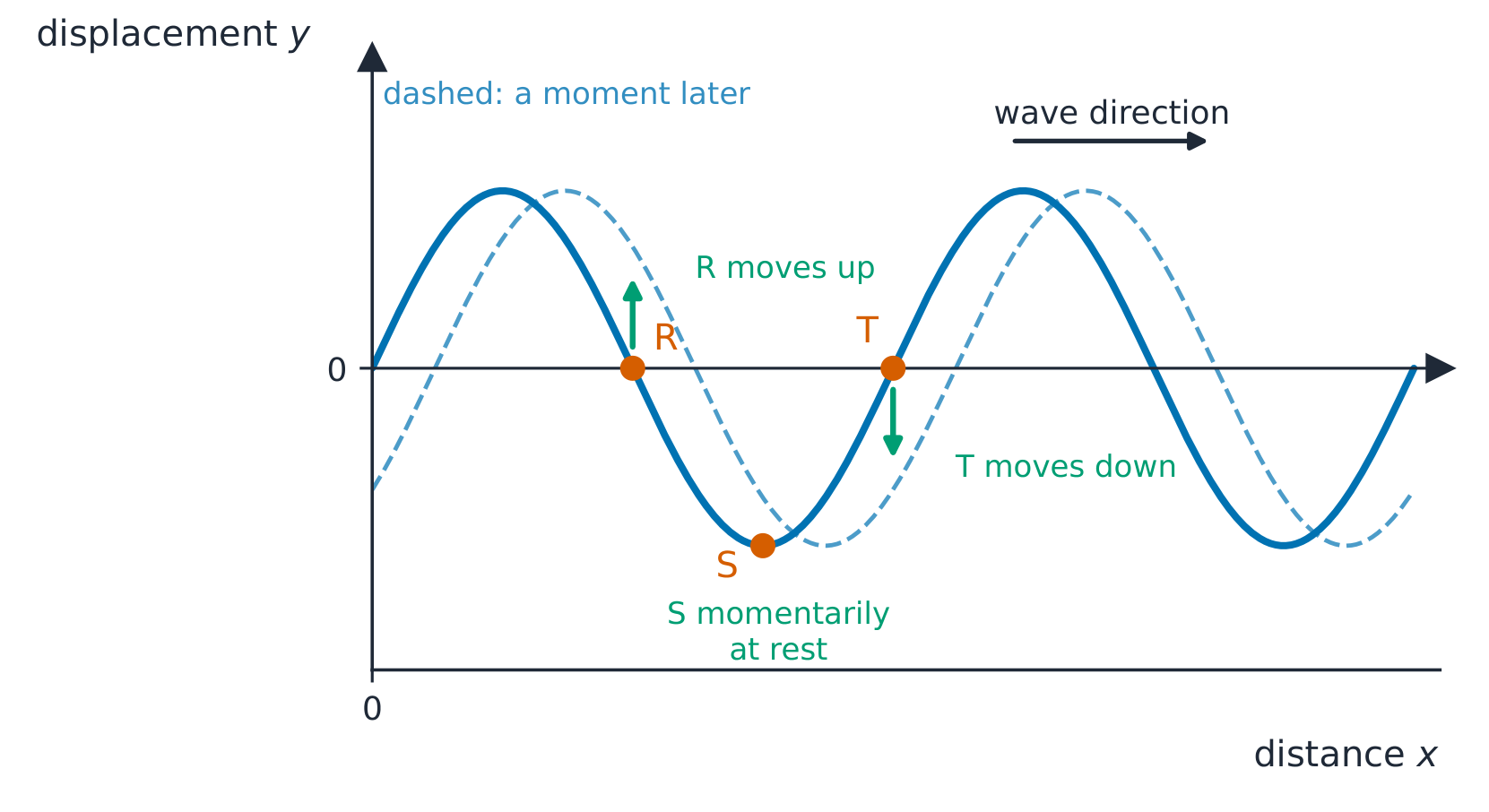
To find the phase difference between two points from a displacement–distance graph, divide their separation by the wavelength and multiply by $360°$ (or $2\pi$): two points $0.50\ \text{m}$ apart on a wave of wavelength $2.0\ \text{m}$ ($v = 600\ \text{m s}^{-1}$, $f = 300\ \text{Hz}$) differ in phase by $0.25 \times 360° = 90°$. Only the fraction of a cycle matters, so $450°$ is the same as $90°$. From two displacement–time graphs, read the time shift between the peaks as a fraction of the period. Which way is a point moving at the instant a graph shows? The whole profile moves along, so each point takes up the displacement that its neighbour on the side the wave comes from has now; a point at a crest or a trough is momentarily at rest.
Worked example. Points R and T on a string are $0.62\ \text{cm}$ apart and a quarter of a cycle out of phase. The wave speed is $0.27\ \text{m s}^{-1}$. Find the frequency.
A quarter of a cycle is a quarter of a wavelength, so $\lambda = 4 \times 0.62 = 2.5\ \text{cm}$ and $f = v / \lambda = 0.27 / 0.025 = 11\ \text{Hz}$.
The wave equation
In one period $T$, the wave moves forward by one wavelength $\lambda$. So speed $= \text{distance} / \text{time} = \lambda / T = \lambda f$:
$$v = f \lambda.$$
This comes straight from the definitions of speed, frequency and wavelength, and works for every progressive wave. For the two-mark derivation write both steps: in one period $T$ the wave travels one wavelength $\lambda$, so $v = \lambda / T$; and $f = 1/T$, so $v = f\lambda$. Because $v$ is fixed by the medium, a higher frequency means a shorter wavelength. A period question is the same equation the other way round: light of wavelength $460\ \text{nm}$ has $f = c / \lambda = 6.5 \times 10^{14}\ \text{Hz}$ and $T = 1/f = 1.5 \times 10^{-15}\ \text{s}$.
Reading a CRO trace
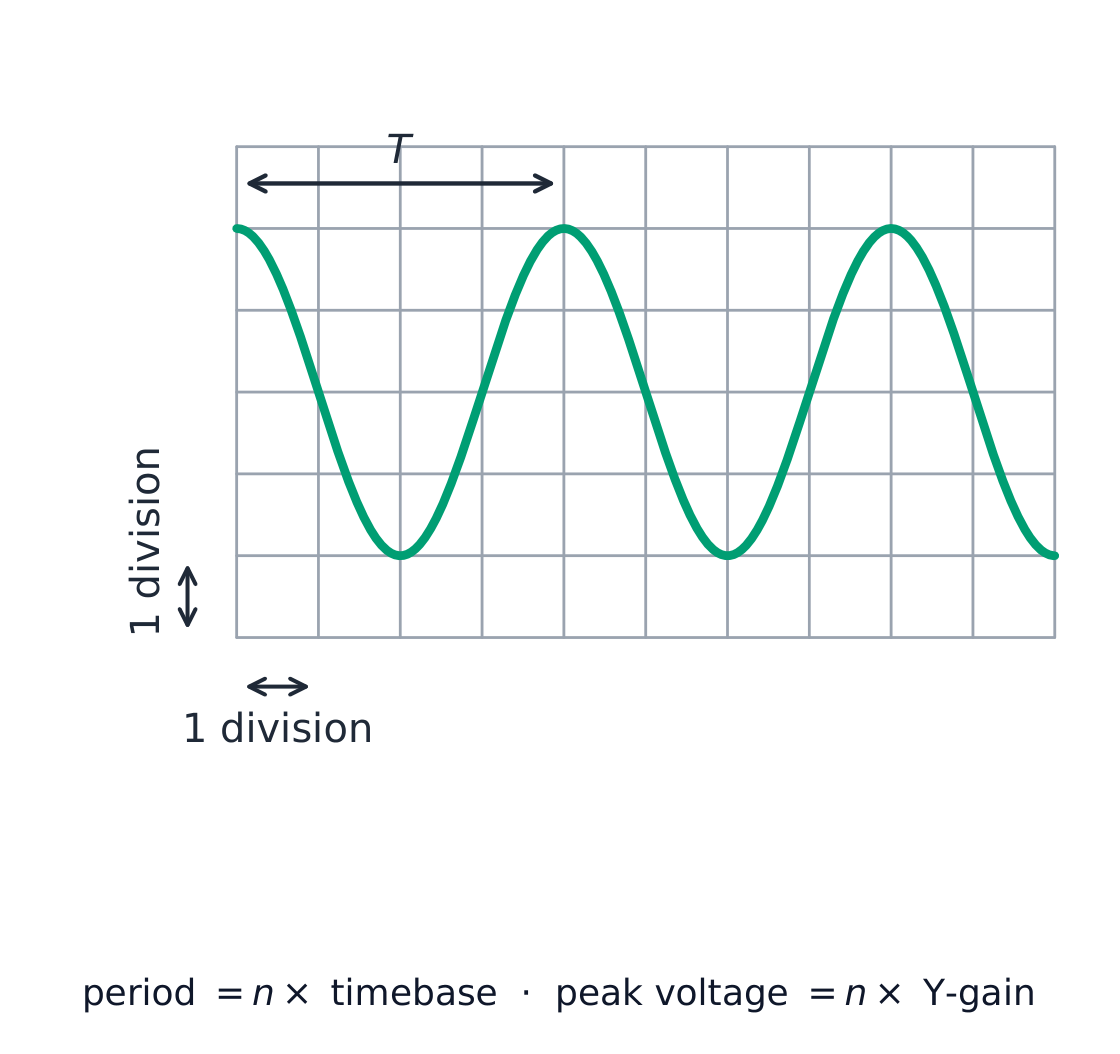
A cathode-ray oscilloscope 示波器 (CRO) draws a voltage signal — for sound, the output of a microphone — against time. Two controls matter:
time-base 时基 (seconds per division across): turns horizontal distance on the screen into time. Read the period $T$ as the distance between two next-door peaks, then $f = 1/T$.
y-gain 垂直增益 (volts per division up): turns vertical distance into voltage. The amplitude in volts is the peak height from the centre line.
If the time-base is $5\ \text{ms}/\text{div}$ and one full cycle takes $4$ divisions, then $T = 4 \times 5\ \text{ms} = 20\ \text{ms}$ and $f = 50\ \text{Hz}$.
The time-base is the time represented by one division (or one centimetre) across the screen, in $\text{s}\ \text{div}^{-1}$. To set it for a given signal, work backwards: a $2000\ \text{Hz}$ sound has $T = 0.50\ \text{ms}$, so for one cycle to span $2.5\ \text{cm}$ the time-base must be $0.50 / 2.5 = 0.20\ \text{ms cm}^{-1}$. For the amplitude, multiply the peak height in divisions by the y-gain: $2.0$ divisions at $3.5\ \text{mV cm}^{-1}$ is $7.0\ \text{mV}$. When the intensity of the sound is reduced to a quarter at the same frequency, the trace keeps its period and its peaks halve in height, because $I \propto A^{2}$.
Intensity of a wave
A wave carries energy. The intensity 强度 at a point is the power 功率 passing through unit area at right angles to the direction of travel:
$$I = \frac{P}{A}.$$
Unit: $\text{W m}^{-2}$.
Intensity is proportional to the square of the amplitude:
$$I \propto A^{2}.$$
For a point source 点源 sending out energy equally in all directions, the wavefronts 波前 are spheres; the surface area at distance $r$ is $4\pi r^{2}$, so
$$I = \frac{P}{4\pi r^{2}}, \qquad I \propto \frac{1}{r^{2}}.$$
Doubling the distance cuts the intensity to a quarter, which means the amplitude is halved (since $I \propto A^{2}$).
Worked example. A lamp emits $60\ \text{W}$ of light equally in all directions. Find the intensity of the light $2.0\ \text{m}$ away.
Worked example. Light of power $750\ \text{W}$ falls at right angles on a square solar panel of side $1.2\ \text{m}$. Find the intensity.
$I = P/A = 750 / 1.2^{2} = 520\ \text{W m}^{-2}$. A smaller panel in the same light receives the same intensity but less power, in proportion to its area. The other way round, a magnifying glass of radius $r$ collects a power $I \times \pi r^{2}$ and concentrates it on a small spot.
Two rules the multiple-choice questions turn on. Because $I \propto A^{2}$, the ratio of two intensities is the square of the ratio of the amplitudes: waves of amplitude $3.0\ \text{cm}$ and $2.0\ \text{cm}$ have intensities in the ratio $2.25$, and when an amplitude falls to a half the intensity falls to a quarter. For a point source, $I \propto 1/r^{2}$ means $A \propto 1/r$, so a sketch of $A/A_{0}$ against $d/x_{0}$ is a curve falling as $1/d$, not a straight line. The one-line statement the scheme wants: intensity is proportional to the amplitude squared.
العربية
تموجات الماء هي موجات تقدمية تحمل الطاقة للخارج.موجة ذات تردد مماثل مزاحة بفرق طور
تحمل الموجةطاقة من مكان إلى آخر دون نقل مادة بشكل عام. جزيئات الوسطتهتز حول مواقع سكون ثابتة؛ فقط الاضطراب (وطاقته) ينتشر. أمثلة: موجة عرضية على حبل، موجة طولية على نابض ملول، تموجات الماء، والصوت في الهواء. الموجة التي تنتقل وتحمل الطاقة هي موجة تقدمية.
الحركة الموجية سلسلة من اهتزازات جزيئات وسط، كل منها ينقل الاضطراب إلى التالي: هز طرف الحبل، ادفع طرف النابض، أو لمس سطح الماء في حوض التموجات، وسيتحرك الاهتزاز بعيدًا عن نقطة البداية. للتعريف ذي العلامة الواحدة، الموجة التقدمية تنقل الطاقة من مكان إلى آخر دون نقل مادة؛ الجزيئات تهتز فقط حول مواقع سكونها.
مصطلحات رئيسية
الإزاحة$y$ — مدى حركة الجزيء عن موقع سكونه في لحظة معينة. متجه.
amplitude$A$ — أكبر إزاحة عن وضع التوازن.
wavelength$\lambda$ — أقصر مسافة على طول الموجة بين نقطتين تتحركان بنفس الطور (على سبيل المثال، قمتان متجاورتان).
period$T$ — الزمن اللازم لاهتزاز كامل لجسيم واحد.
frequency$f$ — عدد الاهتزازات الكاملة في الثانية؛ $f = 1/T$. الوحدة: hertz، $\text{Hz}$.
speed$v$ — سرعة انتقال قمة على طول الوسط.
phase difference — الكسر من الدورة الذي تسبق به أو تتأخر به اهتزازة واحدة عن أخرى. يُعطى بـ radians (الدورة الكاملة تساوي $2\pi$) أو درجات (الدورة الكاملة تساوي $360°$).
نقطتان تبعدان عن بعضهما موجة كاملة تكونان بنفس الطور (فرق طور 0 أو $2\pi$). نقطتان تبعدان نصف موجة تكونان تماماً عكس الطور (فرق طور $\pi$).
لإيجاد الفرق الطوري بين نقطتين من رسم إزاحة–مسافة، قسّم تباعدهما بالطول الموجي واضرب في $360°$ (أو $2\pi$): نقطتان $0.50\ \text{m}$ مبتعدتان في موجة طولها الموجي $2.0\ \text{m}$ ($v = 600\ \text{m s}^{-1}$، $f = 300\ \text{Hz}$) differs in phase by $0.25 \times 360° = 90°$. فقط كسر الدورة مهم، لذا $450°$ يساوي $90°$. من رسمين للإزاحة–الزمن، اقرأ الإزاحة الزمنية بين القمم ككسر من الدور. أي اتجاه تتحرك نقطة اللحظة التي يظهر فيها الرسم البياني؟ يتحرك الملف الكامل للأمام، لذا كل نقطة تأخذ الإزاحة التي تملكها الآن جارتها من الجهة التي يأتي منها الموج؛ النقطة في الذروة أو الترام تكون ساكنة لحظياً.
Which way each point moves: towards the displacement its neighbour on the incoming side has now; a crest or trough is momentarily at rest
Worked example. Points R and T on a string are $0.62\ \text{cm}$ apart and a quarter of a cycle out of phase. The wave speed is $0.27\ \text{m s}^{-1}$. Find the frequency.
A quarter of a cycle is a quarter of a wavelength, so $\lambda = 4 \times 0.62 = 2.5\ \text{cm}$ and $f = v / \lambda = 0.27 / 0.025 = 11\ \text{Hz}$.
المعادلة الموجية
في دورة واحدة $T$، تتقدم الموجة بمقدار طول موجي واحد $\lambda$. إذن السرعة $= \text{distance} / \text{time} = \lambda / T = \lambda f$:
$$v = f \lambda.$$
This comes straight from the definitions of speed, frequency and wavelength, and works for every progressive wave. For the two-mark derivation write both steps: in one period $T$ the wave travels one wavelength $\lambda$, so $v = \lambda / T$; and $f = 1/T$, so $v = f\lambda$. Because $v$ is fixed by the medium, a higher frequency means a shorter wavelength. A period question is the same equation the other way round: light of wavelength $460\ \text{nm}$ has $f = c / \lambda = 6.5 \times 10^{14}\ \text{Hz}$ and $T = 1/f = 1.5 \times 10^{-15}\ \text{s}$.
قراءة أثر راسم الأشعة الكاثودية
A cathode-ray oscilloscope (CRO) draws a voltage signal — for sound, the output of a microphone — against time. Two controls matter:
time-base (seconds per division across): turns horizontal distance on the screen into time. Read the period $T$ as the distance between two next-door peaks, then $f = 1/T$.
y-gain (volts per division up): turns vertical distance into voltage. The amplitude in volts is the peak height from the centre line.
If the time-base is $5\ \text{ms}/\text{div}$ and one full cycle takes $4$ divisions, then $T = 4 \times 5\ \text{ms} = 20\ \text{ms}$ and $f = 50\ \text{Hz}$.
The time-base is the time represented by one division (or one centimetre) across the screen, in $\text{s}\ \text{div}^{-1}$. To set it for a given signal, work backwards: a $2000\ \text{Hz}$ sound has $T = 0.50\ \text{ms}$, so for one cycle to span $2.5\ \text{cm}$ the time-base must be $0.50 / 2.5 = 0.20\ \text{ms cm}^{-1}$. For the amplitude, multiply the peak height in divisions by the y-gain: $2.0$ divisions at $3.5\ \text{mV cm}^{-1}$ is $7.0\ \text{mV}$. When the intensity of the sound is reduced to a quarter at the same frequency, the trace keeps its period and its peaks halve in height, because $I \propto A^{2}$.
Reading the period T from a CRO trace using the grid and time-baseA real oscilloscope: the grid lets you read off the period and the amplitude
شدة الموجة
A wave carries energy. The intensity at a point is the power passing through unit area at right angles to the direction of travel:
$$I = \frac{P}{A}.$$
Unit: $\text{W m}^{-2}$.
Intensity is proportional to the square of the amplitude:
$$I \propto A^{2}.$$
For a point source sending out energy equally in all directions, the wavefronts are spheres; the surface area at distance $r$ is $4\pi r^{2}$, so
$$I = \frac{P}{4\pi r^{2}}, \qquad I \propto \frac{1}{r^{2}}.$$
Doubling the distance cuts the intensity to a quarter, which means the amplitude is halved (since $I \propto A^{2}$).
Worked example. A lamp emits $60\ \text{W}$ of light equally in all directions. Find the intensity of the light $2.0\ \text{m}$ away.
Worked example. Light of power $750\ \text{W}$ falls at right angles on a square solar panel of side $1.2\ \text{m}$. Find the intensity.
$I = P/A = 750 / 1.2^{2} = 520\ \text{W m}^{-2}$. A smaller panel in the same light receives the same intensity but less power, in proportion to its area. The other way round, a magnifying glass of radius $r$ collects a power $I \times \pi r^{2}$ and concentrates it on a small spot.
قاعدتان أساسيتان تستند إليهما أسئلة الاختيار من متعدد. نظرًا لـ $I \propto A^{2}$، فإن نسبة الشدتين تساوي مربع نسبة السعات: الموجات ذات السعتين $3.0\ \text{cm}$ و$2.0\ \text{cm}$ يكون لها شدتان بنسبة $2.25$، وعندما تنخفض السعة إلى النصف تنخفض الشدة إلى الربع. بالنسبة لمصدر نقطي، $I \propto 1/r^{2}$ تعني $A \propto 1/r$، لذا فإن رسمًا بيانيًا لـ $A/A_{0}$ مقابل $d/x_{0}$ يكون منحنى يتناقص كـ $1/d$، وليس خطًا مستقيمًا. العبارة المختصرة التي يطلبها المنهج هي: الشدة تتناسب طرديًا مع مربع السعة.
Explore · استكشف
Progressive waves · الموجات الانتشارية
y = a sin(bx + c)
A wave: a is amplitude, b sets the wavelength, c the phase. · في موجة: a هي السعة، b تحدد الطول الموجي، c الطور.
Source: Cambridge International syllabus · المصدر: منهج كامبريدج الدولي
English
Transverse vs longitudinal waves
Transverse waves
The particles oscillate perpendicular 垂直 to the direction the energy travels. A wave on a rope, all electromagnetic waves, and S-waves in the Earth are transverse.
Longitudinal waves
The particles oscillate parallel to the direction the energy travels. Sound in any medium, P-waves in the Earth, and the squashes on a slinky are longitudinal. The wave is made of compressions 压缩 (higher pressure, particles close together) and rarefactions 稀疏 (lower pressure, particles spread out).
Graphs of waves
A graph of particle displacement against position at one moment looks like a sine curve 正弦曲线 for both kinds of wave. The difference: for a transverse wave the displacement axis is the real sideways displacement; for a longitudinal wave it is the small back-and-forth displacement along the direction of travel (positive one way, negative the other).
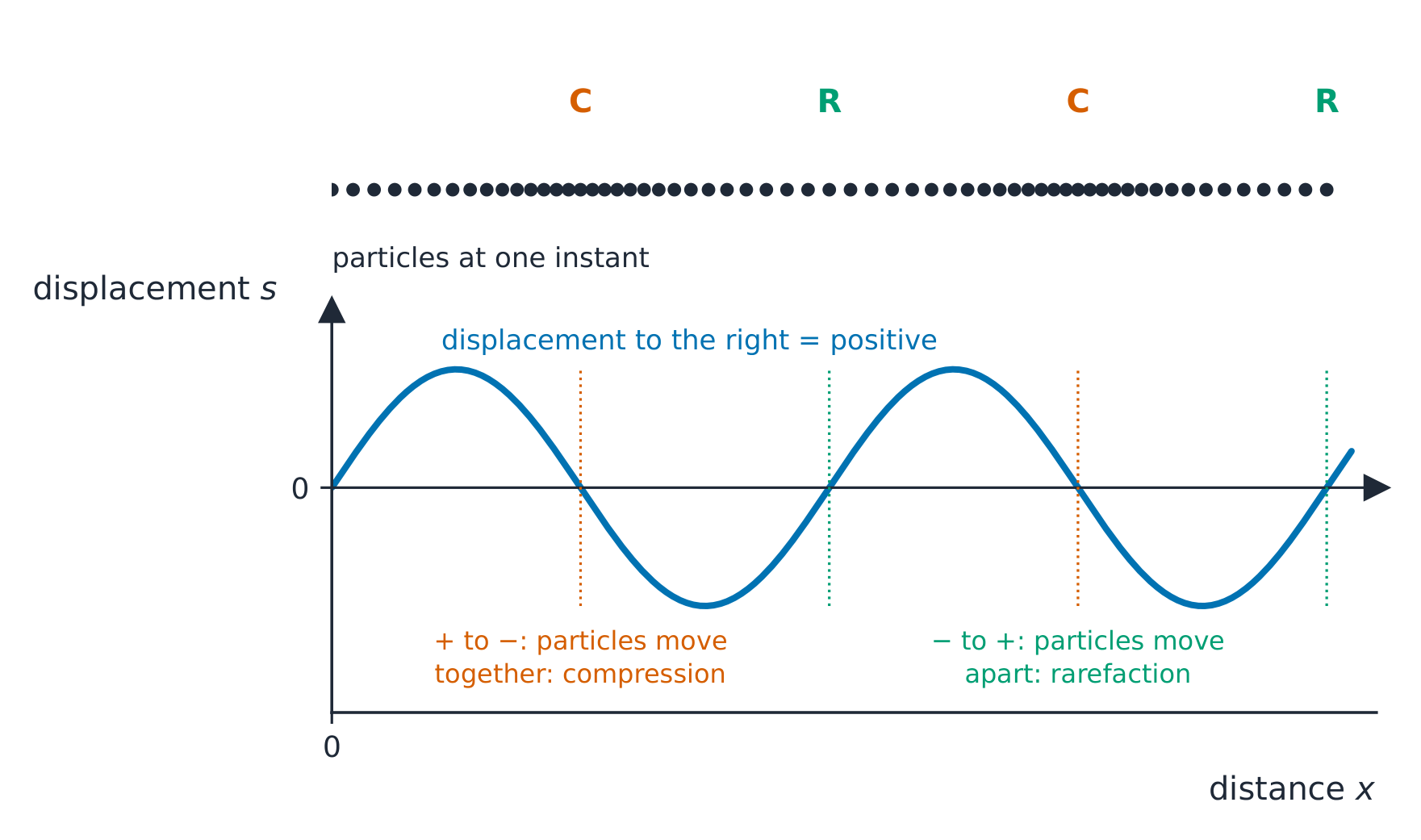
For a longitudinal wave take displacement to the right as positive. Where the graph crosses zero going from positive to negative, the particles on either side have moved towards that point, so it is a compression; where it crosses from negative to positive they have moved apart, a rarefaction. Two neighbouring compressions are one wavelength apart, and a compression and the next rarefaction are half a wavelength apart. The direction of motion of a particle follows the same rule as for a transverse wave: it moves towards the displacement of its neighbour on the side the wave comes from.
A graph of particle displacement against time at one point in space is also a sine curve for both kinds. Read the period $T$ from this graph.
The two-mark comparison, with reference to the direction of energy transfer: in a transverse wave the oscillations are perpendicular to the direction of energy transfer; in a longitudinal wave they are parallel to it. Both kinds transfer energy without transferring matter, both can be reflected, refracted and diffracted, and both can form stationary waves (topic 8). Only transverse waves can be polarised, and only electromagnetic waves, which are all transverse, can travel through a vacuum; sound needs a medium. Reading the two graphs together: the displacement–distance graph gives $\lambda$, the displacement–time graph gives $T$, and $v = \lambda / T$.
العربية
موجات مستعرضة مقابل موجات طولية
الموجات المستعرضة
تتهز الجزيئات عموديًا على اتجاه انتقال الطاقة. موجة الحبل، جميع الموجات الكهرومغناطيسية، وموجات S في الأرض هي موجات مستعرضة.
موجة عرضية على حبل
الموجات الطولية
تتهز الجزيئات متوازية مع اتجاه انتقال الطاقة. الصوت في أي وسط، وموجات P في الأرض، والضغطات على الزنبرك الحلزوني هي موجات طولية. تتكون الموجة من ضغطات (ضغط أعلى، جزيئات متقاربة) وتمددات (ضغط أقل، جزيئات متباعدة).
موجة طولية على زنبرك "سليكي"
الرسوم البيانية للموجات
الرسم البياني لـ إزاحة الجزيء مقابل الموضع عند لحظة واحدة يبدو كـ منحنى جيب لكلا النوعين من الموجات. الفرق: بالنسبة للموجة المستعرضة يكون محور الإزاحة هو الإزاحة الجانبية الحقيقية؛ أما بالنسبة للموجة الطولية فهو الإزاحة الصغيرة ذهابًا وإيابًا على طول اتجاه الحركة (موجبة في اتجاه وسالبة في الاتجاه الآخر).
للموجة الطولية نعتبر الإزاحة نحو اليمين موجبة. حيث يعبر الرسم البياني الصفر من الموجب إلى السالب، تكون الجزيئات على جانبي تلك النقطة قد تحركت نحو تلك النقطة، لذا فهي منطقة ضغط؛ حيث يعبر من السالب إلى الموجب تكون قد تباعدت، مما يشكل تمددًا. المسافة بين ضغطتين متجاورتين تساوي طول موجي واحد، والمسافة بين الضغطة والتمدد الذي يليها تساوي نصف طول موجي. يتبع اتجاه حركة الجزيء نفس القاعدة الخاصة بالموجة المستعرضة: يتحرك نحو إزاحة جاريه من الجهة التي تأتي منها الموجة.
نفس الموجة الطولية كجزيئات وكرسم بياني: ضغطة عندما تتغير الإزاحة من الموجب إلى السالب، وتمدد عندما تتغير من السالب إلى الموجبالرسم البياني للإزاحة–المسافة يظهر سعة الموجة وطولها الموجي
الرسم البياني لـ إزاحة الجزيء مقابل الزمن عند نقطة معينة في الفضاء هو أيضًا منحنى جيب لكلا النوعين. استخرج الدورة $T$ من هذا الرسم البياني.
الرسم البياني للإزاحة–الزمن يظهر سعة الموجة ودورتها
مقارنة قيمتها علامتان، مع الإشارة إلى اتجاه نقل الطاقة: في الموجة المستعرضة تكون الاهتزازات عمودية على اتجاه نقل الطاقة؛ وفي الموجة الطولية تكون متوازية معه. كلا النوعين ينقلان الطاقة دون نقل المادة، وكلاهما يمكن أن يُعكس وينكسر ويتشتت، وكلاهما يمكن أن يكوّن موجات ثابتة (الموضوع 8). فقط الموجات المستعرضة يمكن قطبيتها، وفقط الموجات الكهرومغناطيسية، وهي جميعها مستعرضة، يمكنها السفر عبر الفراغ؛ يحتاج الصوت إلى وسط. قراءة الرسمين البيانيين معًا: الرسم البياني للإزاحة–المسافة يعطي $\lambda$، والرسم البياني للإزاحة–الزمن يعطي $T$، و$v = \lambda / T$.
Explore · استكشف
Transverse waves · موجات مستعرضة
y = a sin(bx + c)
Change the amplitude and wavelength of the wave. · غيّر السعة وطول الموجة للموجة.
understand that when a source of sound waves moves relative to a stationary observer, the observed frequency is different from the source frequency (understanding of the Doppler effect for a stationary source and a moving observer is not required)
use the expression $f_{\text{o}} = f_{\text{s}} v / (v \pm v_{\text{s}})$ for the observed frequency when a source of sound waves moves relative to a stationary observer
العربية
افهم أنه عندما يتحرك مصدر موجات الصوت بالنسبة لمراقب ثابت، فإن التردد المرصود يختلف عن تردد المصدر (لا يُشترط فهم تأثير دوبلر لمصدر ثابت ومراقب متحرك)
استخدم التعبير $f_{\text{o}} = f_{\text{s}} v / (v \pm v_{\text{s}})$ للتردد المرصود عندما يتحرك مصدر موجات الصوت بالنسبة لمراقب ثابت
Source: Cambridge International syllabus · المصدر: منهج كامبريدج الدولي
English
When the source 波源 of a sound moves relative to a stationary 静止observer 观察者, the heard frequency is different from the source frequency. This is the Doppler effect 多普勒效应.
source moving towards the observer: the wavefronts in front are squashed, so the wavelength is shorter and the heard frequency is higher.
source moving away from the observer: the wavefronts behind are spread out, so the wavelength is longer and the heard frequency is lower.
The formula (source moving at speed $v_{\text{s}}$ along the line to the observer; wave speed $v$, source frequency $f_{\text{s}}$, heard frequency $f_{\text{o}}$):
minus sign on the bottom when the source moves towards the observer ($f_{\text{o}} > f_{\text{s}}$),
plus sign when the source moves away ($f_{\text{o}} < f_{\text{s}}$).
You only need the case of a stationary observer.
Worked example. A car horn at $f_{\text{s}} = 800\ \text{Hz}$ moves at $30\ \text{m s}^{-1}$ towards a still listener. Speed of sound $v = 340\ \text{m s}^{-1}$:
Moving away at the same speed, the listener hears $340 \times 800 / (340 + 30) = 735\ \text{Hz}$: the frequency is constant while the car approaches, drops as it passes, and is constant again, lower, as it recedes. A sketch of observed frequency against time for a source passing at constant speed is two level lines joined by a fall. Working backwards, a source of $1200\ \text{Hz}$ heard as $960\ \text{Hz}$ is moving away ($f_{\text{o}} < f_{\text{s}}$): $960 = 1200 \times 340 / (340 + v_{\text{s}})$ gives $v_{\text{s}} = 85\ \text{m s}^{-1}$. A buzzer swung in a horizontal circle at $25\ \text{m s}^{-1}$ while emitting $846\ \text{Hz}$ is heard between $846 \times 330 / 355 = 786\ \text{Hz}$ (moving directly away) and $846 \times 330 / 305 = 915\ \text{Hz}$ (moving directly towards), once each per revolution. If the period of a CRO trace of the sound rises continuously, the observed frequency is falling: the source is moving away with increasing speed. The Doppler effect happens for all waves, light included (topic 25); only the sound formula is examined here.
العربية
عندما يتحرك مصدر الصوت نسبيًا لـ مراقبثابت، فإن التردد المسموع يختلف عن تردد المصدر. هذا هو تأثير دوبلر.
مصدر يتحرك نحو المراقب: تتكدس الأماميات الموجية أمامه، لذا يكون طول الموجة أقصر ويكون التردد المسموع أعلى.
مصدر يتحرك مبتعدًا عن المراقب: تتباعد الأماميات الموجية خلفه، لذا يكون طول الموجة أطول ويكون التردد المسموع أقل.
مصدر متحرك يضغط موجات أمامه، مما يرفع التردد الملاحظ
الصيغة (المصدر يتحرك بسرعة $v_{\text{s}}$ على الخط نحو المراقب؛ سرعة الموجة $v$، تردد المصدر $f_{\text{s}}$، التردد المسموع $f_{\text{o}}$):
يتحرك مبتعداً بنفس السرعة، يسمع المستمع $340 \times 800 / (340 + 30) = 735\ \text{Hz}$: التردد ثابت أثناء اقتراب السيارة، ينخفض عند مرورها، ثم يصبح ثابتاً مرة أخرى، وأقل، أثناء ابتعاده. رسم تخطيطي للتردد الملاحظ مقابل الزمن لمصدر يمر بسرعة ثابتة هو خطان أفقيان متصلان بانخفاض. بالرجوع للخلف، مصدر $1200\ \text{Hz}$ يُسمَع $960\ \text{Hz}$ يتحرك مبتعداً ($f_{\text{o}} < f_{\text{s}}$): $960 = 1200 \times 340 / (340 + v_{\text{s}})$ يعطي $v_{\text{s}} = 85\ \text{m s}^{-1}$. زازية تُدور في دائرة أفقية بسرعة $25\ \text{m s}^{-1}$ بينما تصدر تردد $846\ \text{Hz}$ تُسمع بين $846 \times 330 / 355 = 786\ \text{Hz}$ (تتحرك مباشرة مبتعدة) و$846 \times 330 / 305 = 915\ \text{Hz}$ (تتحرك مباشرة مقتربة)، مرة واحدة لكل دورة. إذا زاد الدور period لآلة تتبع الموجات الكهرومغناطيسية بشكل مستمر، فإن التردد الملاحظة يتناقص: المصدر يبتعد بسرعة متزايدة. يحدث تأثير دوبلر لجميع الأمواج، بما في ذلك الضوء (الموضوع 25); يتم اختبار صيغة الصوت فقط هنا.
Explore · استكشف
Doppler effect · تأثير دوبلر
Send the source moving and watch the wavefronts bunch up ahead (higher pitch) and stretch out behind — the siren effect, controlled by the source's speed. · اجعل المصدر يتحرك ولاحظ كيف تتراكم واجهات الموجة أمامه (نبرة أعلى) وتمتد خلفه — تأثير الجرس الإنذاري، المُتحكم بواسطة سرعة المصدر.
state that all electromagnetic waves are transverse waves that travel with the same speed $c$ in free space
recall the approximate range of wavelengths in free space of the principal regions of the electromagnetic spectrum from radio waves to $\gamma$-rays
recall that wavelengths in the range 400–700 nm in free space are visible to the human eye
العربية
أذكر أن جميع الموجات الكهرومغناطيسية هي موجات مستعرضة تسير بنفس السرعة $c$ في الفراغ
تذكر النطاق التقريبي للأطوال الموجية في الفراغ للمناطق الرئيسية من الطيف الكهرومغناطيسي بدءًا من موجات الراديو إلى أشعة$\gamma$
تذكر أن الأطوال الموجية في نطاق 400–700 نانومتر في الفراغ تكون مرئية للعين البشرية
Source: Cambridge International syllabus · المصدر: منهج كامبريدج الدولي
English
All electromagnetic waves 电磁波 (EM waves) are transverse and travel in a vacuum 真空 at the same speed:
$$c = 3.00 \times 10^{8}\ \text{m s}^{-1}.$$
The electromagnetic spectrum 电磁波谱 includes radio waves, microwaves 微波, infrared 红外线, visible light, ultraviolet 紫外线, X-rays X射线 and $\gamma$-rays γ射线.
Approximate wavelength ranges in free space (learn the orders of magnitude):
radio waves: $> 10^{-1}\ \text{m}$ (up to many km).
microwaves: $10^{-3}\ \text{m}$ to $10^{-1}\ \text{m}$.
infrared: $\sim 7 \times 10^{-7}\ \text{m}$ to $10^{-3}\ \text{m}$.
visible light: $400\ \text{nm}$ (violet) to $700\ \text{nm}$ (red), i.e. $4 \times 10^{-7}\ \text{m}$ to $7 \times 10^{-7}\ \text{m}$.
ultraviolet: $\sim 10^{-8}\ \text{m}$ to $4 \times 10^{-7}\ \text{m}$.
X-rays: $\sim 10^{-11}\ \text{m}$ to $10^{-8}\ \text{m}$.
$\gamma$-rays: $< 10^{-11}\ \text{m}$.
The boundaries between regions are not sharp. Use $c = f\lambda$ to change between wavelength and frequency. Only light with wavelengths $400$–$700\ \text{nm}$ can be seen.
To identify a region, convert to a wavelength with $\lambda = c / f$ and compare with the ranges: $2.1\ \text{cm}$ is a microwave; $138\ \text{pm} = 1.4 \times 10^{-10}\ \text{m}$ is an X-ray; $30\ \text{THz}$ gives $\lambda = 1.0 \times 10^{-5}\ \text{m}$, infrared; $3.0 \times 10^{16}\ \text{Hz}$ gives $1.0 \times 10^{-8}\ \text{m}$, ultraviolet. Visible light spans frequencies of about $4.3 \times 10^{14}$ to $7.5 \times 10^{14}\ \text{Hz}$, so a wave of $5.0 \times 10^{14}\ \text{Hz}$ can be seen and one of wavelength $5.0 \times 10^{-6}\ \text{m}$ (infrared) cannot. Red light has a longer wavelength and a lower frequency than green. A list "in order of increasing wavelength" runs $\gamma$-rays, X-rays, ultraviolet, visible, infrared, microwaves, radio waves. A pulse of light reflected from a wall $150\ \text{m}$ away returns after $2 \times 150 / (3.00 \times 10^{8}) = 1.0\ \mu\text{s}$.
العربية
جميع الأمواج الكهرومغناطيسية (أمواج EM) هي مستعرضة وتنتقل في الفراغ بنفس السرعة:
$$c = 3.00 \times 10^{8}\ \text{m s}^{-1}.$$
يشمل الطيف الكهرومغناطيسي موجات الراديو، الموجات الدقيقة، الأشعة تحت الحمراء، الضوء المرئي، الأشعة فوق البنفسجية، أشعة إكس X و**$\gamma$-أشعة** γ.
الطيف الكهرومغناطيسي
نطاقات الطول الموجي التقريبية في الفراغ (احفظ أorders of magnitude):
الموجات الدقيقة: $10^{-3}\ \text{m}$ إلى $10^{-1}\ \text{m}$.
الأشعة تحت الحمراء: $\sim 7 \times 10^{-7}\ \text{m}$ إلى $10^{-3}\ \text{m}$.
الضوء المرئي: $400\ \text{nm}$ (بنفسجي) إلى $700\ \text{nm}$ (أحمر)، أي $4 \times 10^{-7}\ \text{m}$ إلى $7 \times 10^{-7}\ \text{m}$.
الأشعة فوق البنفسجية: $\sim 10^{-8}\ \text{m}$ إلى $4 \times 10^{-7}\ \text{m}$.
أشعة إكس: $\sim 10^{-11}\ \text{m}$ إلى $10^{-8}\ \text{m}$.
$\gamma$-أشعة: $< 10^{-11}\ \text{m}$.
الحدود بين المناطق ليست حادة. استخدم $c = f\lambda$ للتبديل بين الطول الموجي والتردد. يمكن رؤية الضوء الذي أطواله الموجية $400$–$700\ \text{nm}$ فقط.
لتحديد region، حول إلى wavelength بـ$\lambda = c / f$ وقارن مع النطاقات: $2.1\ \text{cm}$ هو موجة ميكروية؛ $138\ \text{pm} = 1.4 \times 10^{-10}\ \text{m}$ هو أشعة إكس؛ $30\ \text{THz}$ يعطي $\lambda = 1.0 \times 10^{-5}\ \text{m}$، الأشعة تحت الحمراء؛ $3.0 \times 10^{16}\ \text{Hz}$ يعطي $1.0 \times 10^{-8}\ \text{m}$، الأشعة فوق البنفسجية. يمتد الضوء المرئي عبر frequencies حوالي $4.3 \times 10^{14}$ إلى $7.5 \times 10^{14}\ \text{Hz}$، لذا يمكن رؤية موجة بتردد $5.0 \times 10^{14}\ \text{Hz}$ ولا يمكن رؤية موجة بطول موجي $5.0 \times 10^{-6}\ \text{m}$ (الأشعة تحت الحمراء). ضوء الأحمر له wavelength أطول وfrequency أقل من الأخضر. قائمة "按照 increasing wavelength" تبدأ بـ$\gamma$-أشعة، X-rays، فوق بنفسجية، مرئية، تحت حمراء، ميكروية، موجات راديو. نبضة ضوء منعكسة من جدار على مسافة $150\ \text{m}$ تعود بعد $2 \times 150 / (3.00 \times 10^{8}) = 1.0\ \mu\text{s}$.
Explore · استكشف
Slide across the spectrum · مرر عبر الطيف
Radio waves, visible light and gamma rays are all the same wave — only the wavelength changes, and with it the frequency, photon energy and everyday use. · الموجات الراديوية والضوء المرئي وأشعة غاما كلها نفس الموجة — يتغير فقط الطول الموجي، ومع ذلك يتغير التردد وطاقة الفوتون والاستخدام اليومي.
understand that polarisation is a phenomenon associated with transverse waves
recall and use Malus’s law ($I = I_0 \cos^2\theta$) to calculate the intensity of a plane-polarised electromagnetic wave after transmission through a polarising filter or a series of polarising filters (calculation of the effect of a polarising filter on the intensity of an unpolarised wave is not required)
العربية
افهم أن الاستقطاب ظاهرة ترتبط بـالموجات المستعرضة
تذكر واستخدم قانون مالوس ($I = I_0 \cos^2\theta$) لحساب الشدة لـموجة كهرومغناطيسية مستقطبة مسطحاً بعد مرورها عبر فلتر استقطاب أو سلسلة من الفلاتر (لا يُشترط حساب تأثير فلتر الاستقطاب على شدة موجة غير مستقطبة)
Source: Cambridge International syllabus · المصدر: منهج كامبريدج الدولي
English
Polarisation 偏振 means making a transverse wave oscillate in one plane only.
Only transverse waves can be polarised — the oscillation is perpendicular to the direction of travel, so different perpendicular planes are real choices.
Longitudinal waves (sound) cannot be polarised — the oscillation is along the direction of travel, so there is no other plane.
So polarisation is a test: if a wave can be polarised, it must be transverse.
Malus's law
Plane-polarised 平面偏振 light of intensity $I_{0}$ passes through a polarising filter 偏振片 whose transmission axis 透光轴 is at angle $\theta$ to the plane of polarisation. The transmitted intensity is given by Malus's law 马吕斯定律:
$$I = I_{0} \cos^{2}\theta.$$
$\theta = 0°$: filter lined up with the polarisation, $I = I_{0}$, all passes through.
$\theta = 90°$: filter at right angles, $I = 0$, all blocked.
Worked example. Plane-polarised light of intensity $12\ \text{W m}^{-2}$ meets a polarising filter whose axis is at $30°$ to the plane of polarisation. Find the transmitted intensity.
For two filters in a row, use Malus's law twice with the angle between each pair. Be careful with the angle each time — after the first filter the polarisation is along that filter's axis, and the second filter's angle is measured from there.
(You do not need to work out the effect of a polarising filter on an unpolarised wave.)
When a filter is rotated through $360°$ in front of plane-polarised light, the transmitted intensity varies as $\cos^{2}\theta$: it is a maximum when the transmission axis is parallel to the plane of polarisation ($0°$ and $180°$), zero when perpendicular ($90°$ and $270°$), and never negative. Because $I \propto A^{2}$, the transmitted amplitude is $A_{0}\cos\theta$: at $45°$ the intensity halves and the amplitude falls to $0.71$ of its value. For two filters, the first sets the plane of polarisation along its own axis, so the second filter's angle is measured from that: vertically polarised light through filters at $50°$ and then $80°$ to the vertical keeps $\cos^{2} 50° \times \cos^{2} 30° = 0.31$ of its intensity. The one-mark definitions: polarisation is the oscillation of a transverse wave in a single plane, which contains the direction of travel; sound cannot be polarised because its oscillations are along the direction of travel, so there is no plane to select.
العربية
الاستقطاب يعني جعل موجة مستعرضة تتذبذب في مستوى واحد فقط.
فقط الموجات المستعرضة يمكن استقطابها — التذبذب عمودي على اتجاه الحركة، لذا فإن مستويات العمود المختلفة هي خيارات حقيقية.
الموجات الطولية (الصوت) لا يمكن استقطابها — التذبذب على طول اتجاه الحركة، لذا لا يوجد مستوى آخر.
لذا الاستقطاب هو اختبار: إذا كانت الموجة قابلة للاستقطاب، يجب أن تكون مستعرضة.
موجات غير مستقطبة ترتج في مستويات متعددة؛ موجة مستقطبة ترتج في مستوى واحد
*منقلة بلاستيكية شفافة موضوعة بين فلترين مستقطبين متقاطعين. يصل الضوء إلى عينك فقط لأن البلاستيك المضغوط يدور مستوى استقطابه — الألوان تمثل أين تم ضغط البلاستيك أكثر. مع الضوء العادي سيبدو شفافاً فقط
قانون مالوس
ضوء مستقطب مستوياً شدته $I_{0}$ يمر عبر فلتر مستقطب يكون محور النقل الخاص به بزاوية $\theta$ بالنسبة لمستوى الاستقطاب. تُعطى الشدة المنقولة بـ قانون مالوس:
$$I = I_{0} \cos^{2}\theta.$$
$\theta = 0°$: الفلتر مصطف مع الاستقطاب، $I = I_{0}$، كل شيء يمر.
مرشحات متقاطعة (a) تحجب الضوء؛ مرشحات متوازية (b) تسمح بمروره
بالنسبة لفلترين متتاليين، استخدم قانون مالوس مرتين مع الزاوية بين كل زوج. كن حذراً مع الزاوية في كل مرة — بعد الفلتر الأول يكون الاستقطاب على طول محور ذلك الفلتر، وزاوية الفلتر الثاني تقاس من هناك.
(لا تحتاج إلى حساب تأثير الفلتر المستقطب على موجة غير مستقطبة.)
عند تدوير فلتر بزاوية $360°$ أمام ضوء مستقطب مسطحاً، تتغير الشدة المنقولة كما يلي $\cos^{2}\theta$: تكون في أقصى قيمة عندما يكون محور النفاذ موازياً لمستوى الاستقطاب ($0°$ و$180°$)، وصفرًا عند التعامد ($90°$ و$270°$)، ولا تكون سلبية أبدًا. وبما أن $I \propto A^{2}$، فإن السعة المنقولة هي $A_{0}\cos\theta$: عند $45°$ تنخفض الشدة إلى النصف وتنخفض السعة إلى $0.71$ من قيمتها. بالنسبة لفلترين، يحدد الفلتر الأول مستوى الاستقطاب على طول محوره الخاص، لذا تُقاس زاوية الفلتر الثاني من هذا المحور: الضوء المستقطب عموديًا المار عبر فلاتر بزاويتين $50°$ ثم $80°$ مع العمودي يحافظ على $\cos^{2} 50° \times \cos^{2} 30° = 0.31$ من شدته. تعريفات الدرجة الواحدة: الاستقطاب هو تذبذب موجة عرضية في مستوى واحد يحتوي اتجاه الحركة؛ لا يمكن استقطاب الصوت لأن تذبذباته تكون موازية لاتجاه الحركة، لذا لا يوجد مستوى للاختيار.
Explore · استكشف
Polarisation intensity lab · مختبر كثافة الاستقطاب
intensity changes with polariser angle · تتغير الكثافة مع زاوية المستقطر
Rotate a polariser and see why only transverse waves can be polarised. · أدر مستقطراً واشرح لماذا يمكن استقطاب الموجات المستعرضة فقط.
7.5
Definitions the examiner accepts · التعريفات التي يقبلها المصحح
English
A definition question is marked against fixed wording. Learn these exactly, and give one answer only.
Term
Definition
progressive wave
a wave that transfers energy from one place to another without transferring matter
transverse wave
a wave whose oscillations are perpendicular to the direction of energy transfer
longitudinal wave
a wave whose oscillations are parallel to the direction of energy transfer
displacement
the distance of a particle from its equilibrium (rest) position, in a stated direction
amplitude
the maximum displacement of a particle from its equilibrium position
wavelength
the minimum distance between two points on the wave that are in phase (for example, adjacent crests)
period
the time for one complete oscillation of a particle (or for the wave to travel one wavelength)
frequency
the number of oscillations per unit time (or the number of wavefronts passing a point per unit time)
phase difference
the fraction of a cycle, as an angle, by which one oscillation leads or lags another
intensity
the power per unit area, at right angles to the direction of travel
Doppler effect
the change in the observed frequency of a wave when the source moves relative to the observer
polarisation
the oscillations of a transverse wave are in one plane only, containing the direction of travel
time-base
the time represented by one division across the screen of a CRO
العربية
تُصنّف أسئلة التعريف بناءً على صياغة ثابتة. احفظ هذه التعريفات بدقة، وقدم إجابة واحدة فقط.
مصطلح
تعريف
موجة متقدمة
موجة تنقل الطاقة من مكان إلى آخر دون نقل المادة
موجة عرضية
موجة تكون فيها التذبذبات عمودية على اتجاه نقل الطاقة
موجة طولية
موجة تكون فيها التذبذبات موازية لاتجاه نقل الطاقة
الإزاحة
المسافة التي تبعدها جزيء عن موضعه الاتزاني (السكوني)، في اتجاه محدد
السعة
أقصى إزاحة لجزيء عن موضعه الاتزاني
الطول الموجي
أقصر مسافة بين نقطتين على الموجة تكونان في نفس الطور (على سبيل المثال، القمتان المتجاورتان)
الدور
الوقت اللازم لتذبذب كامل لجزيء واحد (أو لقطع الموجة طولًا موجيًا واحدًا)
التردد
عدد التذبذبات لكل وحدة زمن (أو عدد واجهات الموجات المارة بنقطة واحدة لكل وحدة زمن)
فرق الطور
كسر من الدورة، كمقياس زوايا، يتقدم أو يتأخر به تذبذب واحد عن الآخر
الشدة
القدرة لكل وحدة مساحة، عمودية على اتجاه الحركة
تأثير دوبلر
التغير في التردد المرصود للموجة عندما يتحرك المصدر بالنسبة للمرصد
الاستقطاب
تذبذبات الموجة العرضية تكون في مستوى واحد فقط، يحتوي اتجاه الحركة
قاعدة الزمن
الوقت الذي تمثله كل تدريجة أفقية على شاشة جهاز示波器 (CRO)
7.5
Exam tips · نصائح للامتحان
English
Define terms precisely (displacement, amplitude, wavelength, period, frequency) and use $v = f\lambda$.
Distinguish transverse (vibration perpendicular to travel) from longitudinal (parallel); only transverse waves can be polarised.
For the Doppler effect, the observed frequency rises as the source approaches and falls as it recedes.
Learn the electromagnetic spectrum order; all its waves travel at $c$ in a vacuum.
Common mistakes
A phase difference bigger than one cycle, or degrees where radians were asked. Only the fraction of a cycle matters: $450°$ is $90°$, and $90°$ is $\pi/2$.
Reading the wavelength from a displacement–time graph. That graph gives the period; the wavelength comes from the displacement–distance graph.
Doubling the amplitude and "doubling" the intensity. Intensity goes as the amplitude squared: four times.
Choosing the Doppler sign by feel. Towards means minus on the bottom (frequency up); away means plus (frequency down). Check that the answer lies on the right side of $f_{\text{s}}$.
Using the first filter's angle for the second. After a filter the light is polarised along that filter's axis, and the next angle is measured from there.
Saying that sound can be polarised. Only transverse waves can.
ميّز بين الموجات العرضية (اهتزاز عمودي على الحركة) والطولية (موازية للحركة)؛ لا يمكن استقطاب إلا الموجات العرضية.
بالنسبة لـتأثير دوبلر، يرتفع التردد المرصود عندما يقترب المصدر ويقل عندما يبتعد.
احفظ ترتيب المجال الكهرومغناطيسي؛ تنتقل جميع موجاته بسرعة $c$ في الفراغ.
أخطاء شائعة
فرق طور أكبر من دورة كاملة، أو درجات حيث طُلب الراديان. يهم فقط كسر الدورة: $450°$ هو $90°$، و$90°$ هو $\pi/2$.
قراءة الطول الموجي من رسم الإزاحة–الزمن. يعطي ذلك الرسم الدور؛ يأتي الطول الموجي من رسم الإزاحة–المسافة.
مضاعفة السعة و"مضاعفة" الشدة. الشدة تتناسب مع مربع السعة: أربع مرات.
اختيار إشارة دوبلر بالحدس. التقارب يعني سالبًا في المقام (التردد يرتفع)؛ الابتعاد يعني موجبًا (التردد ينخفض). تأكد من أن الإجابة تقع على الجانب الصحيح من $f_{\text{s}}$.
استخدام زاوية الفلتر الأول للفلتر الثاني. بعد الفلتر، يصبح الضوء مستقطبًا على طول محور ذلك الفلتر، وتُقاس الزاوية التالية منه.
القول بأن الصوت يمكن استقطابه. لا يمكن استقطاب إلا الموجات العرضية.
Interactive lessons on this topic · دروس تفاعلية حول هذا الموضوع
Work through it step by step, with instant-check exercises. · ا-working عليه خطوة بخطوة، مع تمارين تحقق فوري.
Pick one and the site follows you — notes, papers, videos and practice all open on it. · اختر واحدًا وسيتبعك الموقع — الملاحظات، الأوراق، الفيديوهات والتدريب جميعها تفتح عليه.
Type to search notes, lessons, code, vocabulary and past-paper questions across every subject. · اكتب للبحث عن ملاحظات، دروس، أكواد، مفردات وأسئلة امتحانات سابقة عبر جميع المواد.






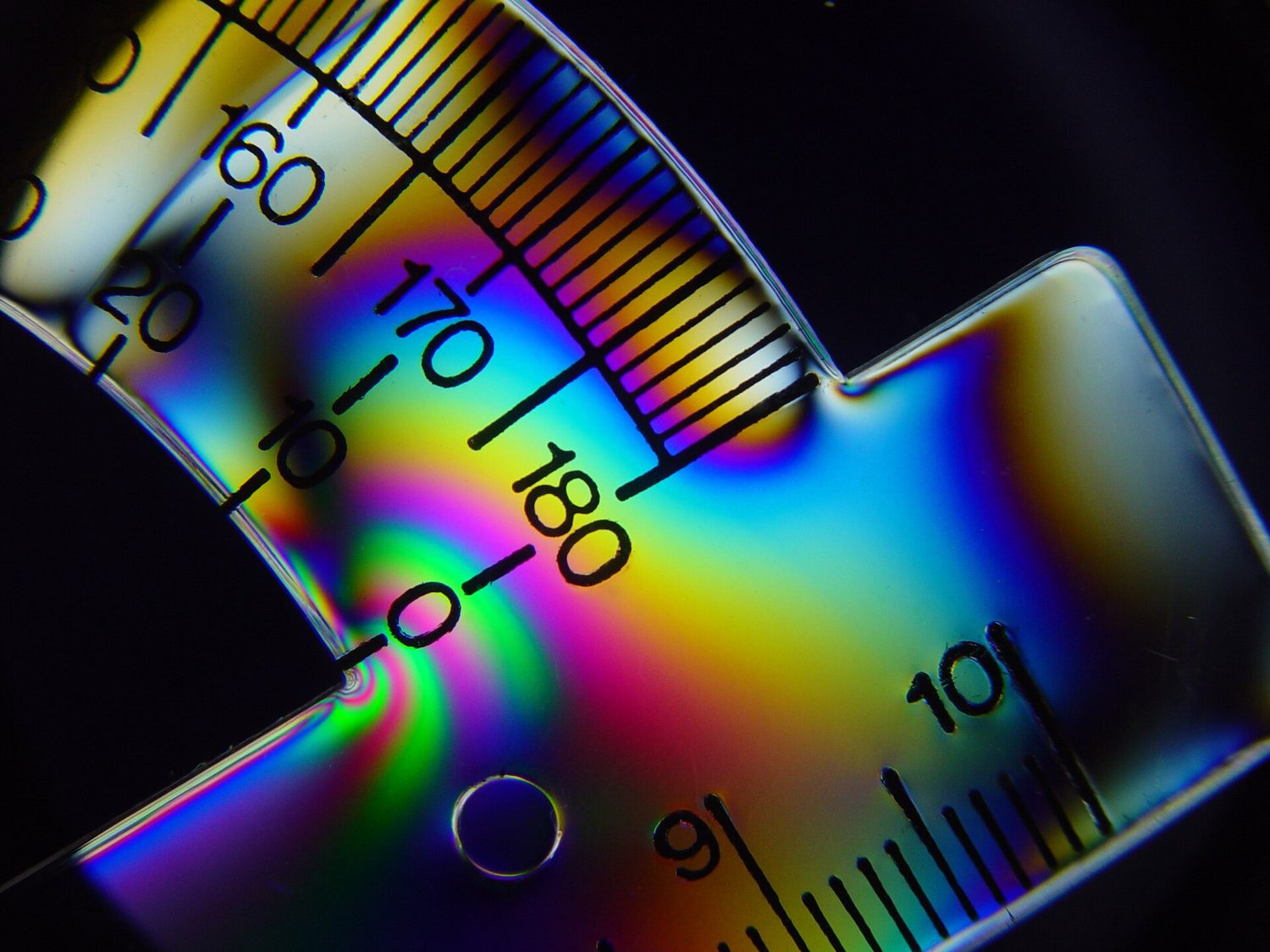 *منقلة بلاستيكية شفافة موضوعة بين فلترين مستقطبين متقاطعين. يصل الضوء إلى عينك فقط لأن البلاستيك المضغوط يدور مستوى استقطابه — الألوان تمثل أين تم ضغط البلاستيك أكثر. مع الضوء العادي سيبدو شفافاً فقط