English
This topic looks more deeply at consumers, costs and firms.
العربية
ينظر هذا الموضوع بعمق أكبر إلى المستهلكين والتكاليف والشركات.
A-Level Economics · A-Level الاقتصاد · Topic 7 · الموضوع 7
 18:50
18:50
نظام الأسعار والاقتصاد الجزئي (مستوى A)
انظر إلى هؤلاء المشترين. لكل منهم ميزانية محدودة، وكل شيء إضافي يشترونه يمنحهم متعة أقل قليلاً مما سبقه. الآن، مصنع فولاذ ضخم: إنه ينتج…
English narration · English + 中文 subtitles burned in · سرد باللغة الإنجليزية · ترجمة مدمجة بالإنجليزية + الصينية
This topic looks more deeply at consumers, costs and firms.
ينظر هذا الموضوع بعمق أكبر إلى المستهلكين والتكاليف والشركات.

Source: Cambridge International syllabus · المصدر: منهج كامبريدج الدولي
utility 效用 is the satisfaction a consumer gets from a good.
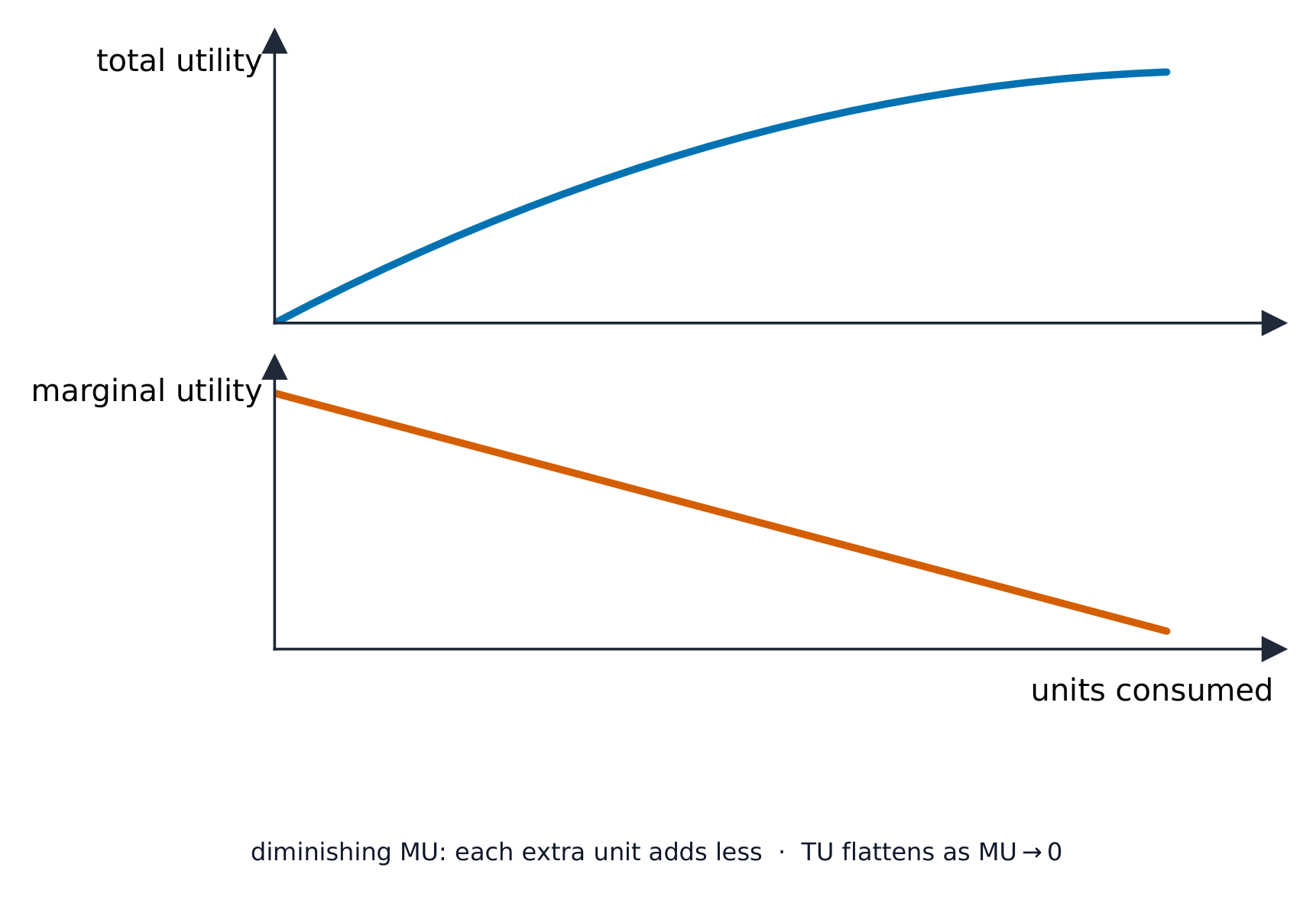
The law of diminishing marginal utility 边际效用递减 says each extra unit gives less extra satisfaction. Total utility still rises, but more and more slowly.
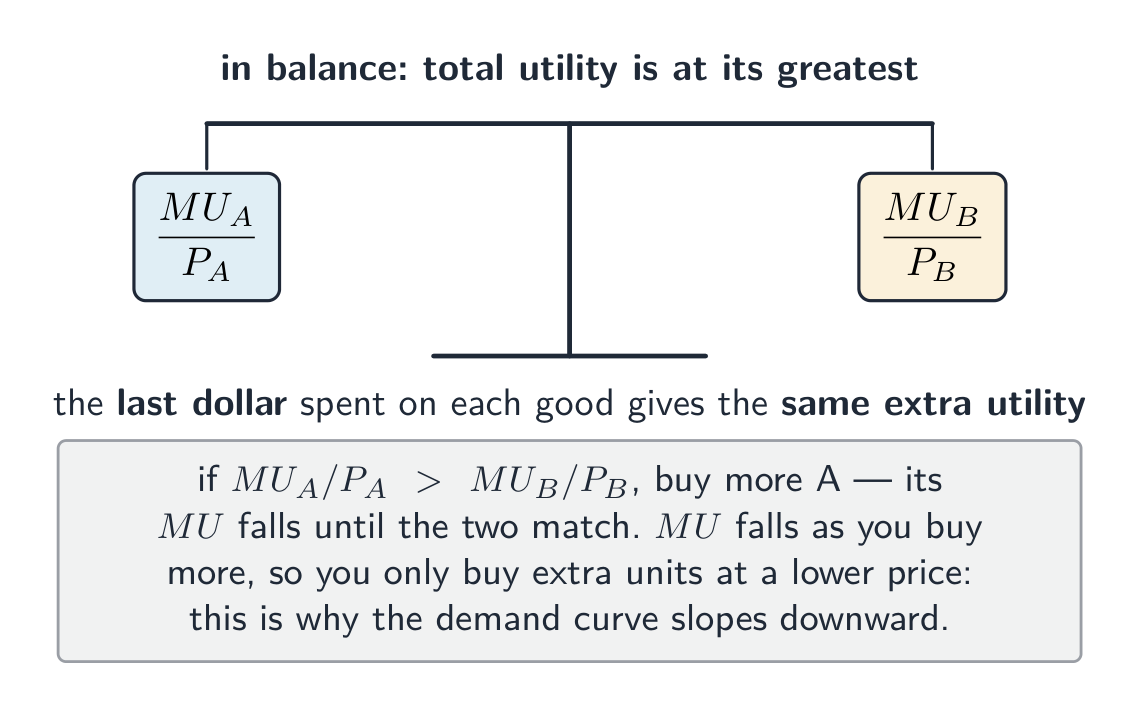
A consumer with a fixed budget gets the most total utility when the last dollar spent on each good gives the same extra utility. This is the equi-marginal principle 等边际原则:
Because marginal utility falls as you buy more, you only buy extra units when the price falls. This is why the demand curve 需求曲线 slopes downward.
The approach is hard to use in practice: utility cannot really be measured in numbers, and people do not calculate like this. It also ignores habit and advertising.
المنفعة هي الرضا الذي يحصل عليه المستهلك من سلعة ما.
تنص قانون تناقص المنفعة الحدية على أن كل وحدة إضافية تعطي رضا إضافياً أقل. لا تزال المنفعة الكلية ترتفع، ولكن بوتيرة متزايدة البطء.
يصل المستهلك الذي يمتلك ميزانية ثابتة إلى أقصى منفعة كلية عندما تكون المنفعة الحدية الأخيرة لكل دولار يُنفق على كل سلعة متساوية. هذا هو مبدأ التساوي الحدي:
بما أن المنفعة الحدية تتناقص مع زيادة الشراء، فإنك لا تشتري وحدات إضافية إلا إذا انخفض السعر. ولهذا السبب منحنى الطلب ينحدر نحو الأسفل.
صعب تطبيق هذه الطريقة عمليًا: لا يمكن قياس المنفعة حقًا بأرقام، والناس لا يحسبون بهذه الطريقة. كما أنها تتجاهل العادات والإعلانات.
total utility rises more slowly as quantity increases · تزداد المنفعة الكلية ببطء أكبر مع زيادة الكمية
Add units consumed and see why extra satisfaction usually falls. · أضف الوحدات المستهلكة وانظر لماذا عادة ما تنخفض الرضا الإضافي.
| English | العربية |
|---|---|
| utility/juːˈtɪlɪti/ | أداة مساعدة |
| total utility/ˈtəʊtl juːˈtɪlɪti/ | إجمالي المنفعة |
| marginal utility/ˈmɑːdʒɪnl juːˈtɪlɪti/ | المنفعة الحدية |
| diminishing marginal utility/dɪˈmɪnɪʃɪŋ ˈmɑːdʒɪnl juːˈtɪlɪti/ | انخفاض المنفعة الحدية |
| equi-marginal principle/ˈekwi ˈmɑːdʒɪnl ˈprɪnsɪpl/ | مبدأ المساواة الحدية |
| demand curve/dɪˈmænd kɜːv/ | منحنى الطلب |
| indifference curve/ɪnˈdɪfrəns kɜːv/ | منحنى اللامبالاة |
| budget line/ˈbʌdʒɪt laɪn/ | خط الميزانية |
| consumer equilibrium/kənˈsuːmə ˌiːkwɪˈlɪbrɪəm/ | توازن المستهلك |
| substitution effect/ˌsʌbstɪˈtjuːʃn ɪˈfekt/ | تأثير الإحلال |
| income effect/ˈɪŋkʌm ɪˈfekt/ | تأثير الدخل |
| normal good/ˈnɔːml ɡʊd/ | سلعة عادية |
| inferior good/ɪnˈfɪərɪə ɡʊd/ | سلعة رديئة |
| Giffen good/ˈdʒɪfən ɡʊd/ | سلعة جيفن |
| productive efficiency/prəˈdʌktɪv ɪˈfɪʃənsi/ | الكفاءة الإنتاجية |
| allocative efficiency/ˈæləkətɪv ɪˈfɪʃənsi/ | الكفاءة التخصيصية |
| Pareto optimality/pæˈriːtəʊ ˌɒptɪˈmælɪti/ | مثالية باريتو |
| dynamic efficiency/daɪˈnæmɪk ɪˈfɪʃənsi/ | الكفاءة الديناميكية |
| market failure/ˈmɑːkɪt ˈfeɪlɪə/ | فشل السوق |
Source: Cambridge International syllabus · المصدر: منهج كامبريدج الدولي
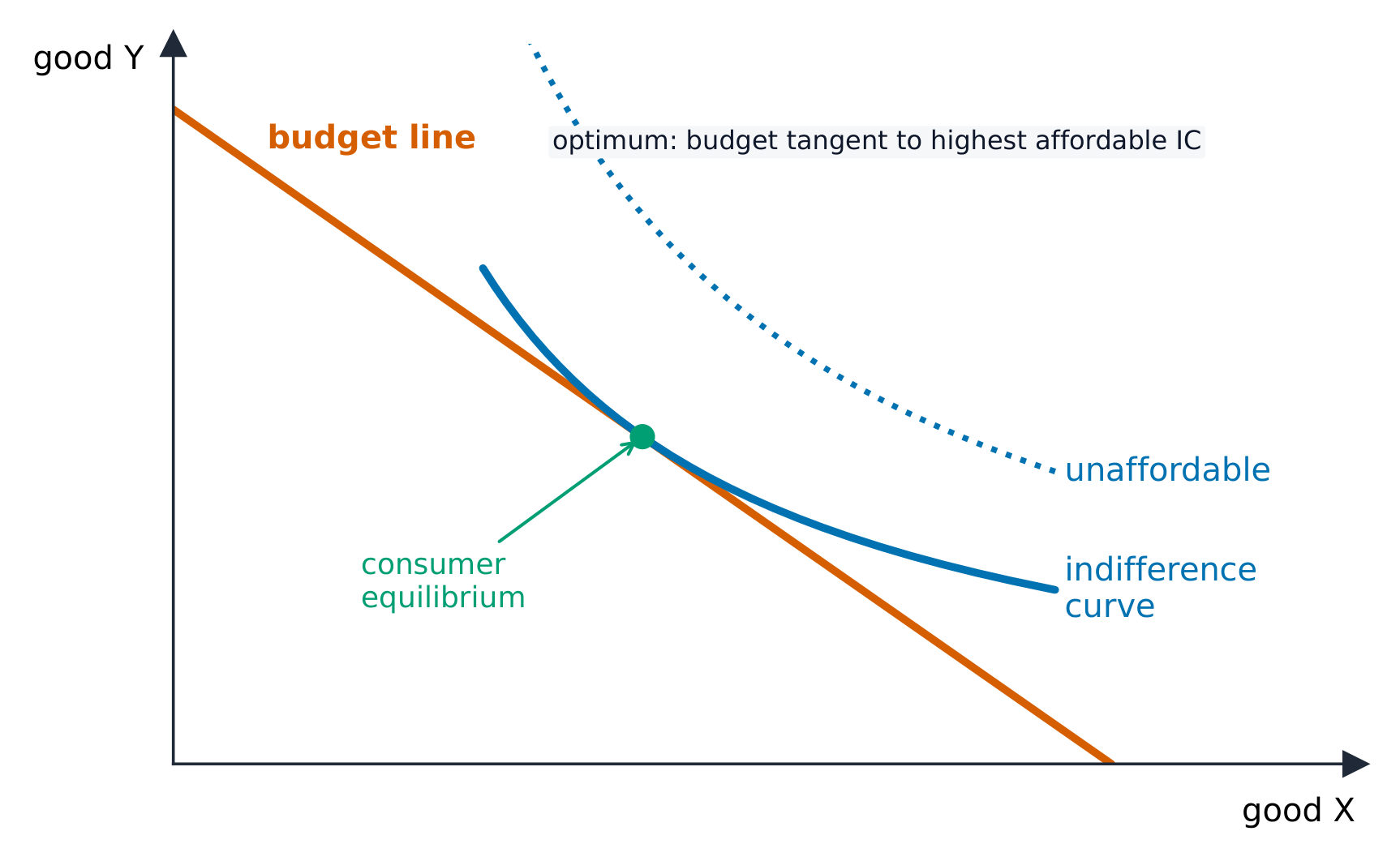
An indifference curve 无差异曲线 shows all the combinations of two goods that give a consumer the same total utility. It slopes downward (more of one good means less of the other) and bows in towards the origin.
A budget line 预算线 shows all the combinations the consumer can just afford with their income, at the current prices.
consumer equilibrium 消费者均衡 is the best the consumer can do: the point where the budget line just touches the highest possible indifference curve.
When the price of a good falls, the consumer buys more for two reasons:
These effects work differently for different goods:
منحنى التعادل يُظهر جميع التوليفات الممكنة لسلعتين تمنح المستهلك نفس المنفعة الكلية. ينحدر هذا المنحنى نحو الأسفل (زيادة السلعة الأولى تعني نقص السلعة الأخرى) وينحني نحو نقطة الأصل.
خط الميزانية يُظهر جميع التوليفات التي يستطيع المستهلك تحملها بالضبط بدخله، عند الأسعار الحالية.
توازن المستهلك هو أفضل ما يمكن للمستهلك تحقيقه: النقطة التي يلمس فيها خط الميزانية أعلى منحنى تعادل ممكن.
عند انخفاض سعر سلعة معينة، يشتري المستهلك المزيد لسببين:
تعمل هذه التأثيرات بشكل مختلف حسب نوع السلعة:
good B = income / priceB - slope x good A
Move quantity of one good and see the trade-off with the other good. · حرك كمية سلعة واحدة وشاهد المقايضة مع السلعة الأخرى.
Source: Cambridge International syllabus · المصدر: منهج كامبريدج الدولي
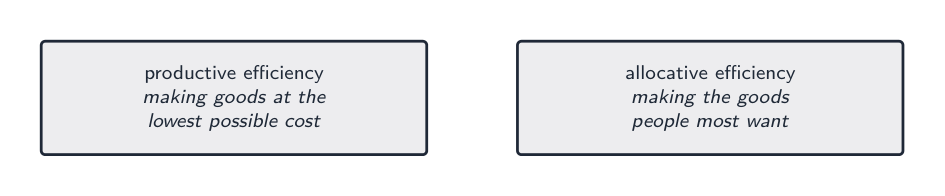
Economists judge how well resources are used.
market failure 市场失灵 happens when the free market does not reach an efficient result. The main causes are monopoly power, externalities 外部性, public goods 公共物品, information failure 信息失灵, and factor immobility 要素不流动性 (factors cannot move quickly to where they are needed).
يحكم الاقتصاديون على مدى كفاءة استخدام الموارد.
فشل السوق يحدث عندما لا يحقق السوق الحر نتيجة كفءة. الأسباب الرئيسية هي قوة الاحتكار، الآثار الخارجية، السلع العامة، فشل المعلومات، وعدم حركة عوامل الإنتاج (لا تستطيع العوامل التحرك بسرعة إلى الأماكن التي تحتاجها).
The market is allocatively efficient where supply meets demand — price equals marginal cost. Market failure pushes it away from that point. · يكون السوق كفاءً تخصيصياً حيث يلتقي العرض بالطلب — السعر يساوي التكلفة الحدية. يدفع فشل السوق عنه.

Source: Cambridge International syllabus · المصدر: منهج كامبريدج الدولي
Some costs and benefits fall on people outside the deal. We separate three levels:
We study externalities with marginal analysis 边际分析, using these curves:
The best outcome for society is where MSC = MSB. But the market produces where MPC = MPB. The gap between these creates lost welfare.
The lost welfare from making too much or too little is the deadweight welfare loss 无谓损失 — the triangle on the diagram between the social and private curves.
بعض التكاليف والمنافع تقع على أشخاص خارج الصفقة. نفصل ثلاثة مستويات:
ندرس الآثار الخارجية باستخدام التحليل الحدي، عبر هذه المنحنيات:
النتيجة المثلى للمجتمع تكون عندما MSC = MSB. لكن السوق ينتج حيث MPC = MPB. الفجوة بين هذين المستويين تُحدث خسارة في الرفاهية.
خسارة الرفاهية الناتجة عن الإنتاج الكبير أو الصغير جدًا تُسمى خسارة الرفاهية الزائدة — وهي المثلث الموجود في الرسم البياني بين المنحنيات الاجتماعية والخاصة.
A negative externality means the social cost is above the private supply curve; the free-market quantity is then too high. · الآثار السلبية تعني أن التكلفة الاجتماعية فوق منحنى العرض الخاص؛ فتكون الكمية في السوق الحر مرتفعة جداً.
| English | العربية |
|---|---|
| externality/ekˈstɜːnælɪti/ | التأثير الخارجي |
| public good/ˈpʌblɪk ɡʊd/ | سلعة عامة |
| information failure/ˌɪnfəˈmeɪʃn ˈfeɪlɪə/ | فشل المعلومات |
| factor immobility/ˈfæktə ɪˌməʊˈbɪlɪti/ | عدم حركة العوامل |
| private cost/ˈpraɪvət kɒst/ | التكلفة الخاصة |
| private benefit/ˈpraɪvət ˈbenɪfɪt/ | الفائدة الخاصة |
| external cost/ekˈstɜːnl kɒst/ | التكلفة الخارجية |
| external benefit/ekˈstɜːnl ˈbenɪfɪt/ | الفائدة الخارجية |
| social cost/ˈsəʊʃl kɒst/ | التكلفة الاجتماعية |
| social benefit/ˈsəʊʃl ˈbenɪfɪt/ | الفائدة الاجتماعية |
| marginal analysis/ˈmɑːdʒɪnl əˈnæləsɪs/ | التحليل الهامشي |
| marginal private cost/ˈmɑːdʒɪnl ˈpraɪvət kɒst/ | التكلفة الخاصة الحدية |
| marginal social cost/ˈmɑːdʒɪnl ˈsəʊʃl kɒst/ | التكلفة الاجتماعية الحدية |
| marginal private benefit/ˈmɑːdʒɪnl ˈpraɪvət ˈbenɪfɪt/ | الفائدة الخاصة الحدية |
| marginal social benefit/ˈmɑːdʒɪnl ˈsəʊʃl ˈbenɪfɪt/ | الفائدة الاجتماعية الحدية |
| negative externality/ˈneɡətɪv ekˈstɜːnælɪti/ | الأثر الخارجي السلبي |
| positive externality/ˈpɒzɪtɪv ekˈstɜːnælɪti/ | الأثر الخارجي الإيجابي |
| deadweight welfare loss/ˈdedweɪt ˈwelfeə lɒs/ | خسارة الرفاهية العاجزة |
| short run/ʃɔːt rʌn/ | قصير الأجل |
| long run/lɒŋ rʌn/ | طويل الأجل |
| fixed cost/fɪkst kɒst/ | التكلفة الثابتة |
| variable cost/ˈveərɪəbl kɒst/ | التكلفة المتغيرة |
| total cost/ˈtəʊtl kɒst/ | إجمالي التكلفة |

Source: Cambridge International syllabus · المصدر: منهج كامبريدج الدولي
In the short run 短期, at least one factor is fixed; in the long run 长期, all factors can change.
| Cost | Meaning |
|---|---|
| fixed cost 固定成本 | does not change with output (rent on a factory) |
| variable cost 可变成本 | changes with output (raw materials) |
| total cost 总成本 | fixed cost plus variable cost |
| average cost 平均成本 | total cost per unit: $AC = TC / Q$ |
| marginal cost 边际成本 | the cost of one more unit: $MC = \Delta TC / \Delta Q$ |
Worked example. Making $10$ units costs £500 in total; making $11$ units costs £540. Find the average cost at $10$ units and the marginal cost of the 11th unit.
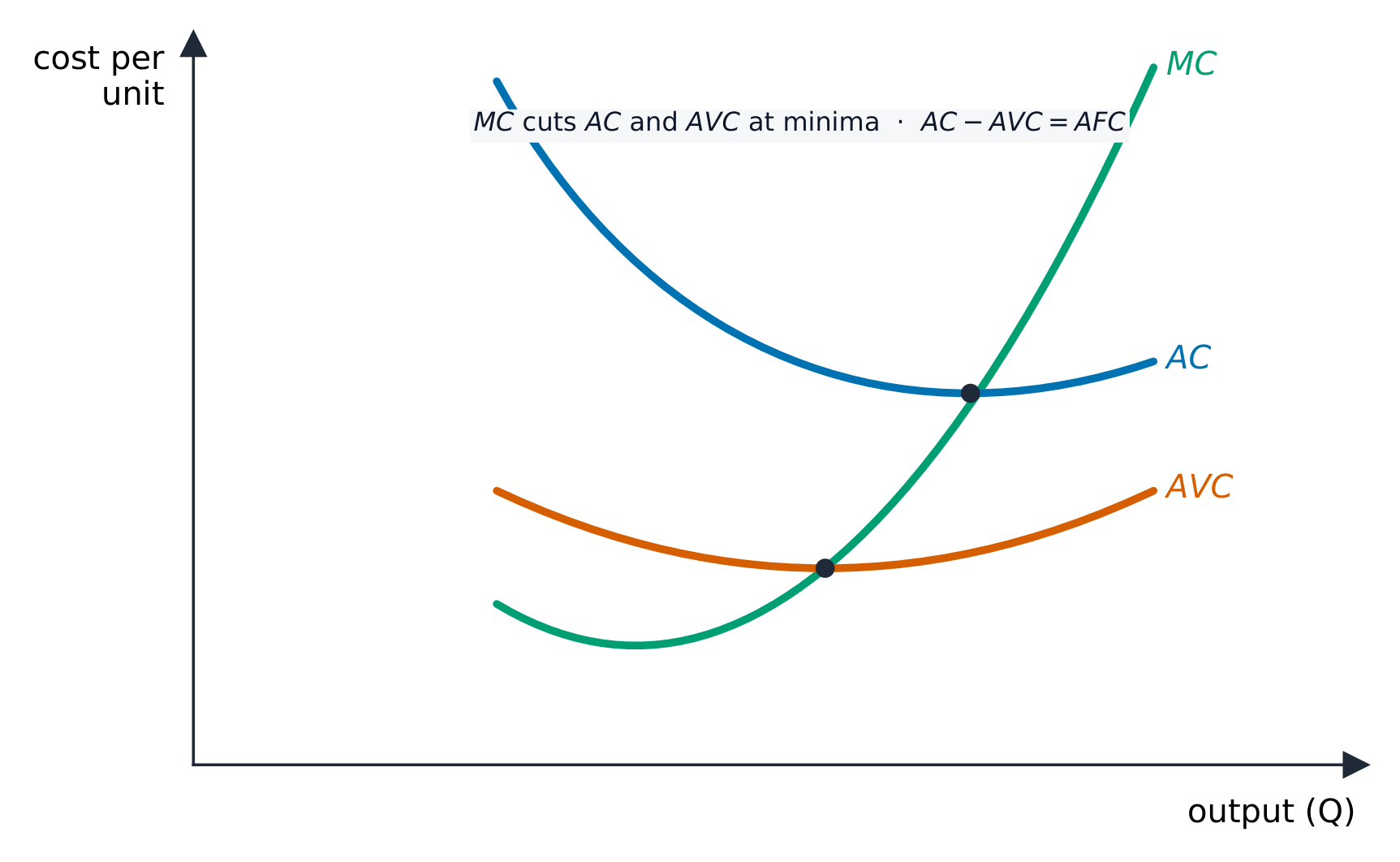
Here $MC$ ($\text{\pounds} 40$) is below $AC$ ($\text{\pounds} 50$), so making the 11th unit pulls the average cost down — whenever marginal cost is below average cost, average cost falls.
In the short run, output is limited by the law of diminishing returns 边际报酬递减: as you add more of a variable factor (workers) to a fixed factor (machines), each extra worker eventually adds less output. This makes marginal cost rise.
In the long run, all factors vary, so we look at returns to scale 规模报酬. As a firm grows, it can gain economies of scale 规模经济 (lower average cost from buying in bulk, using big machines, and specialising). If it grows too big, it may suffer diseconomies of scale 规模不经济 (poor communication and control), and average cost rises.
| Revenue | Meaning |
|---|---|
| total revenue 总收益 | all money from sales: $TR = P \times Q$ |
| average revenue 平均收益 | revenue per unit, which equals the price |
| marginal revenue 边际收益 | the revenue from one more unit: $MR = \Delta TR / \Delta Q$ |
Worked example. A firm sells $10$ units at £50 each. To sell an 11th unit it must lower the price to £48 on every unit. Find the total revenue at each output and the marginal revenue of the 11th unit.
The marginal revenue ($\text{\pounds} 28$) is well below the £48 price, because the lower price applies to all $11$ units, not just the extra one.
Profit is total revenue minus total cost. Economists include the opportunity cost of the owner's resources in cost, so:
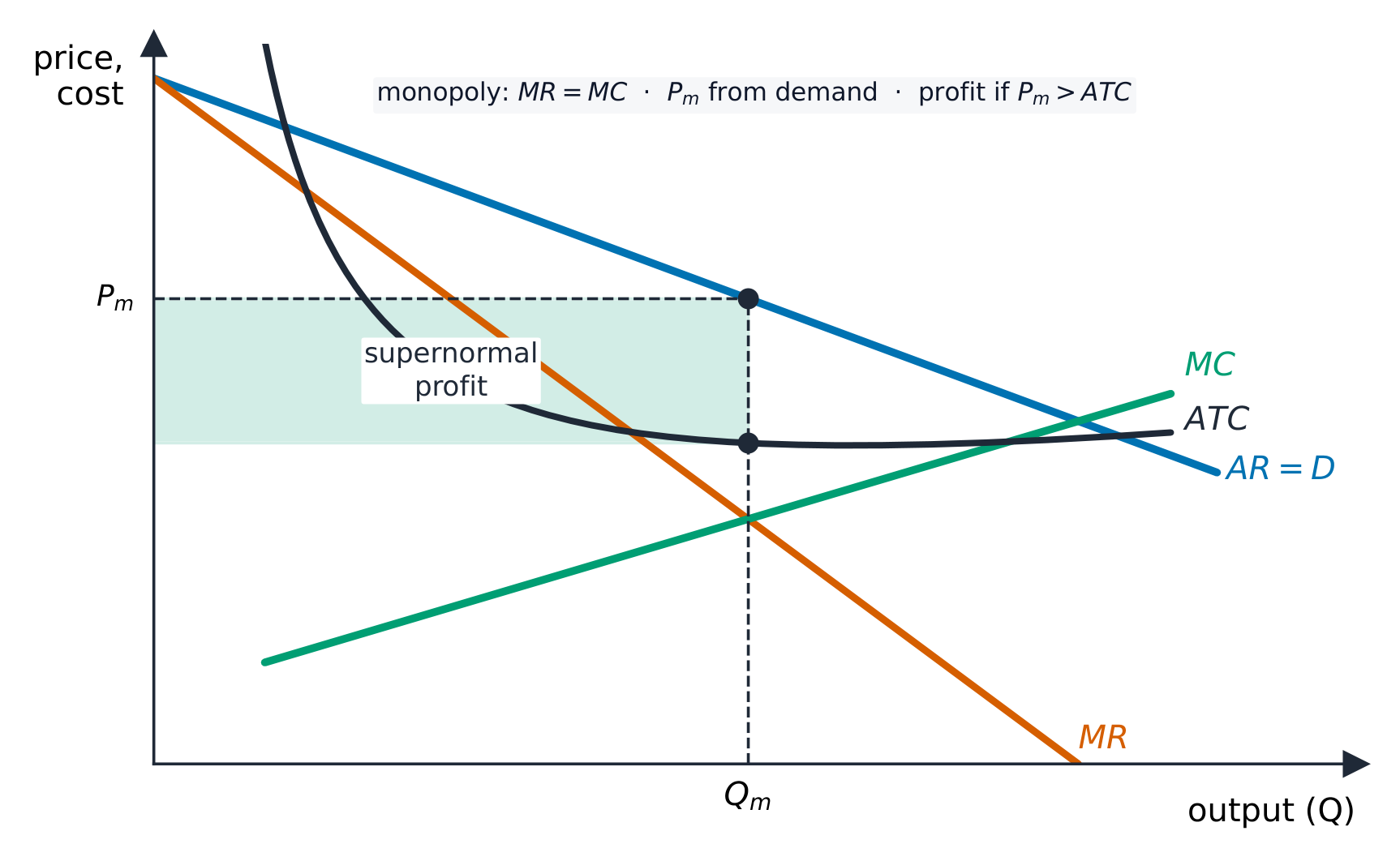
A firm makes the most profit at the output where $MR = MC$.
Worked example. At its best output a firm makes $100$ units, sells each for £12 (its average revenue), and has an average cost of £9. Find the supernormal profit.
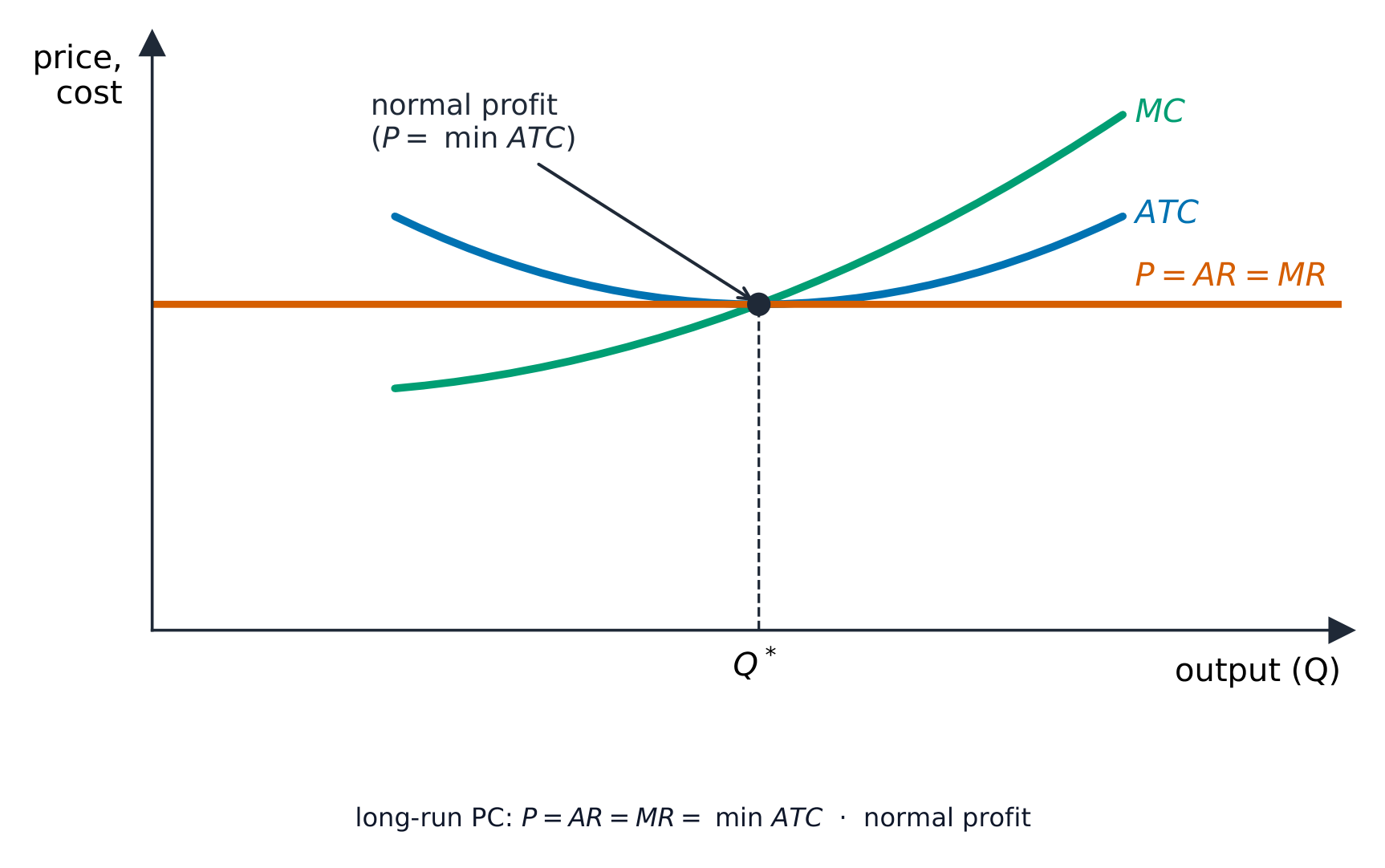
Because average revenue (£12) is above average cost (£9), the firm earns supernormal profit. If instead $AR = AC$, it would make only normal profit; if $AR < AC$, it would make a loss.
في المدى القصير، يكون عامل واحد على الأقل ثابتًا؛ أما في المدى الطويل، فتتغير جميع العوامل.
| التكلفة | المعنى |
|---|---|
| تكلفة ثابتة | لا تتغير مع الإنتاج (إيجار المصنع) |
| تكلفة متغيرة | تتغير مع الإنتاج (المواد الخام) |
| التكلفة الكلية | التكلفة الثابتة زائد التكلفة المتغيرة |
| متوسط التكلفة | التكلفة الكلية لكل وحدة: $AC = TC / Q$ |
| التكلفة الحدية | تكلفة وحدة إضافية واحدة: $MC = \Delta TC / \Delta Q$ |
مثال محلول. إنتاج $10$ وحدة costing £500 إجمالاً؛ إنتاج $11$ وحدة costing £540. أوجد متوسط التكلفة عند $10$ وحدة والتكلفة الحدية للوحدة 11.
هنا $MC$ ($\text{\pounds} 40$) أقل من $AC$ ($\text{\pounds} 50$)، لذا فإن إنتاج الوحدة الـ 11 يسحب بتكلفة Average cost للأسفل — whenever marginal cost is below average cost, average cost falls.
في المدى القصير، يكون الإنتاج محدوداً بقانون العود المتناقص: مع إضافة المزيد من عامل متغير (عمال) إلى عامل ثابت (آلات)، يضيف كل عامل إضافي في النهاية إنتاجاً أقل. هذا يؤدي إلى ارتفاع التكلفة الحدية.
في المدى الطويل، تتغير جميع العوامل، لذا ننظر إلى عوائد الحجم. مع نمو الشركة، يمكنها تحقيق مزايا الحجم (انخفاض متوسط التكلفة من الشراء بالجملة، استخدام آلات كبيرة، والتخصص). إذا نمت بشكل كبير جداً، قد تعاني من متاعب الحجم (سوء التواصل والسيطرة)، ويرتفع متوسط التكلفة.

| الإيراد | المعنى |
|---|---|
| الإيراد الكلي | جميع الأموال الناتجة عن المبيعات: $TR = P \times Q$ |
| الإيراد المتوسط | الإيراد لكل وحدة، وهو يساوي السعر |
| الإيراد الحدي | الإيراد الناتج عن وحدة إضافية واحدة: $MR = \Delta TR / \Delta Q$ |
مثال محلول. تبيع شركة $10$ وحدة بسعر £50 لكل منها. لبيع الوحدة الـ 11، يجب خفض السعر إلى £48 على جميع الوحدات. أوجد إجمالي الإيرادات عند كل مستوى إنتاج وإجمالي الإيرادات الحدية للوحدة الـ 11.
الإيراد الحدي ($\text{\pounds} 28$) أقل بكثير من سعر £48، لأن السعر المنخفض يطبق على جميع $11$ وحدات، وليس فقط الوحدة الإضافية.
الربح هو الإيراد الكلي مطروحاً منه التكلفة الكلية. يشمل الاقتصاديون تكلفة الفرصة البديلة لموارد المالك في التكلفة، لذا:
تحقق الشركة أقصى ربح عند المستوى الذي يكون عنده $MR = MC$.
مثال محلول. عند أفضل مستوى إنتاج لها، تنتج شركة $100$ وحدة، وتبيع كل منها بـ £12 (وهو إيرادها المتوسط)، ولديها متوسط تكلفة قدره £9. أوجد الربح غير العادي.
بما أن الإيراد المتوسط (£12) أعلى من متوسط التكلفة (£9)، فتكسب الشركة ربحاً غير عادي. أما لو كان $AR = AC$، فستحقق ربحاً عادياً فقط؛ وإذا كان $AR < AC$، فستتحمل خسارة.
y = ax² + bx + c
Total revenue rises then falls as price changes. · تزداد الإيرادات الكلية ثم تنخفض مع تغير السعر.
Average cost is U-shaped; marginal cost cuts it at the minimum. Different market structures price relative to these curves. · التكلفة المتوسطة على شكل حرف U؛ تقطعها التكلفة الحدية عند أدنى نقطة. تحدد الهياكل السوقية الأسعار بالنسبة لمنحنيات التكلفة هذه.
Change output. Marginal cost cuts average cost at its lowest point — the heart of the theory of the firm. · غيّر الإنتاج. التكلفة الحدية تتقاطع مع متوسط التكلفة عند أدنى نقطة لها — وهو جوهر نظرية الشركة.
| English | العربية |
|---|---|
| average cost/ˈævrɪdʒ kɒst/ | التكلفة المتوسطة |
| marginal cost/ˈmɑːdʒɪnl kɒst/ | التكلفة الحدية |
| diminishing returns/dɪˈmɪnɪʃɪŋ rɪˈtɜːnz/ | المتغيرات الناقصة |
| returns to scale/rɪˈtɜːnz tə skeɪl/ | عوائد الحجم |
| economies of scale/ɪˈkɒnəmiz ɒv skeɪl/ | اقتصاديات الحجم |
| diseconomies of scale/ˌdɪsɪˈkɒnəmiz ɒv skeɪl/ | عدم اقتصاديات الحجم |
| total revenue/ˈtəʊtl ˈrevənjuː/ | إجمالي الإيرادات |
| average revenue/ˈævrɪdʒ ˈrevənjuː/ | الإيراد المتوسط |
| marginal revenue/ˈmɑːdʒɪnl ˈrevənjuː/ | الإيراد الحدي |
| normal profit/ˈnɔːml ˈprɒfɪt/ | ربحًا طبيعيًا |
| supernormal profit/ˈsuːpənɔːml ˈprɒfɪt/ | ربح استثنائي |
| subnormal profit/ˈsʌbnɔːml ˈprɒfɪt/ | ربح دون العادي |

Source: Cambridge International syllabus · المصدر: منهج كامبريدج الدولي
A market structure 市场结构 describes a market by the number of firms, the barriers to entry, and the type of product.
| Structure | Firms | Barriers | Product | Long-run profit |
|---|---|---|---|---|
| perfect competition 完全竞争 | very many | none | identical | normal only |
| monopolistic competition 垄断竞争 | many | low | slightly different | normal |
| oligopoly 寡头垄断 | a few | high | varies | often supernormal |
| monopoly 垄断 | one | very high | unique | supernormal |
price discrimination 价格歧视 is charging different consumers different prices for the same good (for example, cheaper train tickets for students). It needs price-setting power, groups with different elasticities, and a way to stop resale between groups. It raises the firm's profit.
هيكل السوق يصف السوق بعدد الشركات، وحواجز الدخول، ونوع المنتج.
| الهيكل | الشركات | حواجز الدخول | المنتج | الربح في المدى الطويل |
|---|---|---|---|---|
| المنافسة الكاملة | عدد كبير جداً | لا يوجد | متطابق | عادي فقط |
| المنافسة الاحتكارية | عدد كبير | منخفضة | مختلفة قليلاً | عادي |
| الاحتكار الثنائي/العشوائي | عدد قليل | عالية | متنوع | غالباً غير عادي |
| الاحتكار | واحدة | عالية جداً | فريد | غير عادي |
التمييز السعري هو فرض أسعار مختلفة للمستهلكين المختلفين على نفس السلعة (على سبيل المثال، تذاكر قطار أرخص للطلاب). يتطلب ذلك سلطة في تحديد الأسعار، ومجموعات ذات مرونة مختلفة، وطريقة لمنع إعادة البيع بين المجموعات. وهو يزيد من ربح الشركة.
How a firm prices depends on demand and supply; with market power it can charge above the competitive level. · يعتمد تسعير الشركة على العرض والطلب؛ ومع امتلاكها قوة سوقية يمكنها فرض أسعار أعلى من المستوى التنافسي.
| English | العربية |
|---|---|
| market structure/ˈmɑːkɪt ˈstrʌktʃə/ | هيكل السوق |
| perfect competition/ˈpɜːfekt ˌkɒmpəˈtɪʃn/ | منافسة مثالية |
| monopolistic competition/məˈnɒpəlɪstɪk ˌkɒmpəˈtɪʃn/ | منافسة احتكارية |
| oligopoly/ˌɒlɪˈɡɒpəli/ | احتكار ثنائي |
| monopoly/məˈnɒpəli/ | احتكار |
| price taker/praɪs ˈteɪkə/ | قاصر السعر |
| product differentiation/ˈprɒdʌkt ˌdɪfəˌrenʃɪˈeɪʃn/ | تمايز المنتج |
| collusion/kəˈluːʒn/ | التواطؤ |
| cartel/kɑːˈtel/ | كتلة احتكارية |
| barriers to entry/ˈbærɪəz tʊ ˈentri/ | حواجز الدخول |
| price competition/praɪs ˌkɒmpəˈtɪʃn/ | منافسة الأسعار |
| non-price competition/nɒn praɪs ˌkɒmpəˈtɪʃn/ | المنافسة غير السعرية |
| price discrimination/praɪs dɪˌskrɪmɪˈneɪʃn/ | التمييز السعري |
| internal growth/ɪnˈtɜːnl ɡrəʊθ/ | النمو الداخلي |
| external growth/ekˈstɜːnl ɡrəʊθ/ | النمو الخارجي |
| merger/ˈmɜːdʒə/ | اندماج |
| horizontal integration/ˌhɒrɪˈzɒntl ˌɪntɪˈɡreɪʃn/ | اندماج أفقي |
| vertical integration/ˈvɜːtɪkl ˌɪntɪˈɡreɪʃn/ | اندماج عمودي |
| conglomerate integration/kənˈɡlɒməreɪt ˌɪntɪˈɡreɪʃn/ | اندماج مختلط |
| niche/niːʃ/ | المكان البيئي |
| barriers to exit/ˈbærɪəz tʊ ˈeɡzɪt/ | حواجز الخروج |
| profit maximisation/ˈprɒfɪt ˌmæksɪmaɪˈzeɪʃn/ | تعظيم الربح |
| revenue maximisation/ˈrevənjuː ˌmæksɪmaɪˈzeɪʃn/ | تعظيم الإيرادات |
| sales maximisation/seɪlz ˌmæksɪmaɪˈzeɪʃn/ | تعظيم المبيعات |
| satisficing/ˈsætɪsfɪsɪŋ/ | الرضا |
| divorce of ownership from control/dɪˈvɔːs ɒv ˈəʊnəʃɪp frɒm kənˈtrəʊl/ | فصل الملكية عن السيطرة |
| principal-agent problem/ˈprɪnsɪpl ˈeɪdʒənt ˈprɒbləm/ | مشكلة الوكيل والمالك |
Source: Cambridge International syllabus · المصدر: منهج كامبريدج الدولي
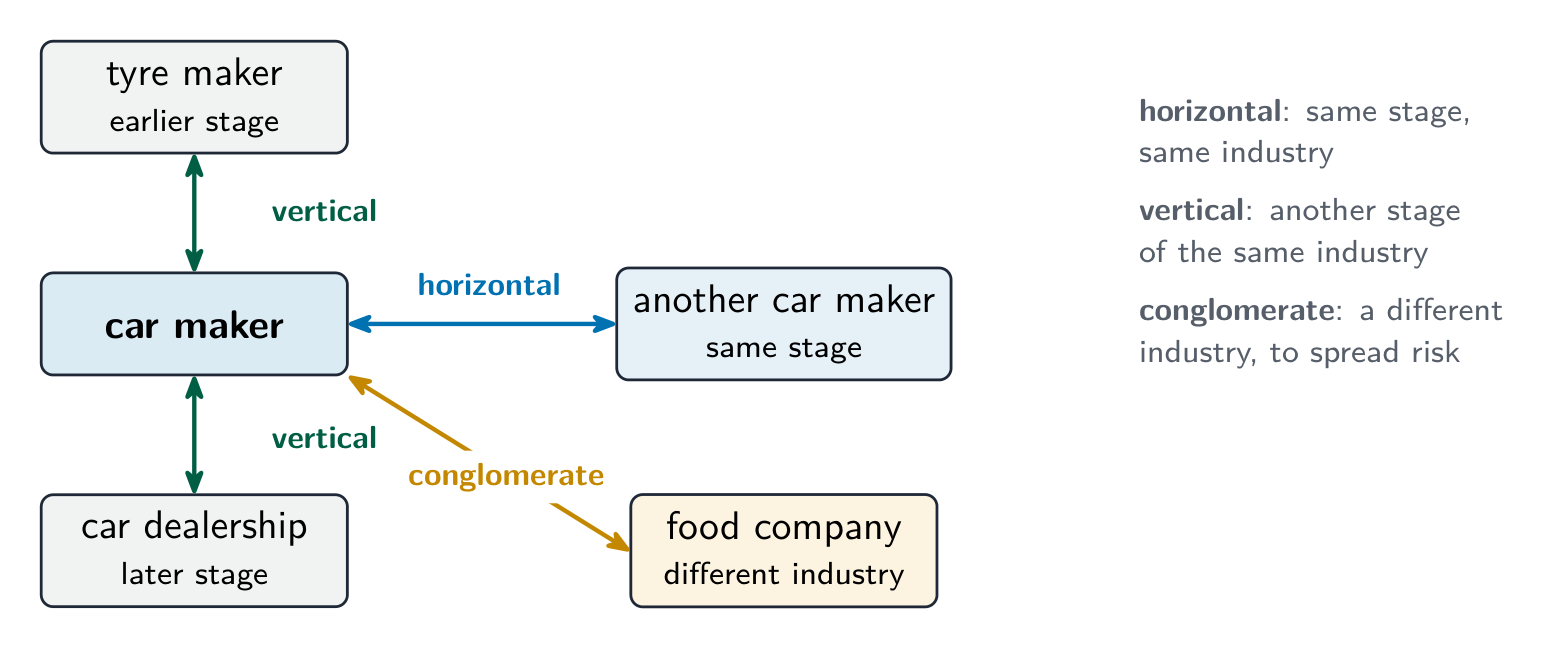
Firms grow in two ways:
Many firms stay small because the market is small (local services), the owner wants to keep control, or there are few economies of scale. They survive by offering personal service or filling a niche 利基市场.
Firms also face barriers to entry and barriers to exit 退出壁垒 (such as costly machines that cannot be sold). High exit barriers can trap a firm in a loss-making market.
تنمو الشركات بطريقتين:
تبقى العديد من الشركات صغيرة لأن السوق صغير (الخدمات المحلية)، أو يود المالك الحفاظ على السيطرة، أو بسبب قلة اقتصاديات الحجم. وتنجو عن طريق تقديم خدمة شخصية أو شغل ثغرة في السوق.
تواجه الشركات أيضًا حواجز الدخول وحواجز الخروج (مثل الآلات باهظة الثمن التي لا يمكن بيعها). ويمكن أن تحبس حواجز الخروج المرتفعة الشركة في سوق خاسر.
Classify real firm decisions by the objective they reveal. · صنف قرارات الشركات الحقيقية بناءً على الهدف الذي تكشف عنه.
Source: Cambridge International syllabus · المصدر: منهج كامبريدج الدولي
Not every firm simply chases the most profit.
In large companies the owners (shareholders) are not the managers. This divorce of ownership from control 所有权与控制权分离 creates the principal-agent problem 委托代理问题: managers (the agents) may pursue their own aims — bigger salaries or an easier life — instead of the owners' aim of maximum profit.
ليس كل شركة تطارد الربح الأعلى فقط.
في الشركات الكبيرة، ليس الملاك (المساهمون) هم المدراء. يخلق هذا انفصال الملكية عن السيطرة مشكلة الوكيل: قد يسعى المدراء (الوكلاء) لتحقيق أهدافهم الخاصة — مثل زيادة الرواتب أو العيش بسهولة — بدلاً من هدف الملاك المتمثل في تعظيم الربح.
Classify real firm decisions by the objective they reveal. · صنف قرارات الشركات الحقيقية بناءً على الهدف الذي تكشف عنه.
Work through it step by step, with instant-check exercises. · ا-working عليه خطوة بخطوة، مع تمارين تحقق فوري.
Past Papers · أوراق الامتحانات السابقة
Loading subjects… · جار تحميل المواضيع…