الماس ينصهر عند three thousand five hundred and fifty درجة مئوية. اليود ينصهر عند one hundred and fourteen. كلاهما مصنوع فقط من ذرات اللافلزات، وفي…
English narration · English + 中文 subtitles burned in · سرد باللغة الإنجليزية · ترجمة مدمجة بالإنجليزية + الصينية
4.1
The gaseous state · الحالة الغازية
Syllabus · المنهج
English
explain the origin of pressure in a gas in terms of collisions between gas molecules and the wall of the container
understand that ideal gases have zero particle volume and no intermolecular forces of attraction
state and use the ideal gas equation$pV = nRT$ in calculations, including in the determination of $M_r$
العربية
شرح أصل الضغط في الغاز من خلال التصادمات بين جزيئات الغاز وجدار الوعاء
فهم أن الغازات المثالية حجم جسيماتها يساوي صفراً ولا توجد لها قوى بين جزيئية تجاذب
نص واستخدام معادلة الغاز المثالي$pV = nRT$ في الحسابات، بما في ذلك تحديد $M_r$
Source: Cambridge International syllabus · المصدر: منهج كامبريدج الدولي
English
Where gas pressure comes from
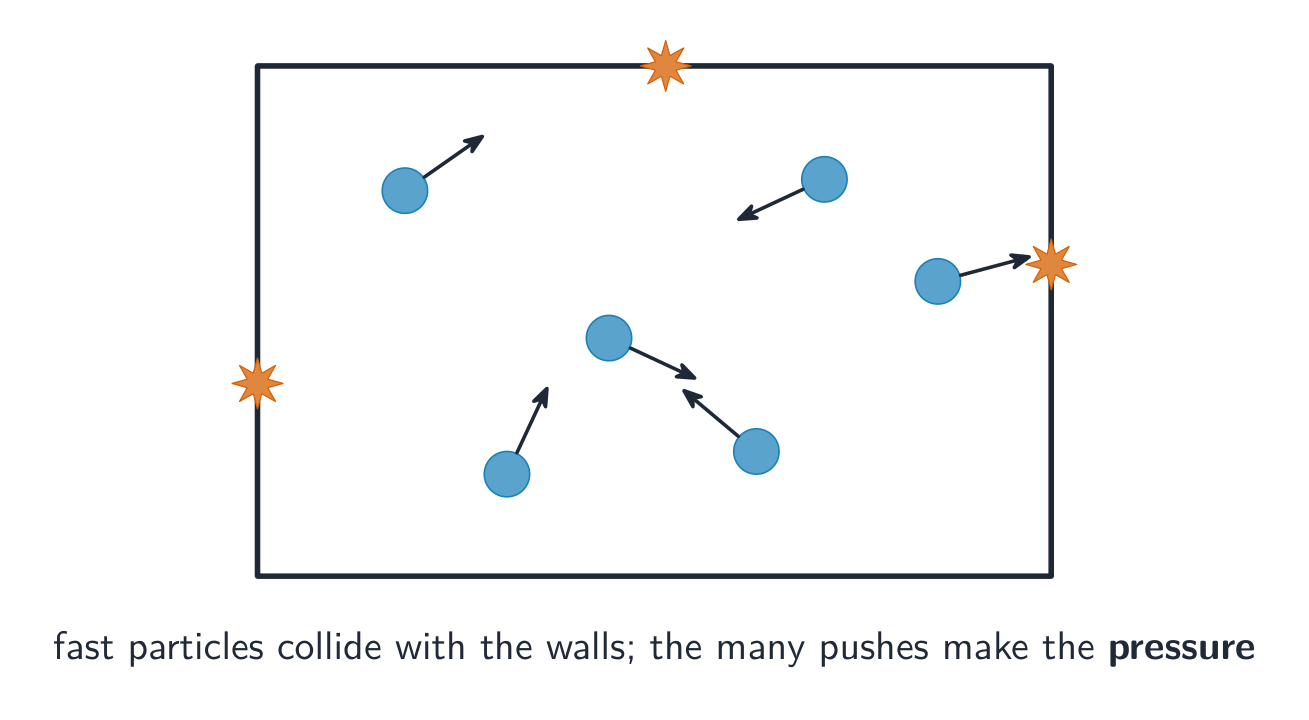
Gas molecules move fast in all directions. They keep hitting — colliding 碰撞 with — the walls of their container. Each hit gives the wall a tiny push. The pressure 压强 of the gas is the overall result of these many collisions on the walls.
Ideal gases
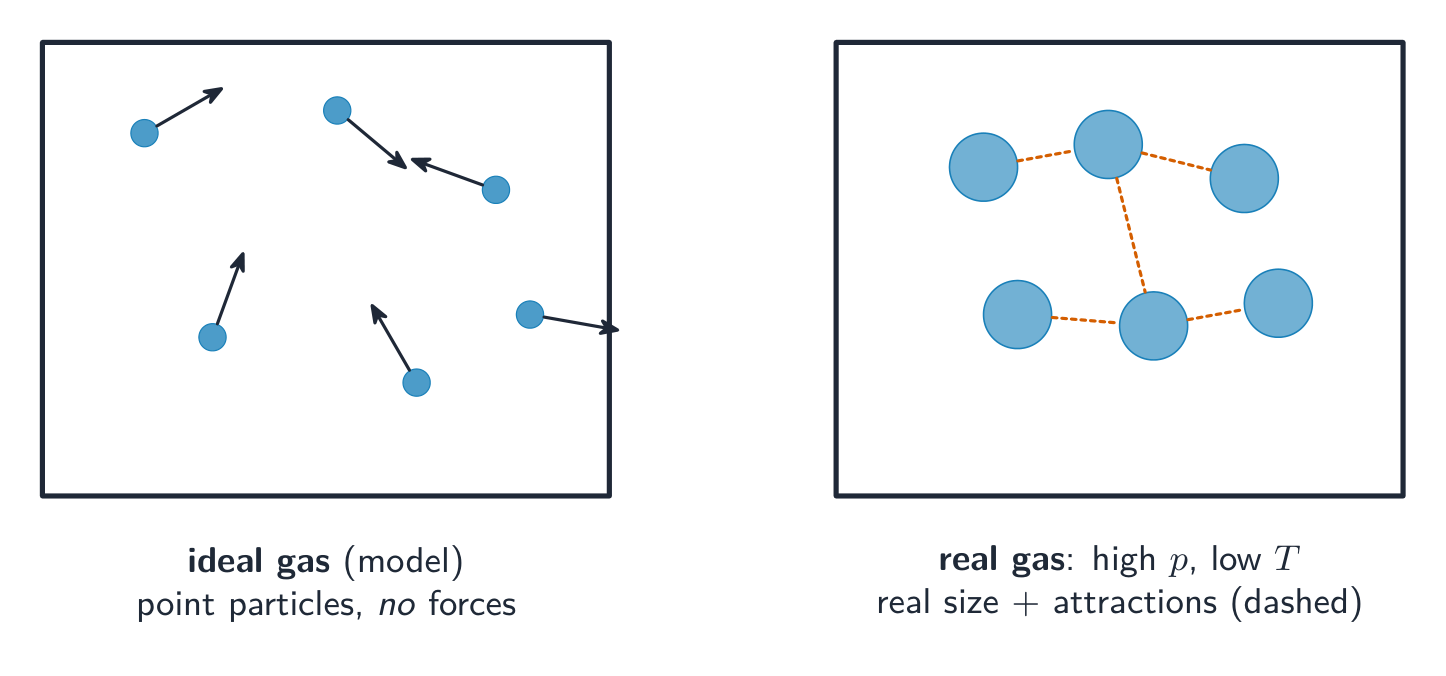
An ideal gas 理想气体 is a simple model. We assume two things:
the particles themselves take up zero volume.
there are no intermolecular forces 分子间作用力 of attraction between the particles.
A real gas 实际气体 follows this model closely at low pressure and high temperature. It behaves least like an ideal gas at high pressure and low temperature, when the particles are squeezed close together and the forces between them start to matter.
The ideal gas equation
The ideal gas equation 理想气体方程 links pressure, volume, amount and temperature:
$$pV = nRT$$
where $p$ is the pressure in Pa, $V$ is the volume in $\text{m}^3$, $n$ is the amount in moles, $T$ is the temperature in kelvin 开尔文 (K), and $R$ is the gas constant 气体常量 ($8.31\ \text{J K}^{-1}\,\text{mol}^{-1}$).
Always change the units first: °C to K (add 273), and $\text{cm}^3$ or $\text{dm}^3$ to $\text{m}^3$.
Worked example. Find the volume of $0.50\ \text{mol}$ of an ideal gas at $27\ ^{\circ}\text{C}$ and $100\ \text{kPa}$. ($R = 8.31\ \text{J K}^{-1}\,\text{mol}^{-1}$.)
You can also use the equation to find a molar mass 摩尔质量. Since $n = m/M$:
$$pV = \frac{m}{M}RT \qquad\Rightarrow\qquad M = \frac{mRT}{pV}$$
This lets you work out $M_r$ from the mass (or the density) of a gas.
Worked example. A flask holds $0.96\ \text{g}$ of a gas in $600\ \text{cm}^3$ at $100\ \text{kPa}$ and $27\ ^{\circ}\text{C}$. Find the molar mass of the gas. ($R = 8.31\ \text{J K}^{-1}\,\text{mol}^{-1}$.)
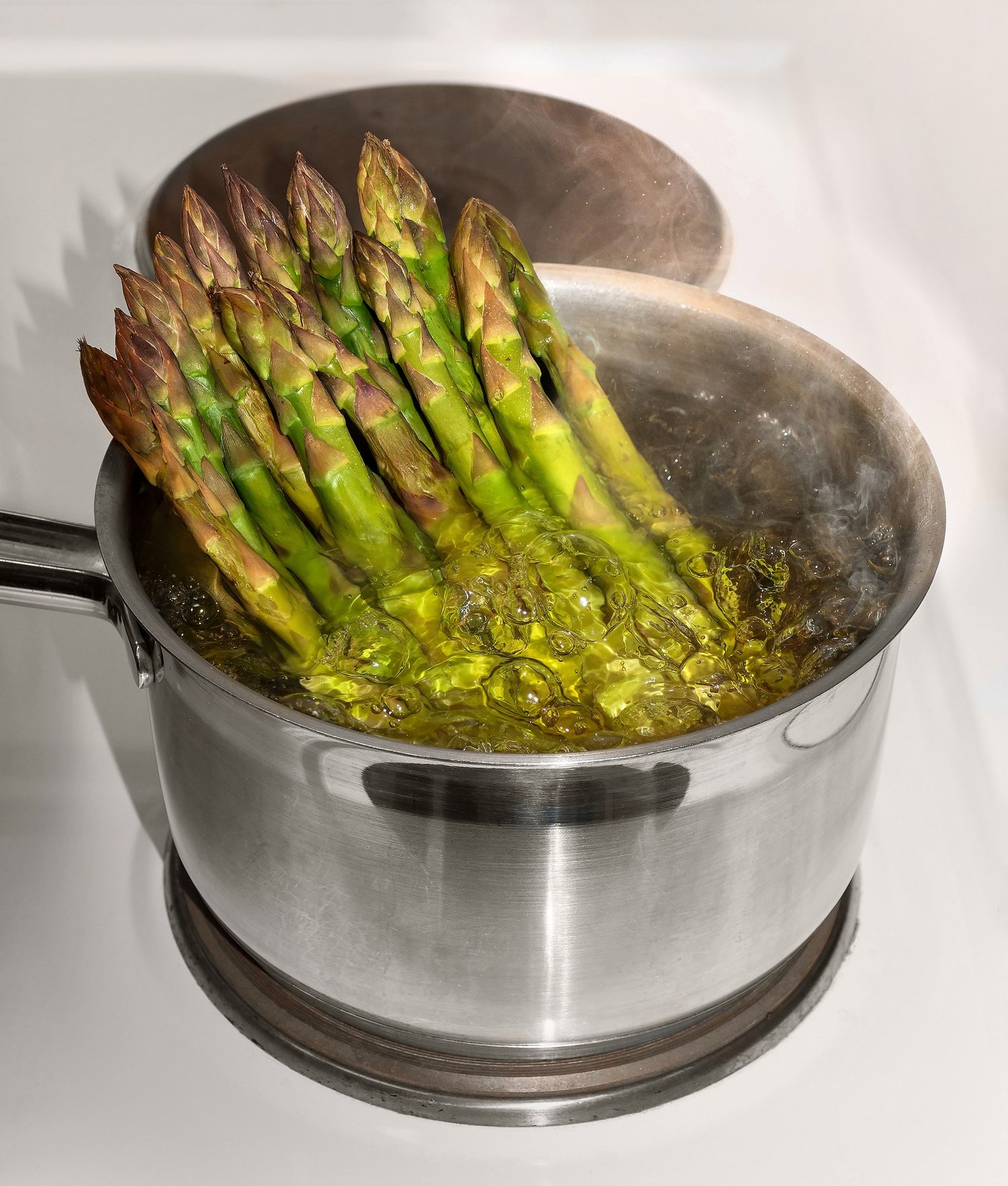
الغليان يحول الماء السائل إلى بخار — وهو تغير بين حالات المادة.
مصدر ضغط الغاز
جزيئات الغاز تتحرك بسرعة في جميع الاتجاهات. تستمر في الاصطدام — التصادم مع — جدران وعائها. كل اصطدام يمنح الجدار دفعة صغيرة. ضغط الغاز هو النتيجة الإجمالية لهذه التصادمات الكثيرة على الجدران.
ضغط الغاز: الجزيئات السريعة تتحرك في جميع الاتجاهات وتصطدم بالجدران؛ جمع الدفعات الصغيرة الكثيرة ينتج الضغط
الغاز المثالي
الغاز المثالي نموذج بسيط. نفترض شيئين:
الجسيمات نفسها لا تشغل حجماً صفرياً.
لا توجد قوى بين جزيئية تجاذب بين الجسيمات.
الغاز الحقيقي يتبع هذا النموذج بشكل مقارب عند الضغط المنخفض ودرجة الحرارة العالية. يتصرف بأقل شبيه بالغاز المثالي عند الضغط العالي ودرجة الحرارة المنخفضة، عندما تُضغط الجسيمات قريباً من بعضها وتبدأ القوى بينها في أن تكون مهمة.
الغاز المثالي هو نموذج: جسيمات نقطية لا قوى بينها. الغاز الحقيقي يتصرف بأقل شبيه بهذا عند الضغط العالي ودرجة الحرارة المنخفضة، عندما تكون الجسيمات مزدحمة وتبدأ حجمها الحقيقي وجاذباتها في أن تكون مهمة
معادلة الغاز المثالي
معادلة الغاز المثالي تربط الضغط والحجم والكمية ودرجة الحرارة:
$$pV = nRT$$
حيث $p$ هو الضغط بالباسكال (Pa)، و$V$ هو الحجم بـ$\text{m}^3$، و$n$ هو الكمية بالمول، و$T$ هي درجة الحرارة بالكلفن (kelvin) (K)، و$R$ هو ثابت الغازات ($8.31\ \text{J K}^{-1}\,\text{mol}^{-1}$).
غيّر الوحدات دائماً أولاً: °C إلى كلفن (أضف 273)، و$\text{cm}^3$ أو $\text{dm}^3$ إلى $\text{m}^3$.
مثال محلول. أوجد حجم $0.50\ \text{mol}$ من غاز مثالي عند $27\ ^{\circ}\text{C}$ و$100\ \text{kPa}$. ($R = 8.31\ \text{J K}^{-1}\,\text{mol}^{-1}$.)
يمكنك أيضاً استخدام المعادلة لإيجاد الكتلة المولية. بما أن $n = m/M$:
$$pV = \frac{m}{M}RT \qquad\Rightarrow\qquad M = \frac{mRT}{pV}$$
هذا يسمح لك بحساب $M_r$ من الكتلة (أو الكثافة) لغاز ما.
مثال محلول. يحتوي قارورة على $0.96\ \text{g}$ من غاز في $600\ \text{cm}^3$ عند $100\ \text{kPa}$ و$27\ ^{\circ}\text{C}$. أوجد الكتلة المولية للغاز. ($R = 8.31\ \text{J K}^{-1}\,\text{mol}^{-1}$.)
حول الوحدات: $V = 6.00 \times 10^{-4}\ \text{m}^3$، $T = 300\ \text{K}$. ثم
describe, in simple terms, the lattice structure of a crystalline solid which is: (a) giant ionic, including sodium chloride and magnesium oxide (b) simple molecular, including iodine, buckminsterfullerene $\text{C}_{60}$ and ice (c) giant molecular, including silicon(IV) oxide, graphite and diamond (d) giant metallic, including copper
describe, interpret and predict the effect of different types of structure and bonding on the physical properties of substances, including melting point, boiling point, electrical conductivity and solubility
deduce the type of structure and bonding present in a substance from given information
العربية
وصف، بأسلوب مبسط، البنية الشبكية للصلب البلوري الذي يكون: (أ) أيوني ضخم، بما في ذلك كلوريد الصوديوم وأكسيد المغنيسيوم (ب) جزيئي بسيط، بما في ذلك اليود، باكنمينستر فوليرين $\text{C}_{60}$ والجليد (ج) جزيئي ضخم، بما في ذلك ثاني أكسيد السيليكون (IV)، الجرافيت والماس (د) فلزي ضخم، بما في ذلك النحاس
وصف وتفسير والتنبؤ بتأثير أنواع مختلفة من البنية والترابط على الخصائص الفيزيائية للمواد، بما في ذلك درجة الانصهار، درجة الغليان، التوصيل الكهربائي والذوبانية
استنتاج نوع البنية والترابط الموجود في مادة من المعلومات المعطاة
Source: Cambridge International syllabus · المصدر: منهج كامبريدج الدولي
English
How a substance behaves depends on how its particles are joined. There are four main structures of a crystalline solid 晶体.
Giant ionic
A giant ionic 离子晶体 structure is a huge regular lattice 晶格 of positive and negative ions 离子, held together by strong attraction in every direction. Examples are sodium chloride and magnesium oxide.
Simple molecular
A simple molecular 分子晶体 structure is made of small molecules 分子. The bonds inside each molecule are strong, but the intermolecular forces between the molecules are weak. Examples are iodine ($\text{I}_2$), fullerene 富勒烯 ($\text{C}_{60}$) and ice.
Giant molecular
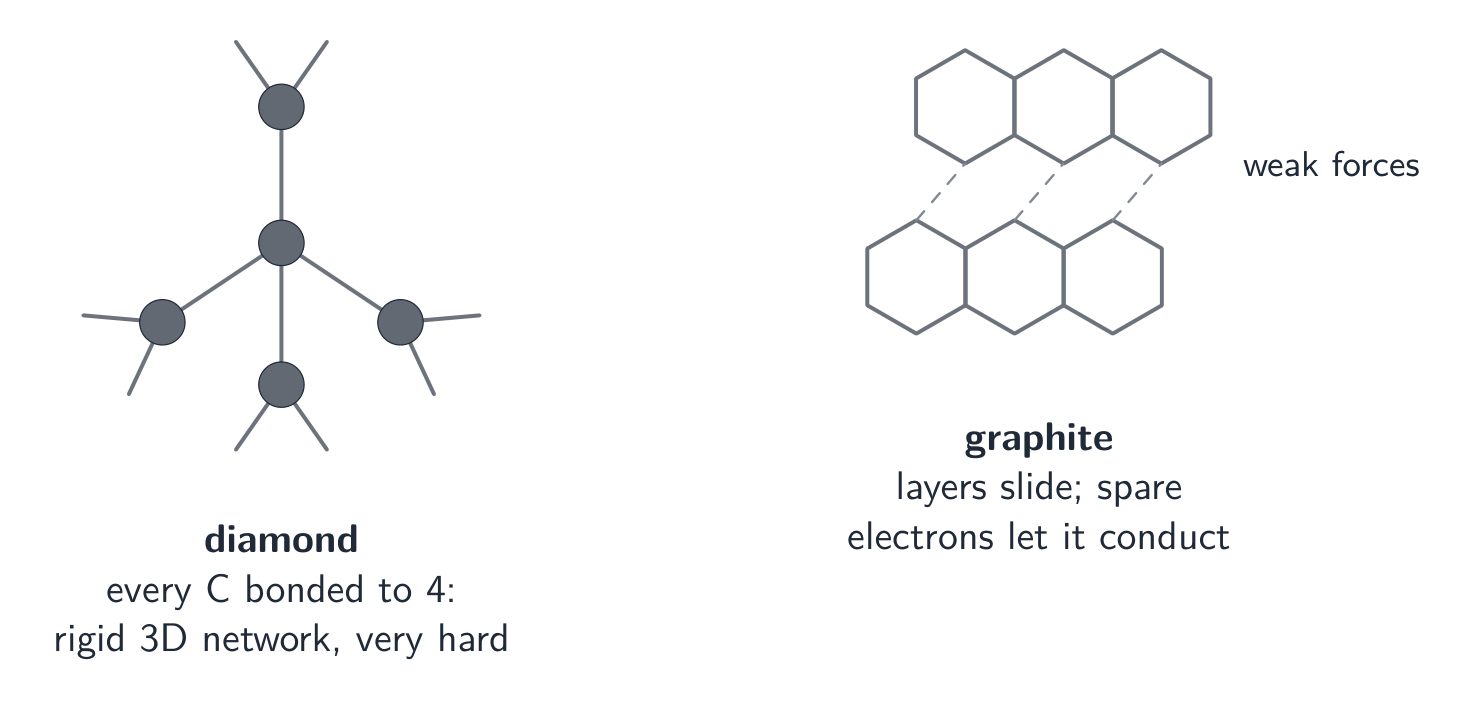
A giant molecular 原子晶体 structure (also called giant covalent) is a huge network of atoms joined by strong covalent bonds 共价键. Examples are silicon(IV) oxide 二氧化硅, graphite 石墨 and diamond 金刚石.
Giant metallic
A giant metallic 金属晶体 structure is a lattice of positive metal ions in a "sea" of delocalised electrons 离域电子. An example is copper.
Physical properties
The structure decides the physical properties:
Structure
Melting/boiling point
Conducts electricity?
Solubility in water
giant ionic
high
only when molten or dissolved
usually soluble
simple molecular
low
no
usually low
giant molecular
very high
no (except graphite)
insoluble
giant metallic
high
yes (solid and molten)
insoluble
melting point 熔点 and boiling point 沸点 are high when strong forces (ionic, covalent or metallic) must be broken, and low when only weak intermolecular forces break.
electrical conductivity 导电性 needs charged particles that can move — ions that are free (when molten or dissolved) or delocalised electrons. Graphite conducts because some of its electrons are delocalised.
solubility 溶解度 in water is usually high for ionic solids and low for molecular and giant covalent solids.
You can work backwards too: from the melting point, conductivity and solubility of an unknown substance, deduce the type of structure and bonding it has.
العربية
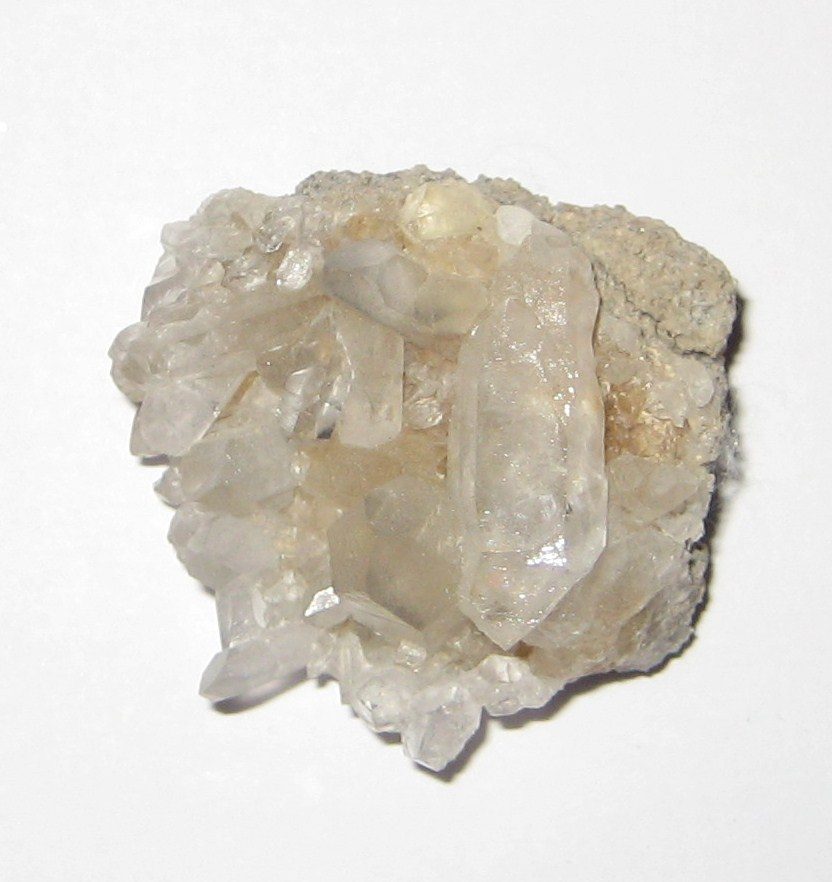
الكوارتز عبارة عن بنية تساهمية عملاقة من السيليكون والأكسجين.
يعتمد سلوك المادة على كيفية ارتباط جسيماتها. هناك أربعة أنواع رئيسية من المواد الصلبة البلورية.
الأنواع الأربعة للمواد الصلبة البلورية — البنية تحدد نقطة الانصهار والتوصيل الذوبانية
الأيونية العملاقة
البنية الأيونية العملاقة هي شبكة شبيكية منتظمة ضخمة من الأيونات الموجبة والسالبة، متماسكة بقوة جذب قوية في جميع الاتجاهات. أمثلة عليها كلوريد الصوديوم وأكسيد المغنيسيوم.
الجزيئية البسيطة
البنية الجزيئية البسيطة تتكون من جزيئات صغيرة. الروابط داخل كل جزيء قوية، لكن قوى التماسك بين الجزيئات ضعيفة. أمثلة عليها اليود ($\text{I}_2$)، الفولرين ($\text{C}_{60}$) والجليد.
الجزيئية العملاقة
البنية الجزيئية العملاقة (وتسمى أيضاً التساهمية العملاقة) هي شبكة ضخمة من الذرات المترابطة بـ روابط تساهمية قوية. أمثلة عليها أكسيد السيليكون(IV)، الجرافيت والألماس.
شكلان ضخمان تساهميان للكربون: الألماس شبكة 3D صلبة (صلب جداً)؛ الجرافيت له طبقات تنزلق وإلكترونات حرة توصل الكهرباءألماس طبيعي في صخره الذي نشأ فيه. هذه البلورة بأكملها جزيء عملاق واحد — شبكة واحدة غير مقطوعة من ذرات الكربون، كل ذرة مرتبطة بأربع ذرات أخرى. كسرها يتطلب كسر عدد لا يحصى من الروابط التساهمية القوية، ولهذا السبب يُعدّ الألماس voted hardest natural material
المعدنية العملاقة
البنية المعدنية العملاقة هي شبكة من أيونات الفلزات الموجبة في "بحر" من الإلكترونات اللامركزة. مثال عليها النحاس.
قطعة من فلز النحاس النقي. اللمعان، وكيفية توصيل الفلزات للكهرباء وانثناءها، كلها نابعة من تلك الشبكة العملاقة لأيونات النحاس التي تجلس في بحر مشترك من الإلكترونات اللامركزة
الخصائص الفيزيائية
تحدد البنية الخصائص الفيزيائية:
البنية
نقطة الانصهار/الغليان
هل توصل الكهرباء؟
الذوبانية في الماء
أيونية عملاقة
عالية
فقط عند الانصهار أو الإذابة
عادةً قابلة للذوبان
جزيئية بسيطة
منخفضة
لا
عادةً منخفضة
جزيئية عملاقة
عالية جداً
لا (باستثناء الغرافيت)
غير قابلة للذوبان
معدنية عملاقة
عالية
نعم (صلبة وسائلة)
غير قابلة للذوبان
نقطة الانصهار ونقطة الغليان تكون عالية عندما يجب كسر قوى قوية (أيونية أو تساهمية أو معدنية)، وتكون منخفضة عندما تنكسر فقط قوى تماسك بين الجزيئات الضعيفة.
التوصيل الكهربائي يحتاج إلى جسيمات مشحونة قادرة على الحركة — أيونات حرة (عند الانصهار أو الإذابة) أو إلكترونات لامركزة. يوصل الغرافيت لأن بعض إلكتروناته لامركزة.
الذوبانية في الماء عادةً ما تكون عالية للمواد الصلبة الأيونية ومنخفضة للمواد الصلبة الجزيئية والتساهمية العملاقة.
يمكنك أيضاً العمل عكسياً: من خلال نقطة الانصهار والتوصيل والذوبانية لمادة مجهولة، استنتج نوع البنية والروابط التي تمتلكها.
Explore · استكشف
Giant structure lab · مختبر الهياكل العملاقة
Compare giant structures by particles and bonding. · قارن الهياكل العملاقة من حيث الجسيمات والترابط.
Use SI units in $pV = nRT$: pressure in Pa, volume in $\text{m}^3$ ($\text{cm}^3 \times 10^{-6}$), temperature in K ($^\circ\text{C} + 273$).
State the ideal-gas assumptions (negligible molecular volume, no intermolecular forces) and when real gases deviate (high pressure, low temperature).
Link each property to structure: giant ionic (high m.p., conducts molten), giant covalent (very high m.p.), simple molecular (low m.p.), giant metallic (conducts, malleable).
Graphite conducts because each carbon has a delocalised electron; diamond does not — a favourite comparison.
العربية
استخدم وحدات SI في $pV = nRT$: الضغط بالباسكال (Pa)، والحجم بـ$\text{m}^3$ ($\text{cm}^3 \times 10^{-6}$)، ودرجة الحرارة بالكلفن (K) ($^\circ\text{C} + 273$).
اذكر افتراضات الغاز المثالي (حجم الجزيئات مهمل، لا توجد قوى بين جزيئية) ومتى تنحرف الغازات الحقيقية (ضغط عالٍ، درجة حرارة منخفضة).
اربط كل خاصية بالبنية: أيونية عملاقة (نقطة انصهار عالية، توصل في الحالة السائلة)، تساهمية عملاقة (نقطة انصهار عالية جداً)، جزيئية بسيطة (نقطة انصهار منخفضة)، معدنية عملاقة (توصل، مطاطية).
يوصل الغرافيت لأن كل ذرة كربون تحتوي على إلكترون لامركز؛ الألماس لا يفعل ذلك — وهو مقارنة مفضلة.
Interactive lessons on this topic · دروس تفاعلية حول هذا الموضوع
Work through it step by step, with instant-check exercises. · ا-working عليه خطوة بخطوة، مع تمارين تحقق فوري.
Pick one and the site follows you — notes, papers, videos and practice all open on it. · اختر واحدًا وسيتبعك الموقع — الملاحظات، الأوراق، الفيديوهات والتدريب جميعها تفتح عليه.
Type to search notes, lessons, code, vocabulary and past-paper questions across every subject. · اكتب للبحث عن ملاحظات، دروس، أكواد، مفردات وأسئلة امتحانات سابقة عبر جميع المواد.