Skip to content · ⁨الانتقال إلى المحتوى⁩

Hydroxy compounds · ⁨مركبات الهيدروكسيل⁩

A-Level Chemistry · ⁨A-Level الكيمياء⁩ · Topic 32 · ⁨الموضوع 32⁩

Video lesson for this topic · ⁨درس فيديو لهذا الموضوع⁩ Open the video page · ⁨افتح صفحة الفيديو⁩
8:38

المركبات الهيدروكسية (A2): الفينول

في الستينيات، كانت الجراحة مرعبة. يمكن النجاة من الجرح؛ لكن العدوى التي تلتها لم تكن تحتم دائمًا. بعد البتر، nearly half…

English narration · English + 中文 subtitles burned in · ⁨سرد باللغة الإنجليزية · ترجمة مدمجة بالإنجليزية + الصينية⁩

32.1

Alcohols with acyl chlorides · ⁨الكحوليات مع كلوريدات الأسيل⁩

Syllabus · ⁨المنهج⁩
English
  1. describe the reaction with acyl chlorides to form esters using ethyl ethanoate
العربية
  1. صف التفاعل مع كلوريدات الأسيل لتكوين إسترات باستخدام إيثيل أسيتات

Source: Cambridge International syllabus · ⁨المصدر: منهج كامبريدج الدولي⁩

English

At A Level you meet one more reaction of an alcohol 醇: it reacts with an acyl chloride 酰氯 to make an ester 酯. This works faster and more completely than using a carboxylic acid. For example, ethanol and ethanoyl chloride give ethyl ethanoate, plus fumes of $\text{HCl}$.

العربية

في مستوى A-Level، ستلتقي بتفاعل واحد آخر للكحول: يتفاعل مع كلوريد الأسيل لتكوين إستر. هذا التفاعل أسرع وأكثر اكتمالاً منه باستخدام حمض الكربوكسيل. على سبيل المثال، الإيثانول وكلوريد إيثانويل ينتج إيثيل إيثانوات، بالإضافة إلى أبخرة $\text{HCl}$.

الإيثانول يتفاعل مع كلوريد إيثانويل لإنتاج إستر إيثيل إيثانوات وحمض الهيدروكلوريك
يتفاعل كلوريد الأسيل مع الكحول أسرع وأكثر اكتمالاً من الحمض الكربوكسيل، منتجاً الإستر وأبخرة HCl
Explore · ⁨استكشف⁩

Acyl chloride with alcohol route · ⁨مسار كلوريد الأسيل مع الكحول⁩

Follow nucleophilic acyl substitution to an ester. · ⁨اتبع استبدال أسيل نوكليوفيلي للحصول على إستر.⁩

Vocabulary · ⁨مفردات⁩ Train · ⁨تدريب⁩
English العربية
alcohol/ˈælkəhɒl/ كحول
acyl chloride/əˈkɪl ˈklɔːraɪd/ كلوريد الأسيل
ester/ˈestə/ إستر
32.2

Phenol · ⁨الفينول⁩

Syllabus · ⁨المنهج⁩
English
  1. recall the reactions (reagents and conditions) by which phenol can be produced: (a) reaction of phenylamine with $\text{HNO}_2$ or $\text{NaNO}_2$ and dilute acid below $10\text{ }^\circ\text{C}$ to produce the diazonium salt; further warming of the diazonium salt with $\text{H}_2\text{O}$ to give phenol
  2. recall the chemistry of phenol, as exemplified by the following reactions: (a) with bases, for example $\text{NaOH(aq)}$ to produce sodium phenoxide (b) with $\text{Na(s)}$ to produce sodium phenoxide and $\text{H}_2\text{(g)}$ (c) in $\text{NaOH(aq)}$ with diazonium salts, to give azo compounds (d) nitration of the aromatic ring with dilute $\text{HNO}_3\text{(aq)}$ at room temperature to give a mixture of 2-nitrophenol and 4-nitrophenol (e) bromination of the aromatic ring with $\text{Br}_2\text{(aq)}$ to form 2,4,6-tribromophenol
  3. explain the acidity of phenol
  4. describe and explain the relative acidities of water, phenol and ethanol
  5. explain why the reagents and conditions for the nitration and bromination of phenol are different from those for benzene
  6. recall that the hydroxyl group of a phenol directs to the 2-, 4- and 6-positions
  7. apply knowledge of the reactions of phenol to those of other phenolic compounds, e.g. naphthol
العربية
  1. استذكار التفاعلات (الكواشف والظروف) التي يمكن بها إنتاج الفينول: (أ) تفاعل أنيلين مع $\text{HNO}_2$ أو $\text{NaNO}_2$ وحميد مخفف أقل من $10\text{ }^\circ\text{C}$ لإنتاج ملح الديازونيوم؛ تدفئة ملح الديازونيوم إضافية مع $\text{H}_2\text{O}$ للحصول على الفينول
  2. استذكري كيمياء الفينول، كما يوضحه التفاعلات التالية: (أ) مع القواعد، على سبيل المثال $\text{NaOH(aq)}$ لإنتاج فينوكسيد الصوديوم (ب) مع $\text{Na(s)}$ لإنتاج فينوكسيد الصوديوم و$\text{H}_2\text{(g)}$ (ج) في $\text{NaOH(aq)}$ مع أملاح الديازونيوم، للحصول على مركبات آزو (د) نترجة الحلقة العطرية باستخدام $\text{HNO}_3\text{(aq)}$ مخفف عند درجة حرارة الغرفة لإعطاء خليط من 2-نتروفينول و4-نتروفينول (هـ) برومة الحلقة العطرية باستخدام $\text{Br}_2\text{(aq)}$ لتكوين 2,4,6-ثلاثي بروموفينول
  3. اشرح حمضية الفينول
  4. صف وشرح الأحماض النسبية للماء والفينول والإيثانول
  5. اشرح لماذا تختلف الكواشف والشروط المستخدمة في نترتة وبرومة الفينول عن تلك المستخدمة في النترتة والبرومة للبنزين
  6. تذكر أن مجموعة الهيدروكسيل في الفينول توجه التفاعل إلى الموضعين 2- و 4- و 6-
  7. طبق معرفة تفاعلات الفينول على مركبات فينولية أخرى، مثل النافتول

Source: Cambridge International syllabus · ⁨المصدر: منهج كامبريدج الدولي⁩

English

Phenol 苯酚 has an $\text{–OH}$ group joined directly to a benzene 苯 ring. This changes the chemistry of both the $\text{–OH}$ group and the ring.

Making phenol

Cool phenylamine 苯胺 with $\text{NaNO}_2$ and dilute acid below $10\,°\text{C}$ to make a diazonium salt 重氮盐. Warming this salt with water then gives phenol (and nitrogen gas).

Reactions of phenol

  • with a base such as $\text{NaOH(aq)}$: phenol reacts to give sodium phenoxide and water. (Ordinary alcohols do not react with $\text{NaOH}$ — this shows phenol is more acidic.)
  • with sodium metal: gives sodium phenoxide and hydrogen.
  • with a diazonium salt in $\text{NaOH(aq)}$: forms a coloured azo compound 偶氮化合物 (used in dyes).
  • nitration 硝化 with dilute $\text{HNO}_3$ at room temperature: gives a mixture of 2-nitrophenol and 4-nitrophenol.
  • bromination 溴化 with bromine water at room temperature (no catalyst): gives a white precipitate of 2,4,6-tribromophenol.

Acidity of phenol

Phenol loses its $\text{H}^+$ to form a phenoxide ion. This ion is stabilised because its negative charge is spread (delocalised) into the ring. So phenol's acidity 酸性 is higher than that of water or ethanol:

$$\text{ethanol} < \text{water} < \text{phenol}$$

(Phenol is still a weak acid — weaker than a carboxylic acid.)

Why the conditions are milder than for benzene

A lone pair on the phenol oxygen is partly delocalised 离域 into the ring. This makes the ring more electron-rich, so it attracts electrophiles more strongly. Phenol therefore reacts faster and under much milder conditions than benzene — no catalyst is needed, and dilute reagents work at room temperature.

The $\text{–OH}$ group directs new substituents to the 2-, 4- and 6-positions. The same ideas apply to other phenolic compounds, such as naphthol.

Worked example. Phenol, ethanol and ethanoic acid are each shaken with aqueous $\text{NaOH}$ and then with aqueous $\text{Na}_2\text{CO}_3$. Predict what happens, and order the three by acidity. Acidity depends on how well the anion left behind is stabilised. Ethanol's ethoxide keeps its charge stuck on one oxygen, so ethanol is weakest and reacts with neither. Phenol's phenoxide spreads the charge into the ring, making phenol acidic enough to react with the strong base $\text{NaOH}$ but not with the weaker $\text{Na}_2\text{CO}_3$ - so no fizzing. Ethanoate spreads the charge over two oxygens, the most effective of the three, so ethanoic acid reacts with both and fizzes with the carbonate. Order: ethanol < phenol < ethanoic acid. The carbonate is the discriminating test - only a carboxylic acid fizzes, which is exactly how you tell phenol from an acid.

العربية

الفينول يحتوي على مجموعة $\text{–OH}$ متصلة مباشرة بحلقة بنزين. هذا يغير كيمياء كل من مجموعة $\text{–OH}$ والحلقة.

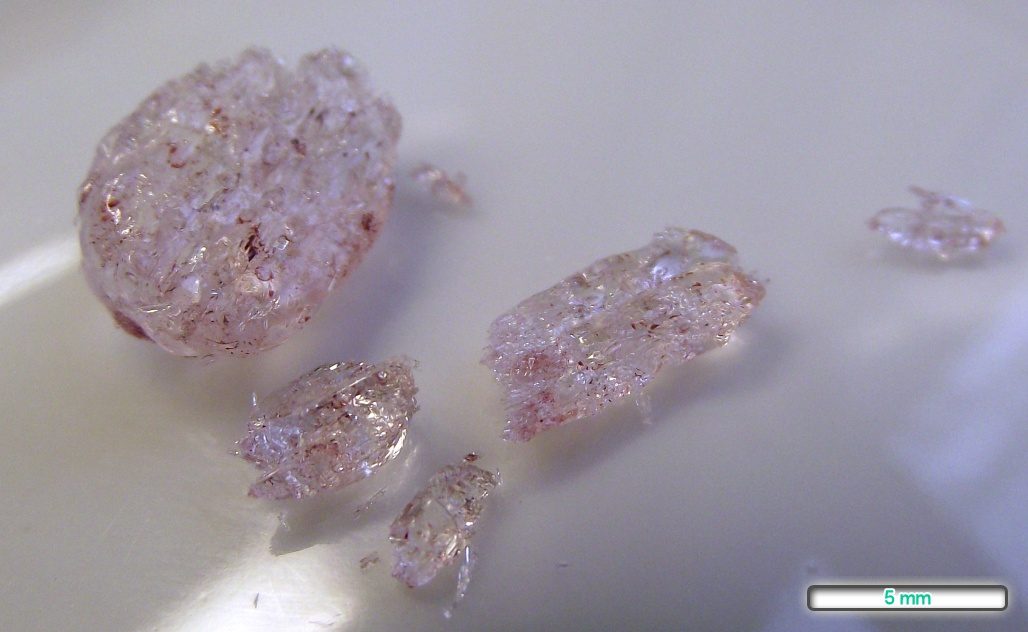
عينة من الفينول تحولت إلى اللون الوردي
الفينول صلب منخفض الانصهار؛ يتحول ببطء إلى اللون الوردي عند تأكسده في الهواء

تحضير الفينول

برّد فينيل أمين مع $\text{NaNO}_2$ وحمض مخفف تحت $10\,°\text{C}$ لتحصل على ملح الديازونيوم. عند تدفئة هذا الملح بالماء نحصل على الفينول (وغاز النيتروجين).

تفاعلات الفينول

  • مع قاعدة مثل $\text{NaOH(aq)}$: يتفاعل الفينول لتكوين فенокسيد الصوديوم والماء. (الكحوليات العادية لا تتفاعل مع $\text{NaOH}$ — وهذا يظهر أن الفينول أكثر حموضة.)
  • مع صوديوم معدني: يعطي فенокسيد الصوديوم والهيدروجين.
  • مع ملح ديازونيوم في $\text{NaOH(aq)}$: يشكل مركب أزو ملون (يستخدم في الأصباغ).
  • نترتة مع حمض $\text{HNO}_3$ المخفف في درجة حرارة الغرفة: يعطي مزيجاً من 2-نيتروفينول و4-نيتروفينول.
  • برومة مع ماء البروم في درجة حرارة الغرفة (بدون محفز): يعطي راسباً أبيض من 2,4,6-ثلاثي بروموفينول.

حمضية الفينول

يفقد الفينول $\text{H}^+$ ليكوّن أيون فенокسيد. يُستقر هذا الأيون لأن شحنته السالبة تنتشر (تُجهَّد) داخل الحلقة. لذلك تكون حمضية الفينول أعلى من الماء أو الإيثانول:
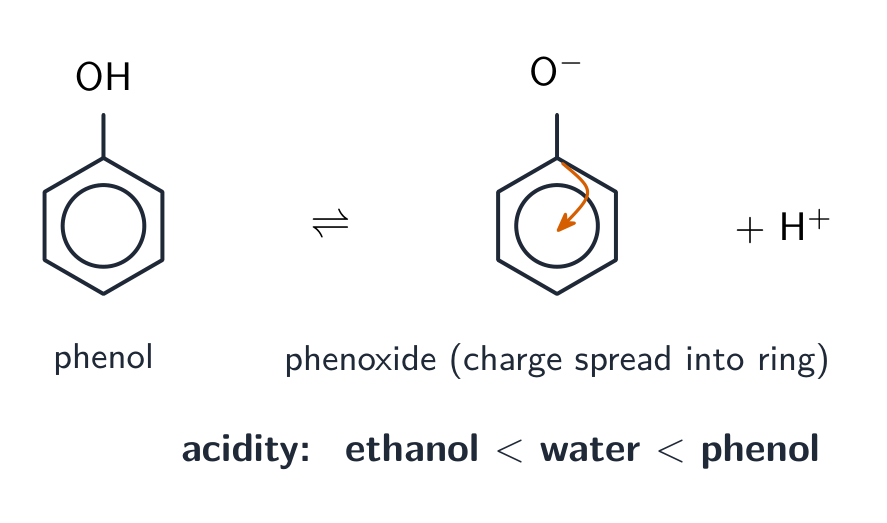
$$\text{ethanol} < \text{water} < \text{phenol}$$
الفينول يفقد بروتوناً ليكوّن أيون فенокسيد، مع سهم منحني يظهر انتشار الشحنة السالبة داخل الحلقة
الفينول أكثر حمضية من الماء أو الكحول: فقدان H$^+$ يعطي أيون فенокسيد تنتشر فيه الشحنة السالبة داخل الحلقة، مستقراً إياه

(الفينول لا يزال حمضاً ضعيفاً — أقل حمضية من حمض الكربوكسيل.)

لماذا الشروط أخف من البنزين

زوج من الإلكترونات الحرة على أكسجين الفينول يتجه جزئياً إلى الحلقة. هذا يجعل الحلقة أكثر غنىً بالإلكترونات، لذا تجذب الإلكتروفيلات بقوة أكبر. لذلك يتفاعل الفينول أسرع وفي ظروف أخف بكثير من البنزين — لا حاجة لمحفز، وتعمل الكواشف المخففة في درجة حرارة الغرفة.
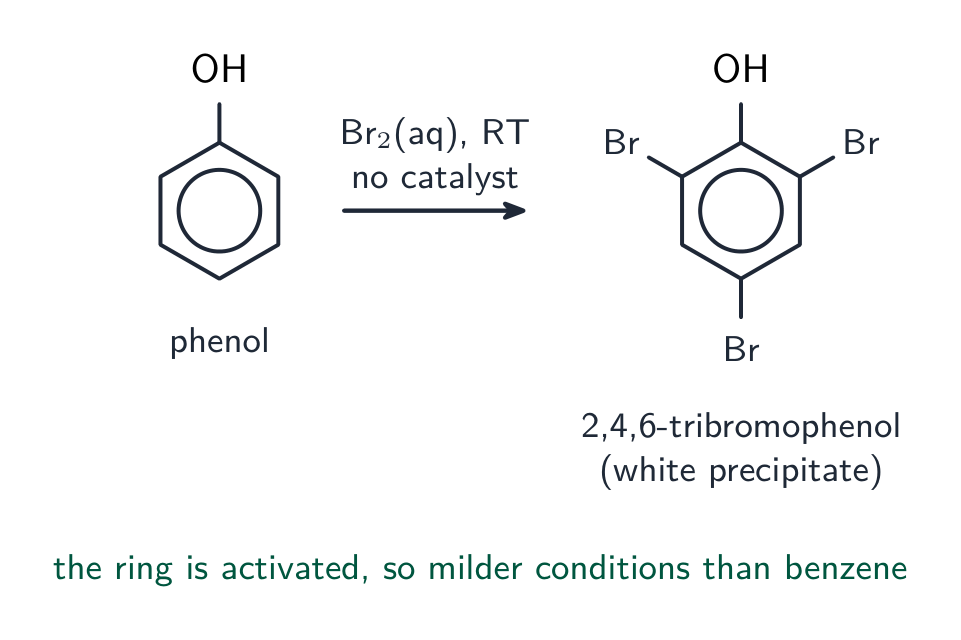
الفينول يتفاعل مع ماء البروم في درجة حرارة الغرفة ليعطي 2,4,6-ثلاثي بروموفينول، وهو راسب أبيض
حلقة الفينول مفعّلة، لذا يقوم ماء البروم بالبرومة في المواقع 2 و4 و6 في درجة حرارة الغرفة بدون محفز، منتجاً راسباً أبيض

توجه مجموعة $\text{–OH}$ المستبدلات الجديدة إلى المواضع 2- و4- و6-. تنطبق نفس الأفكار على المركبات الفينولية الأخرى، مثل النافتول.
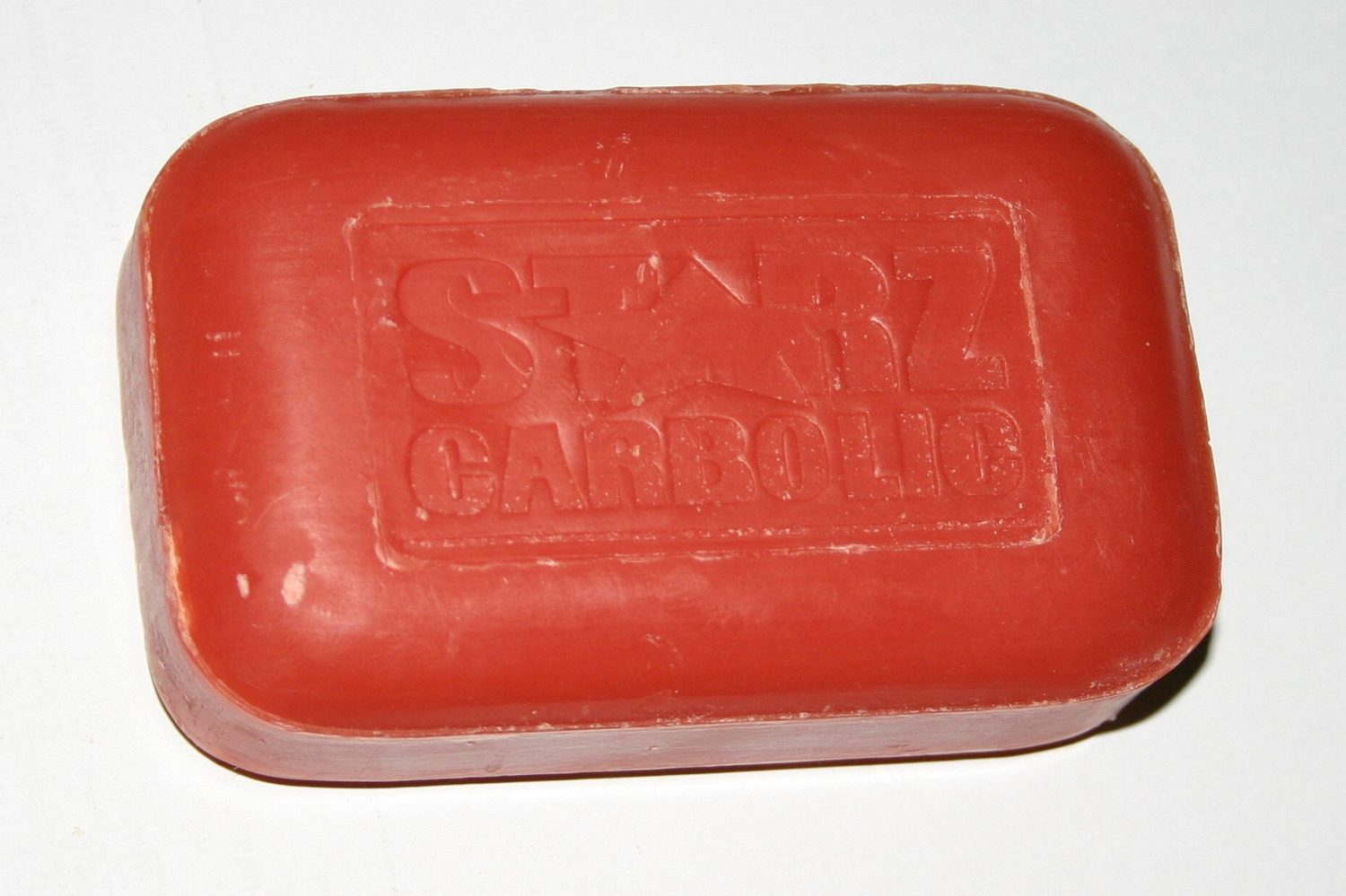
شريط وردي من صابون الكاربولي
صابون الكاربولي يحتوي على الفينول، الذي كان أحد أول المطهرات

مثال محلل. تم رج الفينول والإيثانول وحمض الإيثانويك كلٌ على حدة مع محلول مائي لـ $\text{NaOH}$ ثم مع محلول مائي لـ $\text{Na}_2\text{CO}_3$. تنبأ بما سيحدث، ورتب المواد الثلاث حسب الحمضية. تعتمد الحمضية على مدى استقرار الأنيون المتروك. إيثوكسيد الإيثانول يبقي شحنته مقيدة على الأكسجين الواحد، لذا الإيثانول هو الأقل حمضية ولا يتفاعل مع أي منهما. فенокسيد الفينول ينشر الشحنة داخل الحلقة، مما يجعل الفينول حامياً بما يكفي للتفاعل مع القاعدة القوية $\text{NaOH}$ ولكن ليس مع الـ $\text{Na}_2\text{CO}_3$ الأضعف — لذا لا فقاعات. إيثانوات ينشر الشحنة على أكسجينين، وهو الأكثر فعالية بين الثلاثة، لذا يتفاعل حمض الإيثانويك مع كلاهما ويفور مع الكربونات. الترتيب: إيثانول < فينول < حمض الإيثانويك. الاختبار التمييزي هو الكربونات — فقط حمض الكربوكسيل يفور، وهو بالضبط كيف تميز بين الفينول والحمض.

Explore · ⁨استكشف⁩

Phenol reaction lab · ⁨مختبر تفاعلات الفينول⁩

Classify phenol reactions by the role of the aromatic OH group. · ⁨صنف تفاعلات الفينول حسب دور مجموعة OH العطرية.⁩

Vocabulary · ⁨مفردات⁩ Train · ⁨تدريب⁩
English العربية
phenol/ˈfenɒl/ فينول
benzene/ˈbenziːn/ بنزين
phenylamine/ˌfiːˈnaɪləmiːn/ فينيل أمين
diazonium salt/ˌdaɪəˈzəʊnɪəm sɒlt/ ملح الديازونيوم
azo compound/ˈɑːzəʊ ˈkɒmpaʊnd/ مركب الأزو
nitration/naɪˈtreɪʃn/ نترتة
bromination/ˌbrəʊmɪˈneɪʃn/ برومة
acidity/æˈsɪdɪti/ حموضة
delocalised/dɪˈlɒkəlaɪzd/ مشتت
32.2

Exam tips · ⁨نصائح للامتحان⁩

English
  • Phenol is a stronger acid than alcohols (its anion is stabilised by delocalisation) but weaker than carboxylic acids — it does not react with carbonates.
  • Phenol decolourises bromine water and gives a white precipitate without a catalyst (the ring is activated by oxygen).
  • Acyl chlorides react with alcohols/phenols to give esters readily (better than the reversible acid route); misty HCl fumes are the observation.
العربية
  • الفينول حمض أقوى من الكحوليات (يُستقر أنونه بالتجهيد) لكنه أضعف من أحماض الكربوكسيل —所以他 لا يتفاعل مع الكربونات.
  • يحول الفينول لون ماء البروم ويكوّن راسباً أبيض بدون محفز (الحلقة مفعّلة بواسطة الأكسجين).
  • كلوريدات الأسيل تتفاعل مع الكحوليات/الفينولات لتكوين إستر بسهولة (أفضل من طريق الحمض العكسي)؛ البخار الضبابية لـ HCl هي الملاحظة.

Interactive lessons on this topic · ⁨دروس تفاعلية حول هذا الموضوع⁩

Work through it step by step, with instant-check exercises. · ⁨ا-working عليه خطوة بخطوة، مع تمارين تحقق فوري.⁩

Past Papers · ⁨أوراق الامتحانات السابقة⁩

More topics in A-Level Chemistry · ⁨A-Level الكيمياء⁩ · ⁨المزيد من المواضيع في A-Level Chemistry · ⁨A-Level الكيمياء⁩⁩

Log in or create account · ⁨تسجيل الدخول أو إنشاء حساب⁩

IGCSE, A-Level & AP