Types of number · 数的类型
| English | 中文 | Pinyin · 拼音 |
|---|---|---|
| rational/ˈræʃənl/ | 有理数 | yǒu lǐ shù |
| irrational/ɪˈræʃənl/ | 无理数 | wú lǐ shù |
| natural numbers/ˈnætʃərəl ˈnʌmbəz/ | 自然数 | zì rán shù |
| integers/ˈɪntɪdʒəz/ | 整数 | zhěng shù |
| factor/ˈfæktə/ | 因数 | yīn shù |
| multiple/ˈmʌltɪpl/ | 倍数 | bèi shù |
| prime/praɪm/ | 质数 | zhì shù |
| prime factorisation/praɪm ˌfæktəraɪˈzeɪʃn/ | 质因数分解 | zhì yīn shù fēn jiě |
| HCF/ˌeɪtʃ siː ˈef/ | 最大公因数 | zuì dà gōng yīn shù |
| LCM/ˌel siː ˈem/ | 最小公倍数 | zuì xiǎo gōng bèi shù |
| reciprocal/rɪˈsɪprəkl/ | 倒数 | dào shǔ |
A question that stumped the ancient Greeks
- Is every number a fraction? The Greeks thought yes — until someone proved $\sqrt{2}$ cannot be written as $\dfrac{a}{b}$.
- Legend says the discoverer was thrown overboard for revealing this uncomfortable truth.
- Today we sort numbers into families, and that split — rational 有理数 vs irrational 无理数 — is still the big one.
一个难住古希腊人的问题
- 每个数都是分数吗?希腊人以为是——直到有人证明 $\sqrt{2}$ 无法被写成 $\dfrac{a}{b}$。
- 传说那个发现者因为揭示这个令人不安的真相而被抛下船。
- 今天我们把数分成族,而那个划分——有理数对无理数(rational vs irrational)——仍然是最大的那个。
The number families
- Natural numbers 自然数 $\mathbb{N} = \{1, 2, 3, \dots\}$ — the counting numbers (some definitions include $0$).
- Integers 整数 $\mathbb{Z} = \{\dots, -2, -1, 0, 1, 2, \dots\}$ — whole numbers, positive, negative and zero.
- Rational numbers $\mathbb{Q}$ — anything that can be written $\dfrac{a}{b}$ where $a, b$ are integers and $b \neq 0$.
- Irrational numbers — everything else ($\pi$, $\sqrt{2}$, $e$): they cannot be expressed as a fraction.
Natural → Integer → Rational, each a bigger family. Irrational numbers live outside.
数的家族
- 自然数(natural numbers)$\mathbb{N} = \{1, 2, 3, \dots\}$——计数的数(有些定义包括 $0$)。
- 整数(integers)$\mathbb{Z} = \{\dots, -2, -1, 0, 1, 2, \dots\}$——整的数,正的、负的和零。
- 有理数(rational numbers)$\mathbb{Q}$——任何能被写成 $\dfrac{a}{b}$ 的数,其中 $a, b$ 是整数且 $b \neq 0$。
- 无理数(irrational numbers)——其他一切($\pi$、$\sqrt{2}$、$e$):它们无法被表示为一个分数。
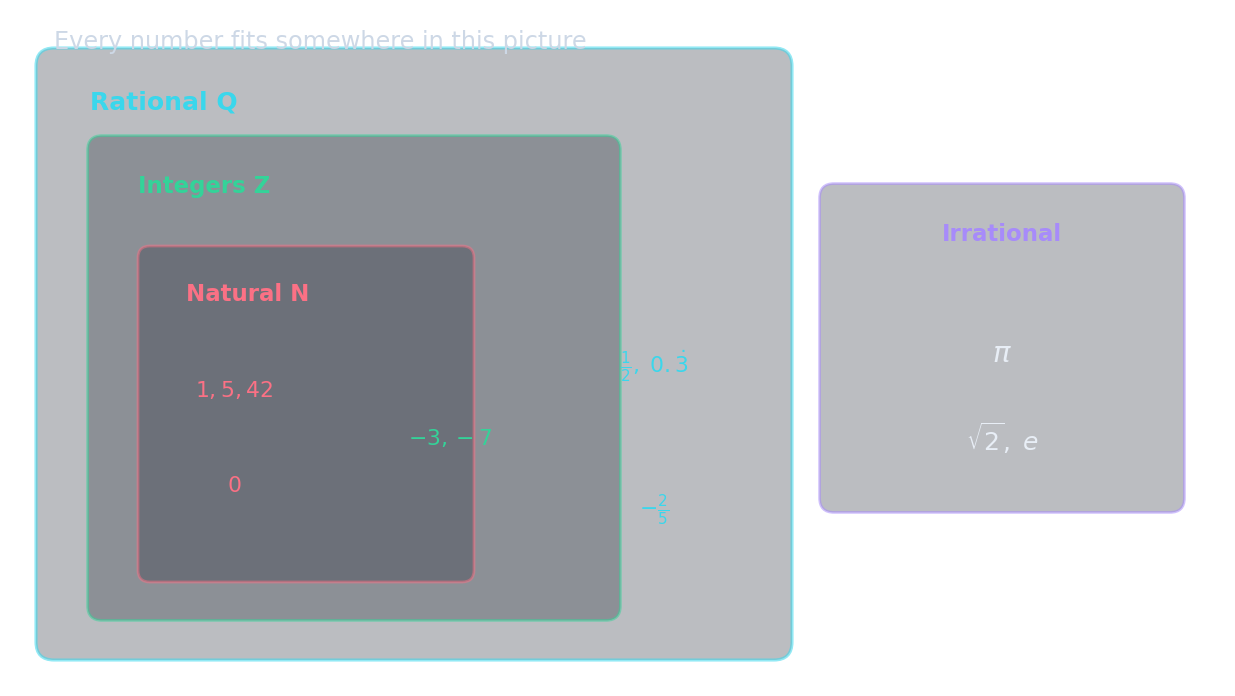
自然数 → 整数 → 有理数,每个是一个更大的族。无理数住在外面。
Sets of numbers · 数的集合
Every counting number is also an integer, every integer a rational — see how the number sets nest, and how union and intersection combine them. · 每个计数数也是整数,每个整数也是有理数——看数集如何层层嵌套,以及并集和交集如何把它们组合起来。
Match each number to its smallest number family. · 把每个数匹配到它最小的数族。
−5 and 0 are integers (whole numbers, including negatives). 3/7 is rational (a fraction of integers). √3 is irrational (cannot be written as a/b). · −5 和 0 是整数(整的数,包括负数)。3/7 是有理数(整数的一个分数)。√3 是无理数(无法被写成 a/b)。
Factors 因数, multiples 倍数 and primes 质数
- A factor of $n$ divides into $n$ exactly. Factors of $12$: $1, 2, 3, 4, 6, 12$.
- A multiple of $n$ is $n \times$ an integer. Multiples of $5$: $5, 10, 15, 20, \dots$.
- A prime has exactly two factors: $1$ and itself.
- $2, 3, 5, 7, 11, 13, \dots$ are prime. $1$ is not prime (only one factor).
1 is NOT prime. A prime must have exactly two distinct factors. $1$ has only one factor (itself), so it fails the definition.
Every natural number is an integer, every integer is rational, and every rational is real; irrational numbers like $\pi$ and $\sqrt{2}$ are real but not rational
因数、倍数和质数
- $n$ 的一个因数(factor)精确地整除 $n$。$12$ 的因数:$1, 2, 3, 4, 6, 12$。
- $n$ 的一个倍数(multiple)是 $n \times$ 一个整数。$5$ 的倍数:$5, 10, 15, 20, \dots$。
- 一个质数(prime)恰好有两个因数:$1$ 和它自己。
- $2, 3, 5, 7, 11, 13, \dots$ 是质数。$1$ 不是质数(只有一个因数)。
1 不是质数。 一个质数必须有恰好两个不同的因数。$1$ 只有一个因数(它自己),所以它不符合定义。

每个自然数都是一个整数,每个整数都是有理数,每个有理数都是实数;像 $\pi$ 和 $\sqrt{2}$ 这样的无理数是实数但不是有理数
Which of these is a prime number? · 这些中哪个是一个质数?
13 has exactly two factors (1 and 13). 1 is not prime; 9 = 3×3; 15 = 3×5. · 13 恰好有两个因数(1 和 13)。1 不是质数;9 = 3×3;15 = 3×5。
The number 1 is a prime number. · 数 1 是一个质数。
1 has only one factor (itself). A prime must have exactly two distinct factors. · 1 只有一个因数(它自己)。一个质数必须有恰好两个不同的因数。
The smallest prime number is . · 最小的质数是。
2 is the smallest (and only even) prime number. · 2 是最小的(也是唯一偶数的)质数。
Prime factorisation 质因数分解, HCF 最大公因数 and LCM 最小公倍数
- Write any number as a product of primes: $72 = 2^3 \times 3^2$, $120 = 2^3 \times 3 \times 5$.
- HCF (highest common factor): take the lowest power of each shared prime.
- HCF of $72$ and $120$ $= 2^3 \times 3 = 24$.
- LCM (lowest common multiple): take the highest power of every prime that appears.
- LCM of $72$ and $120$ $= 2^3 \times 3^2 \times 5 = 360$.
Keep splitting until every branch ends on a prime (circled); collecting them gives $72 = 2^3 \times 3^2$
Quick check. HCF × LCM should equal the product of the two numbers: $24 \times 360 = 8640$ and $72 \times 120 = 8640$. ✓
质因数分解、HCF 和 LCM
- 把任何数写成质数的一个乘积:$72 = 2^3 \times 3^2$,$120 = 2^3 \times 3 \times 5$。
- HCF(最大公因数):取每个共享质数的最低幂。
- $72$ 和 $120$ 的 HCF $= 2^3 \times 3 = 24$。
- LCM(最小公倍数):取出现的每个质数的最高幂。
- $72$ 和 $120$ 的 LCM $= 2^3 \times 3^2 \times 5 = 360$。
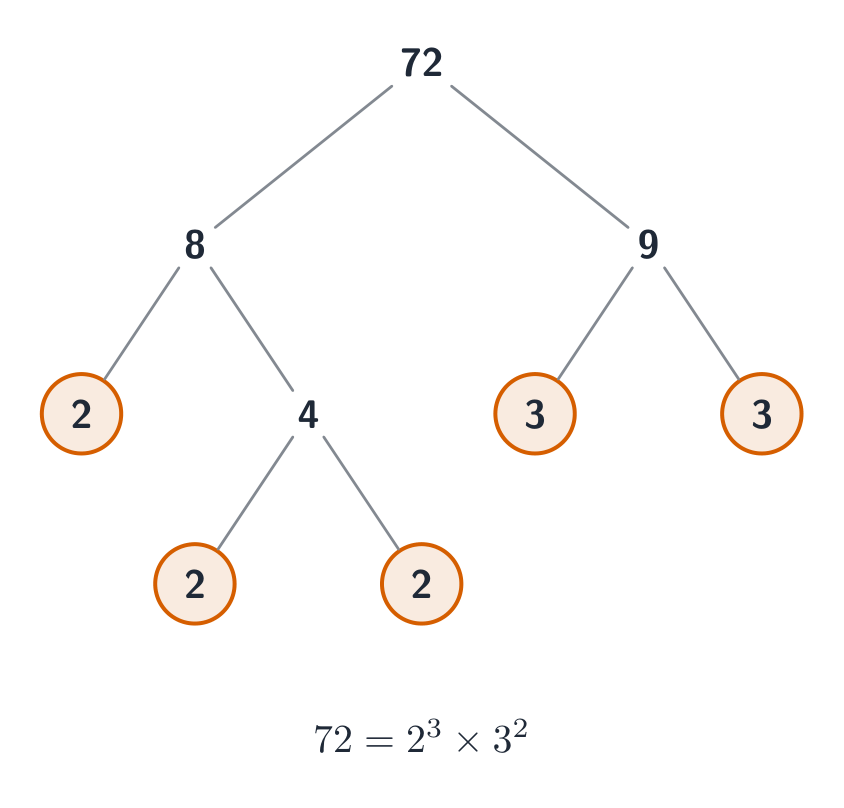
一直分裂直到每条分支都以一个质数(圈出)结束;把它们收集起来得到 $72 = 2^3 \times 3^2$
快速检查。 HCF × LCM 应该等于两个数的乘积:$24 \times 360 = 8640$ 而 $72 \times 120 = 8640$。✓
Find the HCF of 72 and 120. (72 = 2³×3², 120 = 2³×3×5) · 求 72 和 120 的 HCF。(72 = 2³×3²,120 = 2³×3×5)
Take the lowest shared powers: 2³ × 3 = 8 × 3 = 24. · 取最低的共享幂:2³ × 3 = 8 × 3 = 24。
Find the LCM of 72 and 120. · 求 72 和 120 的 LCM。
Take the highest powers: 2³ × 3² × 5 = 8 × 9 × 5 = 360. · 取最高的幂:2³ × 3² × 5 = 8 × 9 × 5 = 360。
Fun fact
- There are infinitely many primes (Euclid proved this around 300 BC).
- The largest known prime (as of 2024) has over 41 million digits — it's $2^{136{,}279{,}841} - 1$, a Mersenne prime.
趣味事实
- 有无穷多个质数(欧几里得在大约公元前 300 年证明了这个)。
- 已知最大的素数(截至 2024)拥有超过 41 百万位数字 —— 它是 $2^{136{,}279{,}841} - 1$,一个梅森素数。
Reciprocals and place value
- The reciprocal 倒数 of a nonzero number multiplies it to 1: for $3/7$ it is $7/3$, since $(3/7)(7/3)=1$. Zero has no reciprocal.
- Group large numbers into thousands: 6000042 is six million and forty-two. $6\,000\,042=6(1\,000\,000)+42$; the zeros hold the missing place values.
倒数与位值
- 非零数的倒数 倒数 与其相乘得 1:对于 $3/7$,其倒数为 $7/3$,因为 $(3/7)(7/3)=1$。零没有倒数。
- 将大数按千位分组:6000042 是六千零四十二万。$6\,000\,042=6(1\,000\,000)+42$;零占位表示缺失的数位。
Find the reciprocal of 5/9. · 求5/9的倒数。
The reciprocal is 9/5 = 1.8; multiplying by 5/9 gives 1. · 倒数为9/5 = 1.8;乘以5/9得1。
You've got it
- natural $\mathbb{N}$ → integer $\mathbb{Z}$ → rational $\mathbb{Q}$; irrational numbers live outside
- prime = exactly two factors ($1$ is not prime)
- HCF = lowest shared prime powers; LCM = highest prime powers of every prime
- $72 = 2^3 \times 3^2$, $120 = 2^3 \times 3 \times 5$ → HCF $24$, LCM $360$
你掌握了
- 自然数 $\mathbb{N}$ → 整数 $\mathbb{Z}$ → 有理数 $\mathbb{Q}$;无理数住在外面
- 质数 = 恰好两个因数($1$ 不是质数)
- HCF = 最低的共享质数幂;LCM = 每个质数的最高质数幂
- $72 = 2^3 \times 3^2$,$120 = 2^3 \times 3 \times 5$ → HCF $24$,LCM $360$