Sets · 集合
| English | 中文 | Pinyin · 拼音 |
|---|---|---|
| set/set/ | 集合 | jí hé |
| elements/ˈelɪmənts/ | 元素 | yuán sù |
| universal set/ˌjuːnɪˈvɜːsl set/ | 全集 | quán jí |
| empty set/ˈempti set/ | 空集 | kōng jí |
| intersection/ˌɪntəˈsekʃn/ | 交集 | jiāo jí |
| union/ˈjuːnɪən/ | 并集 | bìng jí |
| complement/ˈkɒmplɪmənt/ | 补集 | bǔ jí |
| Venn diagram/ven ˈdaɪəɡræm/ | 维恩图 | wéi ēn tú |
The class of 2024
- A school has 30 students. 18 study French, 12 study Spanish, and 5 study both.
- How many study neither? You can't just add — you need sets 集合.
- Sets are the language of grouping, and they power everything from databases to probability.
2024 届
- 一所学校有 30 名学生。18 名学法语,12 名学西班牙语,5 名两者都学。
- 多少名两者都不学?你不能只是相加——你需要集合(sets)。
- 集合是分组的语言,而它驱动从数据库到概率的一切。
What is a set?
- A set is a collection of distinct objects (the elements 元素 or members).
- Written with curly braces: $A = \{1, 2, 3, 4, 5\}$.
- $3 \in A$ means "$3$ is an element of $A$"; $7 \notin A$ means "$7$ is not".
- The universal set 全集 $\xi$ contains everything under discussion. The empty set 空集 $\emptyset$ has no elements.
$A\cap B=\{6\}$ is the only number in both circles; $A\cup B$ is everything inside either circle
什么是集合?
- 一个集合(set)是不同对象的一个汇集(元素elements 或成员members)。
- 用花括号书写:$A = \{1, 2, 3, 4, 5\}$。
- $3 \in A$ 意味着"$3$ 是 $A$ 的一个元素";$7 \notin A$ 意味着"$7$ 不是"。
- 全集(universal set)$\xi$ 包含讨论中的一切。空集(empty set)$\emptyset$ 没有元素。

$A\cap B=\{6\}$ 是两个圆中唯一的数;$A\cup B$ 是任一个圆内的一切
Set operations on a Venn diagram · 韦恩图上的集合运算
A Venn diagram shows two sets. Slide through the operations to see which region union, intersection and complement shade in. · 一个韦恩图显示两个集合。滑过这些运算,看并集、交集和补集给哪个区域上色。
The empty set ∅ is a subset of every set. · 空集 ∅ 是每个集合的一个子集。
The empty set has no elements, so it is trivially contained in every set. · 空集没有元素,所以它平凡地包含在每个集合中。
Intersection 交集 and union 并集
- Intersection $A \cap B$: elements in both $A$ and $B$.
- Union $A \cup B$: elements in $A$ or $B$ (or both).
- Complement 补集 $A'$: everything in the universal set that is not in $A$.
$A = \{1, 2, 3, 4\}$, $B = \{3, 4, 5, 6\}$. Then $A \cap B = \{3, 4\}$ and $A \cup B = \{1, 2, 3, 4, 5, 6\}$.
交集和并集
- 交集(intersection)$A \cap B$:在 $A$ 和 $B$ 两者中的元素。
- 并集(union)$A \cup B$:在 $A$ 或 $B$(或两者)中的元素。
- 补集(complement)$A'$:全集中不在 $A$ 中的一切。
$A = \{1, 2, 3, 4\}$,$B = \{3, 4, 5, 6\}$。那么 $A \cap B = \{3, 4\}$ 而 $A \cup B = \{1, 2, 3, 4, 5, 6\}$。
A = {2,4,6,8,10} and B = {3,6,9}. How many elements are in A ∩ B? · A = {2,4,6,8,10} 且 B = {3,6,9}。A ∩ B 中有多少个元素?
Only 6 is in both sets, so A ∩ B = {6}, which has 1 element. · 只有 6 在两个集合中,所以 A ∩ B = {6},它有 1 个元素。
For the same A and B, how many elements are in A ∪ B? · 对同样的 A 和 B,A ∪ B 中有多少个元素?
A ∪ B = {2,3,4,6,8,9,10}, which has 7 elements. · A ∪ B = {2,3,4,6,8,9,10},它有 7 个元素。
The symbol ∩ means: · 符号 ∩ 意味着:
∩ is intersection (elements in both A and B); ∪ is union. · ∩ 是交集(在 A 和 B 两者中的元素);∪ 是并集。
Venn diagrams 维恩图
- A Venn diagram draws sets as overlapping circles inside a rectangle (the universal set).
- Overlapping region = intersection; everything inside a circle = that set's members.
Venn diagrams show how sets relate — here, every natural number is also an integer and a rational.
Don't double-count. When finding $n(A \cup B)$, use $n(A) + n(B) - n(A \cap B)$. The intersection is counted once in each set, so subtract it once.
韦恩图
- 一个韦恩图(Venn diagram)把集合画成一个矩形(全集)内重叠的圆。
- 重叠区域 = 交集;一个圆内的一切 = 那个集合的成员。
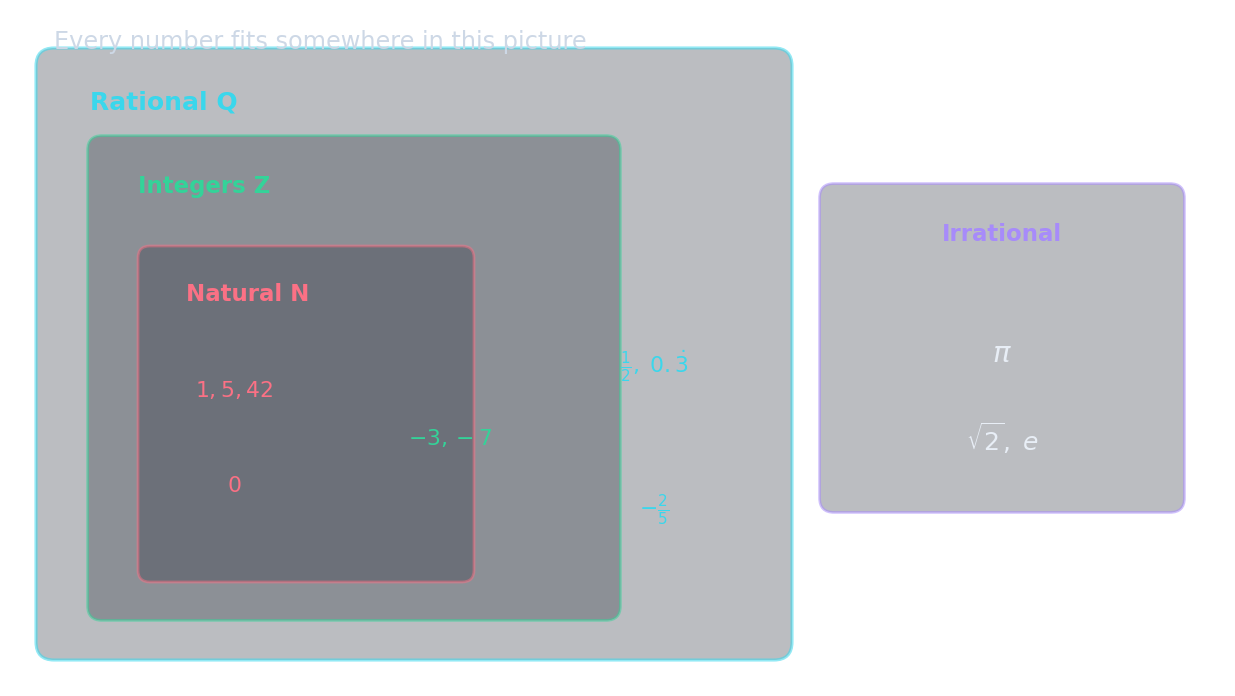
韦恩图显示集合如何相关——这里,每个自然数也是一个整数和一个有理数。
不要重复计数。 当求 $n(A \cup B)$ 时,使用 $n(A) + n(B) - n(A \cap B)$。交集在每个集合中被计数一次,所以减去它一次。
Worked example
- 30 students, $F =$ French (18), $S =$ Spanish (12), $F \cap S = 5$.
- $n(F \cup S) = 18 + 12 - 5 = 25$.
- Neither $= 30 - 25 = 5$ students study neither language.
示例
- 30 名学生,$F =$ 法语(18),$S =$ 西班牙语(12),$F \cap S = 5$。
- $n(F \cup S) = 18 + 12 - 5 = 25$.
- 两者都不 $= 30 - 25 = 5$ 名学生两种语言都不学。
n(A) = 5, n(B) = 3, n(A ∩ B) = 1. Find n(A ∪ B). · n(A) = 5,n(B) = 3,n(A ∩ B) = 1。求 n(A ∪ B)。
n(A ∪ B) = n(A) + n(B) − n(A ∩ B) = 5 + 3 − 1 = 7.
In a class of 30, 18 study French, 12 study Spanish, and 5 study both. How many study neither? · 在一个 30 人的班级中,18 人学法语,12 人学西班牙语,5 人两者都学。多少人两者都不学?
n(F ∪ S) = 18 + 12 − 5 = 25. Neither = 30 − 25 = 5. · n(F ∪ S) = 18 + 12 − 5 = 25。两者都不 = 30 − 25 = 5。
Three sets (Extended)
- In a three-set Venn diagram, fill the triple overlap first, then the parts belonging to exactly two sets, then the single-set regions. If $n(A\cap B)=7$ includes 2 in all three, the AB-only region is $7-2=5$.
- For $n(A)=12,n(B)=10,n(C)=9$, pair intersections AB=4, AC=3, BC=2 and triple=1, the union is $n(A\cup B\cup C)=12+10+9-4-3-2+1=23$. The triple is added back because the three pair subtractions removed it too often.
三个集合(扩展版)
- 在三集合韦恩图中,先填三重交集,再填恰好属于两个集合的部分,最后填单集合区域。若 $n(A\cap B)=7$ 包含 2 于全部三个集合中,则仅属 AB 的区域为 $7-2=5$。
- 对于 $n(A)=12,n(B)=10,n(C)=9$,配对交集 AB=4, AC=3, BC=2 及三重交集=1,其并集为 $n(A\cup B\cup C)=12+10+9-4-3-2+1=23$。三重交集被加回,因为三次两两相减已将其过度扣除。
Set sizes are 12,10,9; pair intersections 4,3,2; triple intersection 1. Find the union size. · 集合大小为12,10,9;两两交集为4,3,2;三集交集为1。求并集大小。
Add singles, subtract all pairs, add triple: 31−9+1 = 23. · 加单集,减所有双集,加三集:31−9+1 = 23。
You've got it
- $A \cap B$ = intersection (both); $A \cup B$ = union (either or both); $A'$ = complement
- $n(A \cup B) = n(A) + n(B) - n(A \cap B)$ — subtract the overlap
- Venn diagrams show set relationships visually; the rectangle is the universal set
- $\emptyset$ = empty set; $\xi$ = universal set
你掌握了
- $A \cap B$ = 交集(两者);$A \cup B$ = 并集(任一或两者);$A'$ = 补集
- $n(A \cup B) = n(A) + n(B) - n(A \cap B)$——减去重叠
- 韦恩图直观地显示集合关系;矩形是全集
- $\emptyset$ = 空集;$\xi$ = 全集