Price determination · 价格的决定
| English | 中文 | Pinyin · 拼音 |
|---|---|---|
| equilibrium/ˌiːkwɪˈlɪbrɪəm/ | 均衡 | jūn héng |
| quantity demanded/ˈkwɒntɪti dɪˈmændɪd/ | 需求量 | xū qiú liàng |
| quantity supplied/ˈkwɒntɪti səˈplaɪd/ | 供给量 | gōng jǐ liàng |
| shortage/ˈʃɔːtɪdʒ/ | 短缺 | duǎn quē |
| surplus/ˈsɜːpləs/ | 过剩 | guò shèng |
| clears/klɪəz/ | 出清 | chū qīng |
Where buyers and sellers agree
- Buyers want low prices; sellers want high ones. The market settles at the one price that satisfies both.
- That balancing price is the equilibrium 均衡 — found where supply meets demand.
买方和卖方达成一致的地方
- 买方想要低价格;卖方想要高的。市场稳定在满足两者的那一个价格。
- 那个平衡价格是均衡(equilibrium)——在供给遇到需求的地方找到。
Market equilibrium is where: · 市场均衡是以下的地方:
Equilibrium clears the market — Qd = Qs. · 均衡使市场出清——Qd = Qs。
At equilibrium there is neither a shortage nor a surplus. · 在均衡处既没有短缺也没有过剩。
The market clears — quantity demanded equals quantity supplied. · 市场出清——需求量等于供给量。
Market equilibrium
- Equilibrium is the price where quantity demanded 需求量 = quantity supplied 供给量.
- At that price there is no shortage 短缺 and no surplus 过剩 — the market clears 出清.
Equilibrium is the crossing point: quantity demanded equals quantity supplied.
市场均衡
- 均衡是需求量 = 供给量的价格。
- 在那个价格没有短缺也没有过剩——市场出清(clears)。
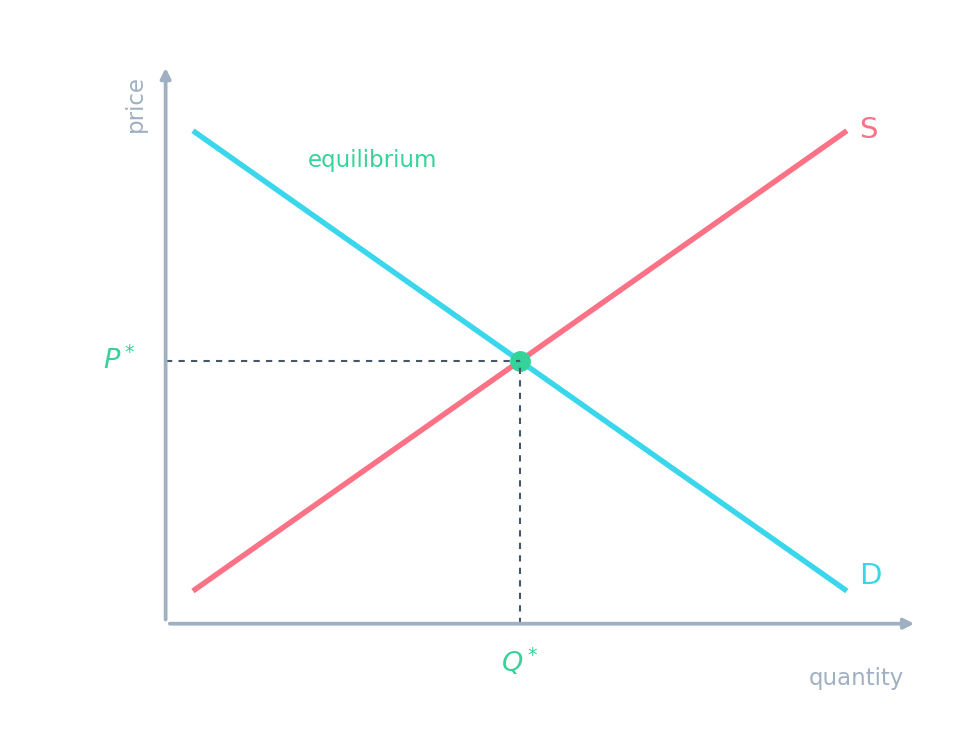
均衡是相交点:需求量等于供给量。
Demand & supply · 需求与供给
Equilibrium · 平衡 is where demand meets supply. · 均衡是需求遇到供给的地方。
If price is set above equilibrium, the result is a: · 如果价格被设在均衡之上,结果是一个:
Above equilibrium, supply exceeds demand — a surplus pushes price down. · 在均衡之上,供给超过需求——一个过剩把价格往下推。
When supply exceeds demand at the current price, there is a . · 当在当前价格供给超过需求时,有一个。
Excess supply is a surplus, which pushes price down. · 过剩的供给是一个过剩,它把价格往下推。
Surplus pushes price down
- If price is above equilibrium, supply exceeds demand → a surplus → sellers cut prices.
- The price falls back towards equilibrium.
Above equilibrium there is excess supply (a surplus); below it, excess demand (a shortage)
过剩把价格往下推
- 如果价格在均衡之上,供给超过需求 → 一个过剩(surplus)→ 卖方削减价格。
- 价格回落向均衡。
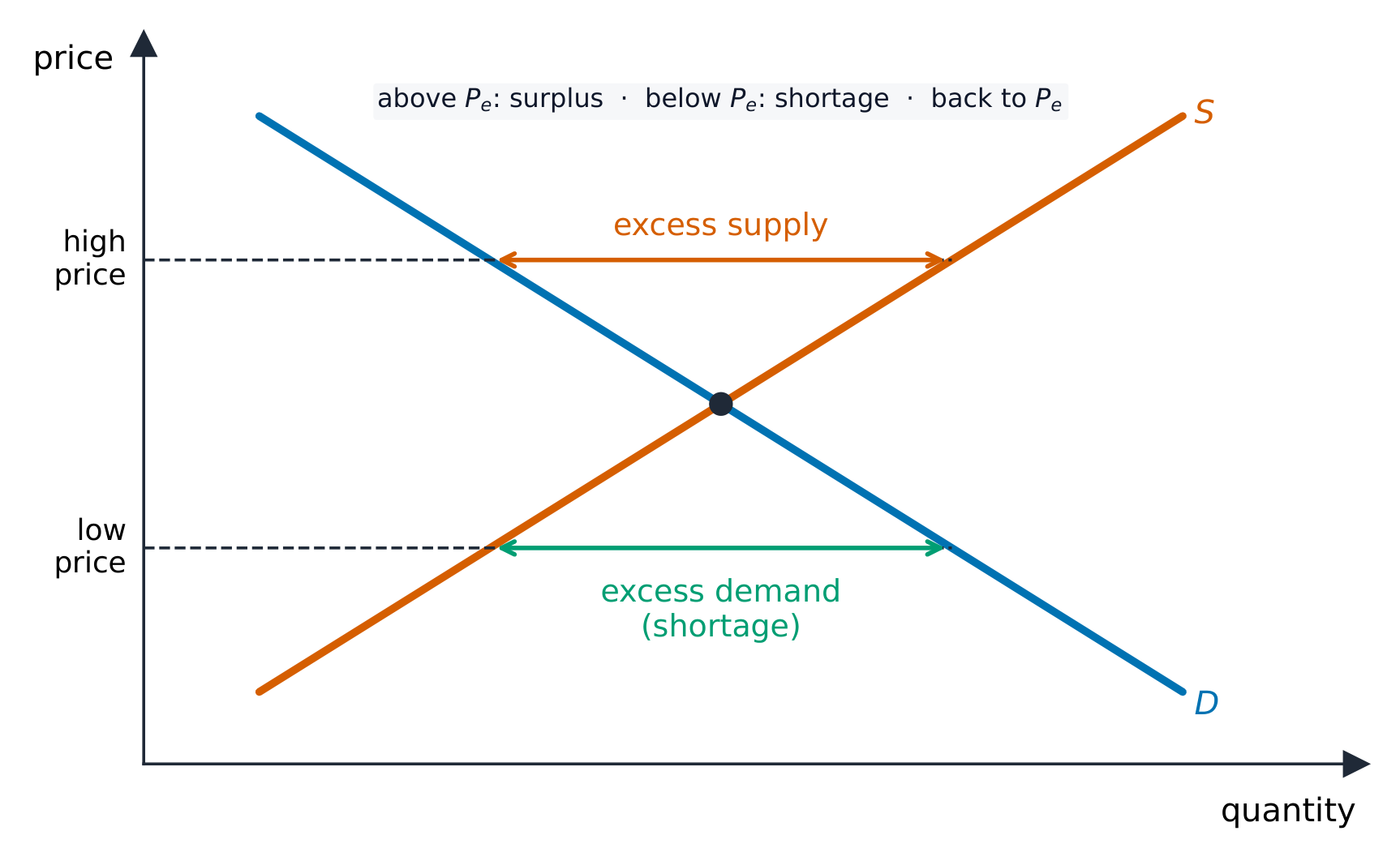
在均衡之上有过剩供给(过剩);在它之下,过剩需求(短缺)
A shortage occurs when price is: · 一个短缺发生在价格:
Below equilibrium, demand exceeds supply — a shortage pushes price up. · 在均衡之下,需求超过供给——一个短缺把价格往上推。
Shortage pushes price up
- If price is below equilibrium, demand exceeds supply → a shortage → buyers bid prices up.
- The price rises back towards equilibrium.
Worked example. Concert tickets priced too low sell out instantly (a shortage) and reappear on resale sites at much higher prices — the market pushing back to equilibrium.
短缺把价格往上推
- 如果价格在均衡之下,需求超过供给 → 一个短缺(shortage)→ 买方把价格抬高。
- 价格回升向均衡。
例题。 定价太低的音乐会门票立刻售罄(一个短缺),并以高得多的价格在转售网站重新出现——市场推回均衡。
You've got it
- equilibrium: quantity demanded = quantity supplied; the market clears
- price above equilibrium → surplus → price falls
- price below equilibrium → shortage → price rises
你掌握了
- 均衡:需求量 = 供给量;市场出清
- 价格在均衡之上 → 过剩 → 价格下降
- 价格在均衡之下 → 短缺 → 价格上升