Demand · 需求
| English | 中文 | Pinyin · 拼音 |
|---|---|---|
| law of demand/lɔː ɒv dɪˈmænd/ | 需求定律 | xū qiú dìng lǜ |
| demand/dɪˈmænd/ | 需求 | xū qiú |
| quantity demanded/ˈkwɒntɪti dɪˈmændɪd/ | 需求量 | xū qiú liàng |
| extension/ekˈstenʃn/ | 扩张 | kuò zhāng |
| contraction/kənˈtrækʃn/ | 收缩 | shōu suō |
| income/ˈɪŋkʌm/ | 收入 | shōu rù |
| tastes/teɪsts/ | 偏好 | piān hǎo |
Why cheaper means more
- Cut the price of pizza in half and you'd probably buy more of it. So would everyone else.
- That everyday instinct is the law of demand 需求定律 — and it shapes every market.
为什么更便宜意味着更多
- 把披萨的价格减半,你可能会买更多。每个人也会。
- 那个日常的直觉是需求定律(law of demand)——而它塑造每个市场。
The law of demand states that, other things equal, as price falls: · 需求定律陈述,其他条件相同,随着价格下降:
Lower price, more demanded — the curve slopes down. · 更低的价格,需求更多——曲线向下倾斜。
Demand requires being both willing and able to pay. · 需求要求既愿意又有能力付款。
Wanting a good is not demand unless you can also afford it. · 想要一个物品不是需求,除非你也买得起它。
The law of demand 需求
- Demand = the quantity buyers are willing and able to buy at each price.
- Law of demand: as price falls, quantity demanded 需求量 rises (and vice versa) — other things equal.
The demand curve slopes down — lower price, more bought.
需求定律
- 需求(demand)= 买方在每个价格愿意且有能力购买的数量。
- 需求定律:随着价格下降,需求量上升(反之亦然)——其他条件相同。
需求曲线向下倾斜——更低的价格,买得更多。
Demand & supply · 需求与供给
Demand · 需求 slopes down — cheaper means more wanted. · 需求向下倾斜——更便宜意味着想要得更多。
A fall in the good's own price causes an ______ of demand (a movement down the curve). · 物品自身价格的一次下降引起需求的一次______(沿曲线向下的一个移动)。
Price fall → extension; price rise → contraction. · 价格下降 → 扩张;价格上升 → 收缩。
Movement along the curve
- A change in the good's own price causes a movement along the demand curve.
- A price fall → an extension 扩张 (more demanded); a price rise → a contraction 收缩 (less demanded).
沿曲线的移动
- 物品自身价格的一个变化引起沿需求曲线的一个移动(movement along)。
- 一次价格下降 → 一次扩张(extension,需求更多);一次价格上升 → 一次收缩(contraction,需求更少)。
Which causes a SHIFT of the demand curve (not a movement along it)? · 哪个引起需求曲线的一个移动(不是沿它的一个移动)?
Income is a non-price factor, so it shifts the whole curve. · 收入是一个非价格因素,所以它使整条曲线移动。
Which factors shift the demand curve? (Select all that apply.) · 哪些因素使需求曲线移动?(选择所有适用的。)
Income, tastes and advertising shift the curve; the own price moves you along it. · 收入、口味和广告使曲线移动;自身价格使你沿它移动。
Shifts in demand
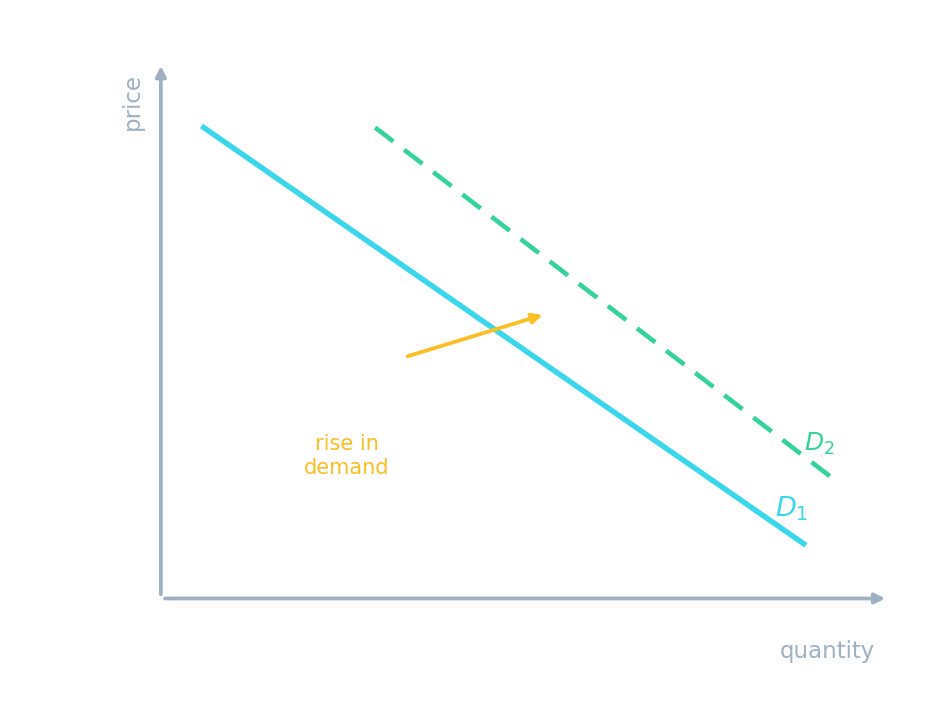
- A change in a non-price factor shifts the whole curve: income 收入, tastes 偏好, prices of related goods, population, advertising.
- Right shift = more demanded at every price; left shift = less.
A change in income, tastes or related prices shifts the whole demand curve right or left
Movement vs shift. Only the good's own price moves you along the curve. Everything else (income, tastes…) shifts the whole curve. Mixing these up is the most common demand error.
需求的移动
- 一个非价格因素的变化使整条曲线移动:收入、口味、相关物品的价格、人口、广告。
- 右移 = 在每个价格需求更多;左移 = 更少。

收入、口味或相关价格的变化使整条需求曲线向右或向左移动
沿曲线移动对移动曲线。 只有物品的自身价格使你沿曲线移动。其他一切(收入、口味……)移动整条曲线。把这些搞混是最常见的需求错误。
You've got it
- demand = willing and able to buy at each price
- law of demand: price down → quantity demanded up (curve slopes down)
- own price → move along; other factors → shift the curve
你掌握了
- 需求 = 在每个价格愿意且有能力购买
- 需求定律:价格下降 → 需求量上升(曲线向下倾斜)
- 自身价格 → 沿曲线移动;其他因素 → 移动曲线