Group VII properties · 第 VII 族性质
| English | 中文 | Pinyin · 拼音 |
|---|---|---|
| Group VII/ɡruːp ˈsevn/ | 第七族 | dì qī zú |
| halogens/ˈhælədʒnz/ | 卤素 | lǔ sù |
| diatomic molecules/ˌdaɪəˈtɒmɪk ˈmɒlɪkjuːlz/ | 双原子分子 | shuāng yuán zi fèn zǐ |
| displace/dɪˈspleɪs/ | 置换 | zhì huàn |
The reactive Group VII 第七族 non-metals
- Chlorine bleaches, iodine stains — the Group VII elements (the halogens 卤素) are reactive non-metals.
- They show clear trends down the group.
活泼的第 VII 族非金属
- 氯漂白,碘染色——第 VII 族(Group VII)元素(卤素)是活泼的非金属。
- 它们沿族向下显示清晰的趋势。
Group VII trend lab · 第 VII 族趋势实验
Follow halogens down the group and watch reactivity decrease. · 沿卤素族向下观察,反应性减弱。
How many electrons are in the outer shell of a Group VII element? · 第 VII 族元素最外层有多少个电子?
Halogens have seven outer electrons. · 卤素有七个最外层电子。
Halogens gain one electron to form ions with a charge of: · 卤素获得一个电子形成带电荷的离子:
Gaining one electron gives a −1 ion. · 获得一个电子形成 −1 价离子。
Halogens exist as molecules made of two atoms, described as ______. · 卤素以由两个原子组成的分子形式存在,称为 ______。
Cl₂, Br₂ and I₂ are diatomic. · Cl₂、Br₂ 和 I₂ 是双原子分子。
Properties of the halogens
- They exist as diatomic molecules 双原子分子 (Cl₂, Br₂, I₂).
- They have seven outer electrons and gain one to form −1 ions.
Group I gets more reactive down the group; Group VII gets less reactive down
卤素的性质
- 它们作为双原子分子(diatomic molecules)存在(Cl₂、Br₂、I₂)。
- 它们有七个外层电子,并获得一个以形成 −1 离子。
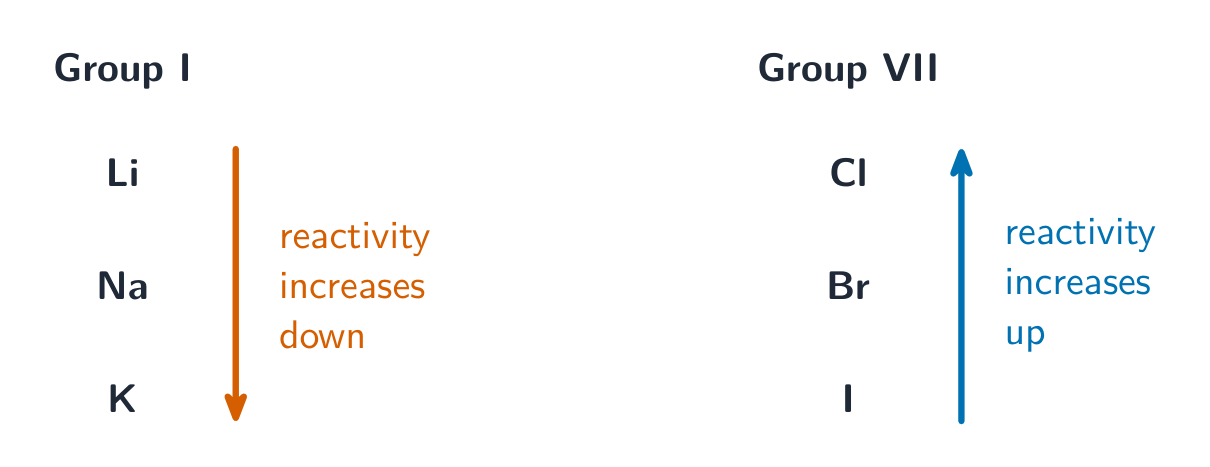
第 I 族沿族向下变得更活泼;第 VII 族沿族向下变得更不活泼
Going down Group VII, reactivity: · 沿第 VII 族向下,反应性:
Halogens get less reactive down the group. · 卤素越往下反应性越低。
Trends down the group
- Going down: colour gets darker and they become less reactive.
- The melting and boiling points increase (fluorine gas → bromine liquid → iodine solid).
沿族向下的趋势
- 向下:颜色变得更深,而它们变得更不活泼。
- 熔点和沸点增加(氟气 → 溴液 → 碘固体)。
A more reactive halogen will: · 反应性更强的卤素会:
More reactive halogens displace less reactive ones. · 反应性较强的卤素能置换反应性较弱的卤素。
Displacement reactions
- A more reactive halogen will displace 置换 a less reactive one from its salt.
- For example, chlorine displaces bromine from a bromide solution.
Worked example. Add chlorine to potassium bromide solution. Chlorine is more reactive, so it displaces the bromine: the solution turns orange as bromine is released. Reactivity decreases down the group.
Chlorine is more reactive, so it displaces bromine; the released bromine turns the colourless solution orange
置换反应
- 一个更活泼的卤素会从它的盐中置换(displace)一个不那么活泼的。
- 例如,氯从一个溴化物溶液中置换溴。
例题。 把氯加到溴化钾溶液中。氯更活泼,所以它置换溴:溶液变成橙色,因为溴被释放。活泼性沿族向下减少。

氯更活泼,所以它置换溴;释放的溴把无色溶液变成橙色
You've got it
- Group VII (halogens) are diatomic, with seven outer electrons (form −1 ions)
- down the group: darker colour, less reactive, higher melting/boiling points
- a more reactive halogen displaces a less reactive one from its salt
你掌握了
- 第 VII 族(卤素)是双原子的,有七个外层电子(形成 −1 离子)
- 沿族向下:颜色更深、更不活泼、更高的熔点/沸点
- 一个更活泼的卤素从它的盐中置换一个不那么活泼的