Active transport · 主动运输
| English | 中文 | Pinyin · 拼音 |
|---|---|---|
| active transport/ˈæktɪv ˈtrænspɔːt/ | 主动运输 | zhǔ dòng yùn shū |
| passive/ˈpæsɪv/ | 被动的 | bèi dòng de |
Moving things the "wrong" way
- Sometimes a cell needs to take in a substance even when there's already more inside than outside.
- That means moving against the gradient — which needs energy. This is active transport 主动运输.
把东西往"错误"的方向移动
- 有时一个细胞需要摄取一种物质,即使内部已经比外部多。
- 那意味着逆着梯度移动——这需要能量。这是主动运输(active transport)。
Active transport moves particles: · 主动运输移动颗粒:
Active transport goes against the gradient and needs energy. · 主动运输逆着梯度并需要能量。
The energy for active transport comes from: · 主动运输的能量来自:
Respiration releases the energy used. · 呼吸作用释放所用的能量。
Active transport moves substances ______ the concentration gradient. · 主动运输______浓度梯度移动物质。
From low to high concentration, unlike diffusion. · 从低浓度到高浓度,不像扩散。
What active transport is
- Active transport is the movement of particles from a low to a high concentration (against the gradient), using energy.
- The energy comes from respiration.
Active transport moves particles against the gradient, using energy and a carrier protein
主动运输是什么
- 主动运输是颗粒从低到高浓度(逆着梯度)、使用能量的移动。
- 能量来自呼吸作用(respiration)。
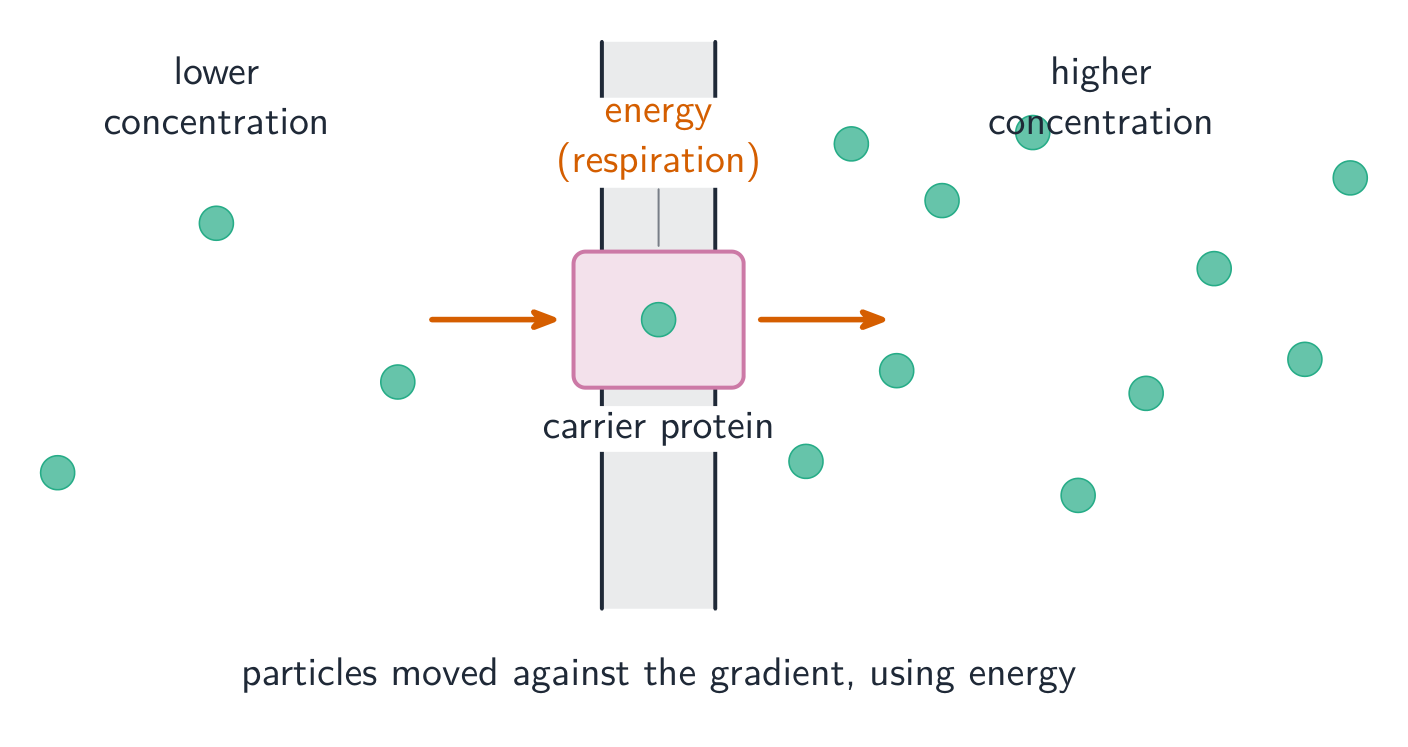
主动运输逆着梯度移动颗粒,使用能量和一个载体蛋白
Active transport step by step · 逐步看主动运输
Step the carrier protein through its cycle: it uses energy from ATP to move a particle against the gradient, from low to high. · 让载体蛋白走过它的循环:它用 ATP 的能量把粒子逆浓度梯度从低运到高。
Active transport — pumping uphill · 主动运输——向上泵送
Unlike diffusion, active transport moves substances AGAINST the concentration gradient, so it needs energy. · 不像扩散,主动运输逆着浓度梯度移动物质,所以它需要能量。
Root hair cells use active transport to absorb: · 根毛细胞使用主动运输来吸收:
Minerals are scarce in soil, so they must be pulled in actively. · 矿物质在土壤中稀少,所以它们必须被主动拉进来。
Why cells need it
- It lets cells absorb substances that are scarce outside.
- Root hair cells use it to take in minerals from very dilute soil water.
Water entering or leaving a plant cell makes it turgid, flaccid or plasmolysed
为什么细胞需要它
- 它让细胞吸收外部稀少的物质。
- 根毛细胞用它从非常稀的土壤水中摄取矿物质。

水进入或离开一个植物细胞使它膨胀、萎蔫或质壁分离
Diffusion and osmosis are passive (no energy), while active transport needs energy. · 扩散和渗透是被动的(不需能量),而主动运输需要能量。
Only active transport requires energy. · 只有主动运输需要能量。
Comparing the three
- Diffusion and osmosis: high → low, no energy (passive 被动的).
- Active transport: low → high, needs energy (active).
Worked example. Soil has very little mineral salt, yet a root must absorb it. Diffusion can't help (it would go the wrong way), so the root hair cell uses active transport, powered by respiration, to pull minerals in.
比较这三个
- 扩散和渗透:高 → 低,不需要能量(被动)。
- 主动运输:低 → 高,需要能量(主动)。
例题。 土壤有非常少的矿物盐,然而一个根必须吸收它。扩散帮不了忙(它会走错方向),所以根毛细胞使用主动运输,由呼吸作用驱动,把矿物质拉进来。
You've got it
- active transport moves particles low → high concentration, using energy from respiration
- it absorbs substances that are scarce outside (e.g. minerals in roots)
- diffusion/osmosis are passive (no energy); active transport is active (needs energy)
你掌握了
- 主动运输把颗粒从低 → 高浓度移动,使用来自呼吸作用的能量
- 它吸收外部稀少的物质(例如根中的矿物质)
- 扩散/渗透是被动的(不需要能量);主动运输是主动的(需要能量)