Kirchhoff's Junction Rule · 基尔霍夫节点定律
| English | 中文 | Pinyin · 拼音 |
|---|---|---|
| junction/ˈdʒʌŋkʃn/ | 节点 | jié diǎn |
| Kirchhoff's junction rule/ˈkɜːkhɒfs ˈdʒʌŋkʃn ruːl/ | 基尔霍夫节点定则 | jī ěr huò fū jié diǎn dìng zé |
At a fork in the wire, where does the current go?
- Wires often split: one path becomes two or three.
- The current can't pile up or vanish at the split.
- Whatever flows in must flow out — that is the junction rule.
- It is the partner of the loop rule for solving networks.
在导线的岔口,电流往哪里去?
- 导线常常分岔:一条路变成两条或三条。
- 电流不能在岔口堆积或消失。
- 流进多少就得流出多少——这就是节点定律。
- 它是回路定律解网络的搭档。
The junction rule: current in = current out
- At any junction 节点 (a meeting of wires), $\sum I_{\text{in}} = \sum I_{\text{out}}$.
- Charge is conserved, so none builds up at the point.
- If $I_1$ enters and $I_2, I_3$ leave: $I_1 = I_2 + I_3$.
- The branches share the incoming current between them.
节点定律:流入 = 流出
- 在任何节点(导线的交汇处),$\sum I_{\text{in}} = \sum I_{\text{out}}$。
- 电荷守恒,所以在那个点没有堆积。
- 若 $I_1$ 流入而 $I_2, I_3$ 流出:$I_1 = I_2 + I_3$。
- 各支路分享流入的电流。
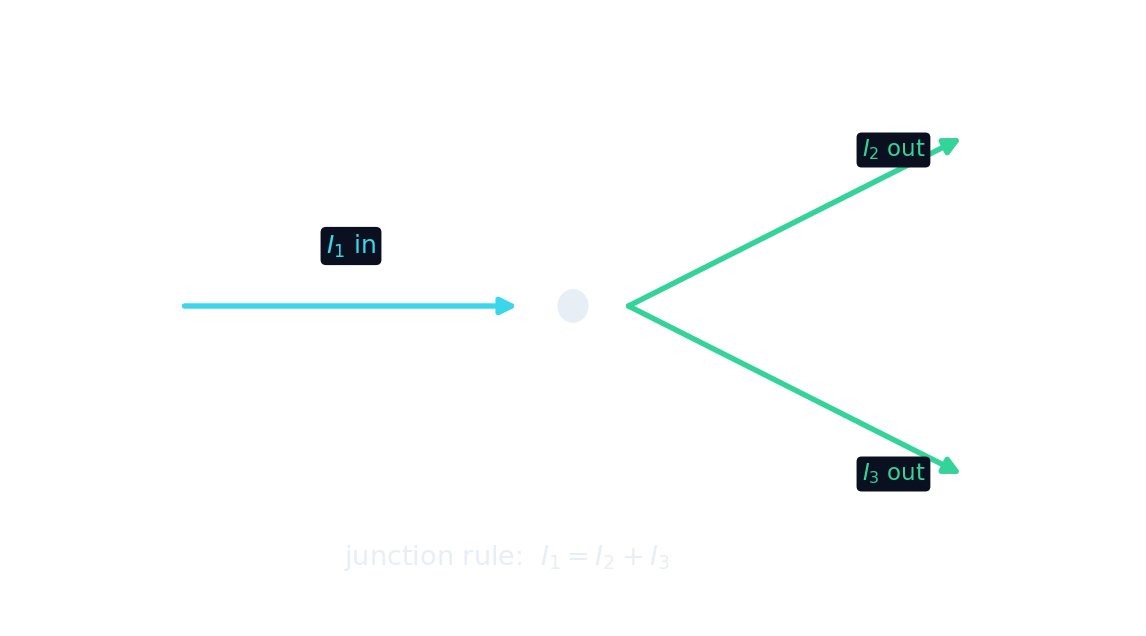
Split the current · 分流电流
Wire two parallel branches and see the current divide between them at the junction. · 连接两条并联支路,观察电流在节点处的分配情况。
Kirchhoff's junction rule states that at a junction: · 基尔霍夫节点定律指出,在节点处:
$\sum I_{\text{in}} = \sum I_{\text{out}}$ — charge is conserved. · $\sum I_{\text{in}} = \sum I_{\text{out}}$ — 电荷守恒。
$7\ \text{A}$ enters a junction and one branch carries $4\ \text{A}$. Find the other branch current (in A). · $7\ \text{A}$ 进入一个节点,一条支路承载$4\ \text{A}$。求另一条支路的电流(单位为A)。
$7 = 4 + I_2 \Rightarrow I_2 = 3\ \text{A}$.
A point where wires meet and current can split is called a . · 导线汇合且电流可分流的一点称为。
That meeting point is a junction (or node). · 该汇合点称为节点(或结点)。
Why: charge can't accumulate
- A junction is just a point of wire — it holds no charge.
- So the rate in must equal the rate out at every instant.
- This is the conservation of charge applied to a point.
- Break it and charge would build up without limit — impossible.
为什么:电荷不能累积
- 节点只是导线上的一个点——它不持有电荷。
- 所以每一刻流入的速率必须等于流出的速率。
- 这是电荷守恒应用于一个点。
- 若打破它,电荷就会无限堆积——不可能。
The junction rule expresses the conservation of: · 节点定律表达了以下哪项守恒:
No charge accumulates at a point — charge is conserved. · 某一点没有电荷积累 —— 电荷守恒。
Bigger branches carry more current
- At equal voltage, the branch with less resistance carries more current.
- Current splits in inverse proportion to the branch resistances.
- The easiest path takes the biggest share.
- Add up all the branch currents and you recover the total.
更大的支路携带更多电流
- 在相同电压下,电阻更小的支路携带更多电流。
- 电流按支路电阻的反比分配。
- 最容易的路径拿走最大的份额。
- 把所有支路电流加起来,你就恢复总电流。
At a split, the branch with less resistance carries more current. · 在分流点,电阻较小的支路承载更多电流。
At equal voltage, current is largest in the lowest-resistance branch. · 在相同电压下,电流最大的支路电阻最低。
Select all · 所有 true statements about the junction rule. · 选择所有关于节点定律的正确陈述。
Junction rule: current in = out, charge conservation, more current in easy branches. Voltage-round-a-loop is the loop rule. · 节点定律:输入电流 = 输出电流,电荷守恒,易通支路电流更大。回路电压是回路定律。
Solving with both rules
- Junction rule gives current equations; loop rule gives voltage equations.
- Together they give enough equations for every unknown current.
- Label each branch current, apply both rules, and solve.
- This pair cracks any resistor network, however tangled.
用两条定律求解
- 节点定律给出电流方程;回路定律给出电压方程。
- 两者一起为每个未知电流给出足够的方程。
- 标出每条支路电流,应用两条定律,求解。
- 这一对能攻克任何电阻网络,不管多缠绕。
A $5\ \text{A}$ current reaches a junction and splits into two branches; one carries $2\ \text{A}$.
- Junction rule: $5 = 2 + I_2$.
- So the other branch carries $I_2 = 3\ \text{A}$.
一个 $5\ \text{A}$ 电流到达一个节点并分成两条支路;一条携带 $2\ \text{A}$。
- 节点定律:$5 = 2 + I_2$。
- 所以另一条支路携带 $I_2 = 3\ \text{A}$。
The junction rule is about current (charge conservation), while the loop rule is about voltage (energy conservation). Don't mix them up: currents meet at junctions, voltages balance around loops.
节点定律讲的是电流(电荷守恒),而回路定律讲的是电压(能量守恒)。别把它们弄混:电流在节点交汇,电压绕回路平衡。
Kirchhoff's junction rule 基尔霍夫节点定则 says the current into a junction equals the current out: $\sum I_{\text{in}} = \sum I_{\text{out}}$. It is conservation of charge at a point. Paired with the loop rule, it solves any resistor network.
基尔霍夫节点定律说流入节点的电流等于流出的:$\sum I_{\text{in}} = \sum I_{\text{out}}$。它是一个点上的电荷守恒。与回路定律配对,它能解任何电阻网络。