Resistor-Capacitor (RC) Circuits · RC电路(电阻-电容电路)
| English | 中文 | Pinyin · 拼音 |
|---|---|---|
| time constant/taɪm ˈkɒnstənt/ | 时间常数 | shí jiān cháng shù |
| exponential/ˌekspəˈnenʃl/ | 指数 | zhǐ shù |
Why does a camera flash take a moment to recharge?
- Press the shutter, and the flash needs a second before it can fire again.
- A capacitor is refilling with charge through a resistor.
- The resistor limits the current, so the filling is gradual, not instant.
- A resistor and capacitor together make an RC circuit — the physics of timing.
为什么相机闪光灯需要一会儿才能再次充电?
- 按下快门,闪光灯要过一秒才能再次触发。
- 一个电容器正通过一个电阻重新充满电荷。
- 电阻限制电流,所以充电是渐进的,不是瞬间的。
- 电阻和电容器合在一起构成一个 RC 电路——计时的物理。
Charging rises toward a limit
- Close the switch and charge flows onto the capacitor: $Q(t) = CV\left(1 - e^{-t/RC}\right)$.
- It climbs fast at first, then slows as the capacitor fills.
- It approaches, but never quite reaches, the final charge $CV$.
- The current does the opposite: large at first, fading to zero.
充电向一个极限上升
- 合上开关,电荷流到电容器上:$Q(t) = CV\left(1 - e^{-t/RC}\right)$。
- 它起初爬得快,随着电容器充满而变慢。
- 它接近但永远不完全达到最终电荷 $CV$。
- 电流则相反:起初大,渐渐衰减到零。
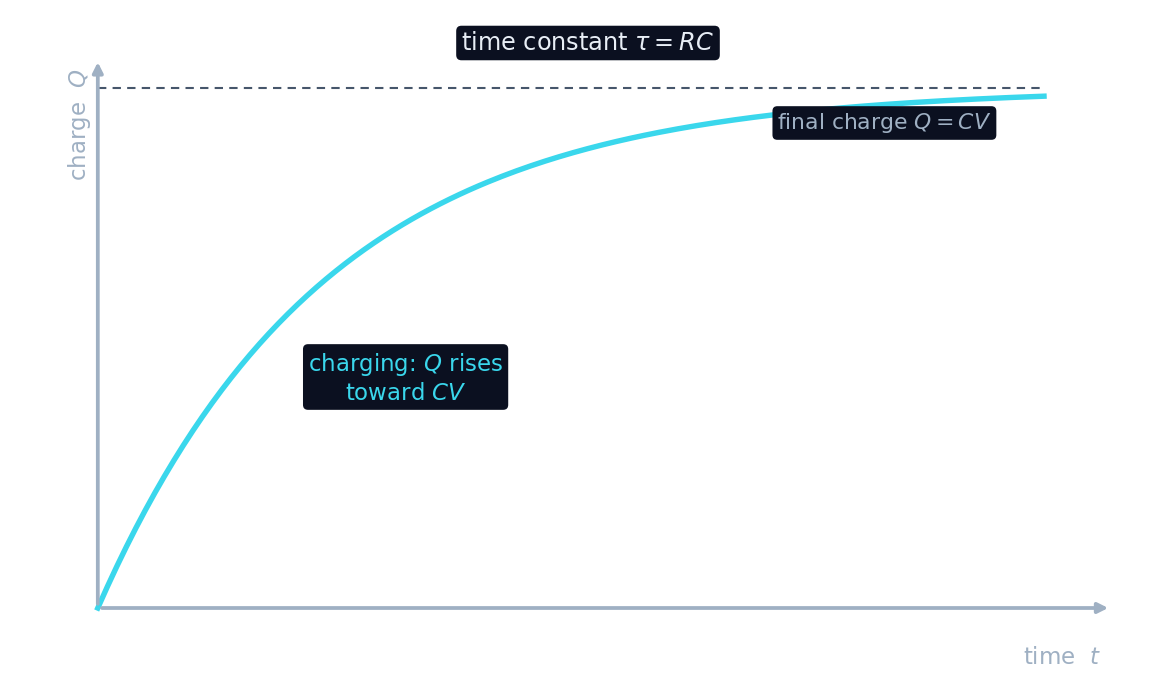
Charge through a resistor · 通过电阻的电荷
Watch the capacitor fill gradually and the charging current fade toward zero. · 观察电容器逐渐充满电以及充电电流逐渐趋近于零。
The time constant τ = RC
- The product $\tau = RC$ is the time constant 时间常数 — the natural timescale.
- In one $\tau$, the charge reaches about $63\%$ of its final value.
- After about $5\tau$, it is essentially fully charged.
- Bigger $R$ or bigger $C$ means slower charging.
时间常数 τ = RC
- 乘积 $\tau = RC$ 是时间常数——自然的时间尺度。
- 在一个 $\tau$ 内,电荷达到最终值的约 $63\%$。
- 大约 $5\tau$ 之后,它基本上完全充满。
- 更大的 $R$ 或更大的 $C$ 意味着充电更慢。
The time constant of an RC circuit is: · RC电路的时间常数是:
$\tau = RC$ sets the charging and discharging timescale. · $\tau = RC$ 决定了充放电的时间尺度。
A $5\ \Omega$ resistor charges a $4\ \text{F}$ capacitor. Find $\tau$ (in s). · 一个$5\ \Omega$电阻给一个$4\ \text{F}$电容器充电。求$\tau$(单位为s)。
$\tau = RC = 5 \times 4 = 20\ \text{s}$.
After one time constant, the charge reaches about 63% of its final value. · 经过一个时间常数后,电荷达到最终值的约63%。
$1 - e^{-1} \approx 0.63$ after one $\tau$. · $1 - e^{-1} \approx 0.63$ 经过一个 $\tau$ 之后。
Discharging fades away
- Disconnect the source and let the capacitor drive the resistor.
- The charge decays: $Q(t) = Q_0\, e^{-t/RC}$ — an exponential 指数 fall.
- The current and voltage decay with the same time constant $\tau = RC$.
- Each $\tau$ the charge drops to about $37\%$ of what it was.
放电逐渐消退
- 断开电源,让电容器驱动电阻。
- 电荷衰减:$Q(t) = Q_0\, e^{-t/RC}$——一次指数下降。
- 电流和电压以相同的时间常数 $\tau = RC$ 衰减。
- 每一个 $\tau$,电荷降到之前的约 $37\%$。
A discharging capacitor loses charge as an ____ decay, $Q = Q_0 e^{-t/RC}$. · 放电电容器的电荷呈____衰减,$Q = Q_0 e^{-t/RC}$。
Discharge is exponential: $Q = Q_0 e^{-t/RC}$. · 放电是指数型的:$Q = Q_0 e^{-t/RC}$。
The capacitor's two extremes
- At the first instant ($t = 0$): the empty capacitor acts like a plain wire.
- After a long time ($t \to \infty$): the full capacitor acts like an open gap.
- So current starts high and ends at zero as the capacitor fills.
- Those two limits let you check any RC answer quickly.
电容器的两个极端
- 在最初一刻($t = 0$):空电容器像一根普通的导线。
- 经过很长时间后($t \to \infty$):满电容器像一个断开的缺口。
- 所以电流起初大,随电容器充满而终于为零。
- 那两个极限让你能快速检验任何 RC 答案。
At the first instant of charging ($t = 0$), an uncharged capacitor acts like: · 在充电开始瞬间($t = 0$),未充电的电容器表现为:
Empty, it offers no back-voltage, so it behaves like a wire (max current). · 空载时不提供反电动势,因此表现得像导线(最大电流)。
Select all · 所有 true statements about RC circuits. · 选择所有关于RC电路的正确陈述。
Exponential charging, τ = RC, open gap when full. Charging is gradual, never instant. · 指数充电,τ = RC,充满时表现为开路。充电是渐进的,非瞬时完成。
A $2\ \Omega$ resistor charges a $3\ \text{F}$ capacitor. Find the time constant.
- $\tau = RC = 2 \times 3 = 6\ \text{s}$.
- After $6\ \text{s}$ the charge is about $63\%$ of its final value.
一个 $2\ \Omega$ 电阻给一个 $3\ \text{F}$ 电容器充电。求时间常数。
- $\tau = RC = 2 \times 3 = 6\ \text{s}$。
- $6\ \text{s}$ 后电荷约为最终值的 $63\%$。
At $t = 0$ an uncharged capacitor behaves like a wire (max current), and at $t \to \infty$ a charged one behaves like an open gap (zero current). Swapping these two limits is the classic RC mistake — check which instant the question asks about.
在 $t = 0$ 时,未充电的电容器表现得像一根导线(最大电流);在 $t \to \infty$ 时,充满的电容器表现得像一个断开的缺口(零电流)。交换这两个极限是经典的 RC 错误——检查问题问的是哪一刻。
In an RC circuit, charging follows $Q = CV(1 - e^{-t/RC})$ and discharging $Q = Q_0 e^{-t/RC}$, both with time constant $\tau = RC$ (about $63\%$ per $\tau$). A capacitor starts like a wire ($t=0$) and ends like an open gap ($t\to\infty$).
在 RC 电路中,充电遵循 $Q = CV(1 - e^{-t/RC})$,放电遵循 $Q = Q_0 e^{-t/RC}$,都以时间常数 $\tau = RC$(每个 $\tau$ 约 $63\%$)。电容器起初像导线($t=0$),终于像断开的缺口($t\to\infty$)。