Electric Circuits · 电路
| English | 中文 | Pinyin · 拼音 |
|---|---|---|
| circuit/ˈsɜːkɪt/ | 电路 | diàn lù |
| electromotive force/ɪˌlektrəʊˈməʊtɪv fɔːs/ | 电动势 | diàn dòng shì |
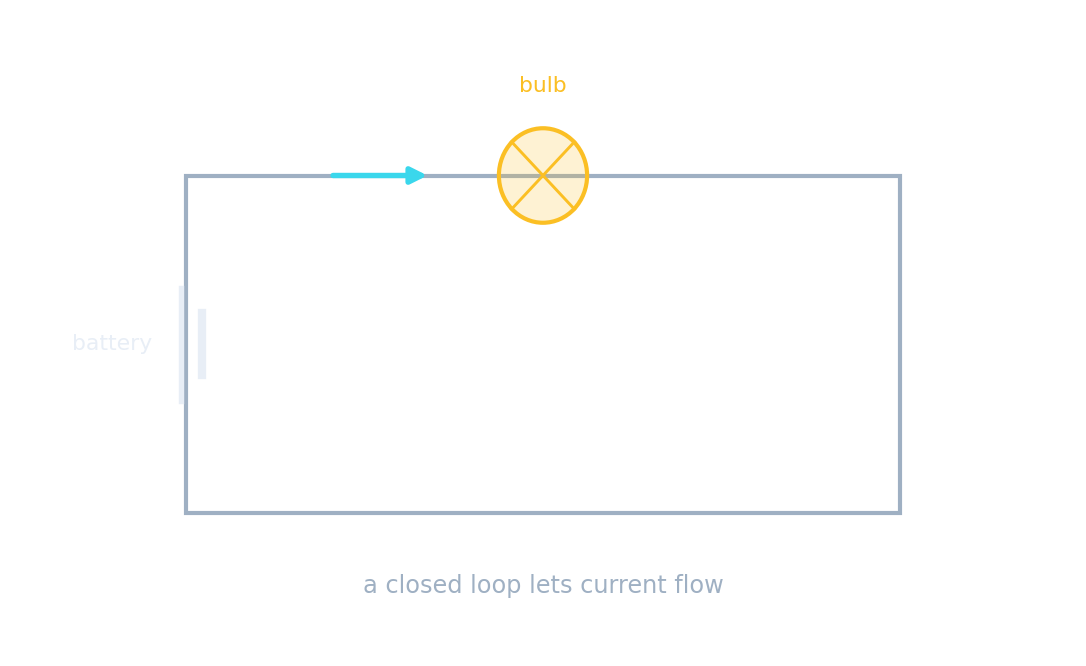
A battery, a wire, a bulb — the smallest complete loop
- Connect a battery to a bulb with wires and the bulb lights.
- Break the wire anywhere and it goes dark at once.
- Current needs an unbroken circuit 电路 — a closed loop.
- This lesson sets up the parts every circuit is built from.
一个电池、一根导线、一个灯泡——最小的完整回路
- 用导线把电池连到灯泡,灯泡就亮。
- 在任何地方弄断导线,它立刻熄灭。
- 电流需要一个不断的电路——一个闭合回路。
- 这一课搭起每个电路都由之构成的部件。
The battery provides EMF
- A battery pushes charge with an electromotive force 电动势 (EMF), symbol $\varepsilon$.
- EMF is the energy given to each coulomb, measured in volts.
- It is not really a "force" — it is energy per charge.
- The battery is the pump that keeps the current flowing.
电池提供电动势
- 电池用电动势(EMF)推动电荷,符号 $\varepsilon$。
- 电动势是给每一库仑的能量,以伏特量度。
- 它其实不是"力"——它是单位电荷的能量。
- 电池就是让电流持续流动的泵。
Build a circuit · 搭建电路
Connect a battery to bulbs and see current flow only when the loop is complete. · 将电池连接到灯泡上,观察只有在回路完整时才有电流流过。
The EMF of a battery is: · 电池的电动势 (EMF) 是:
EMF is energy per charge, in volts — not really a force. · EMF 是每单位电荷的能量,单位为伏特——并非真正的力。
The component that gives energy to the charges is the ____. · 为电荷提供能量的组件是 ____。
The battery supplies the EMF that drives the current. · 电池提供驱动电流的电动势。
The loop must be complete
- Charge can only flow if there is a path back to the battery.
- Any break — a gap, an open switch — stops the current everywhere.
- A switch simply makes or breaks that loop on demand.
- No closed loop, no current.
回路必须完整
- 只有存在返回电池的路径,电荷才能流动。
- 任何断口——一个缺口、一个断开的开关——都会处处停下电流。
- 开关只是按需接通或断开那个回路。
- 没有闭合回路,就没有电流。
Opening a switch anywhere in a simple loop stops the current everywhere. · 打开简单回路中的任意开关都会停止所有电流。
A break anywhere opens the loop, so no current flows at all. · 任意断开都会打开回路,因此完全没有电流流过。
A ____ makes or breaks the loop to turn a circuit on or off. · ____ 用于接通或断开回路以开启或关闭电路。
A switch opens or closes the loop on demand. · 开关按需打开或闭合回路。
Reading circuit symbols
- A battery is a long and short line; a resistor is a rectangle (or zig-zag).
- A bulb is a circle with a cross; a wire is a plain line.
- These symbols let us draw any circuit clearly.
- A neat diagram is the first step to solving a circuit.
读电路符号
- 电池是一长一短两条线;电阻是一个矩形(或折线)。
- 灯泡是带叉的圆;导线是一条平直的线。
- 这些符号让我们清晰地画出任何电路。
- 一张整洁的电路图是解电路的第一步。
Select all · 所有 true statements about circuits. · 选择关于电路的 所有 正确陈述。
Complete loop, EMF per charge, battery gives / resistors take. A break stops the whole loop. · 完整回路,每单位电荷的电动势,电池提供/电阻消耗。断路会停止整个回路。
The energy journey
- The battery gives each charge energy (a voltage rise).
- Components like bulbs and resistors take that energy (a voltage drop).
- Around a full loop, the energy given equals the energy used.
- That balance becomes Kirchhoff's loop rule later.
能量之旅
- 电池给每个电荷能量(电压上升)。
- 灯泡和电阻这类元件取走那份能量(电压下降)。
- 绕完整一圈,给出的能量等于用掉的能量。
- 这个平衡稍后成为基尔霍夫回路定律。
Around a complete loop, the energy the battery gives each charge: · 围绕完整回路,电池提供给每个电荷的能量:
Energy given equals energy used — the loop-rule balance. · 提供的能量等于消耗的能量——回路规则的平衡。
A bulb won't light when connected to a battery. The switch is open.
- An open switch breaks the loop, so no current flows.
- Close the switch to complete the circuit and the bulb lights.
一个灯泡接到电池上却不亮。开关是断开的。
- 断开的开关切断回路,所以没有电流。
- 合上开关完成电路,灯泡就亮。
EMF is energy per charge (volts), not a force despite its name. And a battery only drives current when the circuit is a complete loop — a single broken wire stops the current in the whole circuit, not just at the break.
电动势是单位电荷的能量(伏特),尽管名字里有"力"但它不是力。而且电池只在电路是完整回路时才驱动电流——一根断掉的导线会停下整个电路的电流,不只是断口处。
A circuit is a closed loop driven by a battery's electromotive force (EMF, $\varepsilon$) — energy per charge in volts. Current flows only when the loop is complete. The battery gives energy; resistors and bulbs take it, balancing around the loop.
电路是由电池的电动势(EMF,$\varepsilon$)驱动的闭合回路——单位电荷的能量,以伏特计。只有回路完整时电流才流动。电池给能量;电阻和灯泡取走它,绕回路平衡。