Resistance, Resistivity, and Ohm's Law · 电阻、电阻率与欧姆定律
| English | 中文 | Pinyin · 拼音 |
|---|---|---|
| resistance/rɪˈzɪstəns/ | 电阻 | diàn zǔ |
| resistivity/ˌriːzɪˈstɪvəti/ | 电阻率 | diàn zǔ lǜ |
| ohms/əʊmz/ | 欧姆 | ōu mǔ |
Why does a thin wire get hot while a thick one stays cool?
- Push the same current through a thin wire and it heats up fast.
- The thin wire fights the flow more — it has more resistance 电阻.
- Resistance is how hard a component makes it for charge to pass.
- Two ideas run this lesson: Ohm's law and resistivity.
为什么细导线会发热而粗导线保持凉爽?
- 让相同电流通过细导线,它很快就发热。
- 细导线更抗拒流动——它有更大的电阻。
- 电阻就是元件让电荷通过的难易程度。
- 两个想法贯穿这一课:欧姆定律和电阻率。
Ohm's law: V = IR
- For many materials, voltage and current are proportional: $V = IR$.
- The constant $R$ is the resistance, in ohms 欧姆 ($\Omega$).
- On an $I$–$V$ graph this is a straight line through the origin.
- Rearranged: more resistance means less current for a given voltage.
欧姆定律:V = IR
- 对许多材料,电压和电流成正比:$V = IR$。
- 常数 $R$ 是电阻,单位欧姆($\Omega$)。
- 在 $I$–$V$ 图上这是一条过原点的直线。
- 重排后:电阻越大,给定电压下电流越小。
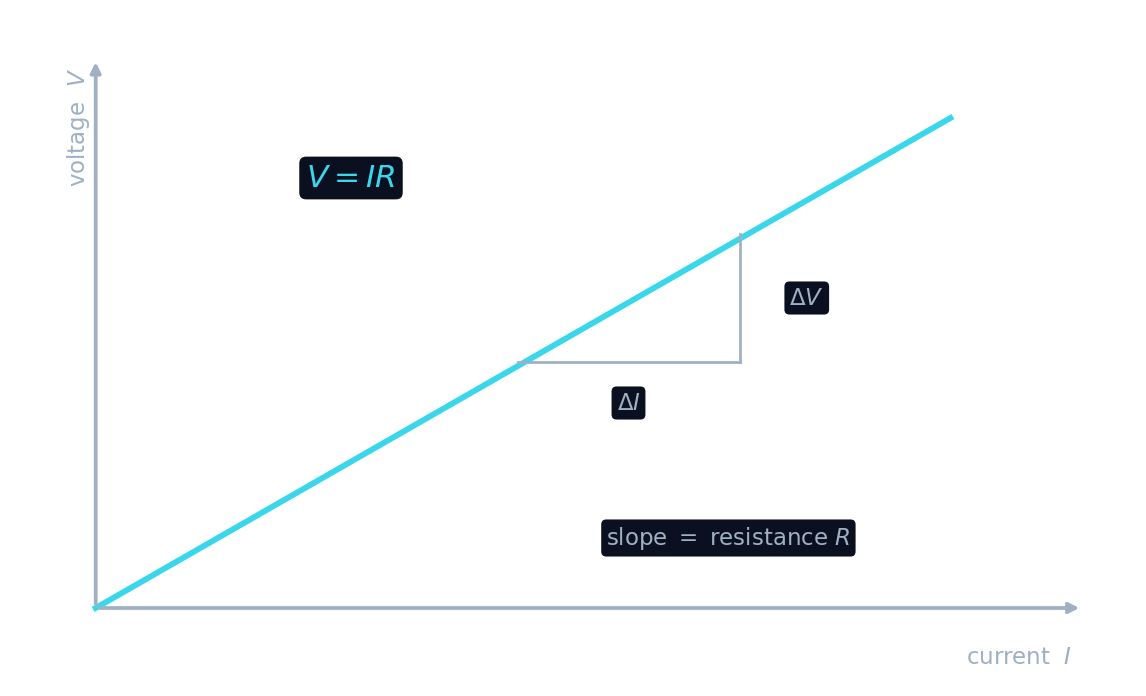
Trace the I–V line · 追踪I–V图线
Vary the voltage across a resistor and watch the current follow a straight line. · 改变电阻两端的电压,观察电流是否沿直线变化。
Ohm's law relates voltage, current and resistance as: · 欧姆定律将电压、电流和电阻的关系表示为:
$V = IR$ for an ohmic device. · $V = IR$ 适用于欧姆器件。
A $9\ \text{V}$ supply drives $3\ \text{A}$ through a resistor. Find $R$ (in Ω). · $9\ \text{V}$电源驱动$3\ \text{A}$通过电阻器。求$R$(单位为Ω)。
$R = V/I = 9/3 = 3\ \Omega$.
Resistivity: material and shape
- Resistance depends on the wire's shape and its material: $R = \dfrac{\rho L}{A}$.
- Resistivity 电阻率 $\rho$ is the material's own opposition to flow.
- Longer wire → more resistance; thicker wire (bigger $A$) → less.
- Copper has low $\rho$ (a good conductor); nichrome has high $\rho$ (a heater).
电阻率:材料与形状
- 电阻取决于导线的形状和材料:$R = \dfrac{\rho L}{A}$。
- 电阻率 $\rho$ 是材料自身对流动的抗拒。
- 更长的导线 → 更大电阻;更粗的导线(更大 $A$)→ 更小。
- 铜的 $\rho$ 低(良导体);镍铬合金的 $\rho$ 高(发热丝)。
Using $R = \rho L/A$, a longer, thinner wire has: · 使用$R = \rho L/A$,一根更长、更细的导线具有:
More length and less area both raise $R = \rho L/A$. · 长度增加和横截面积减小都会提高$R = \rho L/A$。
A material's own opposition to current, symbol $\rho$, is its . · 材料自身对电流的阻碍作用,符号为$\rho$,称为。
Resistivity $\rho$ is the material property in $R = \rho L/A$. · 电阻率$\rho$是材料属性,单位为$R = \rho L/A$。
Ohmic vs non-ohmic
- Ohmic devices keep a constant $R$ — a straight $I$–$V$ line.
- Non-ohmic devices (a bulb, a diode) bend the line.
- A bulb's filament heats up, so its resistance rises with current.
- Always check whether $R$ is really constant before using $V = IR$ blindly.
欧姆性与非欧姆性
- 欧姆性器件保持恒定的 $R$——一条直的 $I$–$V$ 线。
- 非欧姆性器件(灯泡、二极管)会把线弯曲。
- 灯泡的灯丝会发热,所以它的电阻随电流上升。
- 在盲目用 $V = IR$ 之前,总要检查 $R$ 是否真的恒定。
A filament bulb is non-ohmic — its resistance rises as it heats up. · 灯丝是非欧姆元件——其电阻随温度升高而增大。
A hot filament has higher resistance, so its I–V line curves. · 热灯丝电阻较高,因此其I–V图线发生弯曲。
Select all · 所有 true statements about resistance. · 选择关于电阻的所有正确陈述。
Ohmic V=IR, R=ρL/A, metals rise with temperature. Bulbs and diodes are non-ohmic. · 欧姆器件满足 V=IR,R=ρL/A,金属电阻随温度升高。灯泡和二极管是非欧姆器件。
Temperature matters
- In metals, hotter atoms jostle the electrons more.
- So a metal's resistance increases with temperature.
- That is why a bulb's cold resistance is far below its glowing resistance.
- Some materials do the opposite, and a few lose all resistance (superconductors).
温度有影响
- 在金属中,更热的原子更厉害地撞击电子。
- 所以金属的电阻随温度增大。
- 这就是为什么灯泡的冷电阻远低于它发光时的电阻。
- 有些材料相反,少数材料完全失去电阻(超导体)。
A $12\ \text{V}$ battery drives $3\ \text{A}$ through a resistor. Find $R$.
- $R = \dfrac{V}{I} = \dfrac{12}{3} = 4\ \Omega$.
- Double the voltage and (if ohmic) the current doubles too.
一个 $12\ \text{V}$ 电池驱动 $3\ \text{A}$ 通过一个电阻。求 $R$。
- $R = \dfrac{V}{I} = \dfrac{12}{3} = 4\ \Omega$。
- 电压加倍,(若为欧姆性)电流也加倍。
Ohm's law $V = IR$ only holds for ohmic devices with constant $R$. A bulb or diode is non-ohmic — its resistance changes, so its $I$–$V$ graph is a curve, not a line. Don't assume a fixed $R$ for those.
欧姆定律 $V = IR$ 只对电阻恒定的欧姆性器件成立。灯泡或二极管是非欧姆性的——它的电阻会变,所以它的 $I$–$V$ 图是曲线,不是直线。别对这些假设一个固定的 $R$。
Resistance opposes current: Ohm's law $V = IR$ (ohms), a straight $I$–$V$ line for ohmic devices. Resistivity gives $R = \rho L/A$ — longer and thinner means more resistance. In metals, resistance rises with temperature.
电阻抗拒电流:欧姆定律 $V = IR$(欧姆),欧姆性器件的 $I$–$V$ 线是直的。电阻率给出 $R = \rho L/A$——越长越细电阻越大。金属中,电阻随温度上升。