Electrostatics with Conductors · 导体的静电学
| English | 中文 | Pinyin · 拼音 |
|---|---|---|
| electrostatic equilibrium/ɪˌlektrəʊˈstætɪk ˌiːkwɪˈlɪbrɪəm/ | 静电平衡 | jìng diàn píng héng |
| Faraday cage/ˈfærədeɪ keɪdʒ/ | 法拉第笼 | fǎ lā dì lóng |
Why is a metal car one of the safest places in a lightning storm?
- Lightning hits the car, yet the people inside are unharmed.
- A conductor wraps its passengers in a charge-free, field-free space.
- The metal's free electrons rearrange in an instant to cancel the field inside.
- This lesson is about how conductors behave once the charges stop moving.
为什么金属车厢是雷暴中最安全的地方之一?
- 闪电击中汽车,车里的人却安然无恙。
- 导体把乘客包裹在一个无电荷、无场的空间里。
- 金属的自由电子瞬间重排,抵消掉内部的场。
- 这一课讲的是电荷停止移动后导体的行为。
No field inside, in equilibrium
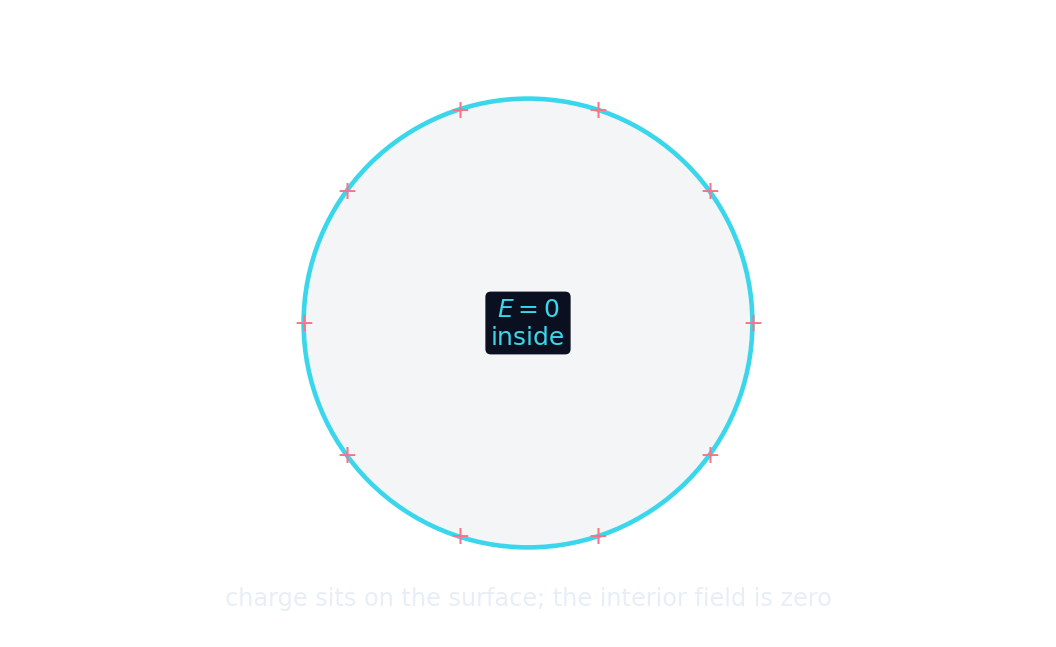
- Once charges settle (electrostatic equilibrium 静电平衡), the field inside a conductor is zero.
- If it weren't, the free charges would feel a force and keep moving — not settled.
- So $E = 0$ everywhere inside the metal.
- Any cavity inside is shielded too — that is a Faraday cage 法拉第笼.
平衡时内部没有场
- 一旦电荷安定下来(静电平衡),导体内部的场为零。
- 若不为零,自由电荷就会受力继续移动——那就没安定。
- 所以金属内部处处 $E = 0$。
- 里面的任何空腔也被屏蔽——这就是法拉第笼。
Inside a conductor in electrostatic equilibrium, the electric field is: · 在静电平衡下的导体内部,电场是:
If it were not zero, free charges would move — so at equilibrium $E = 0$ inside. · 如果不是零,自由电荷会移动——因此在平衡状态下,$E = 0$ 在内部为零。
A hollow conductor shields its inside from external fields (a Faraday cage). · 空心导体屏蔽其内部免受外部电场影响(法拉第笼)。
The conductor cancels the field inside the cavity — a Faraday cage. · 导体抵消了空腔内的电场——这是一个法拉第笼。
All charge lives on the surface
- Because the inside field is zero, no net charge can sit inside.
- Every bit of excess charge is pushed to the surface.
- Gauss's law confirms it: any interior Gaussian surface encloses zero charge.
- The charge spreads to make the whole conductor one potential.
所有电荷都住在表面
- 因为内部场为零,内部不能有净电荷。
- 每一点多余的电荷都被推到表面。
- 高斯定律证实了这点:内部任何高斯面所围电荷为零。
- 电荷铺展开,使整个导体成为一个电势。
Excess charge on a solid conductor sits: · 实心导体上的过剩电荷位于:
With zero interior field, all excess charge must lie on the surface. · 由于内部场强为零,所有过剩电荷必须位于表面。
The field just outside
- Just outside the surface, the field is perpendicular to it.
- A parallel field would push surface charges sideways — but they've stopped.
- Its size is $E = \dfrac{\sigma}{\varepsilon_0}$, set by the local surface charge density $\sigma$.
- Flat inside, purely perpendicular outside.
表面外侧的场
- 就在表面外侧,场垂直于表面。
- 平行的场会把表面电荷推向侧面——但它们已经停下了。
- 它的大小是 $E = \dfrac{\sigma}{\varepsilon_0}$,由当地面电荷密度 $\sigma$ 决定。
- 内部平坦,外部纯粹垂直。
A charged conductor at equilibrium · 处于平衡状态的带电导体
Sort each statement about a conductor in electrostatic equilibrium. · 对每个关于静电平衡下导体的陈述进行分类。
Just outside a conductor's surface, the field is ____ to the surface. · 在导体表面外侧紧邻处,电场方向与表面____。
A parallel component would move surface charges, so $E$ is perpendicular. · 平行分量会使表面电荷移动,因此 $E$ 是垂直的。
Select all · 所有 true statements about a conductor in equilibrium. · 选择关于平衡状态下导体的 所有 正确陈述。
Zero interior field, surface charge, single potential. Charge never fills the volume. · 内部场强为零,表面有电荷,单一电势。电荷从不填充体积。
Charge crowds at sharp points
- On a lumpy conductor, charge piles up where the surface curves sharply.
- Sharp points have the highest $\sigma$ and the strongest field.
- That is why lightning rods are pointed — the field there ionises the air first.
- Smooth, round shapes spread charge more evenly.
电荷聚集在尖点
- 在凹凸不平的导体上,电荷在表面急剧弯曲处堆积。
- 尖点处 $\sigma$ 最高,场最强。
- 这就是为什么避雷针是尖的——那里的场先把空气电离。
- 光滑的圆形使电荷分布得更均匀。
On a conductor, charge and field are strongest at: · 在导体上,电荷和电场在以下位置最强:
Charge crowds at sharp points, giving the highest $\sigma$ and field. · 电荷聚集在尖端,产生最高的 $\sigma$ 和电场。
You sit inside a metal cage as a charged rod touches the outside.
- The charge spreads over the cage's outer surface.
- Inside, $E = 0$, so you feel nothing — the cage shields you.
你坐在金属笼里,一根带电棒接触笼子外面。
- 电荷铺展在笼子的外表面上。
- 里面 $E = 0$,所以你什么也感觉不到——笼子屏蔽了你。
"$E = 0$ inside" holds only in electrostatic equilibrium — after the charges have settled. During the split-second of rearranging, fields inside are not zero. And it applies to the conductor's material, not to a charge you place in a hollow cavity.
"内部 $E = 0$"只在静电平衡时成立——在电荷安定之后。在重排的一刹那,内部的场并不为零。而且它针对导体的材料,不针对你放进空腔里的电荷。
In electrostatic equilibrium a conductor has $E = 0$ inside, so all excess charge sits on the surface and the whole conductor is one potential. Just outside, $E = \sigma/\varepsilon_0$ and is perpendicular to the surface; charge crowds at sharp points.
在静电平衡中,导体内部 $E = 0$,所以所有多余电荷都在表面,整个导体是一个电势。就在外侧,$E = \sigma/\varepsilon_0$ 且垂直于表面;电荷聚集在尖点。