Redistribution of Charge Between Conductors · 导体之间的电荷重新分布
| English | 中文 | Pinyin · 拼音 |
|---|---|---|
| grounding/ˈɡraʊndɪŋ/ | 接地 | jiē dì |
| surface charge density/ˈsɜːfɪs tʃɑːdʒ ˈdensɪti/ | 面电荷密度 | miàn diàn hè mì dù |
Connect a big sphere to a small one — who gets more charge?
- Join two charged conductors with a wire and charge suddenly flows.
- It keeps flowing until something between them is equal.
- That something is potential, not charge — a subtle but key point.
- Get this right and you understand grounding, sharing, and lightning rods.
把大球连到小球——谁得到更多电荷?
- 用导线把两个带电导体连起来,电荷会突然流动。
- 它一直流,直到它们之间的某个量相等。
- 那个量是电势,不是电荷——一个微妙但关键的点。
- 弄懂这点,你就理解了接地、分享和避雷针。
They end at the same potential
- Charge flows from high potential to low, just like water finding its level.
- It stops when both conductors sit at the same $V$.
- At that moment no potential difference remains to push charge.
- Equal potential — not equal charge — is the end state.
它们最终达到相同电势
- 电荷从高电势流向低电势,就像水自己找平面。
- 当两个导体处于相同的 $V$ 时它就停下。
- 那一刻不再有电势差来推动电荷。
- 相等的电势——不是相等的电荷——才是终态。
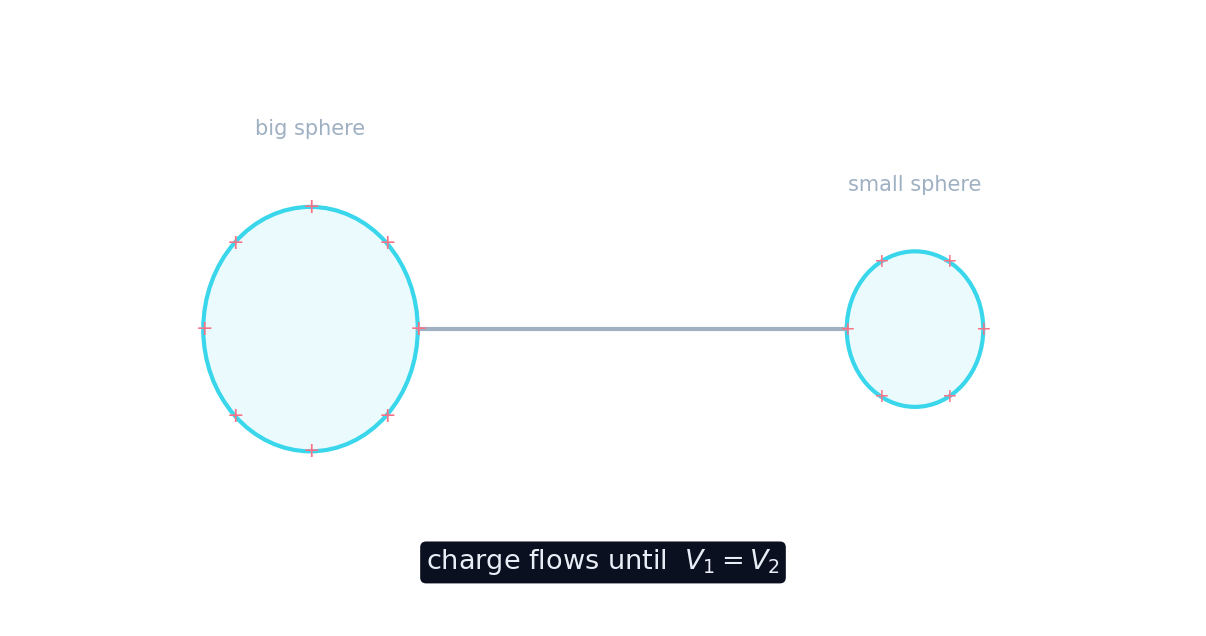
When two conductors are connected, charge flows until they have equal: · 当两个导体连接时,电荷流动直到它们具有相等的:
Charge flows until the potentials are equal — no push remains. · 电荷流动直到电势相等——不再有驱动力。
Bigger conductors hold more charge
- For a sphere, $V = \dfrac{kQ}{R}$, so equal $V$ means $Q \propto R$.
- The bigger sphere ends up with the larger share of charge.
- Double the radius and it holds double the charge at the same potential.
- Size sets how much charge a conductor can hold per volt.
更大的导体持有更多电荷
- 对球,$V = \dfrac{kQ}{R}$,所以相等的 $V$ 意味着 $Q \propto R$。
- 更大的球最终得到更大的电荷份额。
- 半径加倍,它在相同电势下持有双倍电荷。
- 大小决定一个导体每伏能持有多少电荷。
At equal potential, the larger sphere holds more charge ($Q \propto R$). · 在等电势时,较大的球体持有更多电荷($Q \propto R$)。
$V = kQ/R$ equal means $Q \propto R$ — bigger holds more. · $V = kQ/R$ 相等意味着 $Q \propto R$ —— 大的持有更多。
A radius-$3R$ sphere shares charge with a radius-$R$ sphere. The big one holds how many times the charge of the small one? · 一个半径为 $3R$ 的球体与一个半径为 $R$ 的球体共享电荷。大球体持有的电荷是小球体的多少倍?
$Q \propto R$, so the $3R$ sphere holds $3\times$ the charge. · $Q \propto R$,因此 $3R$ 球体持有 $3\times$ 倍的电荷。
But the small one has denser charge
- Surface charge density 面电荷密度 is $\sigma \propto \dfrac{1}{R}$ — higher on the smaller sphere.
- So the small, sharp conductor has the stronger surface field.
- That is the lightning-rod effect again: sharp $=$ dense $=$ strong field.
- Big total charge and high density live on different conductors.
但小球的电荷更密
- 面电荷密度 $\sigma \propto \dfrac{1}{R}$——在较小的球上更高。
- 所以又小又尖的导体有更强的表面场。
- 这又是避雷针效应:尖 $=$ 密 $=$ 强场。
- 大的总电荷和高的密度住在不同的导体上。
Sharing charge between conductors · 导体间的电荷分配
When two conductors are connected, charge flows until they reach the same potential. · 当两个导体连接时,电荷流动直到它们达到相同电势。
Which conductor has the higher surface charge density? · 哪个导体的表面电荷密度更高?
$\sigma \propto 1/R$, so the smaller conductor is denser. · $\sigma \propto 1/R$,因此较小导体的密度更高。
Select all · 所有 true statements about connected conductors. · 选择关于连接导体的 所有 正确陈述。
Equal potential, $Q \propto R$, $\sigma \propto 1/R$. The split is by size, not 50/50. · 等电势,$Q \propto R$,$\sigma \propto 1/R$。分配由大小决定,而非 50/50。
Grounding is sharing with the Earth
- Grounding 接地 connects a conductor to the enormous Earth.
- The Earth is so big it holds any charge at essentially $V = 0$.
- Charge flows until the conductor also reaches $V = 0$.
- That is how induction charging "drains" the unwanted sign.
接地就是与大地分享
- 接地把导体连到巨大的地球。
- 地球太大了,它把任何电荷都保持在基本上 $V = 0$。
- 电荷一直流,直到导体也达到 $V = 0$。
- 这就是感应起电如何"排掉"不需要的符号。
Grounding connects a conductor to the Earth, pulling it to a potential of ____. · 接地将导体连接到地球,使其电势变为 ____。
The Earth holds any charge at $V = 0$. · 地球接受任何处于 $V = 0$ 电势的电荷。
A sphere of radius $2R$ is joined to one of radius $R$, sharing charge.
- Equal potential: $Q \propto R$, so the big sphere holds twice the charge.
- But $\sigma \propto 1/R$, so the small sphere has the denser surface charge.
一个半径 $2R$ 的球连到一个半径 $R$ 的球,分享电荷。
- 相等电势:$Q \propto R$,所以大球持有两倍电荷。
- 但 $\sigma \propto 1/R$,所以小球有更密的表面电荷。
Connected conductors share to equal potential, not equal charge. Don't split the charge 50/50 — split it in proportion to size ($Q \propto R$ for spheres), and remember density runs the other way ($\sigma \propto 1/R$).
相连的导体分享到相等的电势,不是相等的电荷。别把电荷五五分——按大小成比例分($Q \propto R$ 对球),并记住密度走相反方向($\sigma \propto 1/R$)。
Connected conductors exchange charge until they reach the same potential. For spheres, $Q \propto R$ (the bigger holds more), while surface density $\sigma \propto 1/R$ (the smaller is denser). Grounding shares with the Earth, pulling a conductor to $V = 0$.
相连的导体交换电荷,直到达到相同电势。对球,$Q \propto R$(大的持有更多),而面密度 $\sigma \propto 1/R$(小的更密)。接地是与大地分享,把导体拉到 $V = 0$。